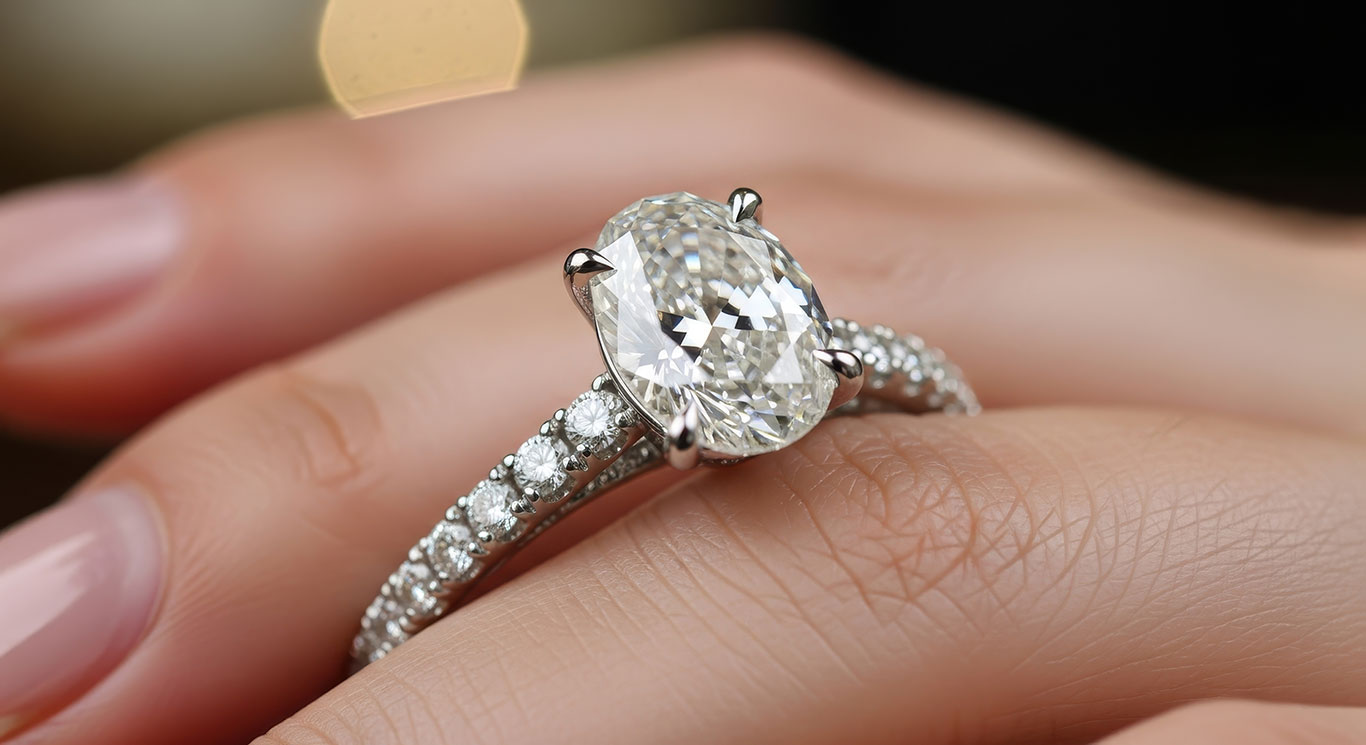
The oval diamond has surged in popularity over the past decade, becoming one of the most sought-after shapes for engagement rings. Its elongated silhouette flatters the finger, faces up larger than a round diamond of the same carat weight, and offers brilliant-cut sparkle at a lower price per carat.
Why Oval Diamonds Are Trending
Oval diamonds offer the brilliance of a round cut in a more distinctive, finger-flattering shape. Their elongated form creates the illusion of greater size — a 1-carat oval typically appears 10 to 15 percent larger than a 1-carat round when viewed from above. This makes ovals an excellent choice for buyers who want maximum visual impact.
Ideal Proportions
| Parameter | Ideal Range |
|---|
| Length-to-Width Ratio | 1.35 – 1.50 (classic) |
| Table % | 53% – 63% |
| Depth % | 58% – 62% |
A ratio of 1.35 to 1.50 is considered the classic oval proportion — elongated enough to flatter the finger while maintaining beautiful symmetry. Ratios closer to 1.30 appear rounder, while ratios above 1.55 look quite elongated.
The Bow-Tie Effect
Nearly all oval diamonds exhibit some degree of "bow-tie" — a dark shadow across the center of the stone that resembles a bow tie. A slight bow-tie is normal and acceptable. A strong, distracting bow-tie significantly reduces the diamond's beauty. Since bow-tie severity is not noted on grading reports, you should always view the diamond (or a high-quality photograph/video) before purchasing.
Best Settings for Ovals
Oval diamonds look stunning in solitaire settings, halo settings, and three-stone configurations. The elongated shape pairs beautifully with thin, delicate bands that accentuate the stone's elegant proportions.