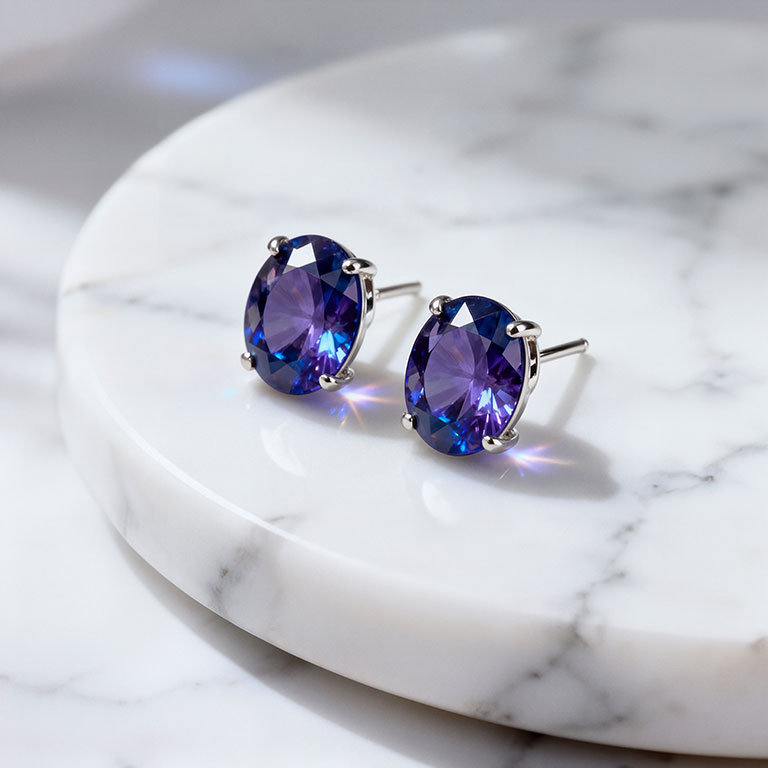
Tanzanite
| Property | Details |
|---|
| Mineral | Zoisite |
| Mohs Hardness | 6 – 7 |
| Refractive Index | 1.691 – 1.700 |
| Birthstone | December (alternative) |
| Anniversary | 24th |
| Major Sources | Tanzania (the only source worldwide) |
| Treatments | Heat treatment (virtually universal, permanent) |
Overview
Tanzanite is a vivid blue-violet variety of the mineral zoisite, found in only one place on earth: the Merelani Hills of northern Tanzania, near Mount Kilimanjaro. Discovered in 1967, tanzanite quickly became one of the most popular colored gemstones due to its intense, saturated color that shifts between blue and violet depending on viewing angle and lighting.
History & Significance
Tanzanite was named by Tiffany & Co., who recognized its potential as a major new gemstone. Its single-source origin makes it approximately 1,000 times rarer than diamond by volume of deposit. Geologists estimate that the Merelani deposit is a one-time geological event, meaning once it's mined out, there will never be another source. This finite supply gives tanzanite potential as a collectible gem that may appreciate in value over time.
Color & Quality Factors
The finest tanzanite is a deep, vivid blue with violet overtones in a medium-dark tone. Stones that are too light appear washed-out, while those that are too dark lose their violet flash. Tanzanite displays pleochroism, showing different colors (blue, violet, and burgundy) from different viewing angles. Virtually all commercial tanzanite is heat-treated to develop its blue-violet color from the brownish-yellow of the natural crystals; this treatment is permanent and universally accepted. Clarity should be eye-clean—clean stones are the standard for tanzanite.
Care & Cleaning
Tanzanite ranks 6 to 7 on the Mohs scale—suitable for earrings and pendants but requires a protective setting for rings. Clean with warm soapy water only. Avoid ultrasonic cleaners, steam cleaners, sudden temperature changes, and hard impacts. Tanzanite should be treated with the same care as emerald.
Shop Tanzanite Jewelry
Browse our collection of tanzanite jewelry including rings, earrings, and pendants featuring natural tanzanite set in white gold and platinum.
Frequently Asked Questions
Why is tanzanite found in only one place?
Tanzanite formed under an extremely unusual set of geological conditions in the Merelani Hills of Tanzania. The combination of specific minerals, pressure, temperature, and the presence of vanadium required to form tanzanite is so rare that geologists consider it a one-time geological event. The mining area is approximately 7 kilometers long and 2 kilometers wide. No other deposit has been found anywhere in the world, making tanzanite one of the rarest gemstones by geographic origin.
Is tanzanite a good investment?
Tanzanite's finite, single-source supply has led some to consider it an investment gem. The deposit will eventually be exhausted, and no new sources are expected to be found. Prices for fine tanzanite have generally increased over the decades. However, like all gemstone investments, there are risks: market demand can fluctuate, and synthetic or imitation materials could affect prices. Fine-quality tanzanite over 5 carats with vivid blue-violet color is the most collectible.
Is all tanzanite heat-treated?
Virtually all commercial tanzanite has been heat-treated to transform its natural brownish-yellow or brownish-violet color into the vivid blue-violet color consumers expect. This treatment is permanent, stable, and universally accepted in the gem industry. Rare naturally blue tanzanite does exist but commands a significant premium among collectors. The heat treatment is considered so standard that many in the trade view it as a natural continuation of the geological process.
Can tanzanite be worn in an engagement ring?
Tanzanite can be used in an engagement ring with some caveats. At 6 to 7 on the Mohs scale, it is softer than sapphire and more susceptible to scratching and chipping during daily wear. Choose a protective setting such as a bezel or halo, and remove the ring during physical activities, cleaning, and sports. Many tanzanite engagement ring owners have a second, more durable ring for active days. With careful handling, a tanzanite ring can provide years of enjoyment.
What size tanzanite is best for jewelry?
Tanzanite's color intensity increases with size. Stones under 1 carat often appear lighter and less saturated, while stones of 2 carats and above display the rich, vivid blue-violet color that tanzanite is famous for. For the best visual impact, consider a tanzanite of at least 1.5 to 2 carats for rings and pendants. Larger stones of 5 carats and above are more collectible and display the most impressive color saturation.
Specialty & Collector Gemstones