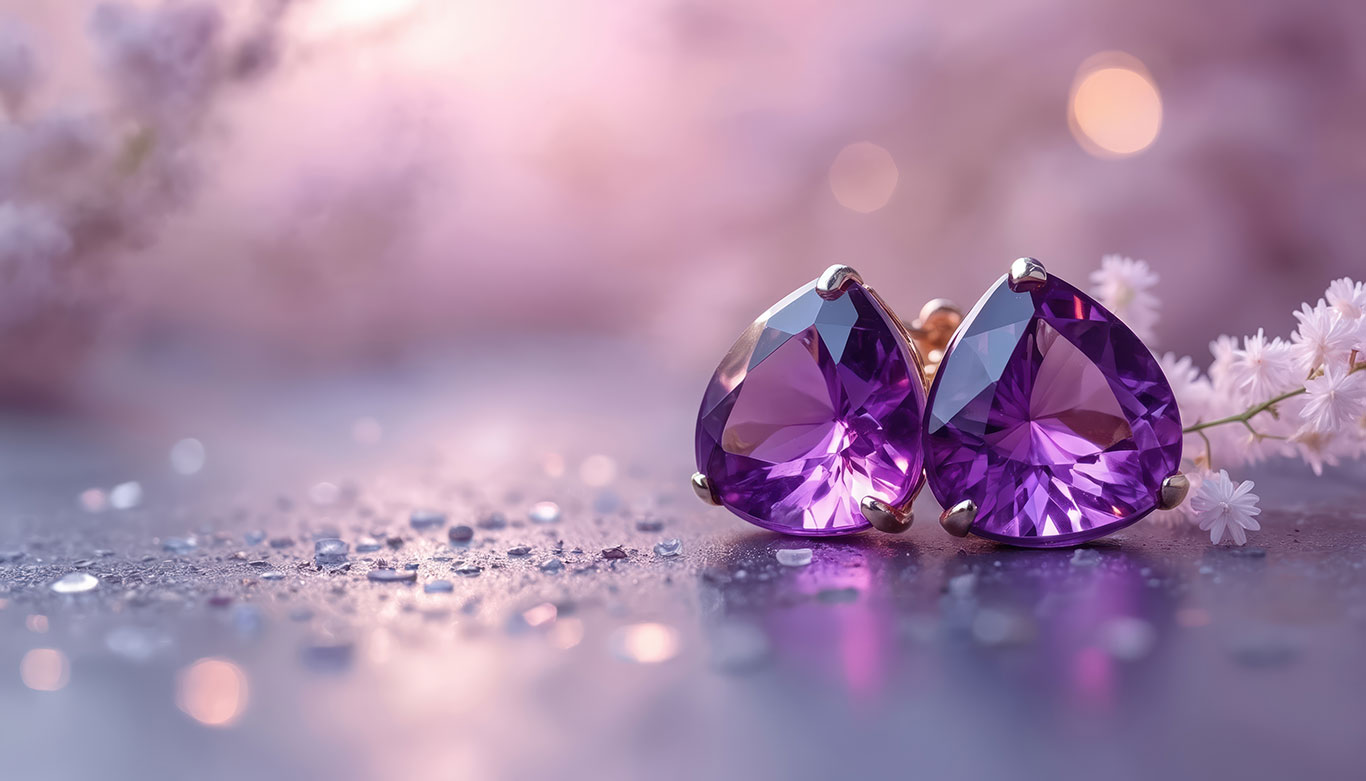
Amethyst
| Property | Details |
|---|
| Mineral | Quartz |
| Mohs Hardness | 7 |
| Refractive Index | 1.544 – 1.553 |
| Birthstone | February |
| Anniversary | 6th |
| Major Sources | Brazil, Zambia, Uruguay, South Korea |
| Treatments | Generally untreated; heat treatment to produce citrine |
Overview
Amethyst is the purple variety of quartz and one of the most popular and affordable colored gemstones. Colors range from a light, pinkish lavender to a deep, saturated royal purple, with the most valued shade being a rich, medium-dark purple with red flashes. Once considered as precious as diamond and sapphire, amethyst became widely available after large deposits were discovered in Brazil.
History & Lore
The name comes from the Greek amethystos, meaning not intoxicated. Ancient Greeks and Romans believed amethyst could prevent drunkenness and keep the wearer clear-headed. English regalia were decorated with amethysts during the Middle Ages to symbolize royalty. Catherine the Great of Russia had a passion for amethyst and sent thousands of miners to the Ural Mountains in search of fine specimens. Bishops traditionally wore amethyst rings, making it the bishop's stone.
Color & Varieties
The most prized shade is a rich, medium-dark purple with flashes of red, sometimes called Siberian amethyst after the now-depleted Russian mines that once produced the finest specimens. Rose de France amethyst features a delicate, pastel lavender that has become popular in modern jewelry. Ametrine, a naturally occurring combination of amethyst and citrine, displays zones of both purple and golden yellow in a single stone.
Quality & Value Factors
Color intensity is the primary value factor. Deep, saturated purple with red or blue secondary hues is most valuable. Clarity is expected to be excellent—eye-clean stones are the standard. Cut quality affects how well the stone displays its color. Amethyst is readily available in large sizes, so size alone does not dramatically increase per-carat value as it does with rarer gems.
Care & Cleaning
With a hardness of 7, amethyst is durable enough for everyday jewelry. It can be cleaned with warm soapy water or an ultrasonic cleaner. However, prolonged exposure to strong sunlight can cause the color to fade over time, so store amethyst away from direct light when not being worn.
Shop Amethyst Jewelry
Browse our collection of gemstone jewelry including amethyst rings, earrings, and pendants.
Frequently Asked Questions
Does amethyst fade in sunlight?
Yes, prolonged exposure to direct, intense sunlight can cause amethyst to fade over time. The purple color in amethyst is caused by irradiation of iron impurities, and UV light can gradually reverse this process. To preserve the color, store amethyst jewelry away from windows and avoid leaving it in direct sunlight for extended periods. Normal everyday wear and incidental sun exposure will not cause noticeable fading.
What is Siberian amethyst?
Siberian amethyst refers to the finest grade of amethyst color: a deep, saturated purple with flashes of red and blue. The term originated from the now-depleted mines in Siberia, Russia, which once produced the world's finest amethyst. Today, the term is used as a color grade rather than an origin designation, and amethyst of this quality can come from any source, including Brazil, Zambia, and Uruguay.
Why was amethyst once considered as precious as diamond?
Until the 18th century, amethyst was extremely rare and reserved for royalty and clergy. Its purple color was associated with power and divinity. The discovery of enormous amethyst deposits in Brazil dramatically increased supply and made the gemstone affordable to the general public. Despite its lower price today, fine amethyst remains a beautiful and popular gemstone with thousands of years of history.
Is amethyst durable enough for an engagement ring?
Amethyst ranks 7 on the Mohs hardness scale, which makes it reasonably durable for rings but less scratch-resistant than sapphire (9) or diamond (10). It can work as an engagement ring if you choose a protective setting and are mindful about removing it during heavy physical activities. For a similar purple color with greater durability, consider a purple sapphire.
What is the difference between amethyst and ametrine?
Amethyst is a uniformly purple variety of quartz, while ametrine is a bicolor quartz that displays both amethyst purple and citrine gold in a single crystal. Ametrine forms when different temperature conditions exist across zones within the same crystal during growth. Nearly all natural ametrine comes from the Anahi mine in Bolivia. Both gemstones share the same hardness and durability.
Specialty & Collector Gemstones