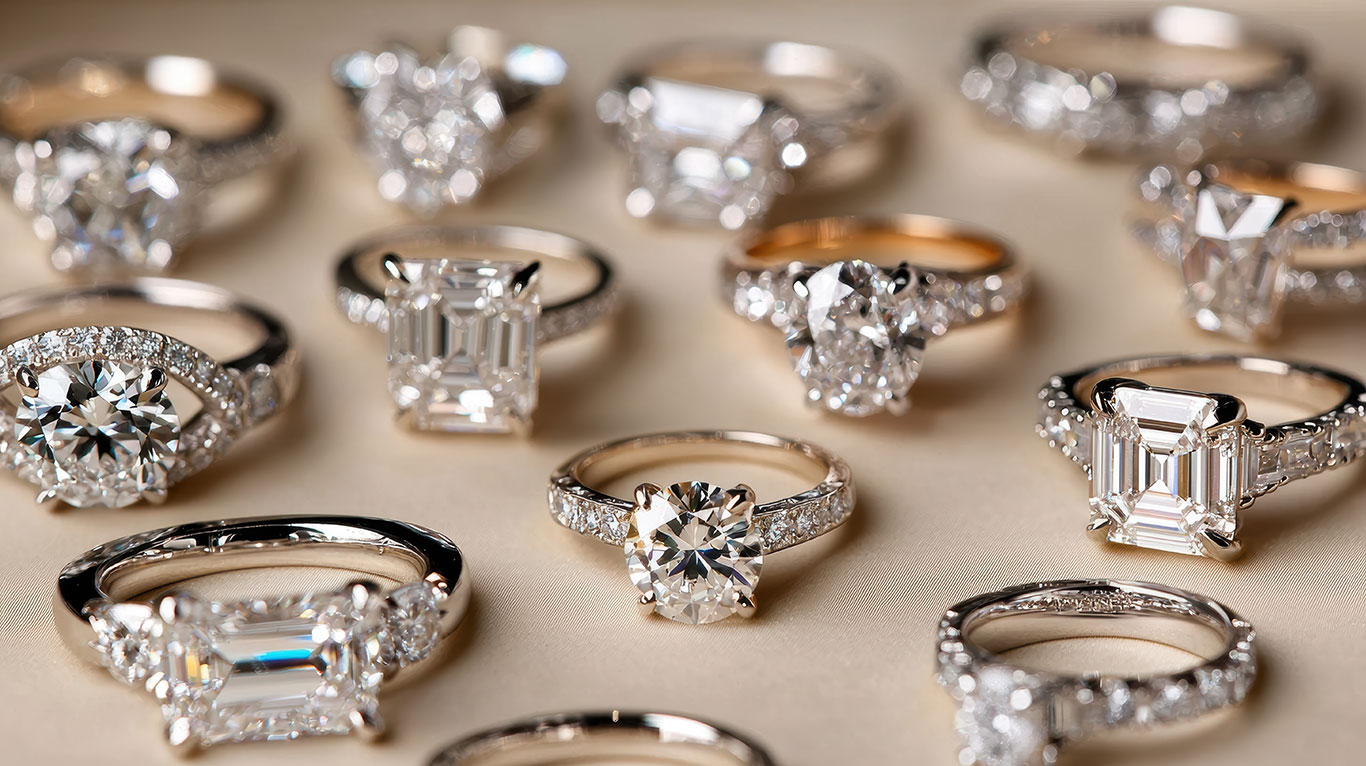
Choosing an engagement ring is one of life's most meaningful decisions. It is a symbol of your commitment, a reflection of your partner's personality, and — let's be honest — a significant investment. Whether you are just starting your research or narrowing down your final options, this guide will walk you through everything you need to know to find a ring your partner will absolutely love.
The good news is that choosing an engagement ring does not have to be stressful. Once you understand the key decisions involved, the process becomes exciting and even fun. Let's break it all down.
The Four Key Decisions
Every engagement ring comes down to four fundamental choices. You do not have to make them in any particular order, and each one influences the others:
1. The Diamond (or Center Stone)
The center stone is typically the most expensive component and the visual focal point of the ring. Most engagement rings feature a diamond, evaluated by the 4Cs: Cut, Color, Clarity, and Carat Weight. Of these, cut quality has the biggest impact on how beautiful the diamond looks — a well-cut diamond sparkles brilliantly, while a poorly cut stone appears dull regardless of its other qualities.
You will also need to decide between a natural diamond and a lab-grown diamond. Both are real diamonds with identical physical properties, but lab-grown options cost 60 to 85 percent less. Our lab vs. natural comparison can help you decide.
2. The Setting Style
The setting is the design of the ring itself — how the diamond is held and what the band looks like. Popular styles include solitaire (a single center stone), halo (center stone surrounded by smaller diamonds), three-stone (center stone flanked by two side stones), and vintage-inspired designs with intricate details. Explore all the options in our styles guide.
3. The Metal
The metal you choose affects both the look and durability of the ring. Platinum is the most durable and hypoallergenic, with a naturally white color that never fades. White gold offers a similar look at a lower price point but requires periodic rhodium replating. Yellow gold provides a classic, warm aesthetic, and rose gold has become increasingly popular for its romantic blush tone. For a full comparison, see our metals guide.
4. The Budget
There is no "right" amount to spend on an engagement ring. The old "two months' salary" rule was invented by a diamond marketing campaign in the 1980s — it has no basis in reality. What matters is finding a ring that is beautiful, meaningful, and financially comfortable. Our budget guide shares practical strategies for maximizing your ring at any price point.
Popular Engagement Ring Styles
Engagement ring styles have evolved dramatically over the decades, and today there are more beautiful options than ever. Here is a quick overview of the most popular styles:
Solitaire: The most timeless and popular style. A single diamond takes center stage on a simple band. The beauty is in the simplicity — nothing competes with the diamond for attention. Solitaires account for roughly 35 to 40 percent of all engagement ring purchases.
Halo: A center diamond surrounded by a "halo" of smaller diamonds that makes the center stone appear 10 to 15 percent larger and significantly more brilliant. Halos are an excellent way to maximize sparkle and perceived size on a budget.
Three-Stone: Three diamonds representing the past, present, and future of your relationship. The center stone is typically larger, flanked by two smaller stones. This style offers more visual interest than a solitaire while carrying beautiful symbolism.
Side-Stone: A center diamond accented by smaller diamonds along the band. This includes pave (tiny diamonds set into the band), channel-set (diamonds set in a groove), and other accent styles. Side stones add sparkle from every angle.
Vintage-Inspired: Rings that draw from historical design periods including Art Deco, Victorian, and Edwardian eras. These feature details like milgrain edging, filigree, scrollwork, and intricate metalwork that give the ring romantic character.
Modern/Contemporary: Clean lines, geometric shapes, split shanks, and unique design elements that break from tradition. These rings appeal to those who want something fashion-forward and distinctive.
How to Determine Ring Size Secretly
If you are planning a surprise proposal, figuring out ring size without giving away the secret can be tricky. Here are the most reliable methods:
- Borrow a ring: Take a ring your partner wears on their ring finger (make sure it is the right finger) and bring it to a jeweler for sizing, or trace the inside on paper.
- Ask friends or family: Your partner's close friends, mother, or siblings may know their ring size or be willing to help you find out discreetly.
- Use a ring they already own: Slip it onto your own finger and mark how far it goes, then have a jeweler measure that spot.
- Estimate based on their build: Average ring size for women is 6 to 6.5, and for men is 10 to 10.5. If your partner has slender fingers, try a size 5 to 5.5; if they have larger hands, try 7 to 7.5.
If you guess wrong, don't worry — most rings can be resized after the proposal. It is better to err slightly larger (easier to size down) than too small. Check our ring size guide for detailed measurements.
Online vs. In-Store Shopping
Both options have advantages. Online jewelers like USA Jewels typically offer 20 to 40 percent lower prices than traditional stores because of lower overhead costs. You also have access to a much larger selection and can compare options easily from the comfort of your home.
In-store shopping lets you see and try rings in person, which some buyers prefer. The ideal approach is often a hybrid: research and compare options online, then purchase from a trusted online retailer that offers a generous return policy so you can evaluate the ring in person.
Why Shop at USA Jewels
At USA Jewels, we combine the value of online shopping with the expertise and service you deserve. Our engagement ring collection features a stunning range of styles, and our Design Your Own Ring tool lets you customize every detail — diamond, setting, and metal — to create something truly unique.
Every engagement ring comes with free shipping, a 30-day return policy, lifetime warranty, and independent diamond certification. Our expert team is available to answer your questions and help you find the perfect ring at the perfect price.
Shop Certified Diamonds
Browse thousands of GIA, IGI, and HRD certified diamonds with 360° video.