Scratch Resistant Metals: Choose a Ring You Can Repair
Tungsten carbide, hard PVD or DLC coatings over titanium, and dense platinum alloys resist surface scratches better than most jewelry metals on the market today. The catch is that the hardest materials are not always the toughest: a few trade brittleness for scratch resistance, and coatings wear down over years of daily contact. The sections below walk through the shortlist, the hardness versus toughness question, and the practical choices that matter most once you are shopping for a ring you plan to wear every day.
TL;DR:
- Tungsten carbide rates around 8 to 9 on the Mohs scale, but impact can fracture it, and traditional resizing is difficult or impossible.
- In wear testing, platinum alloys showed two to three times less volume loss than tested gold alloys, and jewelers can usually resize platinum rings.
- PVD, nitride, and DLC finishes add surface hardness, but wear through with contact; ask about the base metal, reapplication costs, and refinishing options.
- Bezel, channel, and flush settings protect stones and edges, often more effectively than choosing a harder alloy alone, especially for active wear.
- White gold usually needs rhodium replating every year or two, while platinum develops a patina that owners can leave or have polished.
Table of Contents
- Shortlist: Scratch-Resistant Metals and Surface Treatments and Why They Perform
- Hardness Versus Toughness: How Labs Measure Wear and What It Means for Jewelry
- Coatings and Surface Treatments That Improve Scratch Resistance: Benefits, Limits, and Buyer Questions
- How to Pick a Scratch-Resistant Metal for Jewelry: Lifestyle, Settings, Resizing, and Upkeep
- How USA Jewels Helps You Choose Durable Metals and Finishes
- Impact of Metal Alloys and Purity Levels on Scratch Resistance
- Environmental Factors Affecting Scratch Resistance: Chemicals, Sweat, and UV Light
- Tips for Caring for Scratch-Resistant Metals to Maximize Their Lifespan
- Balancing Appearance, Longevity, and Repairability
- Design a Durable Ring with USA Jewels
- FAQ
- Sources
Shortlist: Scratch-Resistant Metals and Surface Treatments and Why They Perform
Every metal on a jewelry counter resists scratches to some degree, but a handful stand out for surface hardness specifically.
- Tungsten carbide sits near the top of the Mohs scale, around 8 to 9, which means it shrugs off the daily scuffs that dull gold or silver, though it can fracture if struck hard enough, and emergency removal of a tungsten carbide ring sometimes requires special cutting methods because of the brittleness involved, as clinical case reports on tungsten carbide ring removal describe.
- Titanium is lightweight and naturally corrosion resistant; on its own it scratches more easily than carbide, but adding a titanium nitride or diamond-like carbon coating raises its surface hardness noticeably, a point we cover in our guide to titanium rings.
- Platinum alloys wear differently than people expect. Wear testing comparing platinum and gold alloys found platinum showing volume loss two to three times lower than the gold alloys tested, which makes platinum a durable, repairable choice even though it is not the hardest metal on this list.
- Cobalt chrome and hardened stainless steel variants are common in wedding bands because they balance decent scratch resistance with lower cost and easier everyday wear.
- Tantalum offers outstanding resistance to corrosion in harsh chemical environments, as documented in tantalum alloy material data, though that corrosion resistance is a separate property from scratch hardness and should not be confused with it.
- Coatings such as PVD, nitride layers, and ceramic or DLC finishes add a hard outer shell to a softer base metal, extending the look of scratch resistance without the brittleness risk of a solid tungsten piece. Our tungsten ring guide goes deeper into how these pieces hold up day to day.
Hardness Versus Toughness: How Labs Measure Wear and What It Means for Jewelry
Hardness measures resistance to scratching or indentation. Toughness measures resistance to cracking or chipping under impact. A metal can score high on one and low on the other, and that gap explains a lot of ring-counter confusion.
Tungsten carbide rings are made from tungsten carbide grains held together by a metal binder, usually cobalt. Mechanical studies on WC-Co microstructures show that shrinking the carbide grain size raises hardness, but that same change often lowers toughness, so manufacturers tune grain size and binder content to land on a particular balance rather than maximizing either property alone.
This is also why a softer alloy sometimes outlasts a harder one in daily wear. Research summarized in GIA’s guidance on ring materials and lifestyle notes that some softer alloys display lower mass loss over time because they wear through micro-ploughing, where metal gets pushed aside and stays on the surface, rather than micro-cutting, where it chips away entirely. A hardness rating alone will not tell you which failure mode you are more likely to live with.
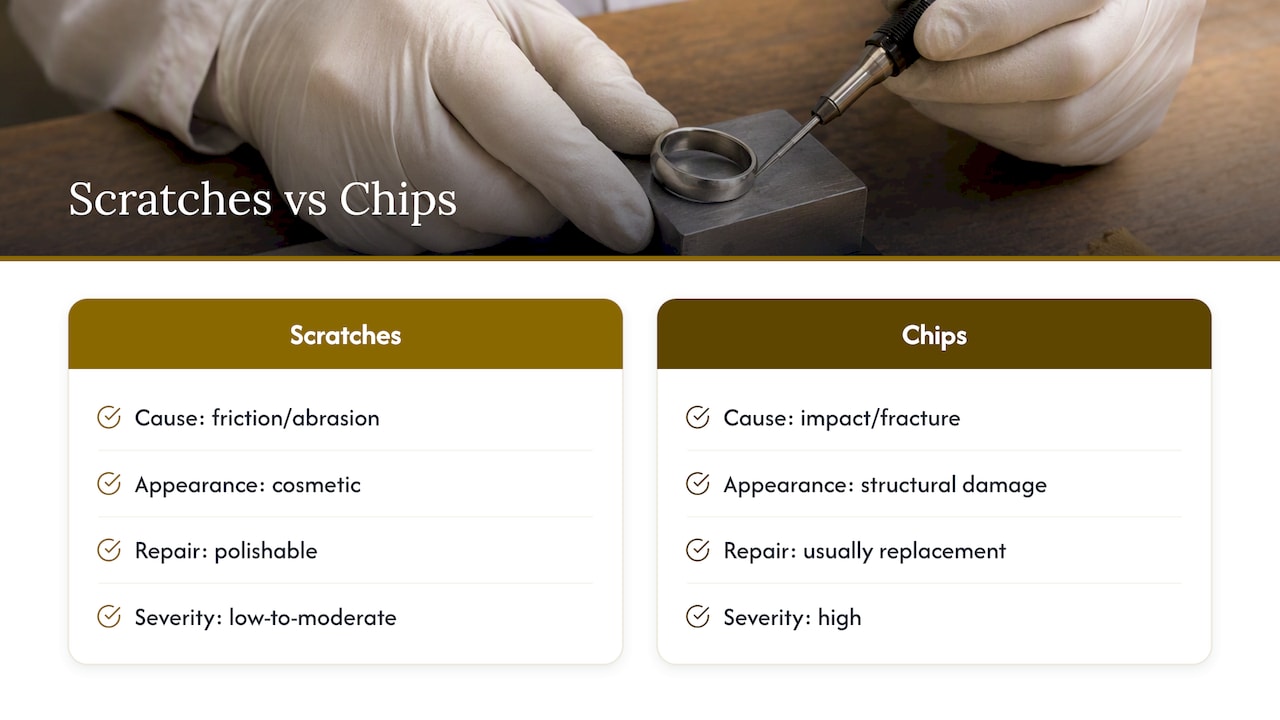
For jewelry, the practical risk breaks into two categories: visible surface scratches, which are cosmetic and often polishable, and chips or fractures, which usually mean replacement. Choosing a metal means choosing which risk you would rather manage.
Coatings and Surface Treatments That Improve Scratch Resistance: Benefits, Limits, and Buyer Questions
PVD and nitride coatings bond a thin, hard layer onto a softer metal, which is how titanium or stainless steel pieces take on gold, black, or graphite finishes while gaining real scratch resistance at the surface. DLC coatings work on a similar principle with an even denser carbon structure.
Industrial research backs up the concept at a larger scale. Laser-formed W-Cr/WC composite coatings tested in a wear resistance study showed that increased tungsten carbide content improved wear resistance, though it also reduced corrosion resistance, a trade-off that echoes what jewelry coatings face on a smaller scale.
Coatings are not permanent. They thin with repeated contact, and once worn through, the base metal underneath is what you are actually wearing. Before buying a coated piece, it helps to ask:
- What coating type is used, and is the base metal solid or plated underneath?
- How long does the finish typically last before it needs reapplication?
- Can the piece be refinished or recoated, and at what cost?
- Is the base alloy itself soft enough that scratches will show once the coating wears away?
U.S. jewelry-marking rules under 16 CFR §23.6 require sellers to disclose when platinum-group metal names are used in ways that could mislead buyers about purity or plating, so a straightforward answer to these questions is not optional, it is expected.
How to Pick a Scratch-Resistant Metal for Jewelry: Lifestyle, Settings, Resizing, and Upkeep
Choosing the right metal starts with how you actually live, not with which material tops a hardness chart.
- Ask yourself whether your hands see regular contact with tools, sports equipment, or heavy manual work, since that changes which trade-offs matter most.
- Consider the setting before the metal: GIA’s lifestyle guidance points out that bezel, channel, and flush settings protect stones and edges even on softer metals, often more effectively than switching to a harder alloy alone.
- Factor in future resizing. Tungsten carbide and some heavily coated pieces are difficult or impossible to resize using traditional methods, while platinum and gold alloys can usually be resized by a jeweler.
- Build in maintenance from the start. White gold typically needs rhodium replating every year or two to keep its bright finish, while platinum develops a soft patina that many wearers choose to leave alone or have professionally polished.
Our settings guide breaks down which setting styles protect stones best for active wearers.
Pro Tip: If you are torn between two metals, pick based on which failure mode you would rather deal with: a scratch you can polish out, or a chip that needs a full repair.
How USA Jewels Helps You Choose Durable Metals and Finishes
We build pieces in solid alloy construction rather than hollow or plated shells, and we tell you plainly which one you are getting. When you work with us on a design, we talk through how your metal, setting, and finish choices match your lifestyle, and we disclose coating type and base alloy before you commit. We provide resizing guidance, warranty, and a diamond upgrade program, so durability decisions never feel permanent or risky.
Impact of Metal Alloys and Purity Levels on Scratch Resistance
Gold in its pure form, 24k, is soft enough to dent with a fingernail, which is why jewelry gold is always alloyed with harder metals like copper, silver, or palladium. The purity level you choose changes how that ring wears.
Lower karat gold alloys generally contain more alloying metals, making them harder and more scratch resistant on the surface, while higher karat golds have richer color but tend to be softer and show fine scratches more readily over years of wear.
This is one reason platinum rings, though platinum itself is a relatively soft precious metal, often get alloyed with metals like iridium or ruthenium to improve durability for jewelry use. The wear testing on platinum versus gold alloys mentioned earlier found platinum alloys showing meaningfully lower volume loss, which lines up with how platinum settings tend to hold prongs and edges over decades rather than needing frequent reinforcement.
When you are comparing purity levels, think about what you are optimizing for. A 14k band built for daily heavy use will likely show fewer visible marks over time than an 18k version of the same design, while 18k keeps a deeper color that some wearers consider worth the extra care.
Environmental Factors Affecting Scratch Resistance: Chemicals, Sweat, and UV Light
Scratch resistance is not purely a mechanical property. Chemical exposure changes how a metal’s surface behaves long before a hard object ever touches it.
Chlorine is one of the more aggressive everyday exposures a ring faces, since it can weaken the structure of gold alloys over repeated contact, making the surface more prone to pitting and, eventually, more vulnerable to scratching. Household cleaning products and lotions with abrasive particles can have a similar, if gentler, effect by slowly degrading a polished surface.
Sweat is mildly acidic and, over years of contact, can dull a finish or accelerate tarnishing on metals like sterling silver, which then makes the surface softer and easier to mark. Platinum and titanium resist this kind of chemical wear better than silver or lower-karat gold, which is part of why they hold a polished look longer in daily wear.
UV light itself does not meaningfully affect metal hardness, but it can affect certain gemstone colors and, indirectly, change how wear on the surrounding metal becomes visible. The practical takeaway is simple: removing rings before swimming, cleaning, or heavy manual work protects the surface regardless of which metal you chose, which is exactly the kind of lifestyle-first thinking GIA recommends in its ring care guidance.
Tips for Caring for Scratch-Resistant Metals to Maximize Their Lifespan
Even the most scratch-resistant metal benefits from a few habits that have nothing to do with the alloy itself.
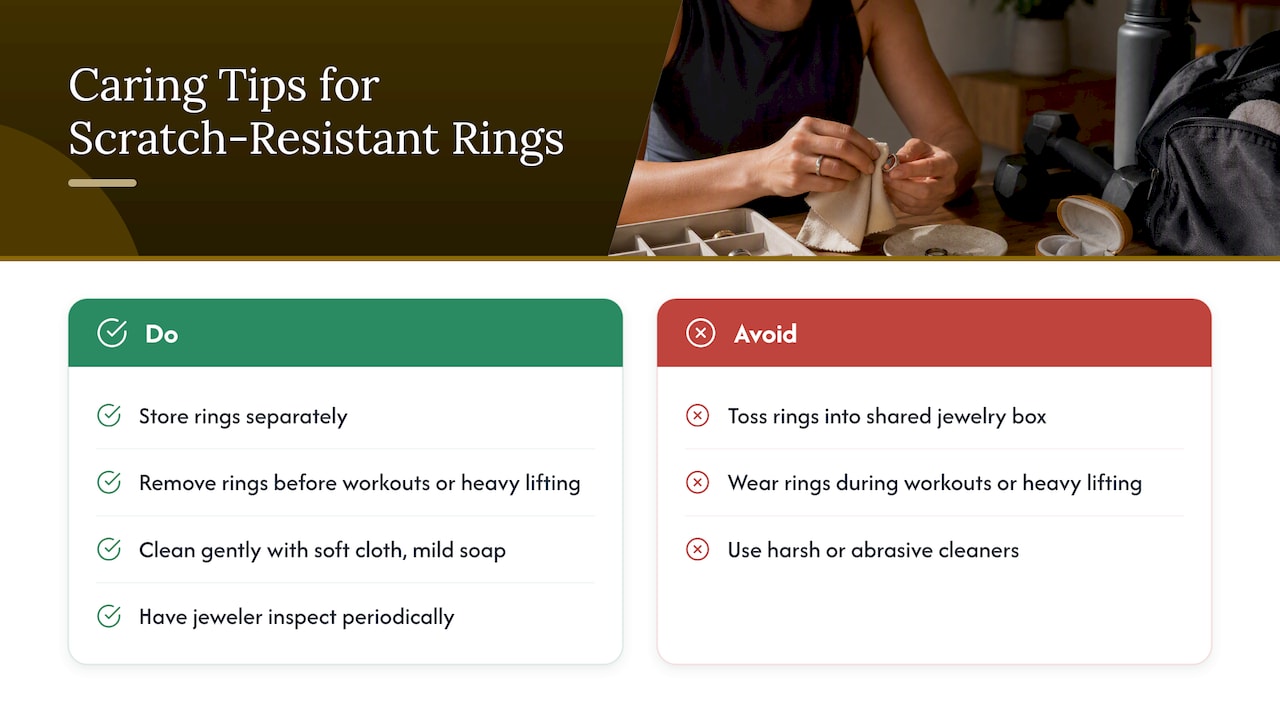
Store rings separately rather than tossing them in a jewelry box where they bump against other pieces. A soft-lined compartment or individual pouch prevents metal-on-metal contact, which is a common source of fine surface scratches that have nothing to do with the metal’s actual hardness.
Avoid impact more than you avoid scratches. A hard surface, like tungsten carbide, resists everyday scuffing but can still fracture if struck directly against concrete or metal tools, so removing rings before workouts, yard work, or heavy lifting protects against the failure mode that actually matters for brittle materials.
Clean gently and regularly. A soft cloth and mild soap remove the grit and residue that cause micro-scratches over time, and professional cleaning once or twice a year catches buildup that home care misses. For gold and silver hallmark questions, resources like this guide to gold hallmarks explain how purity stamps work, which is useful context when you are assessing an older piece’s construction before deciding how to care for it.
Finally, get pieces inspected periodically. A jeweler can spot loosening prongs, thinning coatings, or early wear before they turn into bigger problems, which costs far less than a full repair later.
Balancing Appearance, Longevity, and Repairability
We would rather see you choose a protective setting paired with a metal whose failure mode you can live with than chase the single hardest material on the shelf. Extreme hardness makes sense for a simple band with no stones; repairable precious metals make more sense for a piece you want passed down.
— Joseph
Design a Durable Ring with USA Jewels
We build every piece in solid alloy construction, not hollow or plated, and we tell you what metal and finish you are getting before you commit. Our Platinum Jewelry collection and design-your-own engagement rings both start with a real conversation about your lifestyle.
During a consultation, you can ask about solid versus plated construction, coating type, resizing policy, and warranty coverage. We are happy to discuss these details with you to help you choose a durable piece built to last.
FAQ
What metal is most scratch resistant?
Tungsten carbide is generally considered the most scratch-resistant jewelry metal, with surface hardness around 8 to 9 on the Mohs scale, though it can fracture under impact rather than bend or dent like softer metals.
What metal will never rust?
Platinum and titanium both resist corrosion extremely well due to their chemical stability, and tantalum shows outstanding resistance to aqueous and acidic environments. No common jewelry metal is entirely immune to all forms of chemical change over decades, but these three come closest for everyday wear.
What metal is 30 times rarer than gold?
Platinum is often cited as significantly rarer than gold, which is part of why it carries a premium price despite being a softer metal than tungsten or titanium. Its rarity relates to extraction difficulty rather than scratch resistance, so a higher price does not automatically mean a harder surface.
What metal will last 1000 years?
Gold is famous for resisting tarnish and corrosion over extremely long timescales, which is why ancient gold artifacts still show their original color today. Durability over centuries is mostly about corrosion resistance rather than scratch resistance, and a pure gold object would still show surface wear from handling over time.
How can I tell if a ring is solid metal or just plated?
U.S. jewelry-marking rules under 16 CFR §23.6 require sellers to disclose when platinum-group names are used in ways that could mislead buyers about purity or plating. Asking directly about construction, and requesting any hallmark or stamp information, is the most reliable way to confirm what you are buying.
Sources
- Best Ring Material for Everyday Wear | GIA 4Cs blog
- Properties of Tungsten Carbide Rings When Compressed to Failure or Cut with a Diamond Grinding Bit (PMC)
- Mechanical evaluation of WC-Co materials with varying microstructures (OSTI)
- 16 CFR § 23.6 – Misuse of the words ‘platinum’… | e-CFR
Recommended
- Platinum vs Gold Engagement Rings: Pick by Priority
- Engagement Ring Metal Types: Your 2026 Buying Guide
- Finish Your Engagement Ring in 4–8 Weeks Without Retail Markup

Deep Mehta is the Co-Owner of USA Jewels, a family-owned jewelry business she has led since 2013 in Deerfield Beach, Florida. With over 13 years of hands-on experience in fine jewelry retail, manufacturing, and diamond importing, Deep specializes in engagement rings, wedding bands, and custom jewelry design. She also co-manages Kaash Group Talent Acquisition. Deep is a University of Florida graduate and oversees every aspect of USA Jewels’ operations, from product development to marketing.
Fine Jewelry Collection

You May Also Like
How to Measure Ring Size Accurately at Home
Jewelry Certification Types Guide: What U.S. Buyers Need