How to Measure Ring Size Accurately at Home
Measure, convert your number to a US size using a standard chart, and verify once with a jeweler if the ring is expensive or the fit is uncertain. Most at-home methods land you within about a quarter size of your true fit, which is close enough for most purchases but worth double-checking on a big-ticket ring.
Here’s your three-step plan:
- Measure your finger with a plastic sizer, string, or printable chart at the end of the day.
- Convert the number to a US size using a millimeter chart.
- Verify with a jeweler or a plastic sizer set before you commit to a size, especially for engagement or wedding rings.
Key Takeaways
| Point | Details |
|---|---|
| Use two methods | Cross-check a string or paper measurement against an existing ring or plastic sizer for confidence. |
| Time your measurement | Measure in the afternoon or evening at room temperature, never right after cold exposure or exercise. |
| Adjust for band width | Size up a quarter to a half size for bands 6mm or wider. |
| Round up when in doubt | If your measurement falls between two chart sizes, choose the larger one for comfort. |
| Verify before big purchases | Get a jeweler’s mandrel check for engagement rings, wide bands, or complex settings. |
Table of Contents
- How to Measure Ring Size Using Four Reliable Methods
- What Affects Ring Size Accuracy?
- Ring Size Conversion Chart: Millimeters to US Sizes
- When Should You Get a Jeweler to Size Your Finger?
- How Usajewels Helps You Get Sizing Right
- How Do You Measure Ring Size for a Thumb or Pinky?
- Tips for Measuring Ring Size for Kids and Teens
- Common Mistakes to Avoid When Measuring Ring Size at Home
- Why the Standard Sizing Advice Undersells Band Width
- Sources
- FAQ
How to Measure Ring Size Using Four Reliable Methods
You have four solid options for measuring ring size without leaving your kitchen table, and each one works better in certain situations. Pick one, or better yet, run two and compare results.
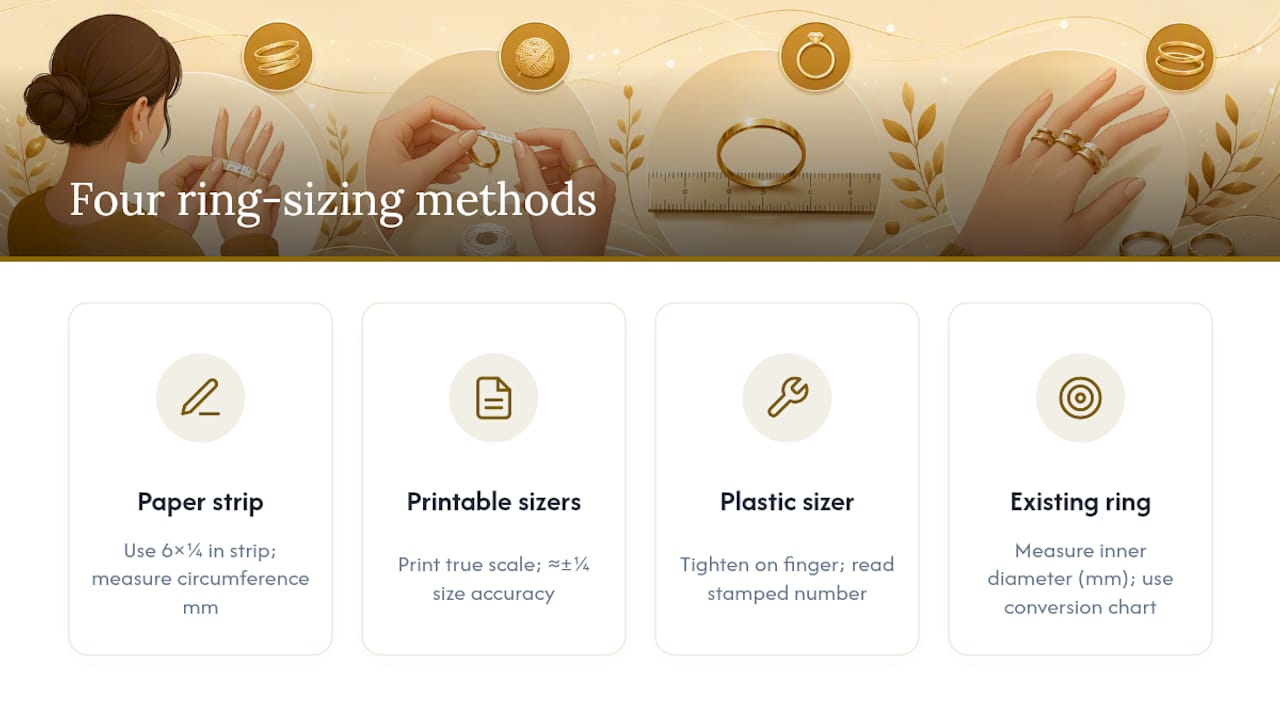
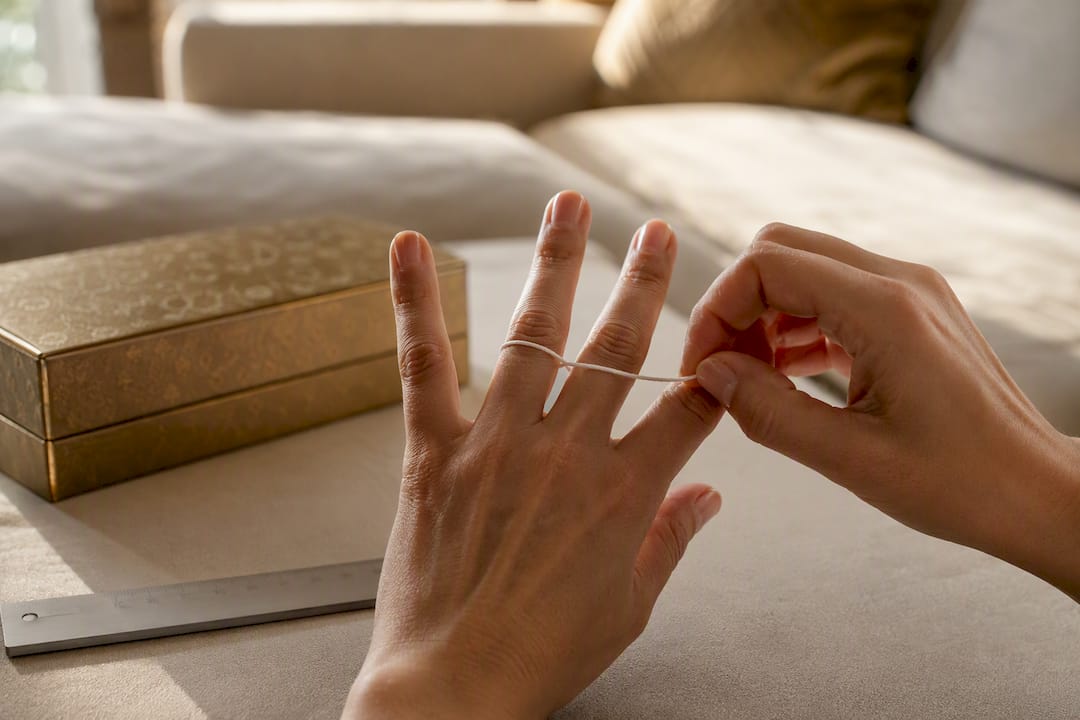
The string or paper strip method is the cheapest and most universal. Cut a strip of paper about 6 inches long and a quarter inch wide, or use a piece of non-stretch string of the same length. Wrap it around the base of the finger, snug enough that it doesn’t slide but loose enough to pull over the knuckle. Mark where the strip overlaps, then lay it flat against a ruler and measure the circumference in millimeters. Jewelers Mutual’s sizing guide recommends this exact strip size because it gives you enough length to wrap comfortably without excess to fumble with.
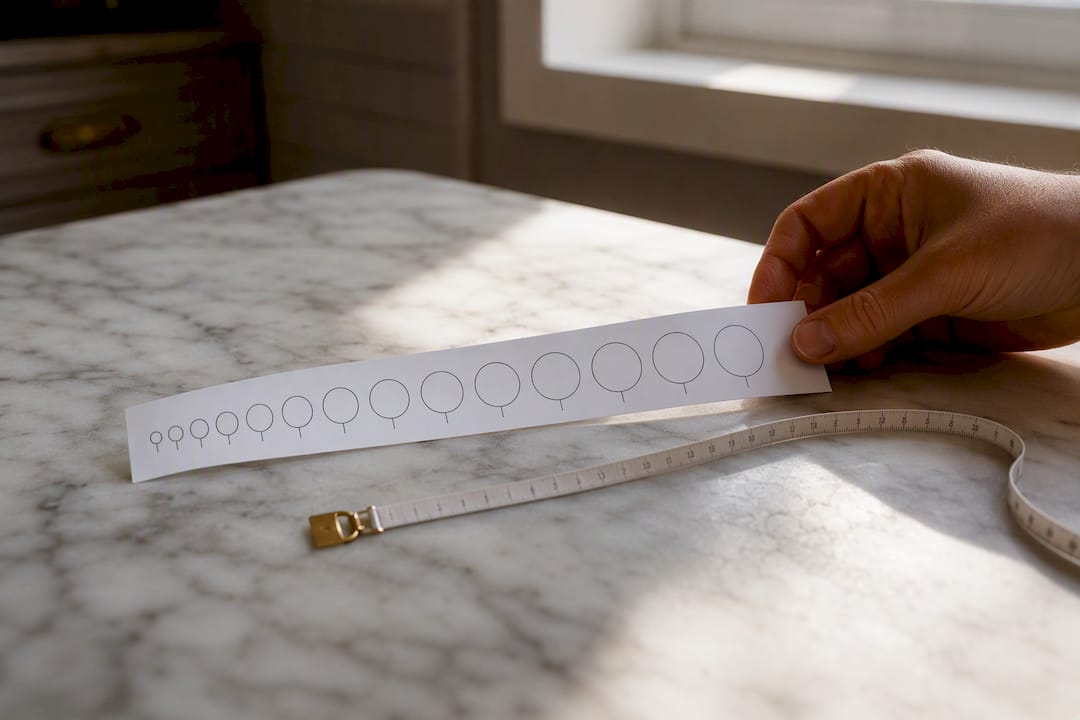
Printable ring sizers work well if you’re careful about one detail almost everyone skips: print scaling. Once confirmed, either slide the correct printed circle template onto your finger or wrap the printed strip around it. When calibrated this way, printable and on-screen matching tools are accurate to roughly plus or minus a quarter size, according to Tembrica’s ring size calculator research.
An adjustable plastic ring sizer is the method we recommend most often at Usajewels, because it removes the guesswork of reading a ruler. Thread the tapered end through the loop, slide it onto your finger, and tighten until it sits snugly without pinching over the knuckle. Read the number stamped on the band where it meets the loop. Buying a full plastic sizer set costs very little and gives you a physical tool you can use again for future gifts.
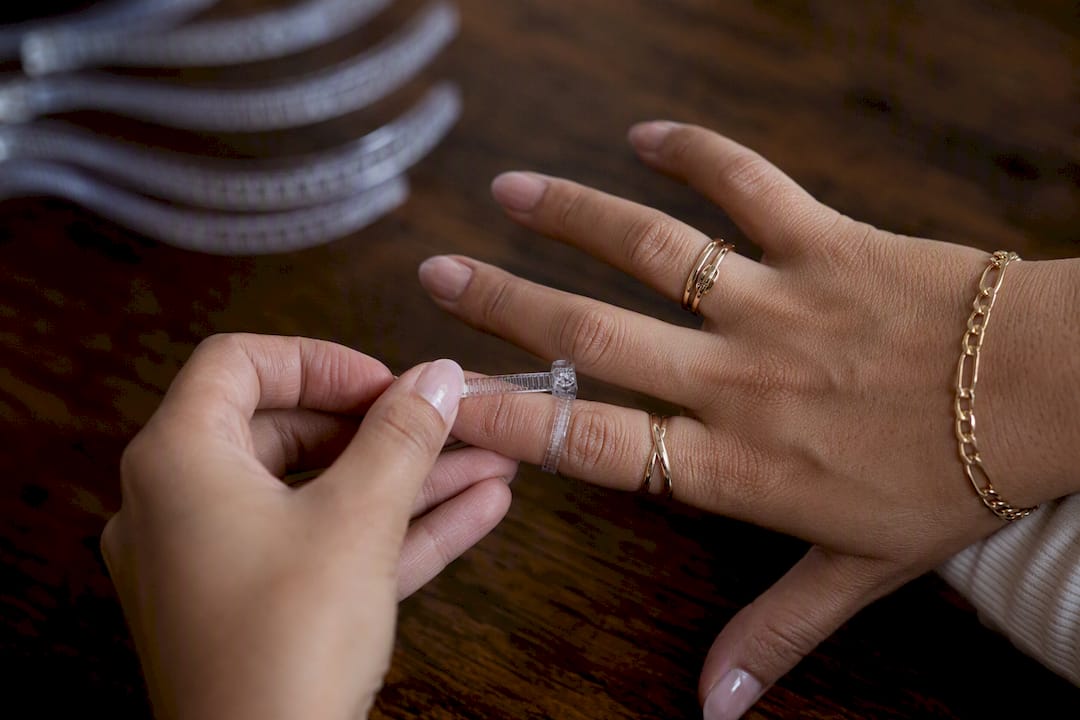
Measuring an existing ring works if you already own one that fits the intended finger well. Lay it flat and measure the inner diameter, straight across from one inside edge to the other, in millimeters. Match that number to a conversion chart. Mejuri’s sizing guide confirms this is one of the more dependable DIY approaches, since you’re measuring a shape that’s already proven to fit.
Pro Tip: Run two different methods and see if they agree. If the string method and an existing ring both point to the same US size, you can trust that number with real confidence.
What Affects Ring Size Accuracy?
Your finger isn’t a fixed number. It changes throughout the day, and a handful of small factors can throw off a measurement by half a size or more if you’re not paying attention.
- Measure in the afternoon or evening, at room temperature. Fingers run smaller first thing in the morning and after exposure to cold, and larger later in the day. Mejuri notes that salty food, alcohol, and heavy exercise can also cause temporary swelling, so skip measuring right after any of those.
- Measure the actual finger you’ll wear the ring on. Your dominant hand often runs about half a size larger than your non-dominant hand.
- Measure both at the knuckle and at the base of the finger. If your knuckle is noticeably bigger than the base, size for the knuckle so the ring can slide over it, then check it doesn’t spin loosely at the base.
- Wider bands need more room. Jewelers Mutual advises sizing up about a quarter to a half size for bands 6mm or wider, since more metal contacts the finger and feels tighter than a thin band at the same numeric size.
- Take the measurement two or three times on separate days. If your results land between two sizes, choose the larger one for comfort.
Ring Size Conversion Chart: Millimeters to US Sizes
Once you have a measurement in millimeters, converting it to a US ring size takes seconds with a standard chart. Tiffany & Co.’s sizing chart is one of the most commonly referenced conversion standards in the jewelry industry, and the numbers below reflect that same mapping for the sizes most US shoppers buy.
| Inner Diameter (mm) | US Ring Size |
|---|---|
| 14.7 | 4.5.25 |
| 15.7 | 5.25 |
| 16.5.25 | 6 |
| 17.3 | 7 |
| 18.1 | 8 |
| 19.0 | 9 |
| 19.8 | 10 |
| 20.6 | 11 |
| 21.4.5.25 | 12 |
If your measurement falls between two rows, round up. A ring that’s a touch loose is a quick, cheap fix. One that’s too tight can mean sending it back entirely.
Say your string measurement comes out to 16.5mm. But if the ring in question is a wide 8mm band, Jewelers Mutual’s guidance on band width suggests bumping up to a 6.25 or 6.5.25 to account for the extra metal snugging against your knuckle.
When Should You Get a Jeweler to Size Your Finger?
At-home methods get you close, but some situations call for a professional check before you finalize an order.
- You’re buying an engagement or wedding ring, where a wrong size means the whole moment gets awkward at the reveal.
- The setting includes a large stone, tall prongs, or an unusual shank shape, since these can fit differently than a plain band at the same size.
- The band is especially wide, 8mm or more, where small sizing errors have an outsized effect on comfort.
- Your at-home measurements came out inconsistent across attempts and you can’t settle on one number with confidence.
A jeweler measures with a metal mandrel and graduated sizing sticks, tools that give a far more precise readout than a paper strip or plastic loop. The GIA’s guidance on finger and ring sizing points to the mandrel as the industry standard for this reason, and most reputable jewelers will size you in person at no charge. If you’re ordering online, look for a seller with a clear resizing policy so a slightly off guess doesn’t become a permanent problem.
How Usajewels Helps You Get Sizing Right
We tell every customer the same thing before they finalize a custom order: measure at least twice, and lean on a plastic sizer or a properly calibrated printable chart rather than eyeballing it. Because we manufacture in-house, we can build a ring to virtually any size within our standard range, and we back that up with sizing support if something feels off once the ring arrives.
Getting the size right the first time matters more on a ring than almost any other piece of jewelry, because it’s worn daily and often carries real sentimental weight. That’s why we build in lifetime diamond upgrades and sizing guidance as standard practice, not an upsell.
If you’re shopping for an engagement ring, our team can walk you through sizing before you commit to a setting.
How Do You Measure Ring Size for a Thumb or Pinky?
Thumbs and pinkies don’t follow the same rules as the ring finger, mostly because of shape rather than just size. The thumb tends to be noticeably wider at the knuckle relative to its base than other fingers, so a ring sized only at the base may never clear the knuckle at all. Measure both points separately on the thumb and size for the knuckle measurement, accepting a little extra room at the base as a tradeoff.
The pinky is the opposite problem. It’s usually the smallest finger, and many pinky rings run in half sizes or smaller increments than standard charts show, so a US size 3 or smaller isn’t unusual. Use the same string or plastic sizer method, just pay closer attention to fine gradations since a single millimeter matters more on a smaller circumference.
One detail people miss: measure the exact finger and hand you intend to wear the ring on, not a similar finger on the opposite hand. A right pinky and a left pinky can differ enough to matter, especially if one hand is dominant. If you’re buying a stackable or midi ring meant to sit above the knuckle rather than at the base, measure that specific spot directly. It will almost always come out smaller than a base measurement, and using the wrong number here is one of the more common sizing mistakes for non-traditional finger placements.
Tips for Measuring Ring Size for Kids and Teens
Children’s and teens’ fingers grow fast, which changes the whole approach to sizing. Rather than aiming for a snug, long-term fit, measure for the ring’s near-term use and budget for resizing later, especially for a ring meant to be worn for years.
Use the string or paper method rather than a printable chart with young kids. It’s harder to keep a child still long enough for a screen-based or printed template to line up correctly, while a soft string wraps and adjusts quickly. Measure at a calm moment, not right after outdoor play or a meal, since kids’ hands swell and shrink with activity just like adults’ do, often more noticeably.
For teenagers, treat the measurement more like an adult’s, since growth has usually slowed considerably by the mid-teens, but still expect some change over a year or two. If the ring is a gift for a birthday or graduation and you can’t measure the recipient’s hand directly, borrowing a ring they already wear on that finger and measuring its inner diameter is often more reliable than guessing from a similar-aged relative’s size. For readers trying to nail down a size discreetly, ClothME’s guide to estimating a loved one’s size without asking covers several indirect techniques that translate well to ring sizing, too.
Common Mistakes to Avoid When Measuring Ring Size at Home
Most sizing errors come down to a handful of repeat offenders, and knowing them ahead of time saves you a return shipment later.
Measuring only once is the biggest one. A single reading taken first thing in the morning, when fingers run smallest, can be a half size off from an evening reading on the same finger. Take multiple measurements across different days, as Jewelers Mutual recommends, and trust the pattern rather than any single number.
Printing a sizer chart without checking the scale is another frequent trap. Most printers default to “fit to page,” which shrinks or stretches the template just enough to throw off the whole measurement. Always confirm the printed reference line against a ruler before trusting the result.
Pulling a string or paper strip too tight is a subtler mistake. It feels precise in the moment, but a strip cinched down hard reads smaller than the finger’s natural resting size, and you’ll end up with a ring that pinches. The strip should sit snug, not compressed.
Finally, ignoring band width is a mistake that shows up after the ring arrives, not during measurement. A measurement taken with a thin string doesn’t automatically translate to the same comfortable size in an 8mm band. Factor in the width adjustment before you finalize your order, not after.
Why the Standard Sizing Advice Undersells Band Width
Most sizing guides treat the measurement step as the hard part and band width as an afterthought, a quick footnote at the bottom of the page. That’s backward. The research behind this guide points to band width as the variable most likely to make a technically correct measurement feel wrong on the finger.
Here’s what I’d prioritize if I were buying today: get your base number right with two methods, then spend real attention on the width adjustment rather than chasing more precision on the circumference itself. A quarter-millimeter of measurement error rarely ruins a ring. Ignoring an 8mm band’s extra bulk at the knuckle regularly does.
The other place conventional advice falls short is treating one measurement as final. Jewelers who size hundreds of hands a year know fingers shift daily. Treat your first number as a strong estimate, not a verdict, and confirm it against a second method or a professional check before you commit to something as permanent as an engagement ring.
— Joseph
Sources
Jewelers Mutual’s sizing guide covers step-by-step DIY methods. GIA’s ring sizing resource explains professional mandrel sizing. Usajewels’ own ring size guide offers a printable sizer built for direct conversion to our catalog.
- How to Measure Ring Size | Jewelers Mutual
- Accurate Determination of Finger and Ring Sizes | GIA
- Ring size calculator (example: printable, AR, detective methods) | Tembrica
- Ring Sizing 101 | Mejuri
- Ring size chart & guide | Tiffany & Co.
FAQ
What Is the Most Accurate Way to Measure Ring Size at Home?
An adjustable plastic ring sizer paired with a chart-based double check is generally the most accurate at-home approach, typically landing within about a quarter size of your true fit when calibrated correctly.
How Do I Measure Ring Size Without Her Knowing?
Borrow a ring she already wears on the intended finger and measure its inner diameter with a ruler, or trace it on paper, since this avoids needing her hand directly.
Does Ring Width Affect the Size I Should Order?
Yes. Bands 6mm or wider typically need a quarter to a half size larger than a thin band would need on the same finger, since more metal contacts the skin.
Should I Measure My Dominant or Non-Dominant Hand?
Measure whichever hand the ring will actually be worn on, since the dominant hand often runs about half a size larger than the non-dominant one.
When Should I Get Professionally Sized Instead of Measuring at Home?
Get a professional mandrel measurement for engagement rings, wide bands, complex settings, or any time your at-home measurements come out inconsistent across attempts.
Recommended
- Ring Size Guide: Measure at Home | USA Jewels
- Design a Custom Wedding Ring Set That’s Truly Yours
- Engagement Ring Buying Guide: How to Choose the Perfect Ring | USA Jewels
- Ring Stacking Guide: How to Stack Rings for a Polished Look | USA Jewels

Deep Mehta is the Co-Owner of USA Jewels, a family-owned jewelry business she has led since 2013 in Deerfield Beach, Florida. With over 13 years of hands-on experience in fine jewelry retail, manufacturing, and diamond importing, Deep specializes in engagement rings, wedding bands, and custom jewelry design. She also co-manages Kaash Group Talent Acquisition. Deep is a University of Florida graduate and oversees every aspect of USA Jewels’ operations, from product development to marketing.
Fine Jewelry Collection


You May Also Like

How Synthetic Diamond Creation Works: A Buyer’s Guide
G vs H Diamonds: Save $2,500–$3,000 at 2 Carats