G vs H Diamonds: Save $2,500–$3,000 at 2 Carats
For most engagement rings, H offers the better value and G earns its place only when the setting or size makes color sensitivity real. If you’re mounting your stone in yellow or rose gold, H saves you money without costing you sparkle. If you’re set on platinum or white gold, especially above 2 carats, G buys you a little extra insurance. Metal, carat, and cut decide the answer, not the label alone.
TL;DR:
- The cost difference between G and H diamonds increases significantly with size, with 2-carat stones showing a savings of $2,500 to $3,000 when choosing H.
- A G or H color grade is difficult to distinguish once mounted, especially under natural lighting and at smaller sizes under 1 carat, making H a better value in warm metals.
- Metal choice influences color visibility, with yellow or rose gold masking faint yellow tint and platinum or white gold exposing it, especially in large or cool metal settings.
- Prioritizing cut quality over a one-grade color upgrade can often yield more visible brilliance and brightness than the difference between G and H.
- Always request GIA certification and mounted HD videos to accurately assess the diamond’s appearance in its intended setting before purchasing.
Table of Contents
- G vs H Diamond Color: What the GIA Scale Actually Measures
- When Does a G vs H Color Difference Become Visible?
- Price and Value: What the G vs H Savings Actually Look Like
- How to Choose Between G and H: A Buyer’s Checklist
- How Usajewels Helps You Put This Decision Into Practice
- Author Takeaway: A Single Buying Rule Worth Remembering
- Start Your G vs H Comparison With Usajewels
- Sources
- FAQ
G vs H Diamond Color: What the GIA Scale Actually Measures
The Gemological Institute of America grades diamonds on a scale that runs from D to Z, and both G and H sit inside the Near-Colorless tier, which spans G through J. G is one step whiter than H and sits at the top of that group, just below the F color and the “colorless” range that starts at D.
That single grade of separation sounds significant until you understand how it’s measured. GIA graders compare loose stones against master sets under controlled, color-corrected lighting, viewed table down against a white background. That’s a lab environment, not your living room or a jeweler’s showcase, which is exactly why two stones a grade apart can look identical once they’re set and worn.
A few things worth knowing about the scale itself:
- G and H are both classified as near-colorless, not “colored” diamonds
- Grading happens loose, unmounted, and face down, the opposite of how you’ll actually see the stone
- A GIA report (or an equivalent lab certificate) is the only reliable way to confirm the grade you’re paying for
Always ask for that certification before you commit. A seller’s own “eye clean” or “near colorless” claim means nothing without paperwork behind it.
When Does a G vs H Color Difference Become Visible?
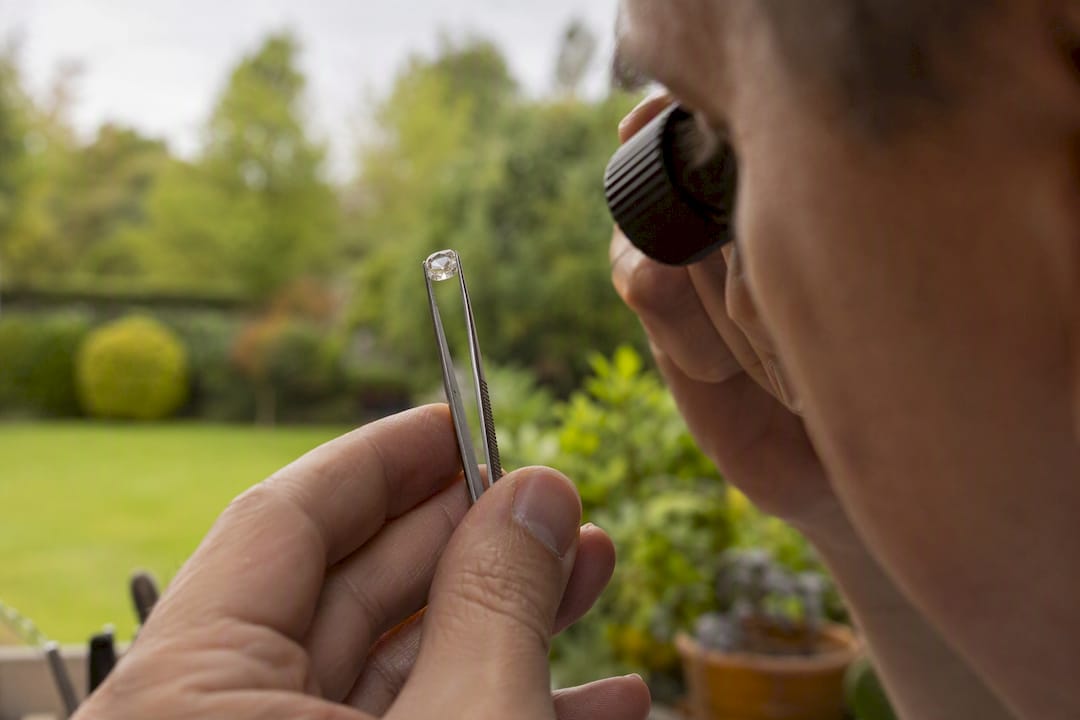
At 1 carat, mounted and viewed casually, most people cannot tell G from H. The difference is real on paper but small enough that it rarely survives the trip from loose stone to finished ring. Once you cross into larger carat weights and cooler metals, the calculus changes.
Three factors decide whether that half step in color shows up:
- Metal tone. Yellow and rose gold reflect warm light back into the stone, which masks faint yellow tint. Platinum and white gold do the opposite, they throw cool light that can expose warmth, especially near the edges or in the side profile.
- Carat size. Color concentrates as the stone grows. A 0.5 carat H and a 2 carat H behave very differently, the larger stone has more material for warmth to hide in.
- Cut quality. A well-cut H can look whiter and brighter than a poorly cut G, because superior faceting scatters more light and distracts the eye from body color. Cut consistently overrides a one-grade color difference in face-up appearance.
Lighting matters too. Diamonds photograph differently under LED store lighting than they do in daylight, and sunlight is the most honest test you’ll find.
Pro Tip: Before buying anything above 1.5 carats in white gold or platinum, ask for HD video of the actual stone mounted in the setting, filmed in natural light, with a side-profile shot included. Warmth often shows at the girdle before it ever shows face-up.
Price and Value: What the G vs H Savings Actually Look Like
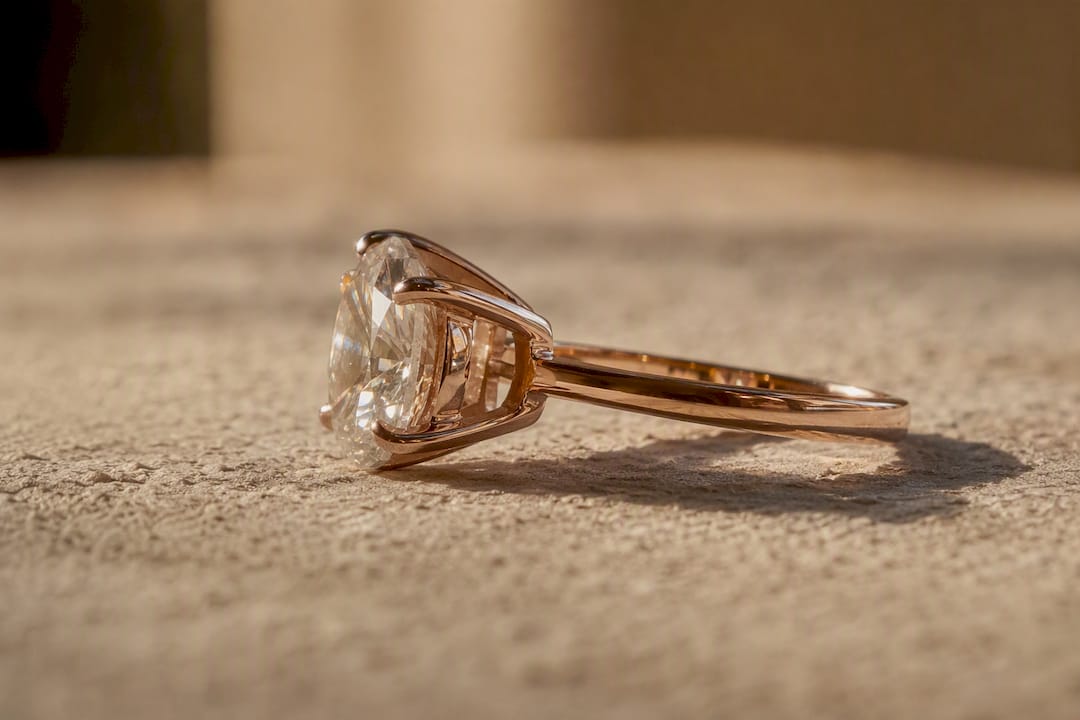
The dollar gap between G and H grows with carat weight, and that’s where the real decision lives. At 1 carat, a G-VS2 diamond runs about $3,230 compared to roughly $2,750 to $2,900 for an H-VS2, a savings window of $330 to $480. At 2 carats, that same G-VS2 jumps to about $16,490 against roughly $13,500 to $14,000 for the H, pushing the savings up to $2,500 to $3,000.
The pattern to remember: the percentage saved stays fairly consistent across sizes, but the absolute dollar amount climbs fast. That’s what makes the choice more consequential as the stone gets bigger, not less.
A few ways buyers typically put that saved money to work:
- Moving up in carat weight within the same budget
- Upgrading from Very Good to Excellent cut, which affects sparkle more than color does
- Putting the difference toward a heavier metal setting, a halo, or pavé detailing
At 1 carat the savings barely register against the total ring cost. At 2 carats and above, that same percentage becomes real money, often enough to fund a better cut grade instead.
How to Choose Between G and H: A Buyer’s Checklist
Work through this in order, and you’ll land on the right grade without overthinking it.
- Decide your metal first. Yellow or rose gold? H is excellent value at nearly any carat weight. Platinum or white gold? Lean toward G, particularly once you’re above 2 carats, since cooler metals reveal warmth that warmer metals absorb.
- Set your carat target. Small stones under 1 carat hide color easily in any metal. Larger stones need more margin, which is exactly why the metal decision comes first.
- Prioritize cut over color. If you’re choosing between a better cut grade and a one-step color upgrade, the cut upgrade almost always wins on visible brilliance.
- Request a GIA report. No certificate, no deal. This is non-negotiable regardless of which grade you land on.
- Ask for HD mounted video or an in-person viewing. Loose stone photos under lab lighting tell you nothing about how the diamond will read in your actual setting.
- Compare mounted examples side by side, ideally in the metal and setting style you’re actually buying.
Three questions worth asking any seller directly:
- “Is this stone GIA-certified, and can I see the report?”
- “Can you send HD video of this exact stone mounted, including a side view?”
- “How does the cut grade compare between the G and H options you’re showing me?”
Pro Tip: If a seller hesitates to provide mounted video or pushes you toward photos of a different “representative” stone, treat that as a red flag. You’re buying the specific diamond, not a category average.
How Usajewels Helps You Put This Decision Into Practice
We built our model around exactly this kind of decision. Because we manufacture in-house and sell direct, you get to choose diamond color, cut, and metal independently instead of accepting whatever combination a showroom happens to have in stock.
Here’s how that plays out for the two paths this article has walked through:
- Want the bigger carat? Choose H color set in yellow or rose gold, and put the savings toward size or a better cut grade.
- Want maximum whiteness in platinum or white gold? Choose G, and we’ll show you exactly how it reads in that setting before you commit.
- Every stone we sell ships with GIA documentation, and we can provide in-setting photos or video so you’re never guessing at how a diamond will look once it’s mounted.
- Our lifetime diamond upgrade program means the choice you make today isn’t permanent if your priorities change later.
Our family has been building custom pieces since 1999, and the questions above are ones we walk customers through every week, not theory we picked up from a guide.
Author Takeaway: A Single Buying Rule Worth Remembering
Here’s the rule I’d give a friend: match your color grade to your metal, spend the savings on cut, and only chase G if you’re in platinum or going big. For personal enjoyment, a well-cut H in warm gold will never disappoint you. For resale, certification and cut carry more weight than a single color grade ever will.
— Joseph
Start Your G vs H Comparison With Usajewels
You don’t have to guess your way through this decision. Usajewels lets you compare G and H side by side in your actual metal and setting before you spend a dollar, which is the one thing static price charts and loose-stone photos can never show you.

Browse our fine diamond jewelry collection and use the design-your-own tool to test H in yellow or rose gold against G in platinum or white gold. Every stone comes with a GIA report, and you can request HD mounted video before you buy, so you see exactly what you’re getting instead of relying on a lab grade alone. If cut quality matters more to you than an extra color grade, our team can walk you through Excellent versus Very Good options in your target carat range. Reach out through the site to start comparing your specific setting today.
Sources
The technical and pricing claims here rely on a small set of sources worth knowing about if you want to dig deeper:
FAQ
Should I buy an H or G color diamond?
Choose H if your ring is set in yellow or rose gold, since the warm metal hides any faint tint and you’ll save meaningful money, especially above 1 carat. Choose G if you’re set on platinum or white gold, or if your stone is 2 carats or larger.
Is a G color diamond good?
Yes. G sits at the top of GIA’s Near-Colorless range, one step below the colorless D-F tier, and it appears white to the naked eye in virtually every setting and size.
Which is better, G or F, in a diamond?
F is one grade whiter than G and sits in GIA’s colorless range, but the visual difference between the two is essentially invisible face-up once mounted. F commands a higher price for a distinction most buyers will never notice without a jeweler’s loupe and side-by-side comparison stones.
Is an H VS1 diamond good?
Yes, an H color paired with VS1 clarity is a strong combination for most engagement rings, particularly in yellow or rose gold. VS1 clarity is already eye-clean, so you’re getting a diamond that looks bright and white while costing meaningfully less than a G or F equivalent.
Is an I color diamond good for an engagement ring?
An I color diamond can work well in yellow or rose gold settings, though it sits at the edge of the Near-Colorless range and starts to show warmth more readily in white metals or at larger carat sizes. If you’re considering I color, request mounted video in your specific setting before buying, the same rule that applies to H at larger sizes applies even more strongly here.
Recommended
- Diamond Quality 4Cs Breakdown: Your Buying Guide
- Diamond Color & Clarity Explained: What to Buy
- Diamond Carat Weight: What It Means and Why It Matters
- Diamond Carat Weight Guide — Size, Price & Value Explained

Deep Mehta is the Co-Owner of USA Jewels, a family-owned jewelry business she has led since 2013 in Deerfield Beach, Florida. With over 13 years of hands-on experience in fine jewelry retail, manufacturing, and diamond importing, Deep specializes in engagement rings, wedding bands, and custom jewelry design. She also co-manages Kaash Group Talent Acquisition. Deep is a University of Florida graduate and oversees every aspect of USA Jewels’ operations, from product development to marketing.
Fine Jewelry Collection


You May Also Like
5 Step Verification to Buy Loose Diamonds Confidently
Wedding Band Width: How Wide Should Yours Actually Be?