5 Step Verification to Buy Loose Diamonds Confidently
Buying a certified loose diamond is often the smarter path to value and personalization, and we’ve seen it work well for families who want a stone they truly chose rather than one that came pre-set. The two checks that matter most are cut quality, especially on round brilliants, and a verifiable GIA or AGS grading report. Confirm the seller’s return policy and insured shipping before you commit.
TL;DR:
- The most important factors to verify are the diamond’s cut grade, especially for round brilliants, and a verifiable GIA or AGS grading report.
- Prioritize cut quality over other Cs, shop just below magic sizes like 1.00 or 2.00 carats, and consider clarity grades like VS2 or SI1 to maximize value.
- Always confirm grading reports through official databases using the report number and beware of labs or reports from unknown sources.
- Reputable sellers should offer insured shipping, clear return policies, treatment disclosures, and transparent pricing with verifiable documentation.
- Buying a loose diamond separately often yields better value than purchasing a pre-set ring, but thorough vetting of the seller and report authenticity is crucial.
Table of Contents
- Quick buying checklist: immediate steps to follow when you find a stone
- The 4 Cs: what each means and buying rules of thumb
- How to verify grading reports and why lab credibility matters
- Where to buy and how to vet sellers
- Pricing, budgeting, and practical ways to save without sacrificing appearance
- Setting, mounting logistics, and timeline after purchase
- Inspection, returns, warranties, appraisals, and insurance
- Publisher perspective: how USA Jewels supports buyers of loose diamonds
- Questions to ask sellers to ensure authenticity and fairness
- Red flags and scams to watch out for when buying loose diamonds
- Payment methods and financing options available when purchasing loose diamonds
- How long the entire buying process typically takes from selection to possession
- How to evaluate and compare sellers based on pricing transparency and customer reviews
- What buyers get wrong about diamond shopping
- Why USA Jewels is a straightforward place to buy your loose diamond
- Sources
- FAQ
Quick buying checklist: immediate steps to follow when you find a stone
When you’ve found a stone that catches your eye, work through these steps before you say yes.
- Ask for the lab report number and run it through the GIA Report Check or the AGS equivalent to confirm it matches the stone you’re seeing.
- For round brilliants, check that the cut grade reads Excellent or Very Good, since cut governs how the stone reflects light.
- Decide which of the 4 Cs matter most for your budget, then let that guide every other decision.
- Ask directly about treatments, the return window, insured shipping, and written guarantees.
- Set aside money for the setting itself and for an appraisal you’ll need for insurance.
A few things are worth confirming in writing, not just conversation:
- The seller discloses any treatments or enhancements up front.
- The return policy states a clear number of days, not “case by case.”
- Shipping is insured for the full value of the stone.
The 4 Cs: what each means and buying rules of thumb
Cut, color, clarity, and carat each affect how a diamond looks and what it costs, but they don’t carry equal weight for a shopper on a budget.
Cut determines how much brightness, fire, and sparkle a stone shows off, and it matters more than any other factor for round brilliants specifically. A well-cut diamond can look larger and livelier than a poorly cut stone of the same weight. Color is graded from D to Z, with D being colorless and the scale moving toward faint yellow tones as it descends. Clarity measures internal and surface characteristics, from Flawless down through grades where inclusions become visible without magnification. Carat is simply weight, and it’s easy to confuse with size since two stones of the same weight can look different depending on their cut.
Some practical rules of thumb we’d pass along to our own family:
- Put your money into cut first, especially for round brilliants, since it drives the sparkle you actually see.
- Consider a VS2 or SI1 clarity grade, since most inclusions at those grades aren’t visible to the naked eye at everyday viewing distances.
- Shop just under “magic sizes” like 1.00 or 2.00 carats, where per-carat pricing jumps sharply for a barely noticeable size difference.
- Use setting choices like a halo to make a smaller center stone read larger without spending more on carat weight.
Larger stones tend to show inclusions and tint more readily, so if you’re buying above two carats, it’s worth tightening your clarity and color minimums rather than loosening them.
Pro Tip: Ask your jeweler to show you the same cut grade in person under different lighting. Photos rarely capture how a well-cut stone actually performs.
How to verify grading reports and why lab credibility matters
A grading report is only useful if you know how to read it and confirm it’s genuine. GIA issues a Diamond Grading Report for loose natural diamonds of 0.15 carat or larger, and it includes the 4 Cs, a plotted clarity diagram showing where inclusions sit, and the stone’s proportions.
Here’s how to put that report to work before you buy:
- Get the report number from the seller and enter it directly into GIA’s Report Check or the AGS database.
- Compare every detail on the report, weight, measurements, clarity plot, against the seller’s own listing to make sure nothing was swapped.
- Ask your jeweler for the GIA grading report itself, not just a summary card, and use the lab’s report number to verify it independently.
If a report comes from a lab you’ve never heard of, or the seller is reluctant to provide a report number at all, treat that as a reason to ask more questions or walk away. Our own guide to GIA certification walks through what a legitimate report should include if you want a closer look before you shop.
Where to buy and how to vet sellers
Online retailers and local jewelers each offer something the other doesn’t, and the right choice depends on how hands-on you want to be.
Buying online gives you access to far more inventory, and reputable sites offer 360 degree imagery, verifiable lab reports, and clear return windows. That combination lets you shop confidently without ever holding the stone first, as long as the report and shipping insurance are both solid. Buying locally lets you inspect the stone in person and work with a setter who can mount it on the spot, which some buyers find reassuring, particularly for a first big purchase.
Whichever route you take, vet the seller the same way:
- Ask for the report number before you pay anything, and check it yourself.
- Get any treatment disclosures in writing, not just a verbal assurance.
- Confirm the return and warranty terms cover the exact scenario you’re worried about.
- Ask for proof of insured shipping and whether an appraisal comes with the purchase.
Our education page on the 4 Cs covers a checklist version of this if you want something to reference while you’re comparing sellers side by side.
Pricing, budgeting, and practical ways to save without sacrificing appearance
Price moves with all four Cs at once, but not evenly. A jump in carat weight, especially crossing a magic size like 1.00 or 2.00 carats, tends to raise the per-carat price more than the same jump in a less-watched weight range.
A loose diamond gives you more control over your budget than a pre-set ring does, since buying unmounted lets you inspect the stone and choose exact specifications rather than paying for a package deal.
A few ways to stretch your budget without the stone looking smaller or duller:
- Prioritize cut over the other three Cs, since it has the biggest visible impact.
- Buy just under a magic size rather than just over it.
- Consider VS2 or SI1 clarity, or a lab-grown diamond, both of which stretch your dollar further.
- Use a halo or similar setting to make a smaller stone appear larger.
One honest note: diamonds aren’t a reliable financial investment, so shop for the stone you’ll love wearing, not one you expect to resell at a profit.
Setting, mounting logistics, and timeline after purchase
Once you own the stone, you’ll need a setting that fits its shape and size, and depending on the design, that might mean a ready-made mounting or a custom build from a bench jeweler.
- Choose a setting style that complements the shape you bought, and confirm it’s sized correctly for the stone’s measurements.
- Ask whether the setting is ready-made or custom, since custom work takes longer and typically costs more.
- Request the setter’s experience with your specific stone shape, since mounting requires real skill and an inexperienced setter risks chipping or misaligning the diamond.
- Inspect the finished piece under magnification before you leave the shop or accept delivery.
Pro Tip: Ask to see the setter’s handling protocol in writing. A shop that documents its process usually treats your stone with the same care.
Inspection, returns, warranties, appraisals, and insurance
Protecting your purchase starts with paperwork, not an afterthought once something goes wrong.
- Get the return policy and warranty terms in writing, along with any treatment disclosures the seller mentioned verbally.
- Have the stone independently appraised for insurance purposes once you own it, and understand that an appraisal value can differ from what you paid.
- Insure the diamond through a homeowner’s or renter’s policy endorsement or a dedicated jewelry policy, and confirm the coverage applies to unset stones, not just finished rings.
- Keep every document, the lab report, the receipt, the appraisal, and the insurance policy, together in one place.
Publisher perspective: how USA Jewels supports buyers of loose diamonds
We built our business around in-house manufacturing so buyers get certified loose diamonds and custom settings without paying for a chain of middlemen. Every stone in our catalog comes with the documentation you’d expect from a serious seller.
- Certified loose diamond inventory backed by verifiable grading reports.
- Guidance on running a GIA verification before you commit to a stone.
- Insured shipping and a 30-day return window on every order.
- A lifetime diamond upgrade program if your needs change down the road.
We’ve been doing this since 1999, and it shows in the reviews our customers have left along the way.
Questions to ask sellers to ensure authenticity and fairness
The right questions, asked before you pay, protect you far more than any policy you read after the fact.
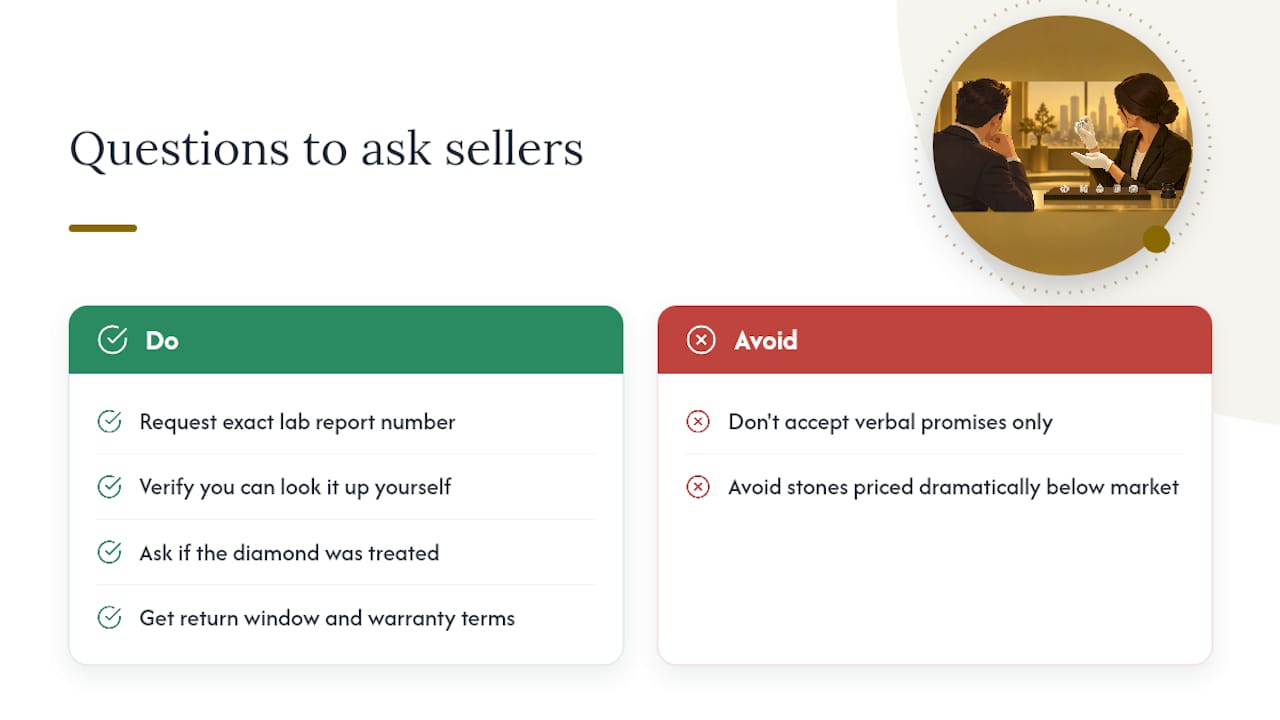
Start with the report itself: ask for the exact lab report number and confirm you can look it up yourself rather than trusting a printed summary. Ask directly whether the diamond has been treated in any way, since sellers are required to disclose this under the FTC’s Jewelry Guides, which set the baseline for truthful marketing and disclosure in this industry.
Ask how the price compares to similar stones with the same 4 Cs, and request an explanation if it seems unusually low. A price that’s dramatically below market for the same specifications is often a sign that something is misrepresented, whether that’s the clarity grade, a treatment that wasn’t disclosed, or the report itself.
Finally, ask what happens if you’re not satisfied: get the return window, the restocking terms, and the warranty coverage spelled out before you pay, not promised verbally. A seller who answers all of this clearly and quickly is telling you something important about how they run their business.
Red flags and scams to watch out for when buying loose diamonds
A few warning signs come up again and again with problem sellers, and they’re worth memorizing before you start shopping.
Watch for a seller who won’t provide a lab report number you can independently verify, or who provides a report from a lab you can’t find any information about. Pressure tactics, like a “deal” that expires in the next hour or a demand for payment before you’ve seen documentation, are a common sign something isn’t right. Be cautious of prices that sit far below what comparable stones are selling for, since that gap often hides an undisclosed treatment or an inflated grade.
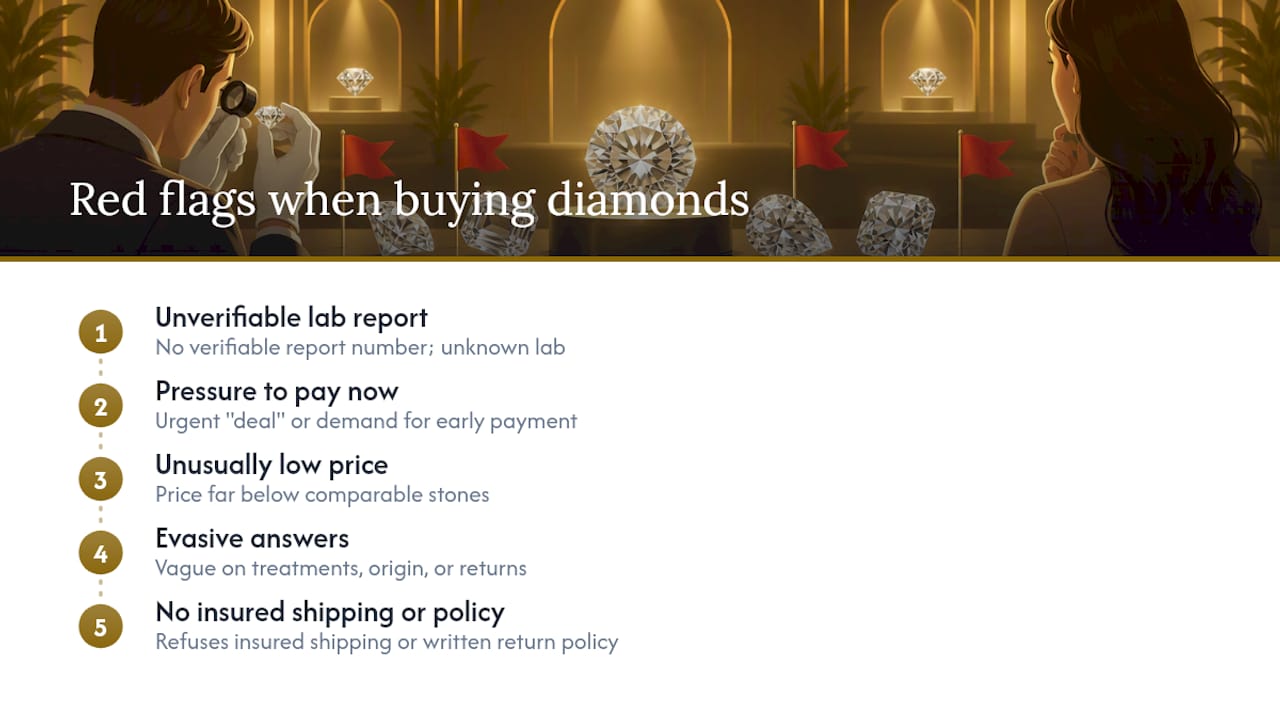
Vague or evasive answers about treatments, origin, or return policy are themselves a red flag, since a legitimate seller has no reason to dodge those questions. If a seller refuses insured shipping or won’t put a return policy in writing, treat that as reason enough to shop elsewhere.
Payment methods and financing options available when purchasing loose diamonds
Most reputable sellers accept major credit cards, bank transfers, and increasingly, third-party financing plans that let you spread the cost over several months. Credit cards carry the added benefit of purchase protection, which can help if a dispute arises later over authenticity or condition.
Financing options vary by seller, so ask specifically what’s available and whether interest applies, since some plans are interest-free for a set period and others aren’t. Whatever payment method you choose, keep the transaction record along with your lab report and receipt, since you’ll want all of it together if you ever need to file an insurance claim or dispute a charge.
How long the entire buying process typically takes from selection to possession
Selecting the stone itself, comparing options, verifying reports, and settling on a final choice, usually takes the longest stretch of the process, especially if you’re weighing several diamonds against each other. Once you’ve paid, a ready-made setting can be mounted and shipped relatively quickly, while a custom design takes longer because a bench jeweler has to build the piece to your specifications.
Shipping adds its own timeline on top of that, and insured shipping in particular is worth the extra day or two it might take compared to standard delivery. If you’re buying locally and having the stone set in-store, you may walk out with the finished piece the same day or within a short wait while the setter completes the mount.
How to evaluate and compare sellers based on pricing transparency and customer reviews
Pricing transparency means a seller shows you exactly what you’re paying for, the stone’s cost, the setting’s cost, and any additional fees, rather than bundling everything into one number you can’t break down. A seller who publishes clear pricing for their certified stones and their settings separately makes it much easier to compare against a competing offer.
Customer reviews tell you how a seller behaves once the sale is made, not just how good their listings look. Look for patterns across reviews rather than a single glowing or negative comment, and pay particular attention to how a seller handled problems when they came up, since that’s a better predictor of your own experience than a perfect five-star average.
What buyers get wrong about diamond shopping
The conventional advice tells people to obsess over carat weight, and that’s backwards. Cut is what makes a diamond look alive, and a smaller, well-cut stone will outshine a larger, poorly cut one every time you see it under normal light. We think most buyers spend too much time chasing a round number on a certificate and not enough time asking whether the report is even legitimate.
The other thing that gets underweighted is the setting timeline. People plan the stone purchase carefully, then treat the mounting as an afterthought, and that’s where damage or delays happen most often. If we could change one habit, it would be this: verify the report before you fall in love with the stone, and vet the setter with the same care you used to vet the seller. That order matters more than most buying guides let on.
— Joseph
Why USA Jewels is a straightforward place to buy your loose diamond
Once you’ve verified a report and worked out your budget, the next step is finding a seller who makes the rest of the process just as clear. USA Jewels sells certified loose diamonds directly, without a chain of middlemen marking up the price, starting at $142 for our certified loose diamonds.
Every stone comes with insured shipping and a 30-day return window, offering flexibility in your purchase. If you’d rather design the whole ring around your stone, our design your own diamond ring service starts at $399 and lets you pick the metal, the setting style, and the exact diamond quality that fits your budget.
We’ve been doing this as a family business since 1999, and it shows in the reviews our customers leave along the way. Browse our certified loose diamonds to see current inventory and start comparing stones with real, verifiable reports attached.
Sources
- How GIA grades diamonds | GIA
- Loose diamonds: how to buy loose diamonds | ORIGIN De Beers Group
- In the Loupe: Advertising diamond, gemstones and pearls | Federal Trade Commission
FAQ
Is it cheaper to buy a loose diamond and get it set separately?
Often, yes, since buying unmounted lets you inspect the stone and choose exact specifications rather than paying for a pre-assembled package. You’ll need to budget separately for the setting and mounting labor, but the combined cost frequently comes in lower than a comparable pre-set ring.
How much does a loose diamond typically cost?
Loose diamond prices vary widely based on the 4 Cs, with cut and carat weight having the biggest impact on price. At USA Jewels, certified loose diamonds start at $142, with the final price depending on the specific stone’s characteristics.
Is buying loose diamonds a good investment?
Diamonds generally aren’t considered a reliable financial investment, since resale value rarely matches the retail price paid. Shop for a stone based on the quality and appearance you want, not as a way to grow your money.
What is the most affordable way to buy diamonds?
Prioritizing cut quality while allowing modest concessions on color or clarity, such as choosing a VS2 or SI1 clarity grade, tends to stretch a budget furthest without sacrificing visible brilliance. Buying just under a magic size like 1.00 carat and considering a lab-grown stone are two other reliable ways to save.
How do I know a diamond’s grading report is legitimate?
Take the report number straight to the GIA Report Check or the AGS database and confirm it matches the stone’s actual specifications. If a seller can’t or won’t provide a report number, treat that as a reason to ask more questions before buying.
Recommended
- How to Buy a Diamond Online Safely: Complete Guide
- Diamond Buying Guide: The 4 C’s Explained
- Diamond Certification Guide: GIA vs AGS vs IGI Compared
- How to Choose a Certified Ethical Diamond Jeweler

Deep Mehta is the Co-Owner of USA Jewels, a family-owned jewelry business she has led since 2013 in Deerfield Beach, Florida. With over 13 years of hands-on experience in fine jewelry retail, manufacturing, and diamond importing, Deep specializes in engagement rings, wedding bands, and custom jewelry design. She also co-manages Kaash Group Talent Acquisition. Deep is a University of Florida graduate and oversees every aspect of USA Jewels’ operations, from product development to marketing.
Fine Jewelry Collection

You May Also Like
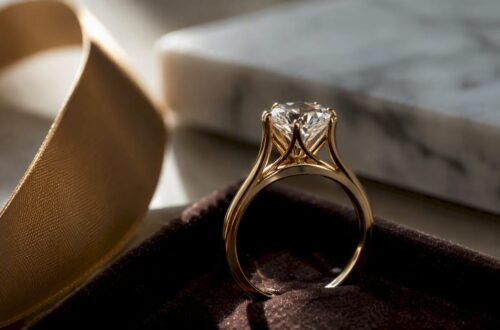
Cathedral Ring Setting: What It Is and How to Choose One
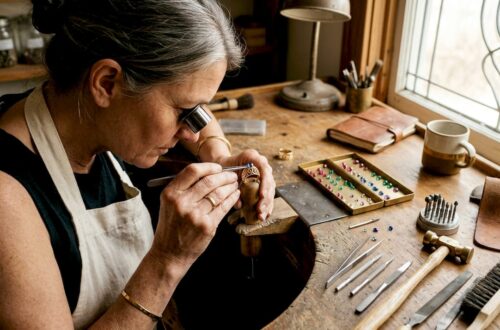
Mother’s Ring Design: What It Means and How to Choose