Direct-to-Consumer Jewelry: How Buying From the Maker Works
Direct-to-consumer jewelry means the company that makes your piece also sells it to you, with no wholesaler, distributor or department-store counter in between. You deal with the maker from the first question to the finished ring. For many buyers that means more control over design and a fairer price for the same materials. This guide explains how the model works, where the savings come from, what to check before you order, and how we do it at USA Jewels.
TL;DR
- Direct-to-consumer (DTC) jewelry is sold by the maker through its own channel, so fewer layers sit between the bench and your hands.
- Savings on finished jewelry come mostly from skipping retail overhead and middlemen. Diamond prices themselves follow the market, so the 4Cs and the grading report matter more than where you buy.
- Custom pieces cost more or less depending on metal, design complexity and the maker’s skill.
- Compare return, warranty and upgrade policies as carefully as the product itself.
- At USA Jewels, you can design your own ring, chain, earrings, pendant or bracelet, with prices starting at $149.
Table of Contents
- What direct-to-consumer jewelry actually means
- Where the price difference comes from
- Wholesale versus retail diamonds: what to compare
- What custom jewelry costs when you buy from the maker
- The benefits of an in-house jeweler
- What to check before you buy direct
- Checking that diamonds are conflict-free
- Who buys direct, and what they choose
- Our perspective
- Start designing with us
- FAQ
- Sources
What direct-to-consumer jewelry actually means
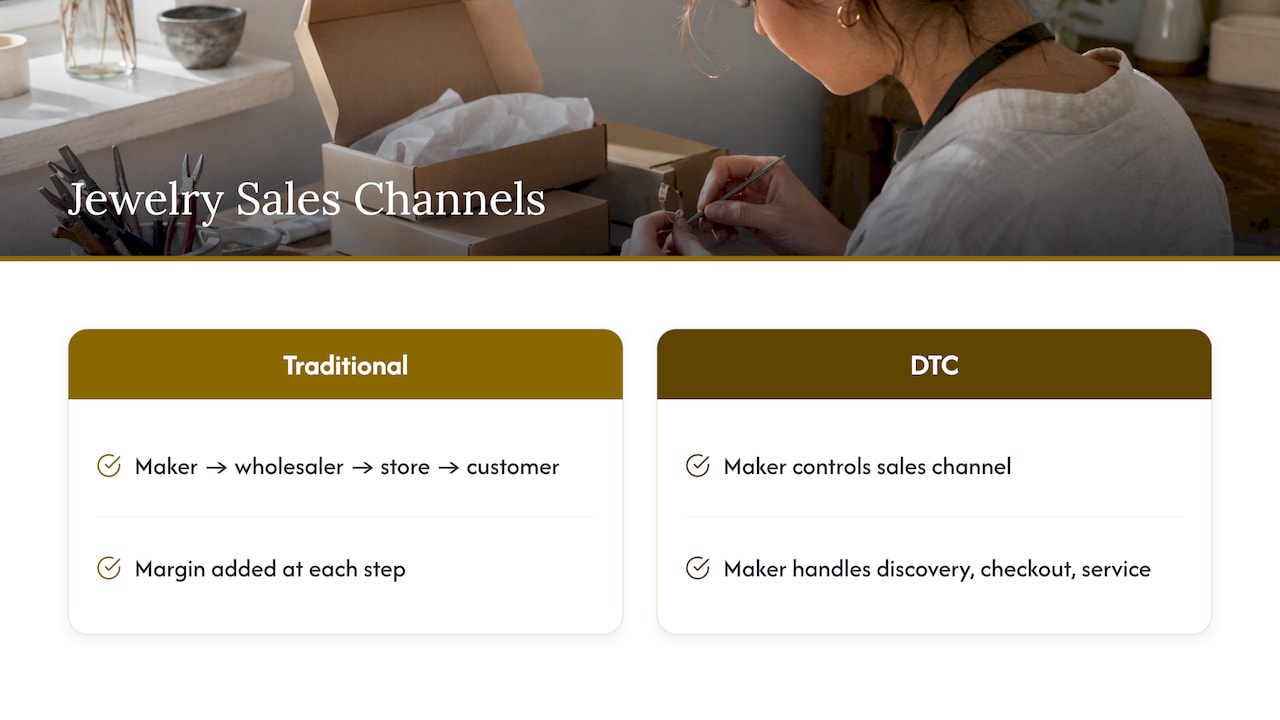
In the traditional chain, a manufacturer sells to a wholesaler, the wholesaler sells to a retail store, and the store sells to you. Each step adds a margin. In the DTC model, the manufacturer sells through a channel it controls, taking responsibility for discovery, checkout and service after the sale.
People search for this under many names: manufacturer-direct jewelry, jewelry direct from the manufacturer, or buying from an in-house jeweler. They all describe the same idea. The people who design and make the piece are the people who answer your email.
That has a practical side. When one company handles design, casting, setting and customer service, a question like “can we move this stone to a lower setting?” gets answered by someone who can do it. There is no relay of messages between a salesperson and a workshop somewhere else.
Where the price difference comes from
A ring does not get cheaper because someone chose a clever website. It gets cheaper because costs disappear from the chain. A traditional store pays for storefront space, security, displays, sales staff, insurance and inventory that can sit for months. Those costs are real, and they are built into the tag price.
A maker that sells directly does not carry the wholesale layer and does not need a large retail footprint for every sale. That is the idea behind our own pricing: we make our jewelry in-house, as a family-owned business, and sell it directly, so we are not paying a middleman and passing the cost on to you.
Here is how the two routes compare in practice.
| What you compare | Traditional retail | Manufacturer-direct |
|---|---|---|
| Who makes the piece | Often a third-party factory | The company selling it |
| Layers between maker and buyer | Wholesaler plus retailer | None |
| Customization | Usually limited to catalog options | Choose metal, stone shape and quality |
| Overhead built into price | Showroom, staff, display inventory | Lean, focused on production and service |
| Who answers after-sale questions | A store employee | The people who made it |
What matters is the result for you: the same karat of gold, the same stone grade, and a lower total price because less of your money goes to the overhead of selling.
Wholesale versus retail diamonds: what to compare
Diamonds deserve their own paragraph, because the price logic is different. The Gemological Institute of America (GIA) says that wholesale diamond prices are broadly similar around the world, and that retail cost depends on taxes, competition among jewelers and consumer demand. The same page advises buyers to learn the 4Cs and ask to see a grading report from a well-known independent laboratory such as GIA.
That is useful guidance, and it changes how to shop. Instead of hunting for a secret source, compare diamonds on facts:
- Cut, color, clarity and carat. The 4Cs set the stone’s value. Two stones with the same carat weight can differ widely in price because of cut and clarity.
- The grading report. An independent lab report describes the stone you are actually buying. Our diamond certification guide explains how GIA, AGS and IGI reports differ.
- Natural or lab-grown. Both are real diamonds, and they are priced very differently. Our comparison of lab-grown and natural diamonds lays out the tradeoffs, and our guide to why lab-grown diamonds cost less explains the reasons.
- The total package. The stone is only part of a ring. The setting, metal, labor and the policies behind it all count.
This is where buying from a maker helps. A diamond is easy to compare by report, and the setting is where a direct maker can make the biggest difference in what you pay. We sell certified loose diamonds from $142, natural and lab-grown, so you can pick the stone first and then choose how it is set.
If you are weighing lab-grown stones, our lab diamond price guide shows what to expect at different sizes.
What custom jewelry costs when you buy from the maker
Custom does not have to mean out of reach. According to Jewelers Mutual, the cost of custom jewelry depends on materials, design complexity, the type of piece and the designer’s skill. It reports that a simple custom ring in gold, silver or platinum typically starts at about $300 and can run to several thousand dollars. The same page puts minimal custom necklaces at $500 to $1,500 and intricate ones at $2,000 or more.
Those four factors are worth understanding one by one. For a closer look at custom jewelry pricing and materials, the same drivers apply across piercing jewelry too.
- Materials. Sterling silver, 14K gold, 18K gold and platinum sit at very different price points. Platinum is denser and typically costs more than gold.
- Design complexity. A solitaire is simpler to produce than a three-stone setting with side accents and a hidden halo.
- Type of jewelry. A chain, a pair of studs and a bracelet use very different amounts of metal and stone.
- Maker skill. Clean prongs, even polish and a secure setting come from experienced hands.
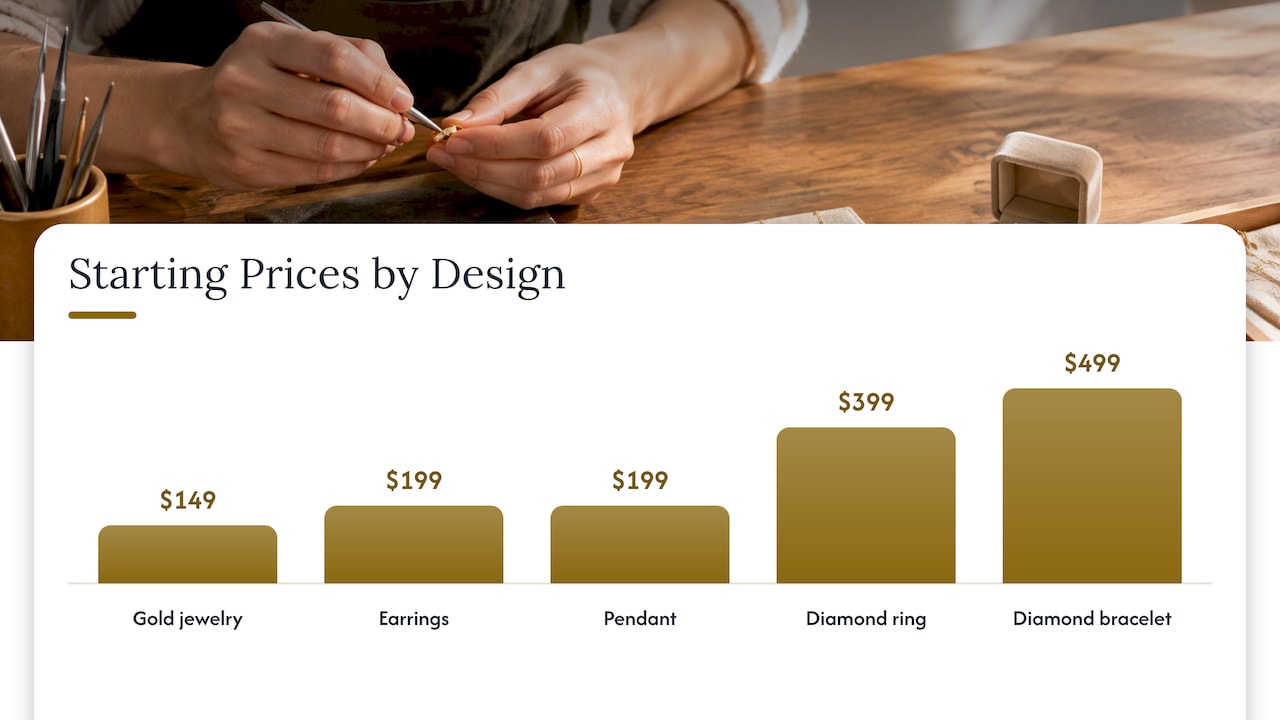
Here are our own starting prices for the “design your own” pieces on our site, all one-time purchases:
| Design your own | Starting price |
|---|---|
| Gold jewelry | $149 |
| Chain | $149 |
| Earrings | $199 |
| Pendant | $199 |
| Diamond ring | $399 |
| Diamond bracelet | $499 |
Your final price depends on the options you choose: diamond shape, diamond quality and metal type. You see those choices as you build, so you can move between them until the design and the budget agree. If you are designing a ring for a proposal, our custom engagement ring design process walks you through it step by step, and the design your own guide covers the builder itself.
The benefits of an in-house jeweler
When the jeweler works for the company that sells the piece, a few things get easier.
Your design is understood by the people building it. Changes like a different stone shape, a thinner band or a different metal are discussed with people who can make them.
Construction is controlled. We make solid jewelry, not hollow or plated pieces. When you control production, you decide what goes inside the piece, not just what it looks like in a photo.
Accountability is simple. If something needs attention after you receive it, there is one company to talk to. Nobody can say it was the supplier’s problem.
Service is personal. We have been a family business since 1999, and more than 222 customers have left us five-star Google reviews. We take that seriously, because jewelry is usually bought for a moment that matters.
What to check before you buy direct
Direct buying works best when you know which questions to ask. A low price is only half of the value. Policies are the other half, so compare them as carefully as you compare the product. Use this checklist with any maker, ours included.
- Metal and construction. Is the piece solid gold, platinum or sterling silver, and is the karat stated? Is it solid or hollow?
- Stone documentation. Does the diamond come with a report from an independent lab?
- Return window. How many days do you have, and is it a money-back guarantee? Ours is 30 days.
- Shipping. Is it insured, and who pays? Ours is free and insured.
- Upgrades. Can you trade up later? Our lifetime diamond upgrade program is built for that: you can move to a larger stone down the road.
- Sizing and care. Who handles resizing, cleaning and repairs after the sale?
- Sourcing. Can the seller explain where its diamonds come from?
Every item on that list is something we are glad to be asked about, and our answers are on our site.
Checking that diamonds are conflict-free
Many buyers want to know their stone was sourced responsibly. In the United States, the Clean Diamond Trade Act requires imported and exported rough diamonds to be handled under the Kimberley Process certification system. Our guide to Kimberley Process diamonds explains what that certificate does and does not tell you.
To go further, ask the seller directly where their stones come from and how they are documented. Ours are ethically sourced and certified. If you are weighing lab-grown stones for the same reason, read our conflict-free versus lab-grown buyer’s guide. For a broader view of the paperwork you may see, our jewelry certification types guide covers what U.S. buyers need.
Who buys direct, and what they choose
The people who shop with us tend to fall into a few groups.
Couples designing an engagement ring. They want a specific shape, a specific metal and a budget they feel good about. Our engagement rings start at $346, and the builder lets you pick the stone and setting separately. Couples planning both rings can read how to design a wedding ring set that matches.
Gift givers. An anniversary, a graduation or a birthday often calls for something personal. Our fine jewelry collections start at $176 for earrings, with pendants from $492, necklaces from $866, rings from $668 and bracelets from $1,303.
Parents choosing something lasting for a child. Sterling silver jewelry starts at $46, a gentle price for a first meaningful piece.
First-time fine jewelry buyers. Platinum jewelry starts at $327, and our platinum guide explains its benefits and care.
Our perspective
We started selling jewelry in 1999, and the thing we learned first is that people do not mind paying for quality. They mind paying for layers they never see.
That is why we make our jewelry in-house and sell it ourselves. When the people who cast the ring also answer your message, you get a fair price and a straight answer. Nobody in the middle takes a cut, and nobody can pass the blame.
We also believe a good price should never mean a thin piece. Ours is solid, not hollow or plated, and our diamonds are certified and ethically sourced. If you want a larger stone later, our lifetime diamond upgrade program lets you grow the piece with your life.
Buying direct is not about finding a trick. It is about dealing with the people who make the thing, and trusting them with the moment it is for.
Joseph
Start designing with us
If you are ready to see what direct pricing looks like for your own design, you can build a ring, chain, earrings, pendant or bracelet on our site, and choose the diamond shape, quality and metal as you go.
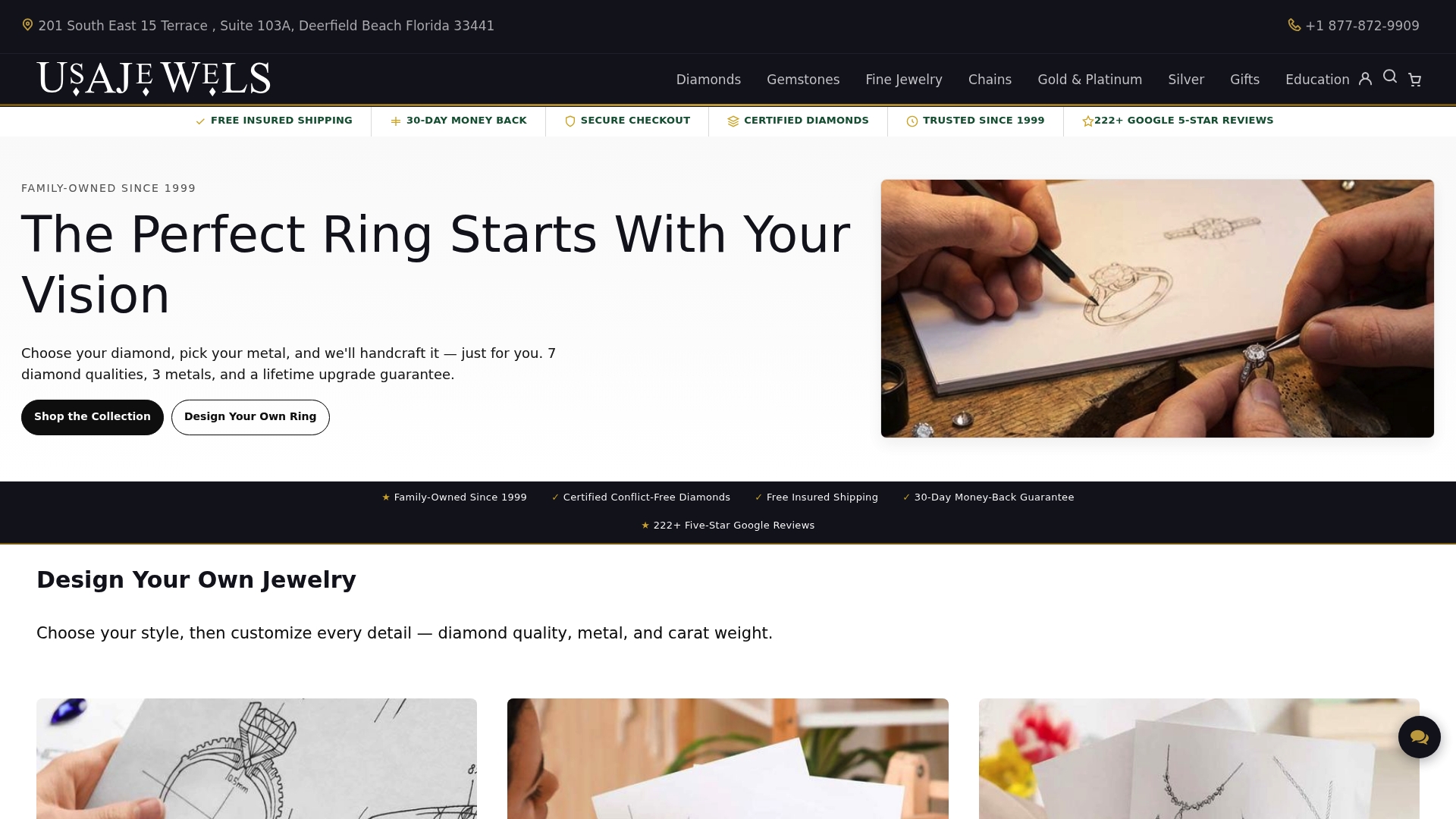
Every order ships free and insured, and our 30-day money-back guarantee gives you time to live with the piece. Start your design at USA Jewels, or browse our gold jewelry collection and gemstone jewelry collection for ready-to-ship ideas.
FAQ
Is direct-to-consumer jewelry really cheaper than retail?
Often, yes, for the finished piece. A maker that sells directly does not pay a wholesaler or carry the cost of a large retail operation for every sale. Diamond prices themselves follow the market, so compare stones by the 4Cs and the grading report, then compare the total price of the finished piece.
Is jewelry from the manufacturer lower quality?
No. Quality depends on the materials and the craftsmanship, not on the sales channel. Ask whether the piece is solid, what karat or metal it is, and whether the diamond has an independent lab report. At USA Jewels, our pieces are solid, not hollow or plated.
What is the difference between wholesale and retail diamond prices?
Wholesale is what a jeweler pays and retail is what you pay. GIA notes that retail cost reflects taxes, competition among jewelers and consumer demand. The best way to judge a price is to compare the stone’s grade and report with similar stones.
What are the benefits of an in-house jeweler?
You deal with the people who design and build your piece, so changes are easier and accountability is clear. It also supports solid construction and consistent service after the sale. We have worked this way as a family business since 1999.
Can I return a ring I design myself?
We offer a 30-day money-back guarantee, and shipping is free and insured. Check the current terms on our site before you order, and ask us about anything that is unclear.
Sources
- Jewelry Manufacturer Direct-to-Consumer Strategy: A Practical 2026 Guide
- How to Get the Best Price for a Diamond | GIA 4Cs
- How Much Does Custom Jewelry Cost? | Jewelers Mutual
- Cartilage Jewelry: Downsize at 4 to 8 Weeks, Swap at 6 to 12 Months | Love Thy Ears
Recommended
- Made-to-Order Jewelry: How It Works, Costs and Timing
- Why Custom Jewelry Beats Store-Bought: Quality and Value
- How to Evaluate Jewelry Craftsmanship for Your First Buy
- In-House Jewelry Manufacturing: What It Is and Why It Matters

Deep Mehta is the Co-Owner of USA Jewels, a family-owned jewelry business she has led since 2013 in Deerfield Beach, Florida. With over 13 years of hands-on experience in fine jewelry retail, manufacturing, and diamond importing, Deep specializes in engagement rings, wedding bands, and custom jewelry design. She also co-manages Kaash Group Talent Acquisition. Deep is a University of Florida graduate and oversees every aspect of USA Jewels’ operations, from product development to marketing.
Fine Jewelry Collection

You May Also Like
Ring Resizing Cost: A U.S. Budgeting Guide for 2026
Why Jeweler Reputation Matters When Buying Fine Jewelry