Jewelry Markup Explained: What You Pay For and Why
Jewelry markup is the amount a seller adds to what a piece costs them to reach the price on the tag. It pays for materials, skilled labor, the shop, the staff, the marketing and the seller’s profit. Reported ranges are wide: roughly 50% to 100% in one diamond guide, and several times that in others. The useful question is not “is there a markup?” but “what does it pay for, and how many hands is it passing through?” We are a family jewelry business, and this is how we explain it to the couples and gift givers who ask.
TL;DR
- Markup is the percentage added to cost. Margin is the share of the selling price that is profit. A 100% markup is only a 50% margin.
- Published figures for diamond and gold jewelry vary widely, so treat any single “average” as a rough guide, not a rule.
- Markup covers real costs: rent, staff, insurance, marketing, inventory and craftsmanship. The number of layers between the maker and you changes how large it gets.
- Compare pieces on specs (metal, weight, stone grade, certificate), not on the tag alone.
- Buying from a maker that manufactures in-house removes middlemen from the chain. That is the model we built at USA Jewels.
Table of Contents
- What jewelry markup actually means
- What the markup pays for
- Typical markup ranges for diamonds
- Markup on gold jewelry
- Does a higher markup mean better jewelry?
- How to compare two quotes
- Why the number of middlemen matters
- Where to start at USA Jewels
- FAQ
- Sources
What jewelry markup actually means
Markup is the retail price minus the cost of the item. Expressed as a percentage, it is that difference divided by cost. Investopedia’s explainer notes that profit margin works from the selling price instead, which is why the two numbers never match.
Here is a simple example with round numbers:
| Cost | Selling price | Markup | Margin | |
|---|---|---|---|---|
| Piece A | $1,000 | $1,500 | 50% | 33% |
| Piece B | $1,000 | $2,000 | 100% | 50% |
| Piece C | $1,000 | $3,000 | 200% | 67% |
This is why you will see sellers quote “keystone” pricing, meaning the price is double the cost. That is a 100% markup and a 50% margin. When someone says a jeweler “makes 50%,” ask whether they mean markup or margin. The same words can describe very different prices.
Markup is also not resale value. What a buyer pays you later for a piece is based largely on its material worth, not what the counter charged. One gold resale explainer makes the point that retail prices include layers resale buyers do not pay for. Jewelry is bought for the occasion, the design and the years of wear, not as a trading product.
Markup shows up in any made-to-order trade. Art framing costs break down the same way, into materials, skilled labor and overhead, and the quote makes more sense once you can see those parts.
What the markup pays for
A tag price is not material cost plus profit. One buyer’s guide lists what sits inside it: storefront rent, display cases, insurance, skilled sales staff, security, marketing and the cost of carrying inventory. For gold jewelry, the same guide says the markup mostly covers making charges for design, craftsmanship and finishing.
Trade press says the same thing from the seller’s side. A June 2026 Rapaport feature quotes a Texas retailer saying that store overhead, including space, sales force, marketing and inventory, makes it hard to move away from keystone pricing. It also quotes a Florida designer saying keystone markups are getting harder to sustain as gold costs climb.
So a markup is not one thing. It is a bundle:
- Materials: metal and stones, at their market cost.
- Labor: design, casting, setting, polishing, quality checks.
- Overhead: showroom, staff, insurance, security, software and shipping.
- Marketing: advertising, brand licensing, sponsorships.
- Profit: what keeps the business open.
When you compare two sellers, the difference usually comes from the overhead and marketing lines, because materials and craftsmanship cost roughly the same for everyone making a comparable piece.
Typical markup ranges for diamonds
People search this because they want a number. The honest answer is that published numbers disagree, and the differences tell you something.
- One diamond buying guide gives a typical range of 50% to 100%, meaning a $1,000 cost sold for $1,500 to $2,000. The same page says average diamond jewelry markups run from 100% to 200%, depending on the retailer’s reputation, location, exclusivity and demand.
- Another guide puts averages at around 160% to 300%, and says luxury retailers can go far higher.
- A hidden-camera report from 2017 described markups of more than 250% at prestige brands for stones it called virtually identical. It also noted that business resources describe most retail markups as around 50%.
Three sources, three different answers. The spread exists because “diamond jewelry” covers a loose stone, a finished ring and a luxury brand’s signature piece, and each has a different cost structure. No single average describes them all, so be wary of any article, including this one, that gives you one number and stops there.
Stone versus setting
One detail helps when you read a quote. According to LegalClarity, loose diamonds and high-value gemstones often carry markups of only 10% to 20%, because buyers comparison-shop them heavily. Metal settings and mountings can be marked up much more, sometimes 200% or beyond. In that view, much of a finished ring’s markup sits in the setting rather than the center stone.
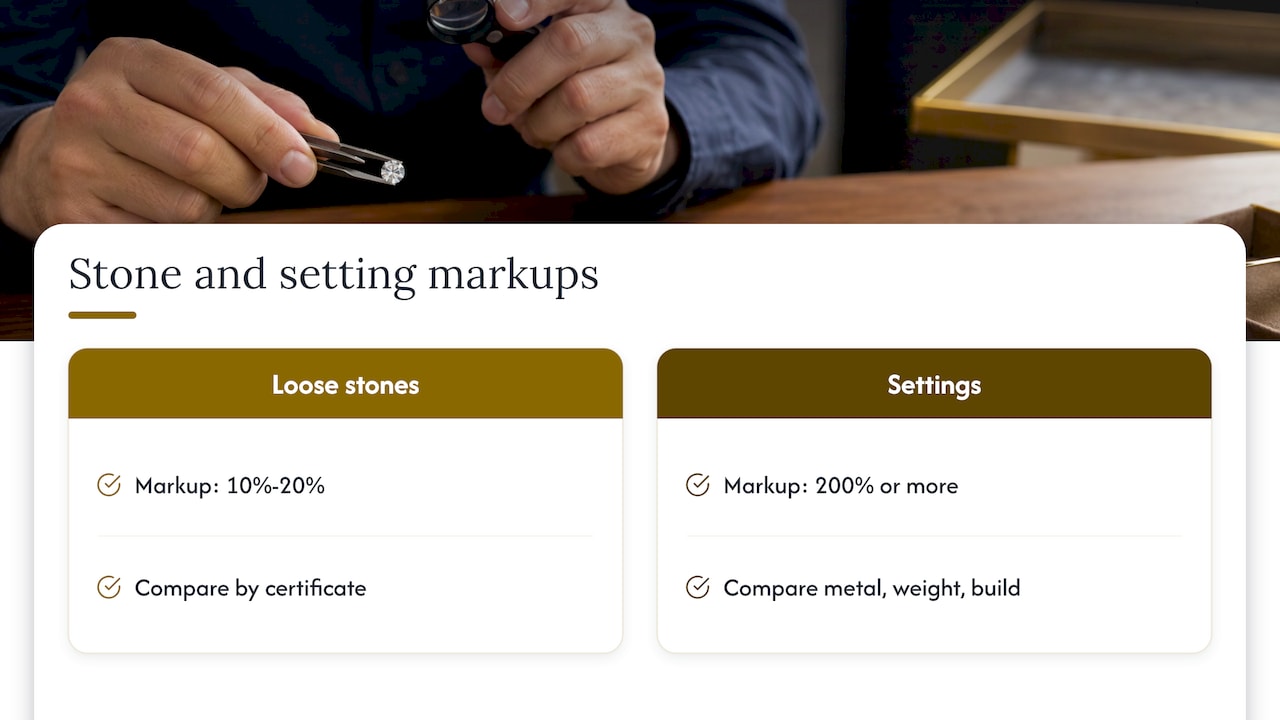
That is a practical reason to look at a ring as two parts: the stone, which you can compare by certificate, and the mounting, which you can compare by metal, weight and build.
Natural versus lab-grown
Lab-grown stones have changed the picture. According to JCK, at U.S. specialty jewelers lab-grown-set pieces made up 20.5% of diamond jewelry unit sales in 2025 but 15.4% of revenue. Lab-grown engagement rings were 53% of diamond engagement rings sold and 27% of their sales value. The same report puts the average spend on a lab-grown engagement ring at $2,448, down nearly 8%.
The takeaway for a shopper: a lab-grown stone carries a lower price tag, but the markup percentage on it is a separate question from the price. What matters is that you can see the certificate and the full price of the finished piece.
Markup on gold jewelry
Gold works differently because the metal has a daily market price. The Gemological Institute-style method published by the International Gem Society shows how to estimate a jeweler’s markup from three inputs: the piece’s weight, its karat purity and the current gold price. Compare that melt value to the retail price and the gap is the markup, and with it the labor, design and overhead.
Reported figures vary here too:
- A U.S. jeweler’s blog says most retail gold jewelry carries a markup of 100% to 300% above melt value. It adds that branded pieces, complex fabrication and lower-karat jewelry run higher, since labor costs stay the same while the alloy is cheaper.
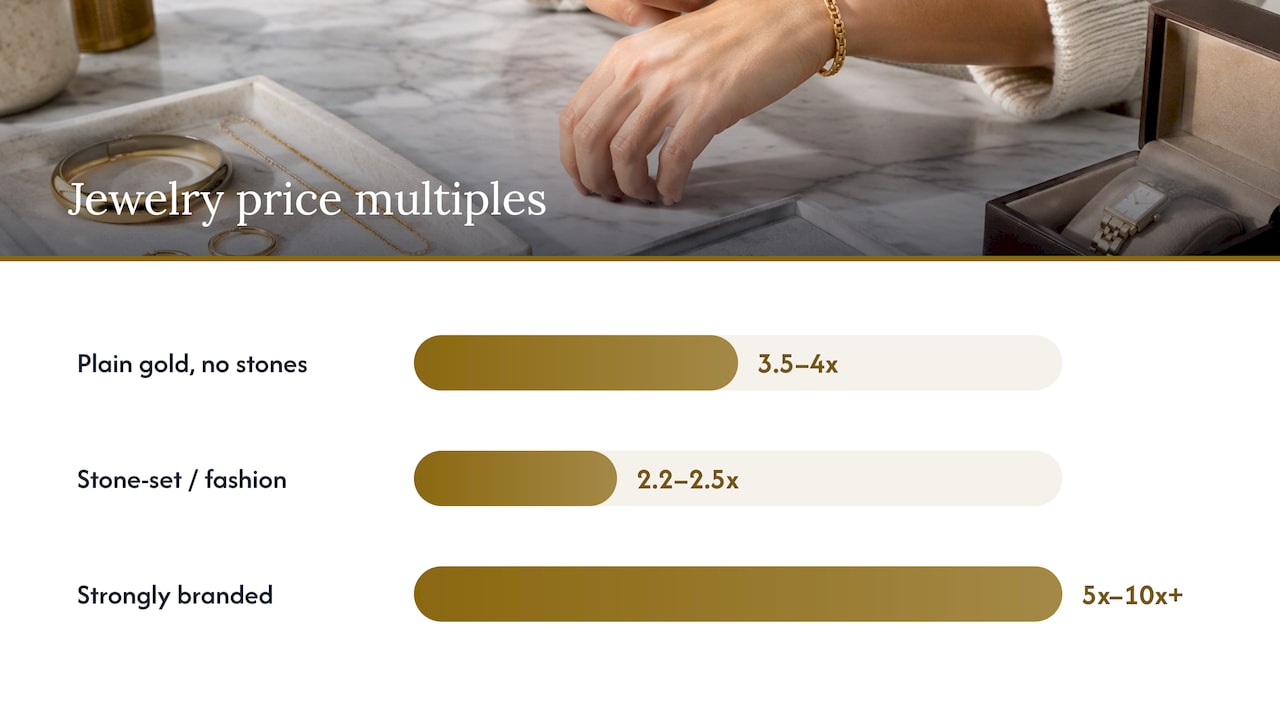
- A 2026 pricing article says plain gold pieces without stones typically price at 3.5x to 4x cost, stone-set and gemstone fashion pieces at 2.2x to 2.5x, and strongly branded pieces at 5x to 10x or beyond. That article is written for jewelry sellers, so it shows how the trade thinks about pricing.
A 14K chain and a hand-finished pendant both contain gold, but the second contains far more labor. A fair gold price reflects both, and that is why weight alone does not tell the full story. Our own guide on why handcrafted jewelry costs differ goes into the labor side in more depth.
Does a higher markup mean better jewelry?
Not by itself. A higher price is justified when it buys something you can measure. One buyer-education piece lists them: better metal purity, more grams of metal, stronger settings, better stone matching, higher workmanship and meaningful certification. It also notes that marketing-heavy pricing leans on words like “luxury” and “timeless” without giving specs.
So read the listing like a checklist:
- Metal and karat. Is it solid gold or platinum, and what purity?
- Weight. How many grams? Two rings that look alike can differ a lot.
- Construction. Solid or hollow, plated or not.
- Stone grade and certificate. Which lab, and can you read the report? Our diamond certification guide compares GIA, AGS and IGI.
- Return and upgrade terms. What can you do if you change your mind?
There is also a legal floor. The FTC Jewelry Guides, found in 16 CFR Part 23, govern how jewelers describe metal content, gemstone quality and treatments. According to LegalClarity’s summary, they do not cap markups, but they do stop a seller from charging premium prices for misrepresented goods, such as passing off a lab-created stone as natural or overstating a diamond’s grade.
What “conflict-free” does and does not tell you
Ethical claims are another place where price and substance can drift apart. The Kimberley Process certificate applies to rough diamonds: the exporting country’s authority issues it at export and importing authorities verify it. According to the Kimberley Process Q&A, it is not a certificate of origin and does not necessarily state where the stones were sourced. If an ethical claim matters to you, ask the jeweler what their sourcing statement says in detail. Our posts on what the Kimberley Process certificate means and what diamond provenance means cover how to ask.
How to compare two quotes
You do not need to calculate a seller’s markup exactly. You need to compare like with like.
- Write down the specs. Metal, karat, weight in grams, stone shape, carat, color, clarity, cut and certificate.
- Split the ring. Price the stone and the mounting separately if you can. Loose stones are easy to compare by report number.
- Check the total, not the headline. Shipping, insurance, sizing and resizing, and any fees.
- Look at the policies. A money-back window and an upgrade program are part of what the price buys.
- Ask who makes it. A piece that passes through a designer, a distributor and a retailer collects a markup at each step.
For a gold piece, the International Gem Society method above gives you a quick sanity check. For a diamond, our diamond pricing guide shows what stones at different quality levels usually cost.
Why the number of middlemen matters
If the markup is a bundle of overhead, then fewer layers means a smaller bundle. A brand that designs in one place, sources from a wholesaler, sells through a retailer and pays for national advertising has to cover all of those layers in one tag. A maker selling directly has fewer to cover.
That is the idea behind our model. We are a family-owned business that has been making jewelry since 1999, and we manufacture in-house, so pieces go from our bench to you without a wholesale step between. We explain what that means in practice in our post on in-house jewelry manufacturing.
Our point of view
People often ask us whether there is a “fair” jewelry markup. We think the better question is whether you can see what you are paying for. A price should be explained by solid metal, a real certificate and honest craftsmanship, not by a famous name or a glass-fronted storefront.
That is why we make our jewelry ourselves. When the same family designs, casts, sets and ships a piece, there is no wholesaler or distributor to pay, and the saving goes into the price you see. Our pieces are solid, not hollow or plated, and our diamonds are certified and conflict-free.
We also think a purchase should not end at checkout. That is why we offer free insured shipping, a 30-day money-back guarantee and lifetime diamond upgrades. A diamond you love today can become a bigger one later, and you should not have to start over.
Ask any jeweler, including us, to show you the specs. We are happy to.
Joseph
Where to start at USA Jewels
If you would like to see a direct-from-the-maker price, start with what you want to buy. Our certified loose diamonds start at $142, so you can compare stones by certificate. Engagement rings start at $346, and you can design your own diamond ring from $399, choosing the diamond shape, the quality and the metal yourself.
For gifts, our fine jewelry collections start at $176, and sterling silver pieces start at $46. Our step-by-step design guide walks through the choices, and more than 222 Google reviews come from families who have been through it. If you are weighing us against other online options, our guide to choosing a certified ethical diamond jeweler lists what to look for.
FAQ
What is the average markup on diamond jewelry?
There is no single reliable average. One buying guide cites 50% to 100% as a typical range, while others put averages at 100% to 300% or higher, and luxury brands can exceed that. The range depends on whether you are buying a loose stone, a finished ring or a branded piece, so compare specific quotes rather than a headline figure.
Is markup the same as profit?
No. Markup is the amount added to cost, and it has to cover rent, staff, insurance, marketing and inventory as well as profit. Margin is the share of the selling price that is profit. A 100% markup equals a 50% margin.
Why do lab-grown diamonds cost less if the markup is similar?
The stone costs less to begin with, so the final price is lower even when the percentage added looks familiar. U.S. specialty jeweler data from JCK shows lab-grown engagement rings were 53% of diamond engagement ring units in 2025 but 27% of their sales value. Judge the stone by its certificate and the total price of the piece.
How can I tell if a jewelry price is fair?
Compare specs: metal and karat, weight, construction, stone grade and certificate. Then compare the full cost, including shipping, insurance and returns. For gold, you can estimate melt value from weight, purity and the day’s gold price, and see how the rest of the price breaks down into labor and overhead.
Sources
- Profit Margin vs. Markup: Key Differences Explained, Investopedia
- Does Jewelry Depreciate? Resale Pricing Explained
- What Is the Markup on Jewelry and How to Pay Less
- Retailers and Designers Need to Find a Business Balance, Rapaport
- What Is The Typical Markup On Diamond Jewelry
- What Is The Markup On Diamonds?
- Hidden Camera Video Reveals Just How High Diamond Markups Can Be
- How Do Jewelers Make Money: Markup, Repairs and More, LegalClarity
- Lab-Grown Diamond Jewelry Sales Hit $23.8 Billion, JCK
- Gold Markup for Jewelry: The Ultimate Guide, International Gem Society
- What Is the Markup on Gold Jewelry?
- Jewelry Pricing Strategy: Beyond Keystone Markup
- Jewelry Margins Explained: What You’re Really Paying For
- Kimberley Process Q&A
- What Art Framing Really Costs
Recommended
- Why Handcrafted Jewelry Costs Differ: A Buyer’s Guide
- In-House Jewelry Manufacturing: What It Is and Why It Matters
- Why Custom Jewelry Beats Store-Bought: Quality and Value
- How to Spot Quality Jewelry Craftsmanship Like a Pro

Deep Mehta is the Co-Owner of USA Jewels, a family-owned jewelry business she has led since 2013 in Deerfield Beach, Florida. With over 13 years of hands-on experience in fine jewelry retail, manufacturing, and diamond importing, Deep specializes in engagement rings, wedding bands, and custom jewelry design. She also co-manages Kaash Group Talent Acquisition. Deep is a University of Florida graduate and oversees every aspect of USA Jewels’ operations, from product development to marketing.
Fine Jewelry Collection

You May Also Like
Buy With Confidence: When Laser-Drilled Diamonds Make Sense
Safe Jewelry Metals for Children: A Parent’s Guide