Lab Diamond Prices in 2026: What You Should Expect to Pay
A one-carat lab-grown diamond now averages about $502 at retail in the US, and a lab-grown engagement ring averages about $4,300. Those are averages. The price of your stone depends on its size, shape, color, clarity, cut and certificate, and two stones that look alike on paper can sit hundreds of dollars apart. Here is what the numbers look like, why they differ, and how to shop with confidence.
TL;DR
- The average one-carat lab-grown diamond asked about $502 in October 2026, against $3,820 for a natural one-carat, according to JewelersTrend’s reporting on StoneAlgo data.
- The average lab-grown engagement ring cost $4,300 in 2025, with a 2.0-carat center stone, per The Knot’s Real Weddings Study.
- Prices have fallen sharply since 2023, but wholesale prices have started to flatten, so waiting for a much lower price is no sure bet.
- Shape, cut quality and certification explain most of the gap between two quotes for the “same” carat weight.
- Set your budget for the whole ring. The setting, metal and finishing now make up a large share of the final price.
Table of Contents
- What lab-grown diamonds cost at retail right now
- Price per carat: why the numbers look so different
- Why prices fell and whether they will keep falling
- What actually sets the price of your stone
- What a lab-grown engagement ring costs
- What $1,000 buys
- How to buy at a fair price
- Our point of view
- Shop certified lab-grown diamonds and custom rings
- FAQ
- Sources
What lab-grown diamonds cost at retail right now
The cleanest recent snapshot comes from retail asking prices. JewelersTrend reported that StoneAlgo’s one-carat lab-grown average was $502 on October 14, 2026, compared with $3,820 for a one-carat natural diamond. From December 2023 to October 2026, the average lab-grown asking price fell 31%, from $732 to $502.
That is a big move, and it shapes how you should read any price list you find online. A “typical” price from 2023 or even early 2025 is out of date. When you compare stones, check that the quotes were pulled recently.
Also keep in mind that an average is a midpoint. A one-carat stone with modest color and clarity sits well under it. A one-carat stone with top color, high clarity and an excellent cut sits above it. Our own certified loose diamonds start at $142, which gives you a sense of how far down the range goes for smaller or more modest stones. You can browse the current selection on our certified loose diamonds page.
Price per carat: why the numbers look so different
People who search for lab diamond cost per carat often find figures that seem to contradict each other. Usually they are measuring different things.
Wholesale prices are what jewelers and manufacturers pay for stones. Edahn Golan’s Q3 2026 price list, updated October 7, 2026, shows average wholesale transaction prices for IGI-certified round lab-grown diamonds of $87 per carat for a 1-carat D VVS, $120 per carat for 2 carats and $142 per carat for 3 carats. Round prices rose 2% quarter on quarter, though the index is still 15% lower than a year earlier.
Retail prices are what you pay. They include the seller’s operating costs, the certificate, insurance, inventory risk and margin. They are higher than wholesale, and they vary far more from seller to seller.
As JewelersTrend’s Richard Wrighterson put it, the lab-grown center stone is now priced almost like a component, with the real money in the mounting, finishing and finished piece. So when you compare, compare the stone price and the finished price separately.
A quick reference
| Measure | Figure | Period |
|---|---|---|
| Average retail asking price, 1 ct lab-grown | $502 | October 2026 |
| Average retail asking price, 1 ct natural | $3,820 | October 2026 |
| Wholesale, 1 ct D VVS round (IGI) | $87 per carat | Q3 2026 |
| Wholesale, 2 ct D VVS round (IGI) | $120 per carat | Q3 2026 |
| Wholesale, 3 ct D VVS round (IGI) | $142 per carat | Q3 2026 |
| Average lab-grown engagement ring | $4,300 | 2025 |
Sources for each row appear in the sections around this table and in the list at the end.
Why prices fell and whether they will keep falling
Lab-grown wholesale prices dropped 26% year on year in 2025, and the quarterly declines slowed to 4.7%, the smallest since lab-grown stones entered the market. Larger stones took the heaviest pressure: 3-carat rounds fell 32%, while 1.50-carat goods slipped only 8%.
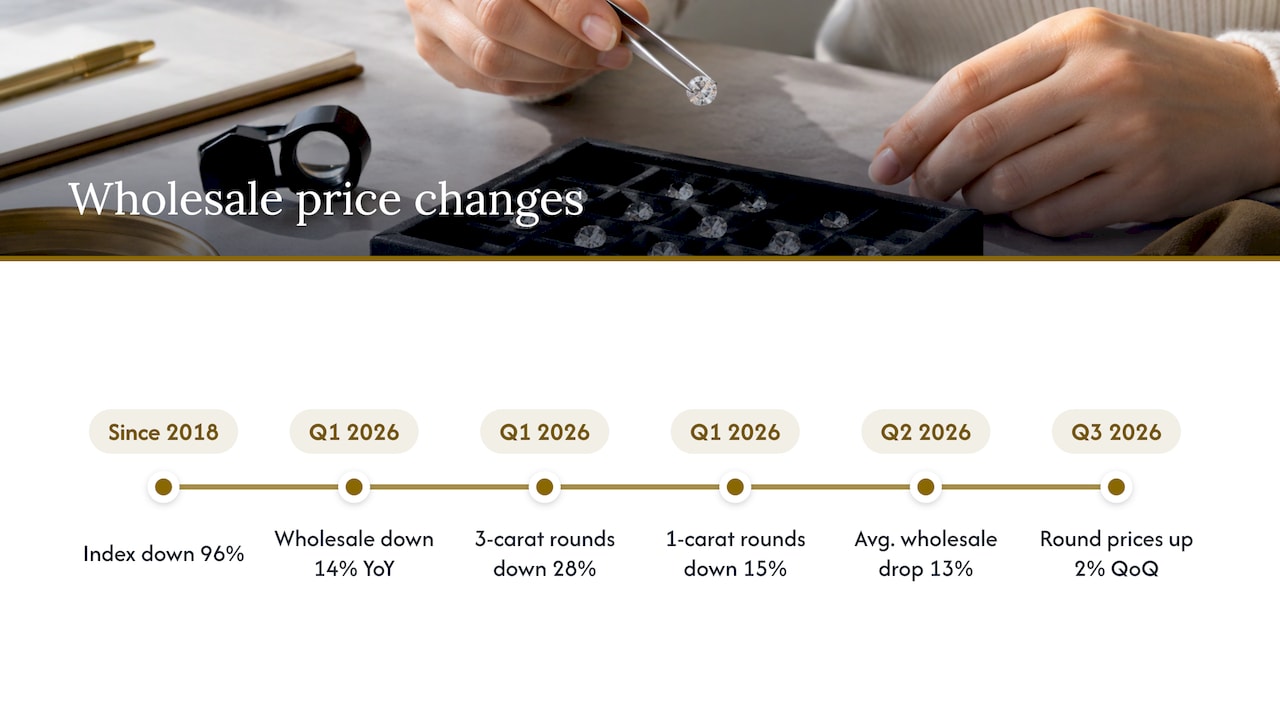
In 2026 the slide has continued but at a gentler pace. Wholesale prices fell 14% year on year in Q1, with 3-carat rounds down 28% and 1-carat rounds down 15%. JCK Online reported that Q2 numbers showed a 13% average drop, and that the wholesale index is down 96% since tracking began in 2018. The Q3 list, by contrast, shows round prices ticking up 2% on the quarter, which Golan’s commentary reads as a possible sign the market is nearing a floor.
What does that mean for you? Nobody can predict next quarter. What we can say is that the steep drops that made people say “just wait” are flattening. If you have a proposal, a wedding date or an anniversary coming, a fair price today is a better plan than holding out for a bigger discount. Our guide to why lab-grown diamonds cost less explains the production side in more detail.
What actually sets the price of your stone
Two lab-grown diamonds of the same weight can differ a lot in price. These are the factors, roughly in order of impact.
Carat weight
Price rises faster than weight. A 2-carat stone costs more than twice a 1-carat stone of the same quality, because larger stones are harder to grow. Prices also jump at popular sizes. A 0.95-carat stone usually costs less than a 1.00-carat stone that looks nearly identical face up. Ask for sizes just under the round number.
Cut
Cut controls how well the stone returns light. It is the factor that most affects how the diamond looks, and we recommend never trading it down to save money. Our piece on choosing cut first, then color and clarity walks through the order we suggest.
Color and clarity
Higher grades cost more, but the visible difference narrows quickly once a stone is mounted. Many buyers choose a near-colorless grade and a clarity grade that looks clean to the eye instead of paying for the top of the scale. If you want help picking, read our guide to the best clarity for an engagement ring.
Shape
Round stones usually cost the most per carat because of demand and how much rough crystal is lost in cutting. Ovals, cushions, pears and emeralds often give more visual size for the money. Oval is the most popular shape among lab-grown buyers, according to The Knot’s study. Our diamond shapes guide compares them side by side.
Certification
A grading report from a recognized lab confirms what you are buying. Reports are not all equal in how strictly they grade, so the same stated grades can carry different prices. Our diamond certification guide compares GIA, AGS and IGI so you can read a listing properly.
What a lab-grown engagement ring costs
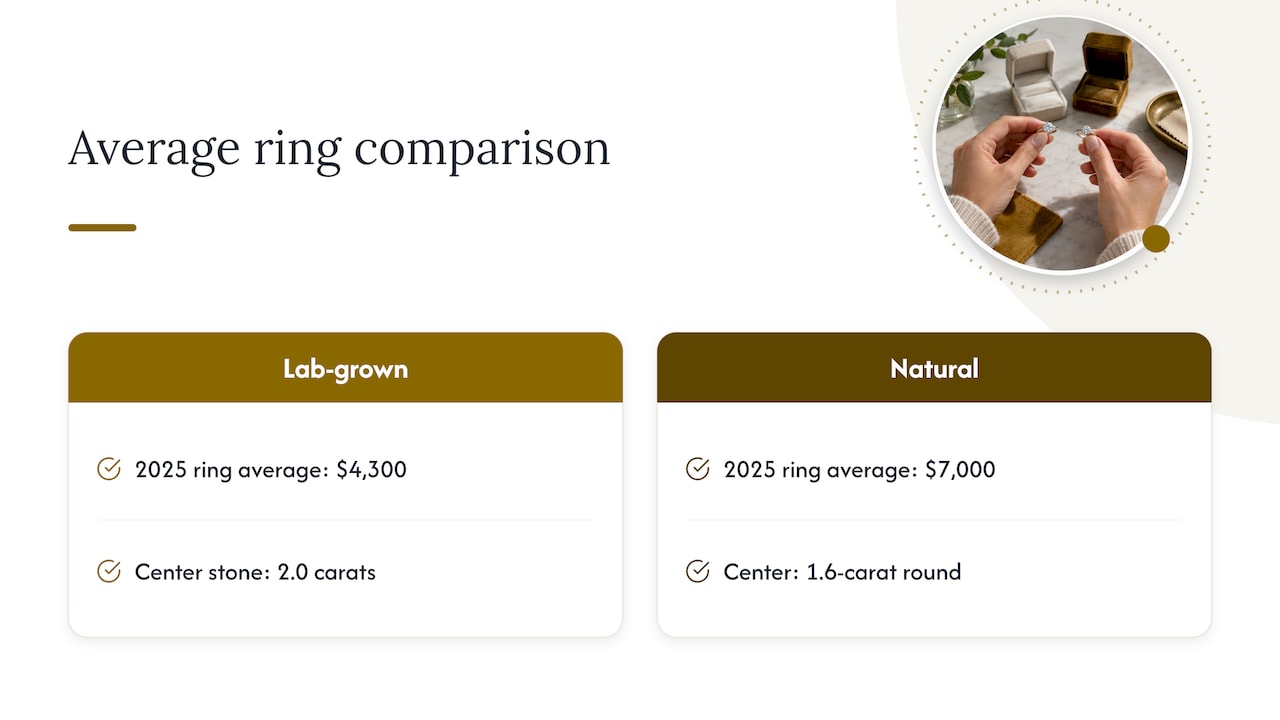
The average lab-grown engagement ring in 2025 cost $4,300, with an average center stone of 2.0 carats, according to The Knot’s Real Weddings Study. The average natural-diamond ring cost $7,000 with a 1.6-carat round, and the overall average across both was $4,600. Sixty-one percent of couples who married in 2025 chose a lab-grown center stone, up from 52% in 2024.
Notice what the numbers say: lab-grown buyers are not spending much less in total. They are getting a larger stone for the same budget. The Knot’s own analysis ties the shift to “economic pragmatism and evolving values”, with 40% of couples saying it was specifically important that their stone be lab-grown.
Earlier data from The Knot’s 2024 study put the average engagement ring at $5,200 across all stone types, with 64% of couples spending under $6,000 and 33% under $3,000. The same page says lab-grown diamonds can cost 50% to 70% less than natural stones of comparable size and quality.
Where the rest of the ring’s price goes
The stone is only part of the bill. The setting, the metal (14K gold, 18K gold or platinum), side stones and the finishing work decide the rest. On a ring with a stone near $500, the setting can easily cost more than the diamond. That is why we build rings with solid construction, not hollow or plated, and why comparing the metal and weight of two settings matters as much as comparing stones.
Our engagement rings start at $346, and you can see the range on our engagement rings page. If you would rather choose each part yourself, our design-your-own diamond ring starts at $399. For a deeper budget walk-through, see our engagement ring budget guide and our article on engagement rings in the $3,000 to $7,000 range.
What $1,000 buys
This is the question behind many searches, and no single price list answers it, because the answer depends on how you trade the 4 Cs against each other. Using the October 2026 retail average of about $502 for one carat as a rough yardstick, a $1,000 budget points toward a stone in the neighborhood of two carats at average quality, or a one-carat stone with higher grades. That is arithmetic on an average, not a quote, and individual stones will land above or below it.
The spread is wide. Buyers in lab-diamond communities regularly note that two 5-carat F VVS2 emerald cuts, both IGI-certified, can be priced at $1,000 and at $3,000 depending on the seller, which is why the same grades do not guarantee the same price.
When two quotes for similar stones differ, compare these things:
- Certificate. Which lab graded it, and is the report number listed?
- Cut grade. Excellent or ideal cut on round stones; for fancy shapes, check proportions and the length-to-width ratio.
- Real color and clarity grades. Same letters, same report type.
- Carat weight. Exact, not rounded.
- Return window and shipping. Insured shipping and a money-back period are part of the price.
- What happens later. Ask whether there is an upgrade program.
We offer free insured shipping, a 30-day money-back guarantee and lifetime diamond upgrades, so those points are covered when you buy from us.
How to buy at a fair price
- Decide your total budget first. Include the setting and metal.
- Pick your shape and a size range instead of a single carat weight.
- Fix cut quality, then relax color and clarity to a level that looks clean to the eye.
- Compare certified stones by their report and by price per carat at the same grades.
- Choose a setting that fits the stone. A solid setting in the metal you want will last.
If you are weighing lab-grown against natural, our lab-grown vs natural diamonds guide lays out the differences, and our page on how lab-created diamonds are made and valued covers the process. If ethical sourcing is on your mind, our conflict-free diamond vs lab-grown buyer’s guide is a good next read.
Our point of view
We have been a family-owned business since 1999, and we make our jewelry in-house. That matters for lab diamond prices more than people think. When a stone costs a few hundred dollars, the gap between a fair price and an inflated one is mostly markup, and we have never liked markup that does not do anything for the customer.
Our advice is simple. Put your money into cut quality and a solid, well-made setting. A lab-grown stone has become affordable enough that you can choose a larger size or a better grade without stretching your budget. A ring is also something you wear every day for decades, so we build ours solid, not hollow or plated, and we back our diamonds with a lifetime upgrade program.
Buy what you love, from people who will answer the phone later. That is the tradition we grew up with, and it is how we treat every couple who walks in or orders online.
Joseph
Shop certified lab-grown diamonds and custom rings
If you are ready to see real stones, our certified loose diamonds start at $142, and you can pair one with a setting you design yourself. Our design-your-own diamond ring starts at $399, and you choose the diamond shape, quality and metal. Shipping is free and insured, and every order comes with a 30-day money-back guarantee.
Prefer to start from a finished design? Look through our engagement rings, or use our step-by-step design guide to plan your own.
FAQ
How much does a lab-grown diamond cost per carat?
At retail, a one-carat lab-grown diamond averaged about $502 in October 2026. Wholesale is far lower: Q3 2026 averages for IGI-certified round D VVS stones ran from $87 per carat at 1 carat to $142 per carat at 3 carats. Your actual price depends on cut, color, clarity, shape and seller.
How much is a lab-grown engagement ring?
The average lab-grown engagement ring cost $4,300 in 2025, with a 2.0-carat center stone. Your total depends on the setting and metal as much as the diamond. Our engagement rings start at $346, and our design-your-own diamond ring starts at $399.
Are lab-grown diamond prices still dropping?
Yes, but more slowly. Wholesale prices fell 26% in 2025 and about 13% to 14% year on year in the first half of 2026, while the Q3 2026 round-diamond index rose 2% on the quarter. If you need the ring soon, a fair price today is a sound choice.
Why do two lab diamonds with the same grades have different prices?
The certificate lab, the cut quality, the shape and the seller’s pricing all play a part. Stones near round carat sizes, such as 1.00 or 2.00, also carry a premium over those just below. Compare the report and exact specs, not only the letters.
Is a lab-grown diamond a real diamond?
Yes, it is a diamond with the same crystal structure as a mined one, grown in a controlled setting. Our lab-created diamonds page explains how they are made and graded.
Sources
- JewelersTrend: lab-grown and natural retail averages, October 2026
- Edahn Golan: Lab-Grown Diamond Wholesale Price List, Q3 2026
- Edahn Golan: wholesale prices down 26% in 2025
- AIDI: wholesale prices fall 14% in Q1 2026
- JCK Online: lab-grown wholesale prices
- IDEX Online: six out of 10 US engagement rings are lab-grown
- Rapaport: lab-grown and engagement-ring spending
- The Knot: average engagement ring cost
Recommended
- Why Lab-Grown Diamonds Cost Less: 2026 Price Guide
- Are Lab-Grown Diamonds Worth It? A Practical 2026 Guide
- Diamond Pricing Guide: What Diamonds Cost
- Lab-Grown vs Natural Diamonds Guide
Deep Mehta is the Co-Owner of USA Jewels, a family-owned jewelry business she has led since 2013 in Deerfield Beach, Florida. With over 13 years of hands-on experience in fine jewelry retail, manufacturing, and diamond importing, Deep specializes in engagement rings, wedding bands, and custom jewelry design. She also co-manages Kaash Group Talent Acquisition. Deep is a University of Florida graduate and oversees every aspect of USA Jewels’ operations, from product development to marketing.
Fine Jewelry Collection

You May Also Like
How Lab-Grown Diamonds Are Ethically Produced
How to Spot Quality Jewelry Craftsmanship Like a Pro