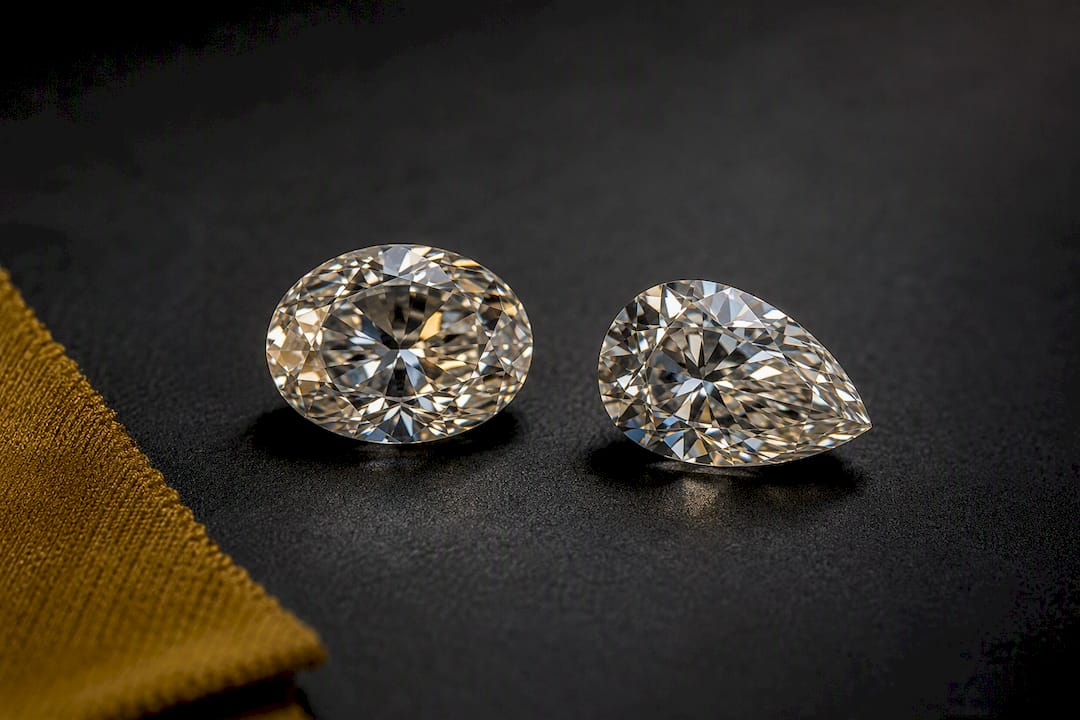
Oval vs Pear: Pick the Right 1.3–1.5 Ratio and Avoid Bow Tie Traps
If you want a versatile, balanced look, choose an oval. If you want a distinctive, directional silhouette, choose a pear. The right pick still depends on the individual stone’s millimeter proportions and bow-tie strength rather than the shape name alone, and pears need thoughtful tip protection to wear well over time.
TL;DR:
- The face-up size of oval and pear diamonds of the same carat is nearly identical, so visual perception relies more on proportions than weight.
- Proper inspection of individual stones’ millimeter dimensions and symmetry is crucial, as certification alone cannot predict how a shape performs under light.
- Bow-tie shadows vary in severity, and slow tilting videos help determine if a faint, lively bow-tie indicates a well-cut stone or a dull, static one.
- Protecting a pear’s pointed tip with a V-prong or bezel is essential for durability, whereas ovals benefit from secure four- or six-prong settings to prevent chipping.
- Buyer preference and perceived size depend more on the proportions and setup rather than the shape’s reputation, emphasizing the importance of examining each stone carefully.
Table of Contents
- Outline, proportions, and perceived size: why millimeters beat carats
- Brilliance and bow-tie: what to expect and how to judge it
- Finger-flattering effects: orientation, ratio, and band pairing
- Settings and durability: protecting a pear’s point, securing an oval
- Buying checklist: step-by-step tests before you commit
- What reputable sellers, including USA Jewels, should provide
- Historical and cultural significance of oval and pear diamond shapes
- Pricing trends and resale value between the two shapes
- Celebrity and fashion influence on oval and pear popularity
- Color and clarity appearance differences by shape
- How cut grades apply differently to each shape
- The real deciding factor most buyers overlook
- How USA Jewels can help you choose and protect your stone
- Sources
- FAQ
Outline, proportions, and perceived size: why millimeters beat carats
An oval is a symmetrical ellipse, rounded at both ends. A pear pairs one rounded end with a single point, borrowing its profile from both the round brilliant and the marquise. Both are classified as elongated modified brilliants, and both typically look best with a length to width ratio between about 1.3 and 1.5, though personal taste varies widely, as explained in GIA’s diamond guidance.
Carat weight tells you what the stone weighs, not how big it looks on your hand. A same-carat comparison of two 2 carat stones found the oval’s face-up area measured 57.21 square millimeters against 57.17 square millimeters for the pear, a difference of about 0.1%. Two stones with the same carat weight can wear almost identically on the finger, or very differently, depending on how shallow or deep the cut runs.
Before you fall for a listing photo, ask the seller for the actual numbers:
- Length, width, and depth in millimeters, not just carat weight.
- The calculated face-up area or spread, when the seller provides it.
- The length to width ratio, stated as a number like 1.4:1.
- Confirmation of symmetry grade and any visible inclusions near the outline.
Our oval diamond guide and carat weight guide walk through how these numbers translate into real-world size.
Brilliance and bow-tie: what to expect and how to judge it
Elongated shapes bend light differently than round brilliants, and that often produces a bow-tie, a shadow across the center of the stone shaped roughly like a bow tie. This happens in both ovals and pears, and it isn’t automatically a flaw. GIA’s gemological guidance draws the meaningful distinction between a faint, lively bow-tie that shifts with movement and a dark, static one that dominates the stone.
A certificate cannot settle this for you. Lab reports grade proportions and clarity, but they don’t fully capture how an elongated stone performs under real light, which is why direct inspection matters more here than with a round brilliant.
Before committing to a specific stone, you may find it helpful to consult a wedding videographer and photographer in Kansas City, MO who can advise on capturing the best angles and videos of your selected diamond.
- Ask for a rotating video filmed under normal indoor lighting, not just a studio close-up.
- Watch whether the bow-tie disappears or intensifies as the stone tilts.
- Compare the same shape across two or three vendors to calibrate what “faint” actually looks like.
Our bow-tie effect guide covers common causes in more depth.
Pro Tip: Watch the video with the stone moving slowly rather than spinning fast. A bow-tie that softens at a slow tilt usually reads as lively in person; one that stays dark at every angle usually won’t improve on your hand.
Finger-flattering effects: orientation, ratio, and band pairing
An oval spreads its length evenly across the finger, which tends to soften and elongate fingers of most widths without drawing attention to any one point.
A pear concentrates that same length toward its tip, creating a directional pull that many people find slims the finger more noticeably when the point faces the fingertip.
Orientation changes the story further. According to the American Gem Society, a point-up pear emphasizes lengthening in the traditional way, while a point-down or east-west setting shifts the look toward something more fashion-forward and less classically elongating. Confirm which orientation you want before finalizing the setting, since remounting later adds cost and time.
A few pairing notes worth considering:
- A higher length to width ratio (closer to 1.5) reads more slender; a lower ratio (closer to 1.3) reads fuller and softer.
- Curved or contoured wedding bands nest more naturally against a pear’s point than a straight band does.
- A halo adds perceived width to either shape, which can balance a narrower finger or add presence to a smaller carat weight.
- Shorter fingers often pair well with a slightly lower ratio on either shape, since extreme elongation can look disproportionate at a glance.
Settings and durability: protecting a pear’s point, securing an oval
A pear’s tip is its most vulnerable point, and reputable setters address that with a V-prong, a notched prong shaped to cradle the point on both sides, or a bezel tip that wraps metal fully around it. Either option meaningfully reduces the risk of chipping from everyday knocks. Our pear-shaped diamond guide goes into more detail on which setting works with which ring style.
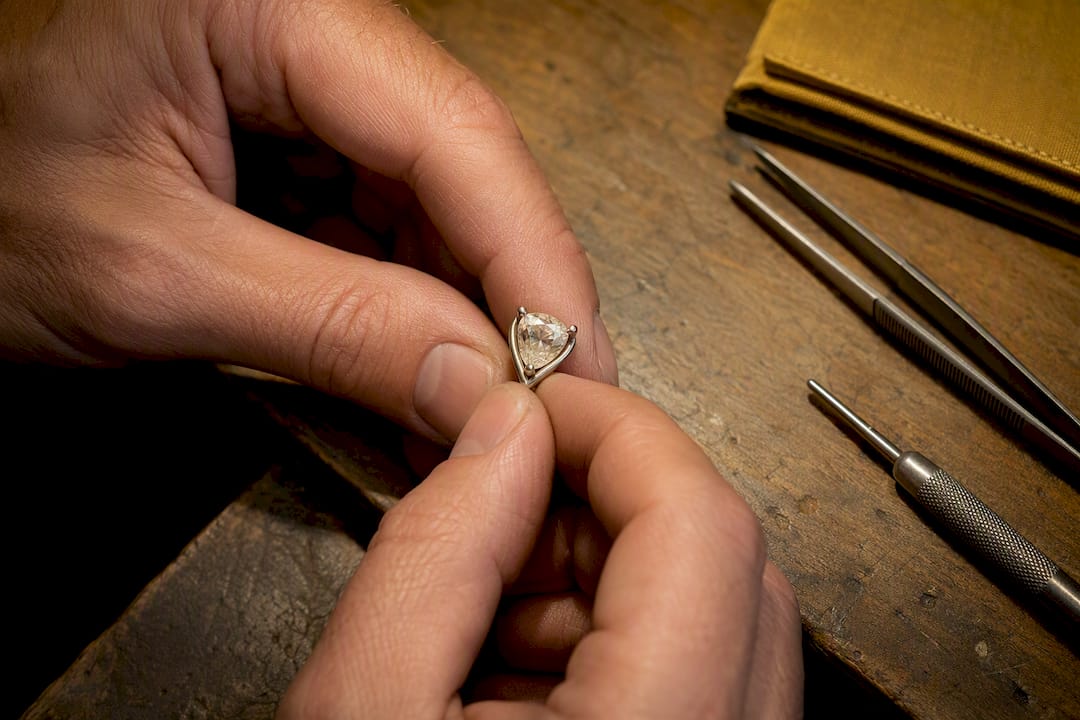
Ovals don’t carry a single vulnerable point, but their long edges still benefit from secure prong placement, typically four or six prongs positioned to support the girdle without covering too much of the stone’s face. Setting height matters too: a lower profile reduces snagging on clothing and hair, which matters more for an active lifestyle than most buyers expect going in.
Whichever shape you choose:
- Ask what warranty or repair policy covers prong retipping and re-tightening over time.
- Confirm whether shipping is insured, since a loose stone or finished ring should never travel uninsured.
- Schedule a professional prong check roughly once a year, more often for daily wear.
Buying checklist: step-by-step tests before you commit
Run through these steps in order, whether you’re shopping online or in a showroom:
- Decide on silhouette first: balanced and even (oval) or directional and pointed (pear).
- Request exact millimeter dimensions and length to width ratio for every stone you’re considering.
- Watch a rotating video or view the stone in person under at least two lighting conditions.
- Judge bow-tie severity specifically while the stone is moving, not in a single static photo.
- Confirm the setting includes appropriate point protection for a pear or secure prong placement for an oval.
- Only then compare color, clarity, certification, and price across your shortlist.
Appearance decisions belong first in that sequence because two stones with identical grades can look completely different once mounted. Certification and price are easier to compare once you’ve already ruled stones in or out by eye.
Pro Tip: Ask sellers for scale images next to a common object like a coin, plus a rotating video and, if possible, a mounting mockup showing the stone in the actual setting style you want.
What reputable sellers, including USA Jewels, should provide
A seller worth trusting will hand you documentation, not just a sales pitch. At minimum, expect a certified lab report, exact millimeter specifications, and a rotating video or the option to view the stone in person before you commit.
You should also expect clear answers about protection options for a pear’s point, straightforward prong or setting choices for an oval, and honest policies on upgrades and returns if the stone doesn’t match your expectations once mounted. A seller worth trusting will typically provide in-house manufacturing, a long-standing history, a reputation supported by customer reviews, and offers policies such as lifetime diamond upgrades and free insured shipping on qualifying purchases.
Whichever seller you choose, verify the paperwork matches the physical stone and ask to see the exact diamond you’ll receive rather than a stock photo of a similar one.
Historical and cultural significance of oval and pear diamond shapes
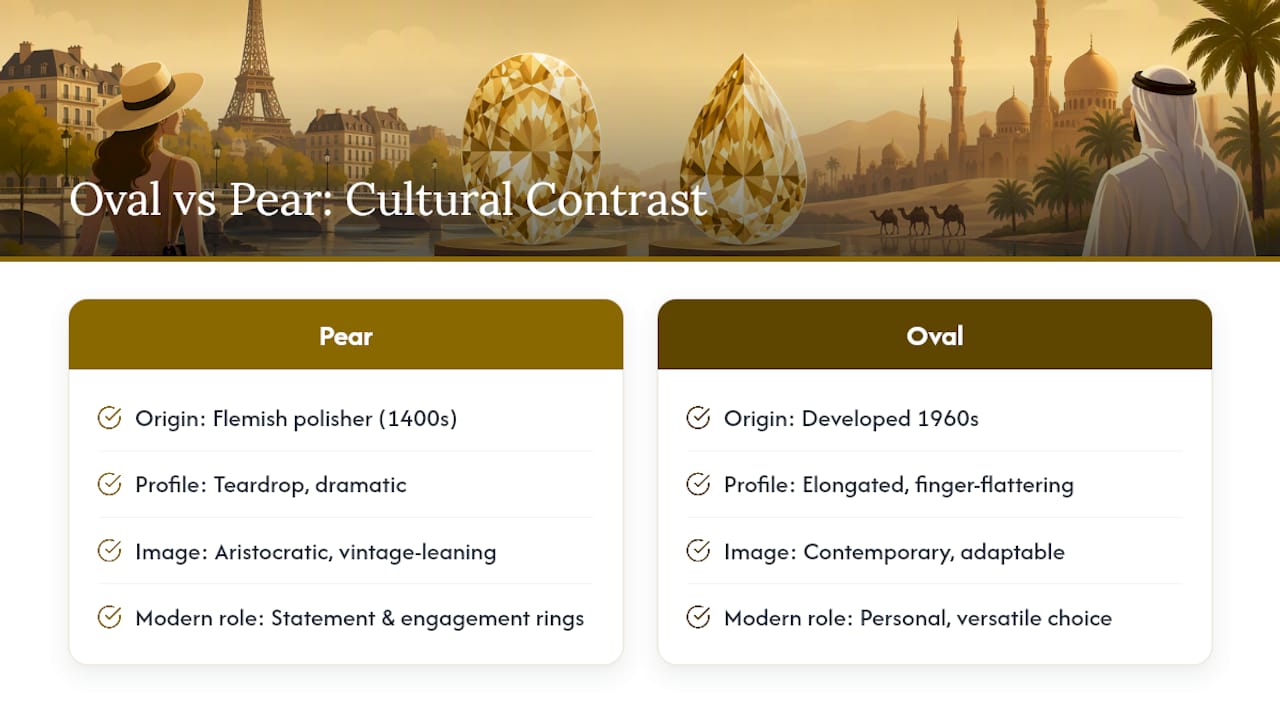
The pear cut traces back centuries, credited to the Flemish polisher Lodewyk van Berquem in the 1400s, whose faceting innovations helped shape how diamonds were cut for royal courts across Europe. Its teardrop profile became associated with dramatic, statement jewelry worn by aristocracy, a reputation that has followed it into modern engagement ring culture.
The oval cut has a more recent history, developed in the 1960s as jewelers sought a shape that offered a round brilliant’s fire with a more elongated, finger-flattering profile. It arrived at a moment when engagement ring styles were shifting away from strictly traditional cuts toward options that felt personal rather than purely conventional.
Both shapes have shed any single cultural association and now function as broadly modern choices. The pear still carries a slightly more formal, vintage-leaning identity in many people’s minds, while the oval reads as contemporary and adaptable. Neither carries the specific symbolic weight that, say, a solitaire round brilliant does in Western engagement traditions, which gives buyers more freedom to make the choice about personal style rather than convention.
Pricing trends and resale value between the two shapes
Fancy shapes like oval and pear generally cost less per carat than round brilliants of comparable quality, largely because cutting them wastes less of the rough diamond. Within fancy shapes, pricing between oval and pear tends to track closely, since both draw from similar rough yield and face similar cutting complexity around maintaining symmetry.
Resale value for both shapes tends to run lower than for round brilliants, which remain the most liquid shape in the secondary market due to consistent demand. That gap isn’t unique to oval or pear specifically. It reflects a broader pattern across most fancy shapes, where buyer preference concentrates heavily on rounds.
If resale value matters to your decision, prioritize a well-proportioned stone with strong symmetry and a minimal bow-tie over one that’s simply larger on paper. A beautifully cut fancy shape holds appeal to future buyers in a way that a poorly proportioned one, even at a lower price, generally doesn’t. This is one more reason the appearance-first approach in the buying checklist above pays off even beyond your own enjoyment of the ring.
Celebrity and fashion influence on oval and pear popularity
Both shapes have had highly visible moments in celebrity engagements over the past two decades, and that visibility tends to move public interest in fairly predictable waves. A prominent engagement featuring either shape often triggers a noticeable bump in searches and requests at jewelers, followed by a gradual leveling off as the initial buzz fades.
Fashion cycles in engagement rings tend to move slower than clothing trends, since a ring is a long-term purchase rather than a seasonal one. That said, the broader shift toward personalized, non-traditional ring styles over the last several years has benefited both oval and pear at the expense of the classic round solitaire’s historical dominance.
Neither shape shows signs of being a passing trend. Both have sustained, multi-decade track records in engagement jewelry, which suggests their popularity rests on genuine finger-flattering qualities rather than a single celebrity moment. If anything, the steady interest in both shapes reflects a broader move toward rings that feel individually chosen rather than simply expected.
Color and clarity appearance differences by shape
The way a diamond’s facets are arranged changes how visible color and inclusions appear, even at identical grades. Elongated shapes like oval and pear tend to show body color more readily near the pointed or narrow ends, where light travels a shorter path and reflects less white light back to the eye.
For that reason, buyers often choose a slightly higher color grade for a pear or oval than they would for a round brilliant of the same size, particularly for stones above one carat where color becomes easier to notice in daylight. Clarity inclusions near a pear’s point are worth extra scrutiny too, since that area sits closer to the eye’s natural focal point when someone looks at the ring.
Neither shape hides flaws better than the other in any consistent way. Both reward careful inspection of the specific stone under different lighting rather than relying on the certificate’s grade alone, echoing the same direct-viewing principle that matters for judging bow-tie severity.
How cut grades apply differently to each shape
Round brilliants have a standardized cut grading scale through GIA, ranging from Excellent to Poor. Fancy shapes like oval and pear don’t receive an overall cut grade from GIA in the same standardized way, since their proportions vary too widely for a single formula to capture beauty consistently across the shape category.
Instead, buyers evaluating oval or pear stones need to look at individual proportion measurements: length to width ratio, depth percentage, table percentage, and symmetry and polish grades, then weigh those against how the stone actually performs in a rotating video. A well-proportioned pear or oval with strong symmetry and polish will typically show better light return than a poorly proportioned one, even when both carry similar grades on paper.
This is exactly why direct inspection matters more for these two shapes than for a round brilliant with a straightforward cut grade to lean on. The absence of a single unifying grade isn’t a flaw in the shapes themselves. It just means the responsibility for judging cut quality shifts more heavily onto the buyer’s own eyes.
The real deciding factor most buyers overlook
Most advice on oval versus pear treats the shape choice as the whole decision, when the proportions of the individual stone usually matter more than the category it falls into. A mediocre oval and a mediocre pear can both disappoint in the same ways: a distracting bow-tie, an unbalanced silhouette, an unprotected point. A well-cut example of either shape solves those problems regardless of which outline you started with.
The conventional wisdom that pears are inherently riskier or ovals are inherently safer doesn’t hold up once you look at enough individual stones. Risk comes from skipping the inspection step, not from the shape itself. Buyers who watch a rotating video and check the length to width ratio before falling in love with a listing photo tend to end up happier than buyers who pick a shape first and assume any example of it will look the same.
If there’s one thing worth prioritizing above all else, it’s this: judge the stone in front of you, not the shape’s reputation. The name on the certificate tells you almost nothing about how the diamond will actually catch light on your hand.
— Joseph
How USA Jewels can help you choose and protect your stone
Once you know whether an oval’s balance or a pear’s point speaks to you, the next step is seeing real stones, not just diagrams. USA Jewels manufactures in-house, which means you’re buying direct rather than paying for extra markup along the way, and every stone comes with the documentation and viewing options this guide recommends you ask for.
A few ways to move forward:
- Browse certified loose diamonds to compare oval and pear stones by exact millimeter specs and request rotating video before you buy.
- Use Design Your Own Diamond Ring to pick your shape, metal, and setting, including V-prong protection for a pear point.
- Ask about lifetime diamond upgrades and free insured shipping, both included with a USA Jewels purchase.
If you’re further along and ready to see finished styles, our engagement ring collection shows how both shapes look across different setting styles.
Sources
- GIA — Diamond information
- 2 Carat Pear vs Oval – Diamond Size Comparison — DiamDB
- American Gem Society
FAQ
Do oval or pear diamonds look bigger?
Neither shape reliably looks bigger than the other at the same carat weight. A matched 2 carat comparison found the oval’s face-up area and the pear’s to be nearly the same, with only a negligible difference between them. Perceived size depends far more on a stone’s individual proportions than on which shape you choose.
What are the disadvantages of pear rings?
The main disadvantage is the exposed point, which is more vulnerable to chipping than any part of a round or oval stone unless it’s protected. A V-prong or bezel tip setting largely addresses that risk, and outline symmetry between the two shoulders also needs closer inspection than with a symmetrical shape.
What is the least desirable diamond shape?
There’s no universally agreed “least desirable” shape since preference varies by buyer and current style trends. Fancy shapes like oval and pear simply carry different considerations, such as bow-tie effects and point protection, that a round brilliant doesn’t, rather than being objectively less desirable.
What is the classiest engagement ring shape?
Classic style is subjective, but round brilliants and ovals are often described as timeless choices because of their balanced, symmetrical outlines. Pear shapes carry a more distinctive, vintage-leaning elegance that appeals to buyers looking for something less conventional.
Which shape flatters the finger more, oval or pear?
An oval tends to elongate fingers evenly and suits most hand shapes, while a pear creates a directional lengthening effect toward its point that many wearers find especially slimming. The better choice depends on your finger shape and whether you prefer a balanced or a directional look.
Recommended
- Oval Diamond Guide: Elegant and Flattering
- Round vs Oval Diamond: Which Shape Is Right for You?
- Bow Tie Effect Oval Diamonds: What Causes It and How to Avoid It

Deep Mehta is the Co-Owner of USA Jewels, a family-owned jewelry business she has led since 2013 in Deerfield Beach, Florida. With over 13 years of hands-on experience in fine jewelry retail, manufacturing, and diamond importing, Deep specializes in engagement rings, wedding bands, and custom jewelry design. She also co-manages Kaash Group Talent Acquisition. Deep is a University of Florida graduate and oversees every aspect of USA Jewels’ operations, from product development to marketing.
Fine Jewelry Collection

You May Also Like
How to Spot Quality Jewelry Craftsmanship Like a Pro
Why Diamond Certifications Differ Globally: 2026 Guide