Finish Your Engagement Ring in 4–8 Weeks Without Retail Markup
You can design a custom engagement ring starting today: set a firm budget first, then decide whether you’ll build around a center stone or a setting. That single decision shapes every choice after it. Working with an in-house maker instead of a traditional retailer often keeps customization affordable, since there’s no middleman markup eating into your budget for stone quality or metal.
TL;DR:
- An in-house jeweler can offer better customization options and pricing by avoiding retail markup but requires careful review of CAD and production timelines.
- Focusing on cut quality, especially for the center stone, provides the most sparkle and is worth stretching your budget over clarity or color for certain shapes.
- Choosing a setting and metal involves balancing protection, durability, and maintenance needs, with options affecting daily wear and longevity.
- Allocation of your budget should prioritize stone quality and durability over elaborate settings, with lab-grown diamonds offering larger size for less cost.
- Starting the design process at least two months before a proposal ensures adequate time for consultations, revisions, and production delays.
Table of Contents
- How Do You Design an Engagement Ring Step by Step?
- How Do You Choose the Center Stone?
- Which Setting and Metal Actually Hold Up Daily?
- What Should You Spend Where?
- What Happens Between Approval and Delivery?
- In-House Jeweler or Online Builder: What to Expect
- Three Mistakes That Wreck a Custom Ring Design
- Start Designing Your Ring With Usajewels
- Where to Learn More
- Sources
- FAQ
How Do You Design an Engagement Ring Step by Step?
Designing an engagement ring follows a predictable rhythm once you know the stages. Most custom pieces move through five checkpoints, and skipping any of them is where projects go sideways.
- Gather inspiration. Save 5 to 10 reference images and note any jewelry your partner already wears and loves.
- Book a consultation. Bring your budget, size notes if you have them, and lifestyle details (hands-on job, gym habits, ring aversion).
- Decide your starting point. Some couples anchor on a specific diamond; others fall for a setting first and build the stone spec around it.
- Review the CAD or sketch. This is your one real chance to catch proportion or prong issues before metal gets cast.
- Approve, then wait through production. Final QC happens before shipping.
A complete custom design workflow typically runs three to six weeks from final CAD approval to delivery, with total start-to-finish timelines of four to eight weeks once you factor in the consultation and revision rounds. If a proposal date is already set, start the process at least two months out. Design guides consistently recommend locking in budget and timeline before you fall in love with a specific stone. It’s the only way a jeweler can steer you toward realistic quality tiers instead of a wish list that blows past what you want to spend.
How Do You Choose the Center Stone?
The 4Cs don’t carry equal weight. Cut drives visible sparkle more than any other factor, so it’s the one C worth stretching your budget for. Color and clarity matter more or less depending on shape: step cuts like emerald or Asscher expose inclusions and tint that a round brilliant would hide, so those shapes need better clarity and color grades to look clean.
- Moissanite: a durable, budget-friendly alternative with more fire than a diamond, appealing if brilliance matters more than tradition.
- Colored gemstones: sapphire and other options bring personality and, depending on the stone, real everyday durability worth considering if you want something distinct from a gemstone ring.
Pro Tip: Shortlist two to four stones side by side, with specs, images, and certificates in front of you, before you commit. Seeing them together makes the trade-offs obvious in a way spec sheets alone never do.
Which Setting and Metal Actually Hold Up Daily?
The setting decides how much protection your stone gets, and that trade-off matters more than most people expect. A prong or solitaire setting maximizes light and sparkle but leaves the stone more exposed. A bezel or flush setting sacrifices a little brilliance for real protection against knocks, which matters if your partner works with their hands or hits the gym daily.
Metal choice comes with its own maintenance reality:
- 14K gold resists scratching better than 18K and costs less, though 18K carries a richer color.
- Platinum is the most durable choice and develops a soft patina rather than scratching visibly.
- White gold needs periodic rhodium plating to keep its bright white finish, usually every year or two.
Also check the band’s profile and width against any wedding band you’ll pair it with later. A setting style guide can help you avoid picking a shape that clashes down the road. For active wearers, prioritize a lower profile, secure prong count, and a metal that shrugs off daily wear.
What Should You Spend Where?
Budget allocation is where most first-time designers freeze up, but a few rules of thumb make it manageable.
- Decide your priority first. If sparkle matters most, put money into cut quality before carat size.
- Stretch carat weight with lab-grown. A lab-grown diamond can let you go up in size without abandoning your budget.
- Budget for the invisible costs. Certification, resizing, and insurance appraisals add up after the ring itself is paid for.
- Save on setting complexity, not stone quality. A simpler band with a well-cut stone almost always outperforms an elaborate setting around a mediocre one.
Custom or made-to-order work doesn’t automatically cost more than off-the-shelf retail, either. Skipping the standing-inventory markup that traditional stores carry often frees up real money for the ring itself. An engagement ring budget guide can help you map dollars against priorities before you ever sit down with a jeweler.
What Happens Between Approval and Delivery?
The CAD or wax-model review is your last practical stopping point before metal gets cast, and it deserves more scrutiny than most buyers give it. Check proportions, prong placement, and clearance for a future wedding band, since structural review at this stage is the only real chance to fix issues before production locks them in.
- Confirm ring size, especially for surprise proposals where sneaking a measurement takes some creativity.
- Ask about the jeweler’s resizing policy up front, before you need it.
- Request independent GIA or IGI certification, and get a post-sale appraisal for insurance purposes.
- Confirm your production window, since bespoke timelines often run four to eight weeks depending on design complexity, with rush options sometimes available for a fee.
Build in buffer time. A ring that’s “almost done” a week before the proposal is not a plan.
In-House Jeweler or Online Builder: What to Expect
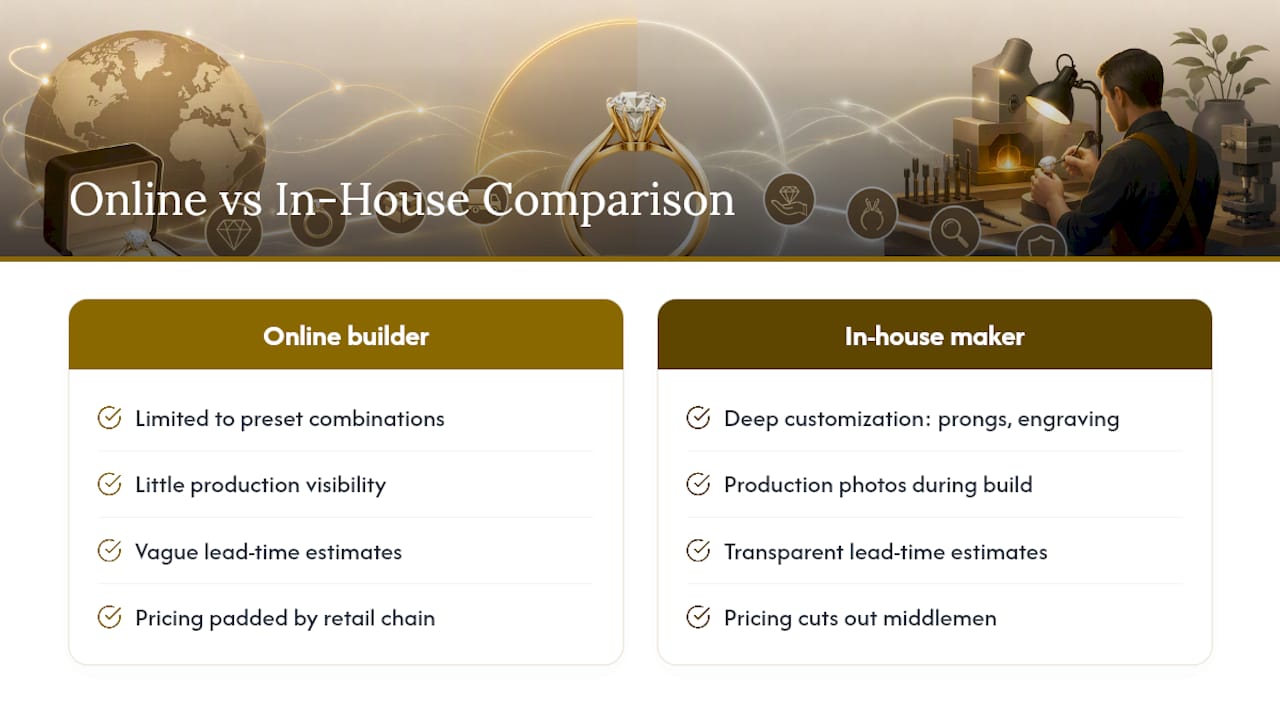
An online builder works well for straightforward designs where you already know the stone shape and setting style and just want to configure and check out. It’s fast, but customization tends to stop at pre-set combinations.
In-house manufacturing goes further. Cutting out middlemen typically means tighter quality control, deeper customization on prong count, engraving, and side stones, and pricing that isn’t padded to cover a retail supply chain. Look for jewelers who offer production photos along the way, transparent lead-time estimates instead of vague promises, a clear diamond upgrade or return policy, and a track record of reviews you can actually verify. Complex or genuinely unique designs almost always turn out better with a maker who builds one-off, rather than a template with swappable parts.
Three Mistakes That Wreck a Custom Ring Design
Most design regrets trace back to the same three slip-ups. Mismatching the setting to daily life is the biggest one: a delicate prong setting on someone who works with their hands is asking for trouble, and a low-profile bezel usually fixes it. Skipping a careful CAD review is the second, since that’s your only real shot at catching prong or proportion errors before casting. Under-budgeting for certification is the third; a GIA or IGI report isn’t optional if you ever plan to insure the piece. Prioritize what gets noticed daily: comfort, durability, and sparkle, in that order.
— Joseph
Start Designing Your Ring With Usajewels
Usajewels is the direct alternative to retail markup: our family-owned, in-house manufacturing means you’re paying for the ring, not a showroom’s overhead. You choose the diamond shape, quality, and metal type yourself, with certified natural and lab-grown stones available and a lifetime diamond upgrade program built in for later.
Since 1999, we’ve built this business one custom order at a time, and it shows in the reviews our customers leave behind. To get started, save three to five inspiration images, settle on a budget range, and schedule a consultation. Our step-by-step design guide walks through every choice in detail, or you can browse engagement rings directly to see finished styles before you customize your own.
Where to Learn More
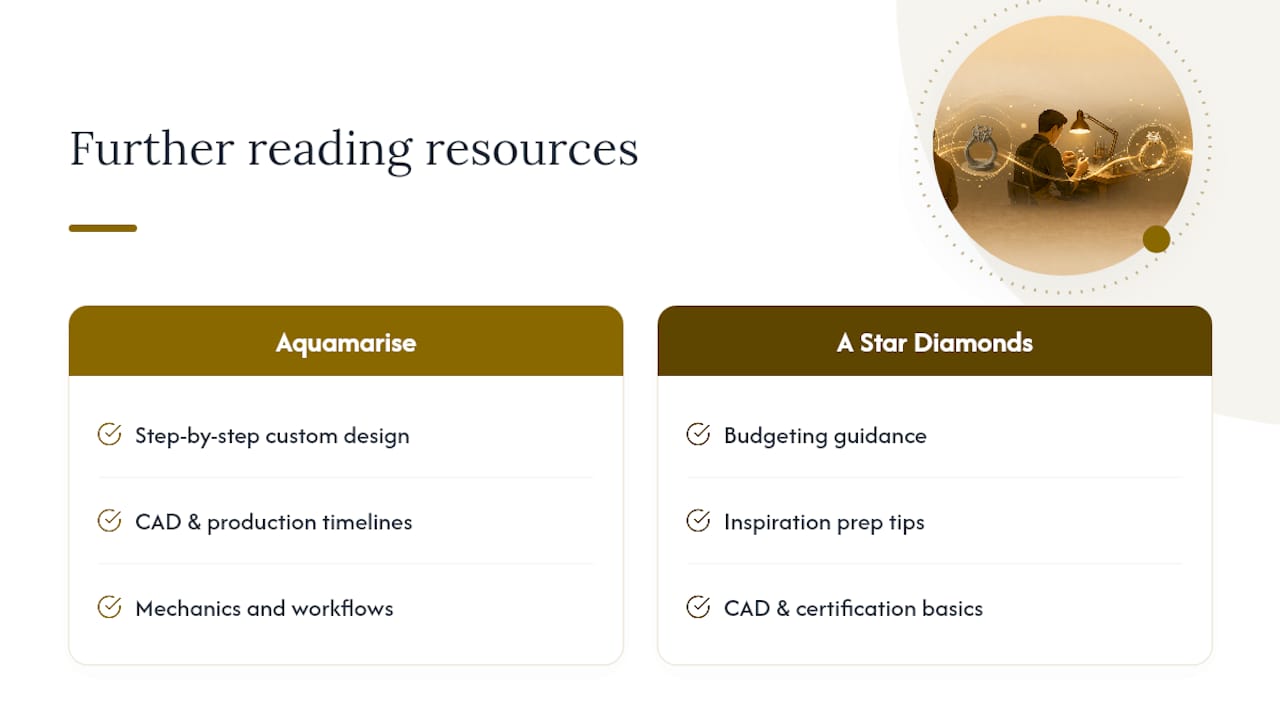
For deeper reading on the mechanics covered here: Aquamarise’s step-by-step custom design guide walks through CAD and production timelines in detail, while A Star Diamonds covers budgeting and inspiration prep and CAD/certification basics.
FAQ
How Do I Design My Own Engagement Ring?
Start by setting a budget and deciding whether to anchor your design on a center stone or a setting, then book a consultation where you’ll move through CAD review, approval, and production, typically taking four to eight weeks total.
Is It Cheaper to Design Your Own Engagement Ring?
Custom or made-to-order rings aren’t automatically more expensive than retail. Working with an in-house maker often removes the standing-inventory markup traditional jewelers charge, freeing up budget for stone quality instead.
Is There an App to Design an Engagement Ring?
Many jewelers offer online design tools where you select diamond shape, quality, and metal type, then move to a CAD render before production begins.
How Much Should I Spend on an Engagement Ring If I Make $100,000 a Year?
There’s no fixed rule tied to income; the better approach is setting a budget you’re comfortable with and prioritizing cut quality and setting durability over chasing a specific carat size or dollar figure.
Recommended
- Design Your Own Engagement Ring: Step-by-Step Guide
- Custom Engagement Ring Design Process: A Couples’ Guide
- 10 Engagement Ring Design Mistakes to Avoid
- Engagement Ring Buying Guide: How to Choose the Perfect Ring

Deep Mehta is the Co-Owner of USA Jewels, a family-owned jewelry business she has led since 2013 in Deerfield Beach, Florida. With over 13 years of hands-on experience in fine jewelry retail, manufacturing, and diamond importing, Deep specializes in engagement rings, wedding bands, and custom jewelry design. She also co-manages Kaash Group Talent Acquisition. Deep is a University of Florida graduate and oversees every aspect of USA Jewels’ operations, from product development to marketing.
Fine Jewelry Collection


You May Also Like
What Is a Halo Ring Setting? Your Full Guide
60–70% Lead Metal Rule: Wear Mixed Metal Jewelry with Intent