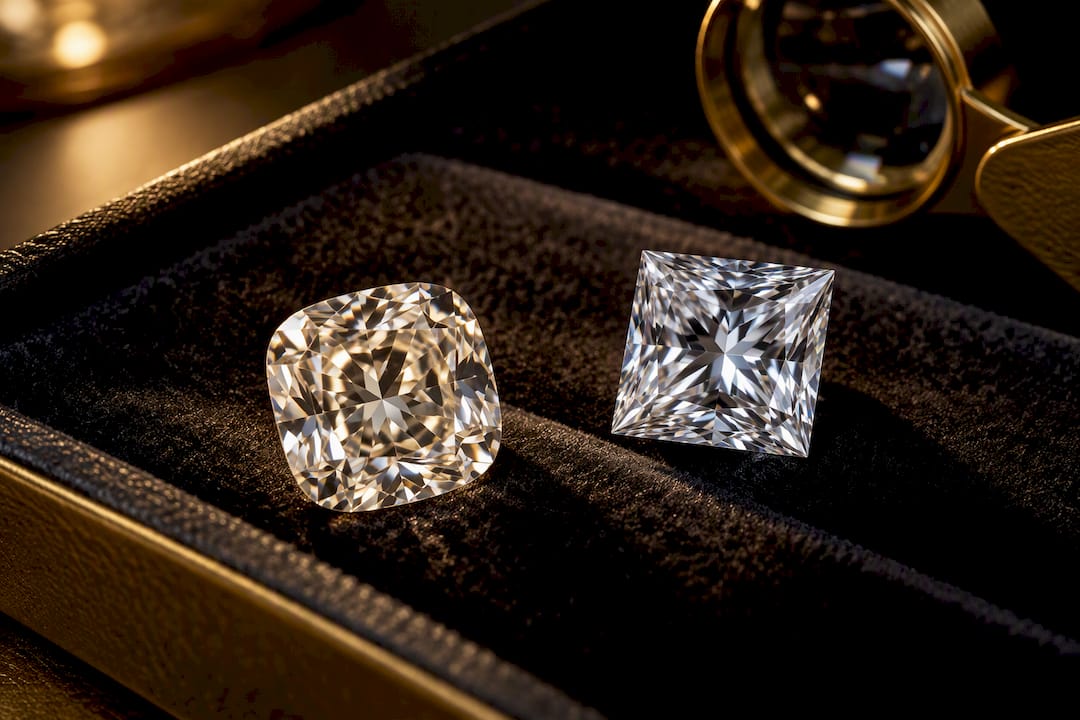
Engagement Buyers: Cushion vs Princess, Durability, Certificates, Price
If durability and everyday wear top your list, a cushion cut is usually the safer pick. If you want a sharp, modern square look, princess wins on architecture. The real tradeoffs come down to sparkle pattern, corner strength, and how GIA certificates read for each shape, something we walk clients through often at USA Jewels, and AGS light-performance grades can add another layer of confidence for princess buyers.
TL;DR:
- Cushion cuts are generally more durable and better suited for active lifestyles due to their rounded corners, whereas princess cuts require protective settings to prevent chipping.
- Crushed ice cushions are favored for subtle sparkle and hiding inclusions, while chunky cushions and princess cuts display larger flashes and sharper brilliance.
- A square cushion typically appears about 5% smaller face-up than a princess of the same carat, with elongation options increasing visible size without raising costs.
- Mid-range cushions usually cost approximately 10-15% less than princess cuts, but top-tier cushions can be more expensive due to higher demand, known as the Pillow Premium.
- Always request a 360-degree video and precise proportions before purchase, especially online, to verify light performance, cut quality, and setting protection features.
Table of Contents
- Optical character: crushed ice, chunky cushions, and princess sparkle
- Durability and setting compatibility for daily wear
- Face-up size and how L:W ratios affect apparent size
- Price and value rules: understanding the Pillow Premium
- Certificates and cut quality: what to check without a GIA cut grade
- Step-by-step buying checklist and questions to ask your seller
- Why trust this guide: publisher and author proof points
- Where cushion and princess cuts got their names
- Where each shape shows up most in jewelry design
- Matching the shape to your style and hand shape
- Comparing brilliance and light return beyond the sparkle pattern
- Caring for cushion and princess cut jewelry
- A jeweler’s honest take on choosing between them
- How USA Jewels can help you choose with confidence
- Sources
- FAQ
Optical character: crushed ice, chunky cushions, and princess sparkle
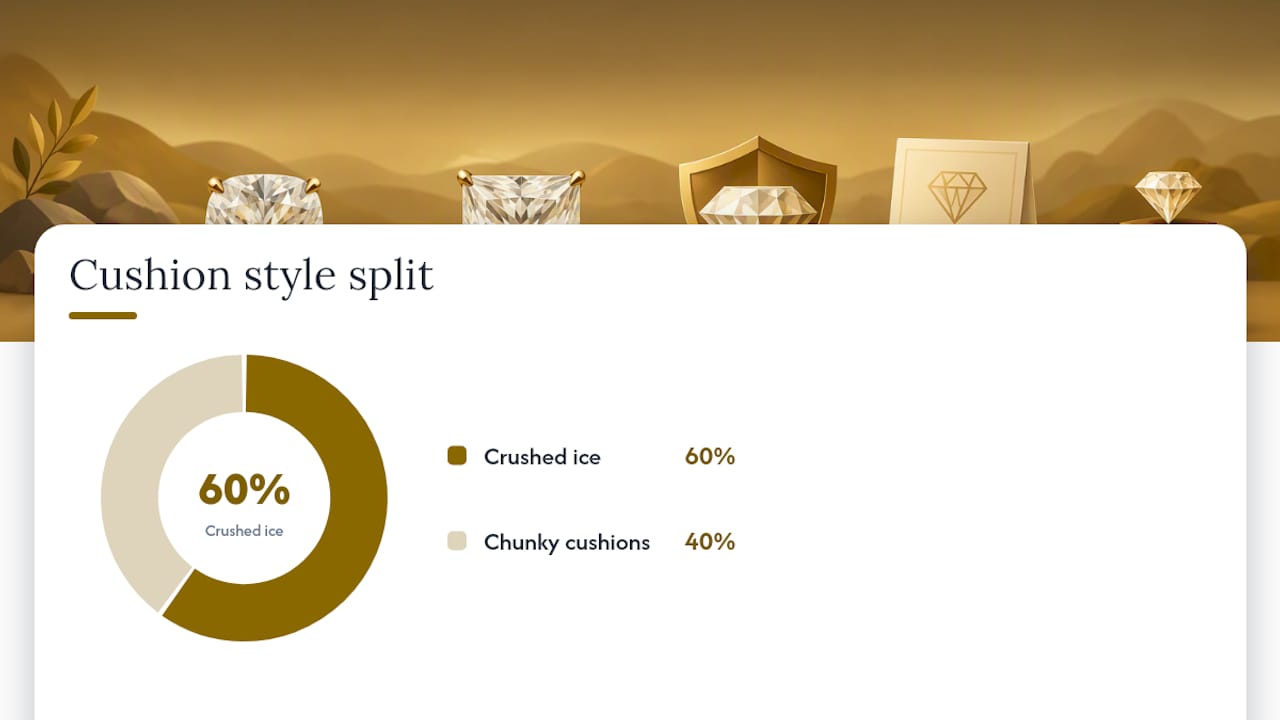
Cushion cuts split into two visual families, and knowing which one you are looking at changes everything about how the stone will read on your hand. “Crushed ice” cushions use a modified brilliant facet pattern that scatters light into small, sparkling flashes across the whole face, almost like sugar catching the sun. “Chunky” cushions use the standard brilliant cut, producing larger, bolder flashes of fire and a more vintage feel. Diamond Critics notes that roughly 60% of cushion sales lean toward the crushed ice style, which tells you where current taste is heading, though chunky cushions remain popular with buyers chasing an heirloom look.
Princess cuts play a different game entirely. Their facet structure creates a chevron pattern, an X-shaped design visible when you look straight down into the stone, which produces linear flashes rather than scattered ones. That architecture gives princess cuts their clean, geometric identity: sharp corners, crisp lines, and a brilliance that feels more disciplined than romantic.
The practical fallout matters more than most shoppers expect. Crushed ice cushions photograph beautifully under soft, ambient light and tend to hide small inclusions well because the broken-up facets scatter attention along with light. Chunky cushions and princess cuts both show their clarity more openly, so any inclusions near the center are harder to disguise.
- Crushed ice cushions favor everyday wearers who want constant, low-key sparkle rather than dramatic flashes.
- Chunky cushions suit buyers who love strong fire and don’t mind a more traditional look.
- Princess cuts reward buyers who want architectural symmetry and don’t mind sparkle that reads in bursts rather than a steady shimmer.
Photos alone will not tell you which subtype you are buying. A still image can make a crushed ice stone look flat or a princess cut look duller than it is in motion.
Pro Tip: Always ask for a 360-degree video before buying online. A stone that looks average in a photo can come alive the moment it moves under light, and the reverse is just as true.
Durability and setting compatibility for daily wear
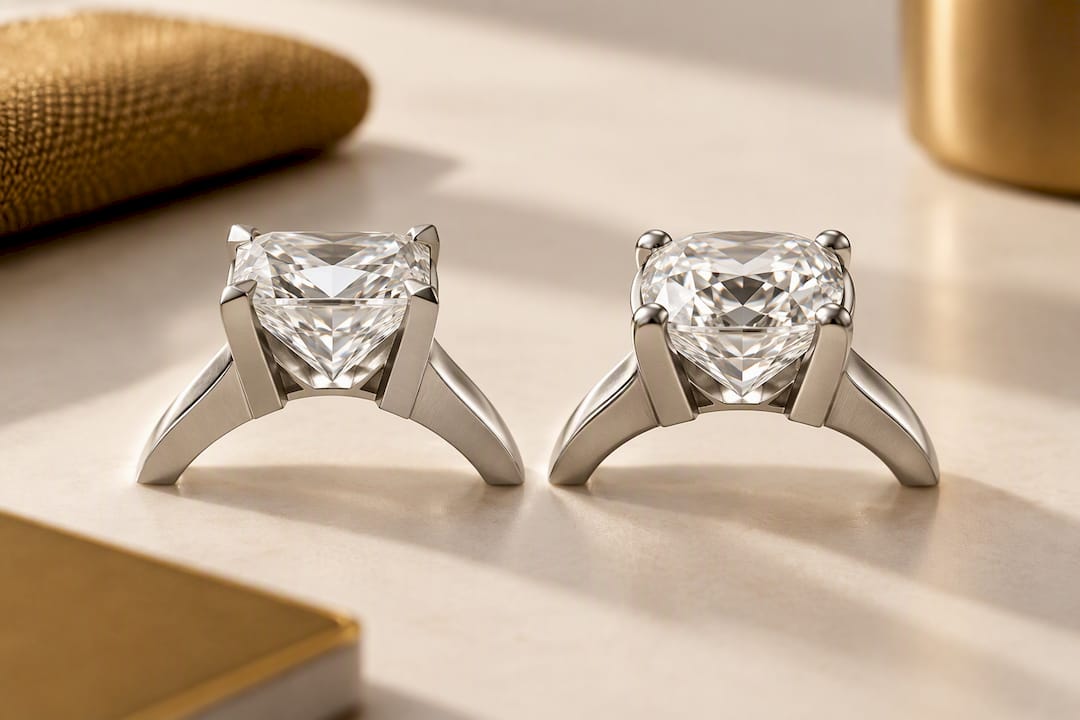
Corners are where these two shapes really part ways. Princess cuts have four sharp, exposed corners that act as structural weak points, and Diamond Critics’ durability research finds that these corners are prone to chipping without proper protection. Cushion cuts round off those same corners, distributing impact across a curve instead of concentrating it at a point, which is part of why cushions rank among the more durable popular engagement shapes for daily wear.
That difference should shape your setting choice, not just your stone choice.
- Choose V-prongs or a bezel edge for princess cuts, since standard prongs leave the corners exposed to knocks against door frames, gym equipment, or a kitchen counter.
- Choose simple four- or six-prong settings for cushion cuts, since the rounded profile tolerates more exposure without the same chipping risk.
- Avoid open claw settings on princess stones if you work with your hands often or live an active lifestyle.
- Have any ring inspected annually for loose prongs, since a stone that shifts even slightly increases stress on its weakest points.
Insurance carriers see the pattern too. Corner damage on princess cuts is one of the more common claims filed on square-shaped engagement rings, and a chip usually means a costly re-cut rather than a simple polish. If you know you’ll be wearing your ring through workouts, yard work, or a hands-on job, that repair frequency is worth weighing before you fall for a particular sparkle.
Pro Tip: Ask your jeweler to show you the prong height and metal thickness at each corner of a princess setting before you buy. Thin metal at the corner tips is the first thing to wear through.
Face-up size and how L:W ratios affect apparent size
Carat weight tells you what the scale says, not what the eye sees, and this gap is especially wide between these two shapes. Diamond Critics measured it directly: a square cushion typically appears about 5% smaller face-up than a princess cut at the same carat weight. At one carat, a square cushion measures around 5.20mm across compared to roughly 5.45mm for a princess, a small difference in millimeters that reads as a noticeably different footprint on the finger. Diamond Critics calls this the “Square Illusion,” and it explains why two stones with identical certificates can look surprisingly different side by side.
Length-to-width ratio, or L:W, is the number to check if size matters to you.
- For a traditional square cushion, look for an L:W ratio between 1.00 and 1.05, which keeps the stone visually balanced without drifting rectangular.
- For more apparent size per carat, consider an elongated cushion, which stretches the same weight across a longer face and can look larger without changing your budget.
- For princess cuts, the same 1.00 to 1.05 range keeps the classic square shape; ratios above that start to look more rectangular.
Because these differences are subtle on paper but obvious in person, compare two stones side by side whenever you can, or buy from a seller with a fair return window so you’re not locked into a choice made from a screen.
Price and value rules: understanding the Pillow Premium
Price behavior between these shapes is not consistent across quality tiers, and that inconsistency is exactly where informed buyers save money. At popular mid-range quality levels, cushions tend to be the better deal. Diamond Critics’ 2026 market sampling found a one-carat G-VS2 cushion priced around $1,770 compared to roughly $1,860 for a comparable princess cut, a gap of roughly 10% to 15% in the cushion’s favor at that tier.
That relationship flips at the top end. Once you move into D to F color and VVS clarity, cushions can become the more expensive shape, a pattern the industry sometimes calls the “Pillow Premium,” driven by higher demand for flawless-looking cushions relative to the supply of rough that cuts well into that shape.
A quality tier shift changes which shape costs more. At G to VS mid tiers, cushions often run cheaper than princess cuts of the same specs; at D to VVS top tiers, that pricing gap can reverse in the Pillow Premium pattern Diamond Critics documented.
Smart budgeting means knowing where to flex and where not to.
- Save money by dropping one color grade (say, from F to H) since the difference is nearly invisible to the eye in either shape.
- Save money by choosing a slightly lower clarity grade, since inclusions are often hidden by the facet pattern, especially in crushed ice cushions.
- Do not compromise on depth percentage, table percentage, or polish and symmetry grades, since those affect how the stone actually performs, not just what the certificate says.
- Consider a lab-grown diamond if budget is tight, since lab-grown stones of the same shape and specs typically cost less than natural stones without changing the optical rules above.
Certificates and cut quality: what to check without a GIA cut grade
Here is something a lot of shoppers do not realize until they are staring at a report: GIA does not issue an overall cut grade for cushion or princess diamonds the way it does for round brilliants. That means the number you’d normally lean on simply isn’t there, and you have to read the proportion and finish fields yourself instead.
- Check the table percentage, aiming for roughly 67% to 72% on princess cuts, since a table outside that range often signals a stone that looks glassy or overly dark.
- Check the depth percentage, with 64% to 70% preferred and up to 75% still acceptable, since depth is a key driver of face-up efficiency according to Diamond Critics’ proportion analysis.
- Check the L:W ratio against the 1.00 to 1.05 range for a true square look in either shape.
- Check polish and symmetry grades, requiring Very Good or Excellent on both, since these act as your cut-quality proxy when no overall grade exists.
- Check the fluorescence field on princess cuts specifically, since chevron facets channel fluorescence toward the corners in what Diamond Critics calls the Chevron Fluorescence Effect, making Strong Blue fluorescence riskier in D to F color stones but a legitimate value play in G to H with video confirmation.
AGS reports sometimes step in where GIA leaves a gap, offering an independent light-performance grade for princess cuts that can help confirm brilliance beyond the proportion numbers alone. Be cautious with IGI reports on natural stones in particular, since grade inflation is a known issue there, and a color or clarity grade that looks generous on paper may not hold up next to a GIA equivalent.
Pro Tip: Request the exact depth and table percentages in writing, not just the grade letters, and ask for a 360-degree video before you commit to any princess or cushion stone sold online.
Step-by-step buying checklist and questions to ask your seller
Buying either shape well comes down to following the same sequence every time, regardless of how much you already know about diamonds.
- Decide your top priority first: durability for active wear, a sharp modern look, or vintage romantic sparkle.
- Match that priority to a shape and subtype: cushion (crushed ice or chunky) for durability or vintage character, princess for architectural symmetry.
- Set your budget tier and decide upfront whether you’re comfortable trading a color or clarity grade for size or setting quality.
- Run the certificate checklist: table percentage, depth percentage, L:W ratio, and polish and symmetry grades.
- Request a 360-degree video and compare it against the certificate numbers before paying anything.
Bring a short list of questions into any conversation with a seller, whether that’s online chat or an in-person showroom visit.
- Ask for the exact table and depth percentages, not just the certificate’s letter grades.
- Ask which lab issued the report and whether a GIA report is available for natural stones.
- Ask for close-up video of the corners on any princess cut you’re considering.
- Ask what setting options include corner protection, such as V-prongs or a bezel.
- Ask about warranty coverage and whether a lifetime upgrade policy applies if you want to trade up later.
A few responses should make you walk away. No GIA report on a natural stone, missing proportion numbers, polish or symmetry graded below Very Good, or a seller who refuses to provide video are all signs to keep looking.
Why trust this guide: publisher and author proof points
USA Jewels has operated as a family-owned business with in-house manufacturing since 1999, which means the diamonds and settings discussed here come from a team that cuts, sets, and inspects stones directly rather than reselling someone else’s work. That in-house model, paired with ethically sourced diamonds and a lifetime diamond upgrade program, has helped build a base of over 222 five-star Google reviews. For deeper reading on either shape, our cushion cut guide and princess cut guide cover facet patterns and setting recommendations in more depth.
Where cushion and princess cuts got their names
The cushion cut is one of the oldest diamond shapes still in circulation, tracing back to the “old mine cut” of the 1800s, when diamonds were faceted by hand and cut for candlelight rather than electric brilliance. Its pillow-like silhouette, rounded corners on a roughly square or rectangular outline, gave the shape its modern name. Cushion cuts fell out of fashion for much of the twentieth century as round brilliants took over, then returned to popularity as vintage and antique styles came back into demand.
Princess cuts are far younger by comparison, developed in the 1960s and refined through the 1970s and 1980s as diamond cutters looked for a square shape that could rival the brilliance of a round stone without wasting as much rough material during cutting. The name itself reflects that ambition: a cut meant to sit alongside the round brilliant as a modern, efficient alternative rather than a historical throwback. Where cushion carries the weight of nearly two centuries of jewelry history, princess represents a more calculated, engineering-driven answer to a specific cutting problem.
Where each shape shows up most in jewelry design
Cushion cuts show up often in vintage-inspired engagement rings, halo settings, and pieces meant to evoke an heirloom feel, since the rounded corners and softer brilliance pair naturally with milgrain detailing, filigree, and antique-style shanks. They also work well as center stones in three-stone rings, where their shape balances comfortably against round or oval side stones.
Princess cuts dominate in clean, modern engagement ring designs, often set in simple four-prong or channel settings that let the geometry speak for itself. They’re also a common choice for matching sets, wedding bands lined with smaller princess-cut accents that echo the center stone’s lines, and men’s jewelry, where the sharp, structured look translates well into cufflinks or signet-style rings. Both shapes appear regularly in stud earrings and pendants, though cushion tends to read softer in those settings while princess reads sharper.
Matching the shape to your style and hand shape
Personal style plays as large a role here as any technical spec. If your everyday jewelry leans toward soft, romantic, or antique aesthetics, a cushion cut will likely feel more like an extension of your existing taste. If you gravitate toward minimalist, architectural, or modern design in your clothing and home, a princess cut fits that same sensibility.
Finger shape and length matter too, though less dramatically than most articles suggest. Elongated cushions and princess cuts both tend to visually lengthen shorter fingers because their outline draws the eye along the length of the stone rather than across it. Square cushions and princess cuts of a true 1:1 ratio sit more compactly and can look proportionally larger on smaller hands, while very slim fingers sometimes look better with a cushion’s softer corners than a princess cut’s sharp geometric edges, which can look imposing on a narrow finger. Trying both shapes on in person, ideally side by side, remains the most reliable way to know which one actually suits your hand.
Comparing brilliance and light return beyond the sparkle pattern
Sparkle pattern gets most of the attention, but total light performance depends on more than just how the flashes look. Brilliance refers to the white light returned to your eye, fire is the flash of color you see as the stone moves, and scintillation is the on-off sparkle pattern created as facets catch and release light.
Crushed ice cushions tend to prioritize scintillation over fire, giving a constant, low-drama shimmer. Chunky cushions and princess cuts both tend to show more pronounced fire, meaning you’ll catch flashes of color more often, though princess cuts concentrate that fire into fewer, larger flashes because of their linear chevron facets rather than scattering it broadly.
None of this shows up reliably in still photography, which is why video verification matters as much for light performance as it does for spotting inclusions or confirming proportions. A well-cut stone of either shape, with polish and symmetry graded Very Good or Excellent, will perform closer to its potential regardless of which sparkle style you prefer.
Caring for cushion and princess cut jewelry
Both shapes collect dirt and oil in the same places, along the underside of the stone and around the prongs, so a mix of warm water, mild dish soap, and a soft toothbrush works well for routine cleaning on either cut. Rinse thoroughly and dry with a lint-free cloth, since leftover soap residue can dull brilliance over time.
The real difference in care comes down to corner attention. Princess cuts need a closer look during cleaning and inspection, since dirt or damage near the corners is easier to miss and more likely to weaken the setting over time. Cushion cuts are more forgiving here, since there are no sharp points for grime or damage to concentrate around. For both shapes, an annual professional inspection to check prong tightness is worth the small cost, especially for anyone who wears their ring daily through work, exercise, or household tasks.
A jeweler’s honest take on choosing between them
If someone asked me to pick blind, I’d lean cushion for anyone with an active daily routine, since the rounded corners simply survive better over decades of wear. I’d lean princess for someone who wants a ring that looks unmistakably modern and is willing to invest in a protective setting to match. Neither shape is objectively better. The right choice depends on which tradeoff you’re willing to live with.
— Joseph
How USA Jewels can help you choose with confidence
Once you know which shape fits your priorities, the next step is finding a stone whose certificate actually backs up what you’re seeing. We can walk you through proportion numbers, polish and symmetry grades, and corner-protection setting options directly rather than passing you between departments.
- Browse certified loose diamonds starting from $399 for a design-your-own diamond ring, and request GIA reports plus 360-degree video before you buy.
- Start a design-your-own engagement ring with settings built around your chosen shape, including corner-protective options for princess cuts.
- Ask about diamond upgrade options if you’re buying now with an eye toward upgrading later.
- Purchases may include insured shipping and a money-back guarantee, so you can compare a stone in person before committing.
FAQ
What is the least desirable diamond shape?
There is no single shape considered universally least desirable since preference depends on personal style and how well a stone is cut. Poorly cut stones in any shape, including cushion and princess, tend to underperform round brilliants in raw brilliance because they are less optimized for light return.
What are the disadvantages of cushion cut diamonds?
Cushion cuts can hide inclusions well, which sounds like an advantage but also means it’s harder to judge true clarity from a certificate alone. Chunky cushions in particular can look darker in the center compared to crushed ice styles, and the shape typically appears about 5% smaller face-up than a same-carat princess cut.
Is princess cut outdated?
Princess cut remains a widely used, modern shape rather than an outdated one, particularly for buyers who want clean geometric lines. Its main practical drawback is corner vulnerability, which requires protective settings like V-prongs rather than any decline in style relevance.
Is a cushion cut diamond more expensive than princess?
It depends on the quality tier. At popular mid-range grades, cushions often cost less than comparable princess cuts, with one 2026 market sample showing a one-carat G-VS2 cushion priced near $1,770 against roughly $1,860 for princess, though that relationship can reverse at top color and clarity tiers in what’s known as the Pillow Premium.
Recommended
- Princess Cut Diamond Guide: Modern Square Brilliance
- Cushion Cut Diamond Guide: Vintage Charm with Modern Sparkle
- Diamond Color & Clarity Explained: What to Buy
- Diamond Cut Comparison Guide for Engagement Rings

Deep Mehta is the Co-Owner of USA Jewels, a family-owned jewelry business she has led since 2013 in Deerfield Beach, Florida. With over 13 years of hands-on experience in fine jewelry retail, manufacturing, and diamond importing, Deep specializes in engagement rings, wedding bands, and custom jewelry design. She also co-manages Kaash Group Talent Acquisition. Deep is a University of Florida graduate and oversees every aspect of USA Jewels’ operations, from product development to marketing.
Fine Jewelry Collection

You May Also Like
Custom Signet Ring Styles: Your Complete Design Guide
Eye Clean Diamonds: How to Get a Flawless Look