How to Measure Your Wrist for the Right Bracelet Size
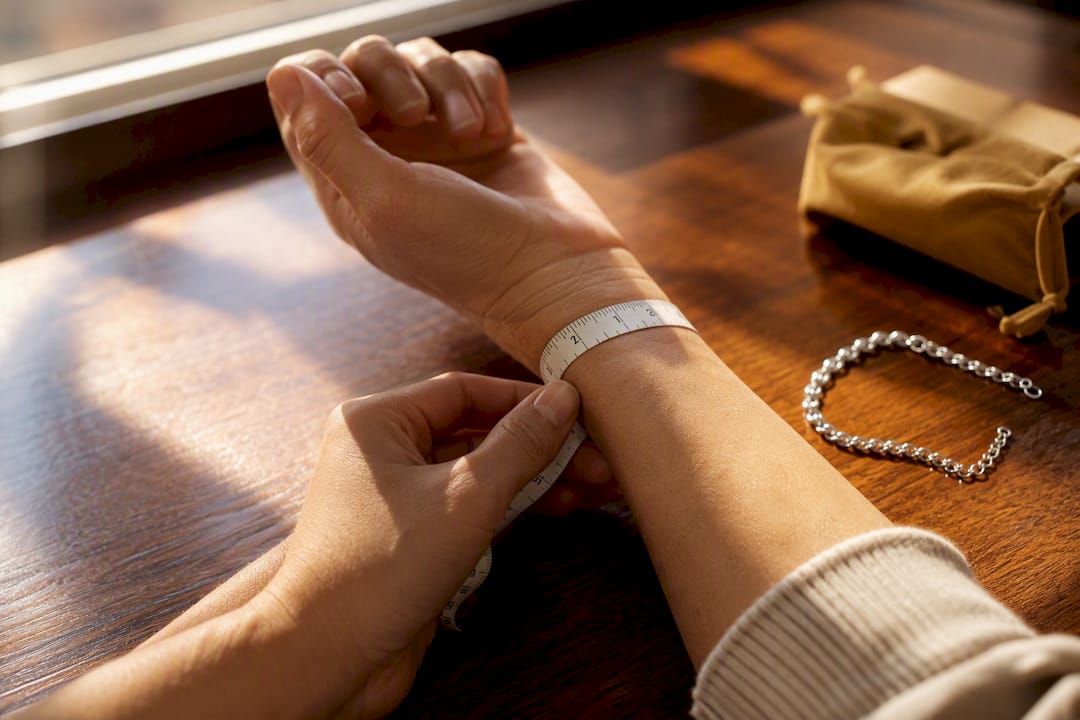
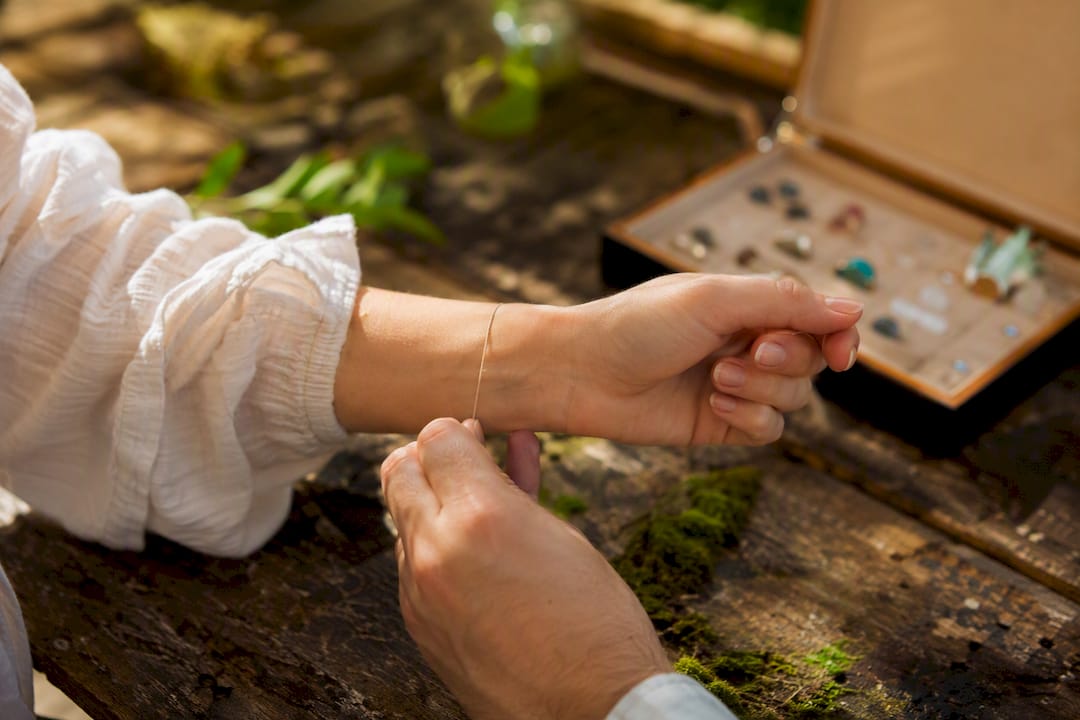
Wrap a flexible measuring tape just above your wrist bone, where your bracelet will actually sit, and read the number where it meets. From there, add about a half inch for a snug fit or about one inch if you like your bracelets a little looser. Bangles and fixed cuffs work differently: since they slide over your hand, measure across your knuckles instead of your wrist.
- Measure directly above the wrist bone, not over clothing or a watch
- Add ½ inch for snug, 1 inch for loose
- For bangles and fixed cuffs, measure hand diameter across the knuckles, not wrist circumference
Key Takeaways
Measuring above the wrist bone and adding the right allowance for your bracelet style is the single most reliable way to get a comfortable, lasting fit.
| Point | Details |
|---|---|
| Measure above the wrist bone | Use a flexible tape at the exact spot the bracelet will sit, not over clothing or a watch. |
| Add the right allowance | Add ½ inch for snug, ¾ inch for standard, or 1 inch for a loose, layered fit. |
| Bangles need hand measurements | Measure knuckle-to-knuckle hand diameter instead of wrist circumference for rigid pieces. |
| Adjust for style | Add extra length for charm and multi-link bracelets so pieces don’t crowd or drag. |
| Consult Usajewels for custom pieces | In-house manufacturing allows custom sizing for diamond and gold bracelets that shouldn’t be forced to fit. |
Table of Contents
- Bracelet Size Guide: Step-by-Step Wrist Measurement
- Bracelet Size Chart: Inches, Centimeters, and Standard Labels
- Sizing Rules for Different Bracelet Styles
- How Much Extra Length Should You Add?
- Measuring Without a Tape: Paper, String, and Rulers
- Common Bracelet Sizing Mistakes and How to Fix Them
- When to Ask a Jeweler for Custom Sizing Help
- How to Determine Bracelet Size for Children and Teens
- How Wrist Size Changes Throughout the Day and Over a Lifetime
- Guidance on Adjustable Bracelets and Their Sizing Considerations
- Recommendations for Sizing When Buying Bracelets as Gifts
- Sources
- FAQ
Bracelet Size Guide: Step-by-Step Wrist Measurement
Getting this right takes about thirty seconds, and it’s the single biggest factor in whether a bracelet feels like it was made for you or ends up in a drawer.
- Grab a soft, flexible measuring tape (the kind used for sewing works perfectly).
- Wrap it around your wrist just above the bone, exactly where the bracelet will sit when worn.
- Pull it comfortably snug against your skin. Not tight, not loose. You should be able to slide a fingertip underneath.
- Read the measurement to the nearest 1/8 inch or millimeter for accuracy.
- No tape on hand? Wrap a strip of paper or a piece of string around your wrist, mark where it overlaps, then lay it flat against a ruler.
If you’re using a printable ruler from a website, check its scale first against a credit card or a quarter.
Timing matters too. Wrists swell slightly overnight and in warm weather, so measuring mid-day gives you the most reliable baseline rather than a reading right after you wake up or after a hot afternoon outside.
Pro Tip: Measure twice, at different times of day, and use the smaller number if the two readings differ by more than 1/8 inch. It’s easier to size up slightly than to return a bracelet that won’t close comfortably.
Bracelet Size Chart: Inches, Centimeters, and Standard Labels
Once you have your wrist circumference, converting it into an actual bracelet size is simple math: the finished bracelet length equals your wrist measurement plus your chosen allowance. Most brands cluster around a handful of standard lengths, and knowing where your number falls saves you from guessing at checkout.
| Bracelet Length | Metric Equivalent | Typical Wrist Fit | Common Label |
| — | — | — |
| 6.5 in | 6.5 inches | smaller wrists | Small |
| 7 in | 7 inches | medium wrists | Medium |
| 7.5 in | 7.5 inches | larger wrists | Large |
| 8 in | 8 inches | extra large wrists | XL |
These figures track Borsheims’ standard sizing breakdown, and they hold up well for most adult women, whose wrists typically run 6 to 7 inches around. If your measurement lands right between two rows, size up rather than down. A bracelet that’s a hair loose is a minor annoyance; one that’s too tight can pinch, mark your skin, or simply refuse to clasp. Keep in mind that labeled sizes aren’t universal across brands, so when you’re shopping a specific designer, their own chart takes priority over any general guide, including this one.
Sizing Rules for Different Bracelet Styles
Not every bracelet fits the same logic, and treating a bangle like a chain bracelet is one of the fastest ways to end up with the wrong size.
- Bangles and fixed cuffs: These don’t open, so your wrist circumference is irrelevant. What matters is your hand diameter, measured across the knuckles between your pinky and pointer finger, since that’s the widest point the bangle has to clear to slide on.
- Open cuffs: These can flex a bit at the opening, but resist the urge to force one wider. A gem-set cuff can crack or loosen its settings if you bend it past its design.
- Chain and charm bracelets: Add extra room, typically ½ to 1 inch beyond your standard allowance, so charms can swing freely instead of crowding together or dragging on your wrist.
- Leather and multi-link styles: These tend to run slightly stiffer than delicate chains, so an extra ½ inch keeps them from feeling constrictive once they settle onto your skin.
Designers point out that this split is really about mechanics, not preference: chain and link styles depend on wrist circumference, while rigid pieces depend entirely on hand size. Mixing up the two methods is the most common sizing mistake shoppers make.
How Much Extra Length Should You Add?
Your ideal allowance comes down to how the bracelet will actually sit against your wrist day to day.
- Snug fit: Add about ½ inch (1.3 cm). One finger should slide underneath comfortably, with almost no dangle.
- Standard, comfortable fit: Add about ¾ inch (roughly 2 cm). This is the sweet spot most people land on for everyday wear.
- Loose, drapey fit: Add about 1 inch (2.5 cm). This is the go-to choice if you like to stack multiple bracelets together.
- Wearing a watch on the same wrist: Size up from your usual choice so the bracelet doesn’t pinch against the watch band or crowd the space.
There’s no single “correct” allowance here. It’s a personal preference, and the right one depends on whether you want a bracelet that stays put or one that moves with you.
Measuring Without a Tape: Paper, String, and Rulers
You don’t need special equipment to get an accurate reading, just a little care in how you do it.
- Wrap a strip of paper or a length of string snugly around your wrist, right where the bracelet will sit.
- Mark the spot where the material overlaps with a pen, keeping the strip flat and unstretched.
- Lay the marked strip against a rigid ruler and read the distance to the mark, which gives you an accurate substitute for a tape measure when done carefully.
- If you’re printing a ruler from home, check the scale against a credit card first.
- Repeat the measurement once more and average the two numbers for extra confidence.
This same overlap-and-measure technique works for other wearable measurements too. If you’re sizing a necklace length at the same time, the process is nearly identical.
Common Bracelet Sizing Mistakes and How to Fix Them
Most sizing complaints trace back to one of a handful of avoidable errors.
- Measuring over a sleeve or watch. Always measure against bare skin, right above the wrist bone, for a true reading.
- Measuring only once. If two attempts give you different numbers, measure again at a different time of day and average the results.
- Splitting the difference wrong. If your number falls between two standard sizes, size up rather than down.
- Skipping a real-world check. If you already own a bracelet that fits well, measure it directly and compare it against your new number before you buy.
Pro Tip: Keep an old bracelet that fits perfectly and measure its length whenever you’re shopping online. It’s a faster gut check than converting wrist circumference every single time.
When to Ask a Jeweler for Custom Sizing Help
Some pieces are worth getting sized in person rather than trusting a chart. Rigid bangles, precious metal cuffs, and anything with tight, gem-set details fall into that category, since the margin for error is small and the cost of a mistake is high.
A cuff or bangle set with diamonds should never be bent or forced to fit. Even a slight adjustment can crack a setting or loosen a stone, and that’s damage a jeweler often can’t fully reverse.
Usajewels builds pieces with in-house manufacturing, which means custom sizing and adjustments happen under one roof instead of being outsourced. For anything rigid, expensive, or set with stones, that kind of hands-on precision beats a DIY guess every time.
How to Determine Bracelet Size for Children and Teens
Kids’ wrists run smaller and grow faster than adults’, so the standard chart above won’t serve you well here. A typical child’s wrist measures somewhere between 4.5 and 5.5 inches, while a teenager’s often falls in the 5.5 to 6 inch range, closing in on adult sizing by the mid to late teen years.
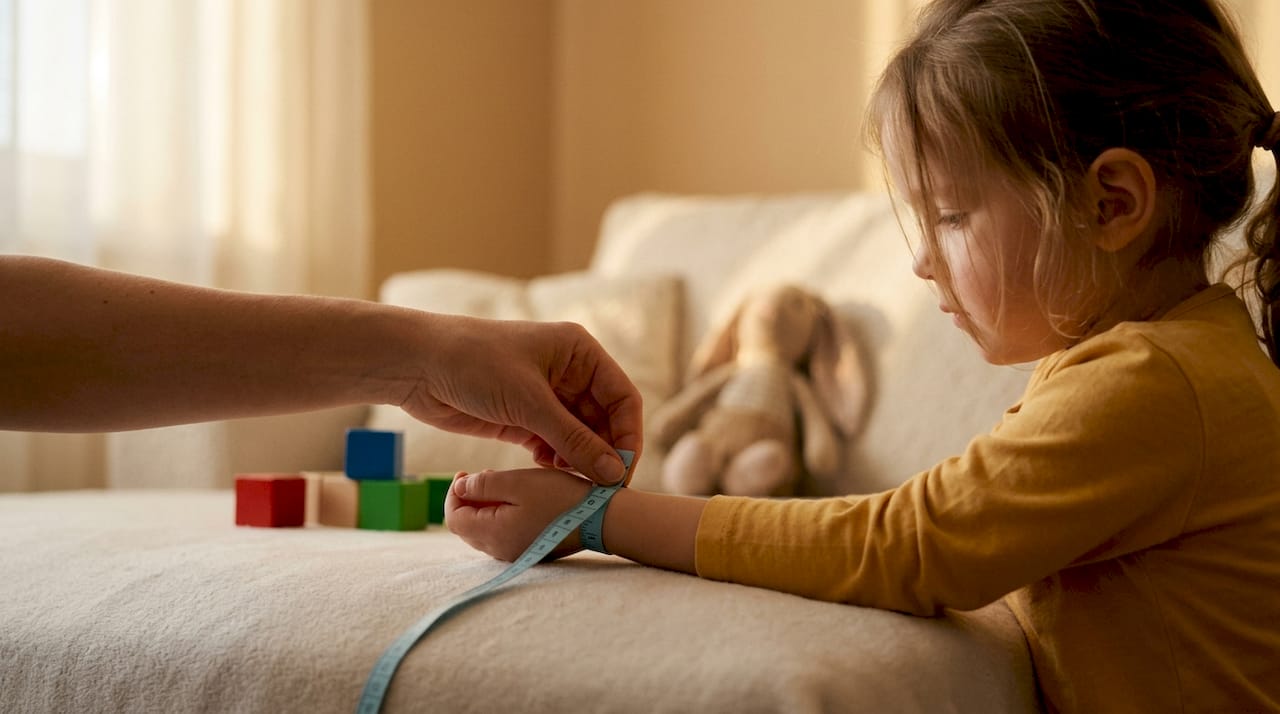
Measure the same way you would for an adult: tape or string just above the wrist bone, then add a small allowance. For younger children, keep the extra room minimal, around ¼ to ½ inch, since a loose bracelet on a small wrist is more likely to slip off or become a choking hazard with certain clasp styles. For teens whose wrists are close to adult size, the standard ½ inch snug allowance usually works fine.
One detail worth planning for: kids grow. A bracelet sized perfectly today might be snug in eighteen months. If you’re buying a piece meant to last, look for adjustable clasps, extension chains, or styles with a little built-in room to grow into rather than a fixed length that will need replacing. Charm bracelets and slider-style pieces tend to handle this better than rigid bangles, which simply won’t work once a child’s hand grows past the opening.
For gifts, when you can’t measure the child directly, err toward the higher end of their age-typical range and choose a style with some adjustability built in.
How Wrist Size Changes Throughout the Day and Over a Lifetime
Your wrist isn’t a fixed number, it fluctuates in small but meaningful ways. Heat, hydration, and activity all cause minor swelling, which is why measuring mid-day tends to give a more consistent baseline than measuring first thing in the morning or after a long, hot day. The difference is usually small, often just a fraction of an inch, but it’s enough to matter for a snug-fitting piece.
Bigger changes happen over longer stretches of time. Weight fluctuations, pregnancy, muscle gain from strength training, and simply aging can all shift wrist circumference by a quarter inch or more over months or years. Someone who measured their wrist five years ago and hasn’t checked since might be surprised by how much that number has moved.
This is exactly why an adjustable clasp or a bracelet with a bit of built-in flexibility tends to age better than one sized to the exact millimeter. If you’re buying a piece you plan to wear for years, whether it’s a gift to yourself or a family heirloom in the making, it’s worth choosing a style that can flex with your body rather than one locked to a single moment in time.
For anyone whose wrist size shifts noticeably with the seasons or with training cycles, re-measuring once or twice a year is a smart habit, especially before a big purchase. It takes thirty seconds and can save you from a bracelet that fit beautifully in January but feels tight by July.
Guidance on Adjustable Bracelets and Their Sizing Considerations
Adjustable bracelets solve a real problem: they let one piece fit a range of wrists without a trip to the jeweler. Sliding knot bracelets, extension chains, and multi-hole clasps are the three most common mechanisms, and each has its own quirks worth knowing before you buy.
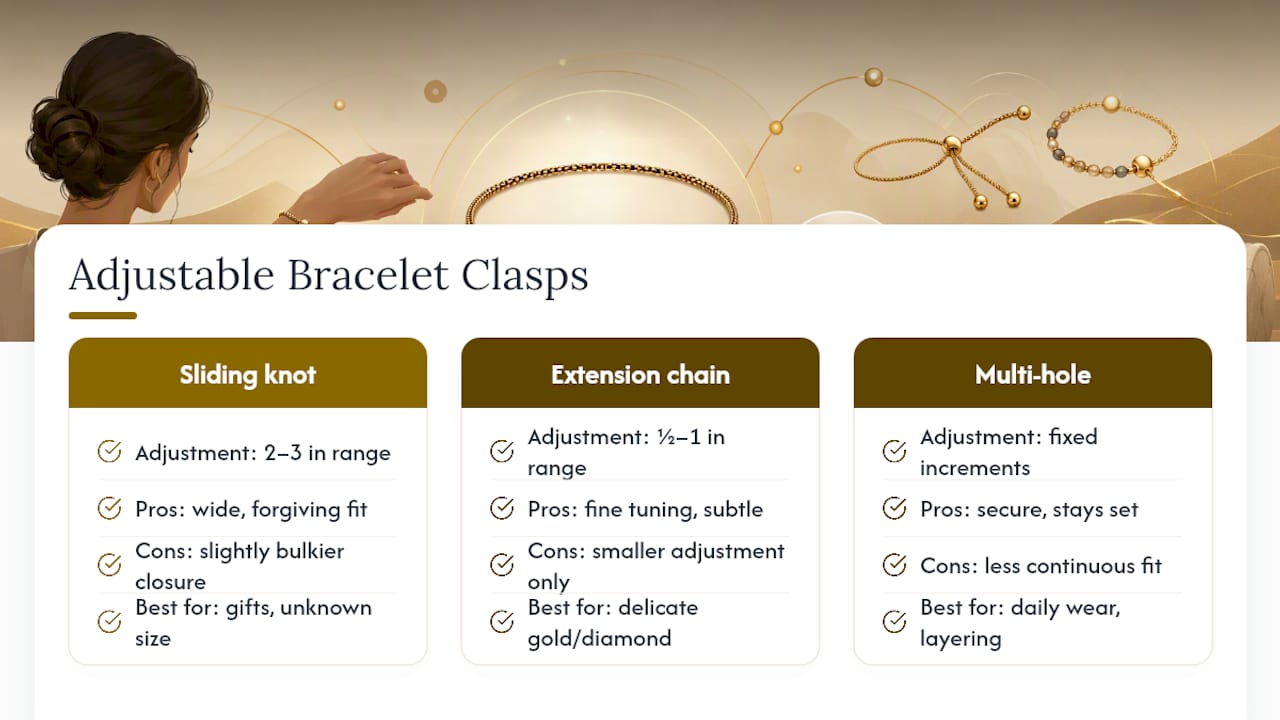
Sliding knot designs, common in cord and beaded bracelets, typically adjust across a wide range, often 2 to 3 inches of total flexibility. That makes them forgiving for gifts when you don’t know the recipient’s exact wrist size. The tradeoff is a slightly bulkier closure that some wearers notice more than a traditional clasp.
Extension chains, often found on finer chain bracelets, add a shorter adjustable segment, usually ½ to 1 inch, at the clasp end. These give you fine-tuning room without changing the overall character of the piece, which is why they’re popular on delicate gold and diamond bracelets. If you’re between two standard sizes, a bracelet with an extension chain often solves the problem better than committing to a fixed length.
Multi-hole or lobster-clasp adjustable designs work similarly but in fixed increments rather than a continuous slide. When choosing between these, think about how the bracelet will be worn: daily wear benefits from a secure, fixed clasp, while a piece you’ll layer or share with someone else benefits from a wider adjustable range.
One caution: adjustability isn’t unlimited stretch. A cord bracelet built to flex from 6 to 8 inches still has real limits, and forcing it past its range strains the material. Check the stated adjustment range before assuming a piece will fit a wrist far outside the average.
Recommendations for Sizing When Buying Bracelets as Gifts
Buying a bracelet for someone else is where sizing anxiety peaks, and for good reason: you can’t always ask without ruining the surprise. A few practical workarounds make this far less stressful.
The most reliable trick is borrowing a bracelet the recipient already owns and wears often, then measuring its length directly. This sidesteps the need to guess their wrist size entirely and gives you an exact number to shop against. If that’s not possible, a length of string wrapped loosely around their wrist while they’re asleep, distracted, or simply not paying attention works in a pinch.
When neither option is available, lean on averages and adjustability rather than a single guess. Most adult women fit comfortably into a 7 inch bracelet, which lines up with the medium range most brands use as their default. For men’s pieces, sizing tends to run larger, often 7.5 to 8.5 inches, and Usajewels’ men’s bracelet collection reflects that wider standard range.
Adjustable styles are your best friend for gifting. A sliding knot, extension chain, or multi-hole clasp gives you room to be wrong by half an inch without the gift feeling like a miss. If you’re set on a fixed-length or rigid piece, like a bangle, consider gifting a gift card or letting the recipient choose in person instead. Forcing a guess on a bangle, where hand diameter is unforgiving, is the riskiest gift-sizing scenario of them all.
A note from someone who’s seen the returns pile up
One habit saves more headaches than any chart: measure at the same time of day you’ll actually wear the piece, not first thing in the morning.
— Joseph
Custom Bracelet Sizing, Made in-House
Getting a bracelet sized right shouldn’t mean settling for whatever length happens to be in stock. Because Usajewels manufactures every piece in-house, sizing adjustments and custom lengths are built into how we work, not a special request that gets sent out and delayed for weeks.

That matters most on pieces where a small sizing error is costly to fix later: tennis bracelets, gold chain bracelets, and anything set with diamonds. Instead of guessing between a 7 inch and a 7.5 inch off-the-shelf option, you can design your own bracelet with the exact length, metal, and diamond quality you want from the start. Fewer guesses at checkout means fewer pieces that come back because they didn’t fit. If you’re ready to find your size, browse the current collections and start a custom order sized specifically to you.
Sources
FAQ
What Is the Standard Bracelet Size for Women?
Most women wear a 7 inch bracelet, which fits a wrist circumference of roughly 6 to 6.5 inches with a comfortable allowance added.
How Do I Measure My Wrist Without a Tape Measure?
Wrap a strip of paper or string around your wrist, mark the overlap point, then measure that length against a rigid ruler.
How Much Should I Add to My Wrist Measurement for a Bracelet?
Add about ½ inch for a snug fit, ¾ inch for a standard comfortable fit, or 1 inch if you prefer a looser, drapey feel.
How Do I Size a Bangle Bracelet?
Measure your hand diameter across the knuckles, from pinky to pointer finger, since that width determines whether the bangle can slide on.
Can Usajewels Custom Size a Bracelet for Me?
Yes, Usajewels manufactures pieces in-house and offers custom sizing on bracelets, which is especially useful for diamond-set or rigid designs.
Recommended
- Bangle Bracelets, Fine Jewelry Artistry | USA Jewels
- Bracelet Collections: Tennis & Gold | USA Jewels
- Ring Size Guide: Measure at Home | USA Jewels
- Tennis Bracelet Guide: How to Choose the Perfect One | USA Jewels

Deep Mehta is the Co-Owner of USA Jewels, a family-owned jewelry business she has led since 2013 in Deerfield Beach, Florida. With over 13 years of hands-on experience in fine jewelry retail, manufacturing, and diamond importing, Deep specializes in engagement rings, wedding bands, and custom jewelry design. She also co-manages Kaash Group Talent Acquisition. Deep is a University of Florida graduate and oversees every aspect of USA Jewels’ operations, from product development to marketing.
Fine Jewelry Collection


You May Also Like
Jewelry Certification Types Guide: What U.S. Buyers Need

The Best Push Present Jewelry Ideas for New Moms