Cut First, Then Color vs Clarity for Engagement Rings
Cut comes first, always. After that, prioritize color over clarity once a stone is eye-clean, because near-colorless grades change what you see face-up while high clarity often does not. The one big exception: step cuts like emerald and asscher shapes, along with stones over two carats, where clarity climbs the priority list because inclusions have nowhere to hide.
TL;DR:
- Most diamonds with G through J color appear white in common settings, so buyers can often choose lower grades without visible impact, especially in yellow or rose gold settings.
- Eye-clean clarity is achievable in many VS2 and SI1 stones, meaning inclusions are not visible at typical viewing distances, allowing for cost savings without visible trade-offs.
- Large stones over two carats or step cuts like emerald and asscher demand higher clarity and color grades because inclusions and tint become more visible.
- Focusing on excellent cut quality maximizes brilliance and minimizes the visibility of color and inclusions, making lower grades appear more flawless.
- Photos, videos, and the clarity plot should be reviewed before purchasing to verify real-world appearance and avoid buying flaws that are visible under normal conditions.
Table of Contents
- Color vs Clarity: How Diamond Color Is Graded
- Color vs Clarity: How Clarity Grading Actually Works
- Color or Clarity: Which Should You Prioritize?
- How Ring Shape and Setting Change the Rules
- Budget-by-Budget Rules for Color and Clarity
- How to Verify Color and Clarity Before You Buy
- How Lighting Changes What You See
- How Color and Clarity Drive Diamond Value
- The Trade-Offs Most Buyers Actually Make
- Why Fluorescent Lighting Changes Diamond Color
- Author Perspective: A Practical Buying Philosophy
- Design Your Own Ring With the Right Color and Clarity
- Sources
- FAQ
Color vs Clarity: How Diamond Color Is Graded
The GIA color scale runs from D to Z, and it measures the absence of color, not the presence of it. A D grade is completely colorless. By the time you reach Z, the stone carries a visible yellow or brown tint. Everything between those extremes falls into buckets that matter more to your wallet than your eye.
D through F is the colorless tier, and it’s where most of the price premium lives. G through J is near-colorless, and this is the sweet spot most jewelers point buyers toward, because those stones look white to the naked eye in the vast majority of settings. K through M starts to show faint warmth, especially in larger stones or under direct light.
Face-up appearance depends on more than the lab grade sitting on a certificate. Cut quality changes how light returns to your eye, stone size makes tint more visible in bigger carats, and metal choice can hide or expose warmth entirely. A well-cut G color diamond in a platinum setting often looks just as bright as an F color stone, at a meaningfully lower price.
Here’s how to set your floor by setting type:
- White metal (platinum or white gold): stay at G or H color for the safest bet.
- Yellow or rose gold, or a halo design: I or J color usually reads just as white, since the warm metal or the surrounding smaller diamonds mask any tint.
- Large solitaires of significant size: consider stepping up to F or G, since size amplifies any visible tint.
- Investment or resale-focused purchases: D through F holds value differently in the secondary market, if that’s a priority for you.
Quick fact: Buyers chasing D–F colorless grades often pay a steep premium for a difference only a gemologist under controlled lighting would notice, according to SuperJeweler’s buying analysis, which found that a well-cut G–H stone frequently outperforms a poorly cut D-color diamond in real-world brilliance.
Color vs Clarity: How Clarity Grading Actually Works
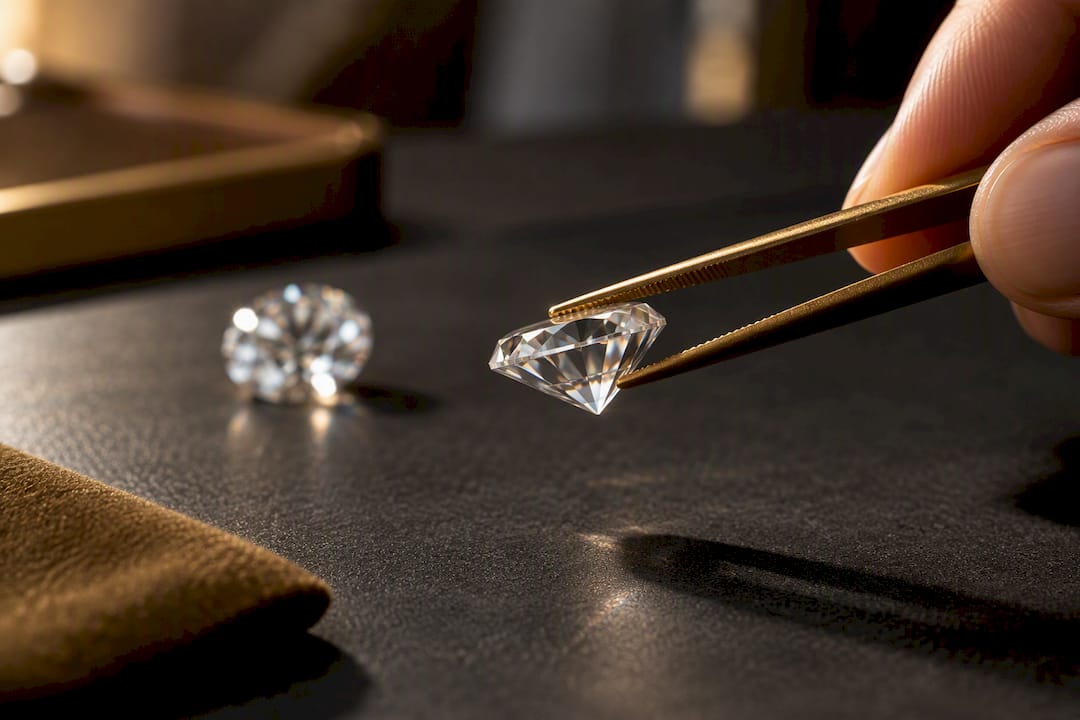
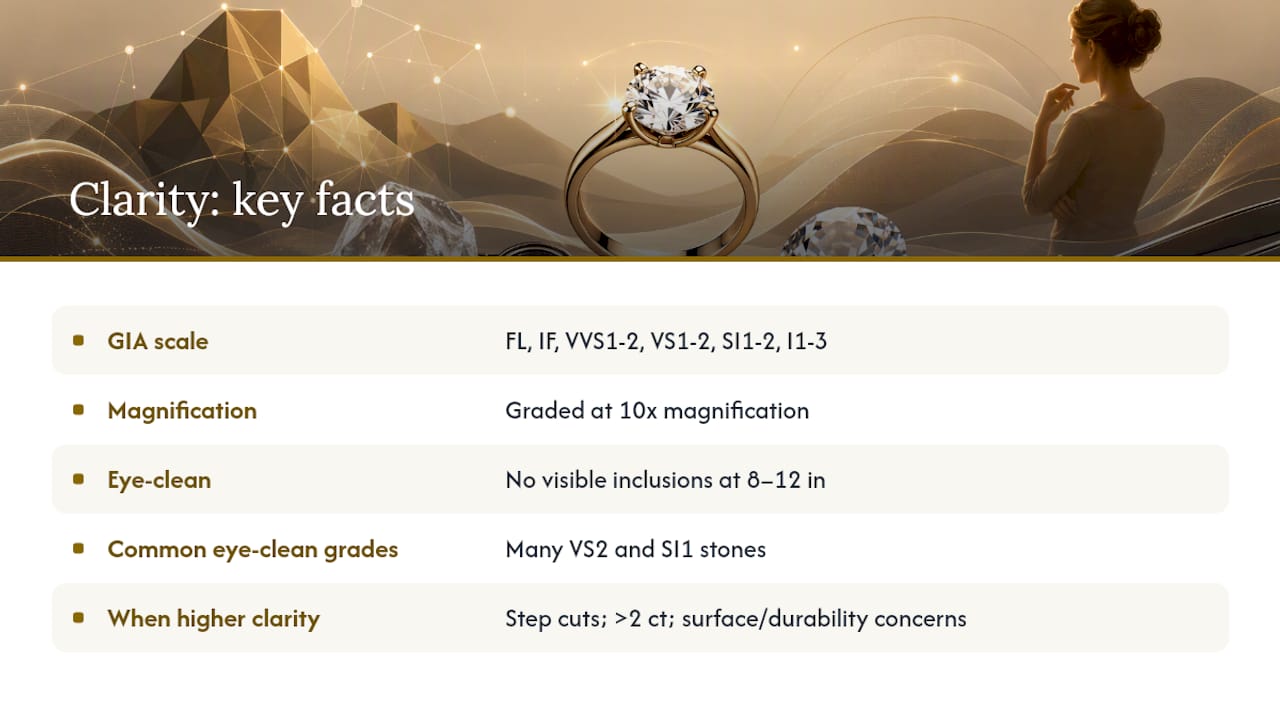
Clarity in diamonds measures internal and external characteristics under 10x magnification, and that magnification detail is the whole story. The GIA clarity scale runs from Flawless (FL) and Internally Flawless (IF), through VVS1 and VVS2, VS1 and VS2, SI1 and SI2, down to I1 through I3. Graders are looking at 10 power magnification, which shows details your bare eye will never register on most of these grades.
That gap between what a magnified lens sees and what a person sees across the dinner table is why “eye-clean” has become the real buying standard. A diamond is eye-clean when no inclusions are visible at a normal viewing distance of roughly 8 to 12 inches. Many VS2 and SI1 stones meet that bar completely, which means you can often skip two or three grade levels above them without losing anything you could actually see.
Grade alone doesn’t tell the whole story, either. Inclusion placement matters as much as inclusion count. A stone with a single inclusion tucked under the setting’s prong will read cleaner than one with a smaller inclusion sitting dead center under the table facet.
Pro Tip: When comparing two stones with the same clarity grade, ask for the clarity plot from the lab report. A cluster of inclusions near the edge, hidden by a prong, beats a single inclusion parked in the middle of the table every time.
Higher clarity earns its price in a few specific cases: step cuts that expose inclusions like a window, stones above two carats where flaws become proportionally larger, and situations where an inclusion sits close enough to the surface to raise durability concerns.
Color or Clarity: Which Should You Prioritize?
Cut still wins first place, full stop. A diamond’s proportions, symmetry, and polish determine how much light bounces back at the viewer, and an excellent or ideal cut grade can make color and clarity issues nearly disappear from view. Once cut is locked at Excellent or Ideal, the color versus clarity question becomes about where your money buys visible change.
Color usually wins that argument for one simple reason: it affects the entire face of the stone, uniformly, in every lighting condition. Clarity, once you’re past the eye-clean threshold, is invisible in normal viewing. That asymmetry is why most buyers get more value tightening color by one grade than clarity by one grade.
The price curve backs this up. Jumping from G to F color, or from H to G, often adds a real premium for a shift a casual observer will not detect face-up. The same is true moving from SI1 to VS2, or VS2 to VVS2, once the stone already passes the eye-clean test. You’re paying for a number on paper, not a visible upgrade.
Here’s when to break the general rule:
- Step-cut shapes. Emerald and asscher cuts have long, flat facets that act like windows into the stone, so inclusions and tint both show more readily than in a round brilliant.
- Stones over two carats. Size magnifies everything, tint and inclusions alike, so both color and clarity floors should rise together.
- Resale or investment purchases. Paperwork and grade often matter more to the next buyer than to you, so higher grades protect resale value even if you can’t see the difference.
- Macro photography plans. If the ring is getting photographed up close for social media or a proposal video, tighter clarity avoids surprises under a camera lens that a human eye would never catch.
How Ring Shape and Setting Change the Rules
Round brilliant cuts are the most forgiving shape on the market, which is exactly why they dominate engagement ring sales. Their 58 facets scatter light in a way that hides both minor tint and small inclusions, so you can comfortably run G to I color with VS2 to SI1 clarity and land a stone that looks flawless to everyone but a jeweler with a loupe.
Step cuts flip the script entirely. Emerald and asscher shapes show inclusions and color more readily because their facets behave like clear glass panes rather than mirrors bouncing light around, according to SuperJeweler’s guide. If you love that vintage geometric look, budget for VS1 or better clarity and expect to need a slightly whiter color grade too, since warmth reads more obviously in those long open facets.
Setting choice does real work here as well:
- Halo settings surround the center stone with smaller diamonds, which brightens the whole piece and lets a lower color grade pass for whiter than it is on paper.
- Pavé bands create the same optical brightening effect along the shank.
- Yellow and rose gold settings reduce visible warmth in the diamond, meaning I or J color can look every bit as good as G or H would in platinum.
- Bezel settings, which wrap metal around the stone’s edge, can hide slight color at the girdle where it would otherwise be most visible.
Budget-by-Budget Rules for Color and Clarity
Your target grades should shift with your budget, not stay fixed at some idealized standard. Here’s how to think through it at each tier.
- Tight budget: Accept J or K color if you’re using warm metal or a halo design, and target SI1 clarity. Always ask for photos or video before buying, since SI1 stones vary widely in eye-cleanliness depending on inclusion placement.
- Mid-range budget: Aim for G to H color paired with VS2 to SI1 clarity, which is the combination most buyer guides point to as delivering the best face-up value for the price paid.
- Higher budget: Move to F or G color with VS1 to VS2 clarity, especially if you’re buying a large stone or a step cut that will show more. D color and Internally Flawless clarity are rarely necessary unless you specifically want that paperwork for resale or personal preference.
Whatever tier you’re shopping in, the goal is the same: spend on what changes what you see, not on a grade that only shows up on a certificate.
How to Verify Color and Clarity Before You Buy
A GIA report tells you the grade. It does not tell you how the stone actually looks in your ring. Closing that gap takes a little homework before you commit.
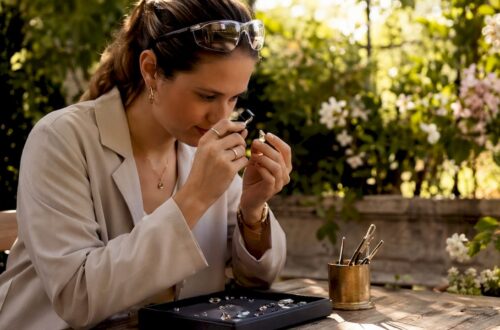
Start by requesting real photos and video, not stock images. Ask for face-up shots, images of the stone mounted in its actual setting, and video taken under at least two different lighting sources. Face-up imaging under multiple lighting conditions tells you more about real-world appearance than any grade printed on paper.
Next, get the lab report itself, whether from GIA or a comparable lab, and actually read the clarity plot. That diagram shows exactly where inclusions sit, and it should also flag any clarity enhancements like laser drilling or fracture filling, which affect both durability and long-term value.
Pro Tip: Look specifically at inclusion contrast and placement, not just the grade letter. An inclusion near the table or one with dark coloring stands out far more than a lighter, edge-positioned flaw of the same technical size.
Watch for red flags that suggest a seller is hiding something:
- No photos available, or only computer-generated renderings instead of real images.
- Inconsistent or single-source lighting in every photo, which can mask tint or inclusions.
- Vague or missing lab documentation, especially for stones marketed as “near-flawless.”
- Heavy blue fluorescence, which can make a diamond appear hazy or oily under UV-heavy lighting like some LED and daylight bulbs.
Reject any stone with a dark, centrally placed inclusion visible in a normal photo. That’s the one flaw type that reliably reads as a flaw to everyone, not just a trained eye.
How Lighting Changes What You See
The same diamond can look like two different stones depending on where you’re standing. Fluorescent office lighting, warm incandescent bulbs, and daylight all shift how color and clarity present themselves, and that’s exactly why relying on a single photo or a single showroom visit is a mistake.
Bright, diffused lighting, like overcast daylight, tends to be the most honest test for color. It shows warmth accurately without exaggerating it. Direct sunlight, on the other hand, can wash out minor tint while making inclusions sparkle in ways that either hide or highlight them depending on their position. Dim restaurant lighting or warm incandescent bulbs flatter almost every diamond, which is part of why a stone can look perfect at dinner and slightly warmer the next morning by a window.
Clarity has its own lighting quirks. Inclusions often become more visible under a single, harsh point-source light, like a jeweler’s spotlight, because that concentrated beam creates contrast against the surrounding facets. Softer, diffused light tends to minimize the visibility of small inclusions, which is exactly why showroom lighting can make an SI2 stone look better than it will under your bathroom vanity bulb at home.
The practical takeaway: never judge a stone under one lighting condition alone. Ask to see it, or ask for video of it, under at least an incandescent-style warm light and a bright, neutral daylight-equivalent light before you commit.
How Color and Clarity Drive Diamond Value
Price in the diamond market does not move in a straight line. It jumps at specific grade boundaries, and understanding those jumps helps you avoid paying for an invisible upgrade.
Color premiums accelerate as you approach D, F, and other colorless grades, largely because true colorless stones are rarer and carry cachet in the trade beyond what the eye can register. Clarity premiums behave similarly at the top end. The leap from VVS2 to VVS1, or VVS1 to Internally Flawless, reflects rarity in the grading population more than any visible difference a buyer will notice once mounted.
Where the two Cs diverge is in how directly they connect to what you actually see. Color affects the entire visible surface of a diamond in every lighting condition, so a color upgrade changes the stone’s overall appearance. Clarity, once a stone clears the eye-clean threshold, stops delivering visible change even as the price keeps climbing. That’s the core reason color usually deserves priority over clarity in a fixed budget, once cut is locked in at Excellent or Ideal.
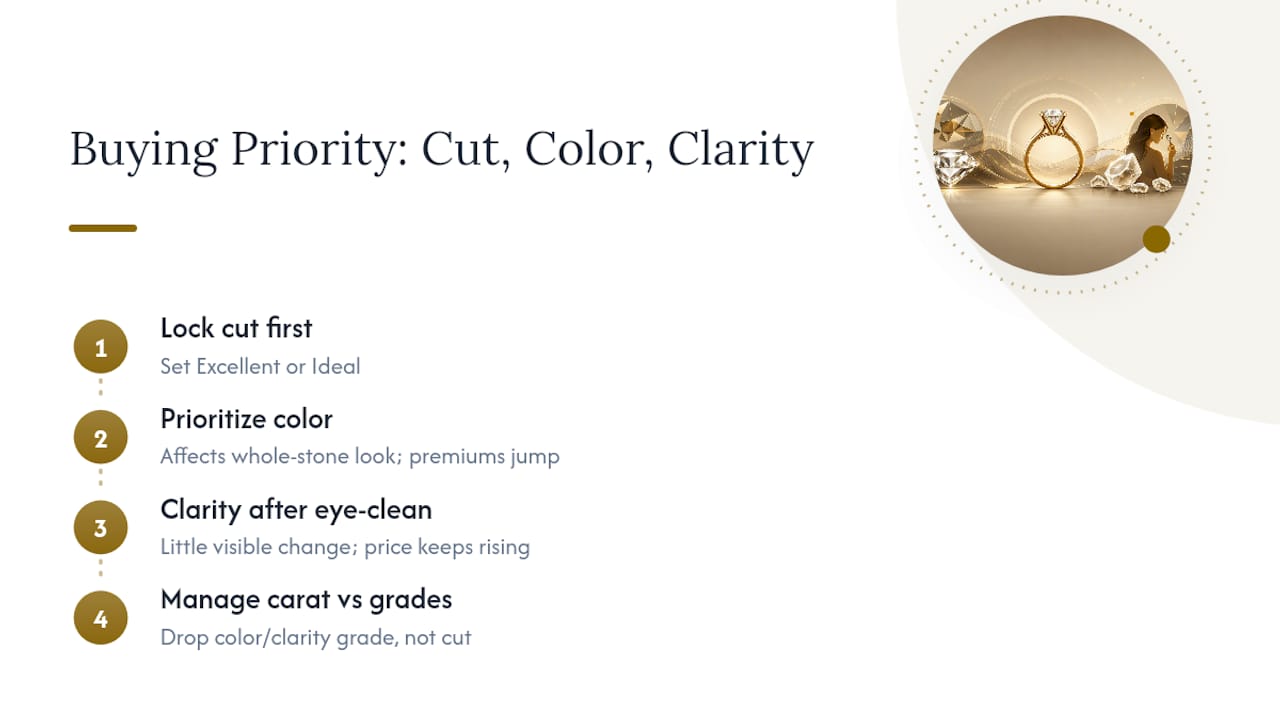
Carat weight complicates the equation further, since price rises roughly with the square of the increase in carat weight, not linearly. A buyer stretching for an extra quarter carat is often better served dropping one color grade or one clarity grade to stay within budget, rather than compromising cut quality to hit a carat target.
The Trade-Offs Most Buyers Actually Make
Almost every engagement ring buyer ends up trading something for something else, because no budget stretches infinitely across all four Cs at once. The trick is trading intentionally instead of accidentally.
The most common trade is color for size: buyers drop from G to I or J color to afford a bigger stone, banking on a halo or warm metal setting to disguise the tint. That trade works well precisely because setting choice does real optical work, as covered earlier.
The second most common trade is clarity for color, where buyers accept an SI1 or SI2 stone specifically to fund a whiter color grade, on the logic that color shows everywhere while clarity, once eye-clean, shows nowhere. That logic holds up for round brilliants and falls apart for step cuts, which is why shape should always inform which trade makes sense.
A smaller group of buyers trade cut for either color or clarity, chasing a Very Good cut grade instead of Excellent to afford a whiter or cleaner stone. This is generally the trade to avoid. Cut affects brilliance far more than either remaining C, and a downgrade here tends to produce a duller stone regardless of what the certificate says about color or clarity.
Finally, some buyers trade certification tier itself, choosing a non-GIA lab report to save money. That trade carries real risk, since grading consistency varies significantly between labs, and a certificate from a less rigorous lab can overstate both color and clarity relative to what GIA would assign the same stone.
Why Fluorescent Lighting Changes Diamond Color
Roughly a third of diamonds exhibit some degree of fluorescence, a glow triggered by ultraviolet light that most people never notice because most environments don’t emit much UV. That changes indoors under certain fluorescent office bulbs and outdoors in direct sunlight, both of which carry meaningful UV content.
Faint to medium blue fluorescence, the most common type, can actually make a lower color grade diamond, like an O or J, appear a touch whiter under UV-rich light, since the blue glow counteracts yellow tint. That’s a genuine, if minor, upside for budget-conscious buyers. Strong or very strong fluorescence tells a different story: it can give a diamond a hazy, oily, or milky look, particularly in larger stones, which actually hurts appearance rather than helping it.
The practical concern is inconsistency. A diamond with strong fluorescence might look crisp and white in a jeweler’s LED-lit display case, then look slightly cloudy at an outdoor daytime wedding, then look fine again under indoor evening lighting. If a lab report flags strong or very strong fluorescence, ask to see the stone, or video of the stone, under natural daylight specifically, since that’s where the haziness effect is most likely to show up.
Author Perspective: A Practical Buying Philosophy
Cut first, then color over clarity once a stone is eye-clean. That’s the whole philosophy in one sentence. Chasing clarity grades past the point your eye can detect is spending money to satisfy a certificate, not your ring finger. An excellent cut with eye-clean clarity and a solid color grade gives you the most visible sparkle per dollar, every time. For deeper reference, the diamond color and clarity education pages walk through grade comparisons in more visual detail than any single article can.
— Joseph
Design Your Own Ring With the Right Color and Clarity
Some jewelers sell certified loose diamonds directly, without a traditional retail markup standing between you and the stone, by using in-house manufacturing to cut out the middlemen. That matters here specifically: instead of choosing from a fixed inventory where someone else already decided the color and clarity trade-off for you, you pick the exact combination that fits your shape, your setting, and your budget.

Every stone is ethically sourced and comes with grading documentation, so you can verify eye-clean clarity and face-up color before it ever reaches your hand. The Design Your Own Diamond Ring tool lets you test different color and clarity combinations against real setting styles, from halo to bezel to classic solitaire, and see how each choice actually reads once mounted. Some jewelers offer a lifetime diamond upgrade program, so the grade you choose today isn’t a decision you’re locked into forever.
Ready to see your options? Browse certified loose diamonds and start comparing color and clarity combinations against your actual budget today.
Sources
- Understanding Diamond Color & Clarity: The 4 Cs
- What Does the GIA Colored Gem Grading Code Mean? – Gem Society
- Diamond Color vs Clarity: What Engagement Ring Buyers Should Prioritize
FAQ
Is it better to prioritize color or clarity?
For most engagement ring buyers, color takes priority over clarity once a stone is eye-clean, since color affects the entire face-up appearance while clarity above the eye-clean threshold becomes invisible. The one major exception is step cuts like emerald and asscher shapes, where inclusions show through more readily and clarity should move up the priority list.
Are colored diamonds worth more than clear diamonds?
Naturally colored diamonds, called fancy color diamonds, are graded on an entirely different scale measuring hue, tone, and saturation rather than the D–Z absence-of-color scale used for white diamonds. Rare fancy colors like pink, blue, and certain intense yellows can command significantly higher prices than a colorless white diamond of similar size, based on rarity in the colored-gem grading system.
What is better clarity, VS1 or VS2?
VS1 sits one grade above VS2 on the GIA clarity scale, meaning its inclusions are slightly smaller or less visible under 10x magnification. In practice, both grades are typically eye-clean, so a VS2 usually delivers the same visible result as a VS1 at a lower price, except in step cuts or very large stones where the extra clarity margin helps.
Is F color good for an engagement ring?
F color sits in the colorless tier of the GIA scale, just below the top D and E grades, and it looks completely white face-up in virtually any setting. It’s a strong choice for step cuts, large stones, or platinum settings where you want a safety margin, though most buyers get equal visible results from a G or H color diamond at a lower price point.
What does eye-clean actually mean when shopping?
Eye-clean means no inclusions are visible to the naked eye at a normal viewing distance of about 8 to 12 inches. Many VS2 and SI1 stones meet this standard, which is why requesting real photos or video before buying matters more than the grade letter alone.
Recommended
- Diamond Color & Clarity Explained: What to Buy
- Save 30–50% with Clarity Enhanced Diamonds: GIA Facts and What to Ask
- Diamond Clarity Chart — FL to I3 Grades Explained

Deep Mehta is the Co-Owner of USA Jewels, a family-owned jewelry business she has led since 2013 in Deerfield Beach, Florida. With over 13 years of hands-on experience in fine jewelry retail, manufacturing, and diamond importing, Deep specializes in engagement rings, wedding bands, and custom jewelry design. She also co-manages Kaash Group Talent Acquisition. Deep is a University of Florida graduate and oversees every aspect of USA Jewels’ operations, from product development to marketing.
Fine Jewelry Collection

You May Also Like

Why Rose Gold Engagement Rings Trend in 2026

How to Measure Ring Size Accurately at Home