Diamond Resale Value: What a Diamond Is Really Worth Later
A diamond bought at retail usually resells for well under what you paid, often around half or less. That is true of almost every retail purchase, and it does not make a diamond a poor buy. It means a diamond earns its value by being worn, loved and, if you choose, upgraded, not by being flipped. Here is what the numbers look like, what moves them, and how to buy so you are protected on day one and for decades after.
TL;DR
- Expect a resale offer of roughly 20% to 60% of the retail price, and closer to half for a well-documented, good-quality natural stone.
- Market prices for diamonds have fallen sharply since 2022, so resale is market-dependent and not a stable store of value.
- A grading report from a respected lab, a classic cut and a clean, well-kept stone give you the strongest offers later.
- Lab-grown diamonds cost much less up front, so the dollars you could recover are small. Judge them on what you pay and what you get to enjoy.
- The smartest way to protect your money is a fair starting price, solid construction and an upgrade path, not a plan to sell.
Table of Contents
- Do diamonds hold their value?
- What can you expect to get back? Typical ranges
- What moves a diamond’s resale price
- Engagement ring resale: the ring is not the stone
- Should resale value decide what you buy?
- Perspective
- How to buy so you are protected from day one
- Design a ring built for keeping
- FAQ
- Sources
Do diamonds hold their value?
Not in the way a house or a savings account might. Retail prices include the work of cutting, setting, marketing and running a store. When you sell, the buyer is paying wholesale-style money for a used stone they must resell. The gap between those two prices is the reason resale feels low.
An expert quoted by Marketplace in 2026 said you might expect to get about half of what you paid if you sell straight back to the market, and that for most people a diamond should not be treated as an investment, with the exception of very high-end stones.
The backdrop matters too. AARP reports that diamond market prices have dropped about 45% since a peak in March 2022, citing the IDEX Diamond Index. And the natural diamond producers’ association, using Rapaport Group data, reports that a standard one-carat stone averaged about $8,007 in September 2021 and about $3,898 by September 2026, a decline of roughly 51%.
So a diamond bought five years ago may well be worth less today, even before you subtract the retail markup. That is useful to know before you buy, because it moves the question from “what will I get back?” to “what am I getting for what I pay right now?”
What can you expect to get back? Typical ranges
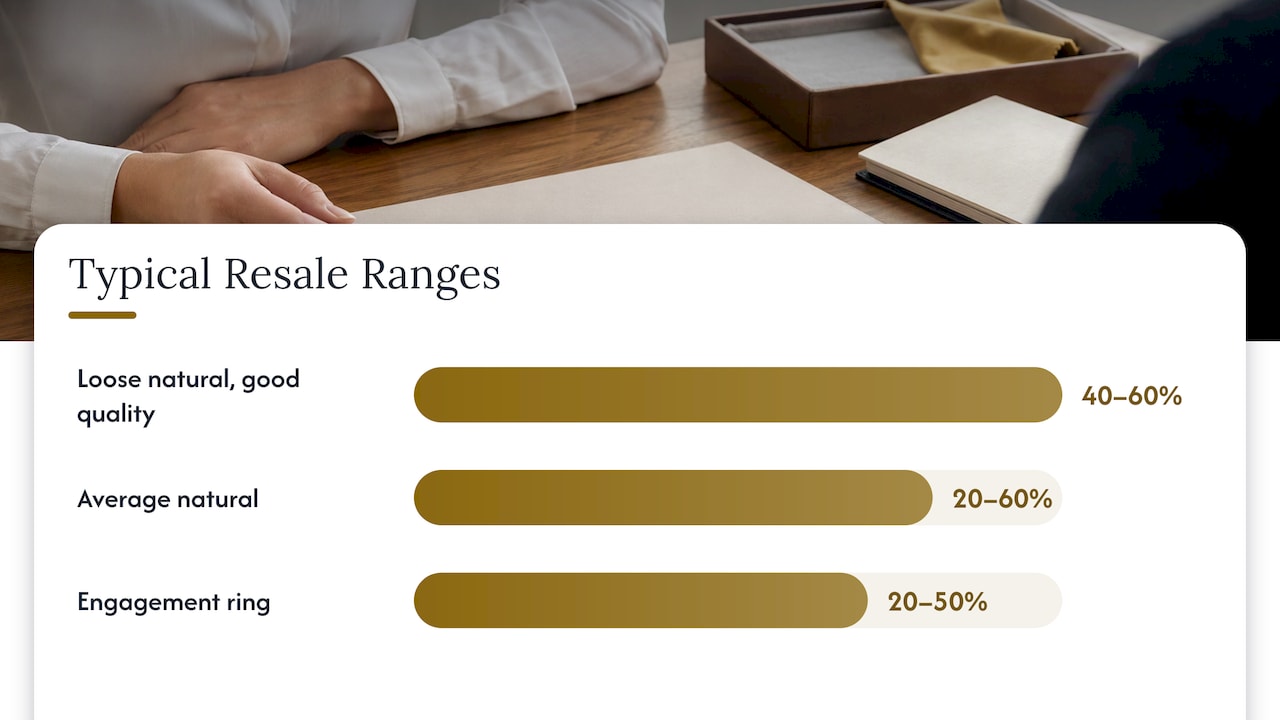
No public record exists of what used diamonds actually sell for. Every percentage you see online is an estimate drawn from offers and private sales, so treat them as ranges, not promises.
The pages that rank for this topic agree on the general picture:
| Item | Typical resale range (share of original retail) |
|---|---|
| Loose natural diamond, good quality, with a grading report | About 40% to 60% |
| Average natural diamond | About 20% to 60% |
| Engagement ring (stone, setting and metal together) | About 20% to 50% |
| Lab-grown diamond | Much lower, often a small fraction |
The range is wide because two stones that look alike to you can be very different to a buyer. A well-documented, well-cut stone sits near the top. A stone with no paperwork, visible chips or a poor cut sits near the bottom.
A worked example
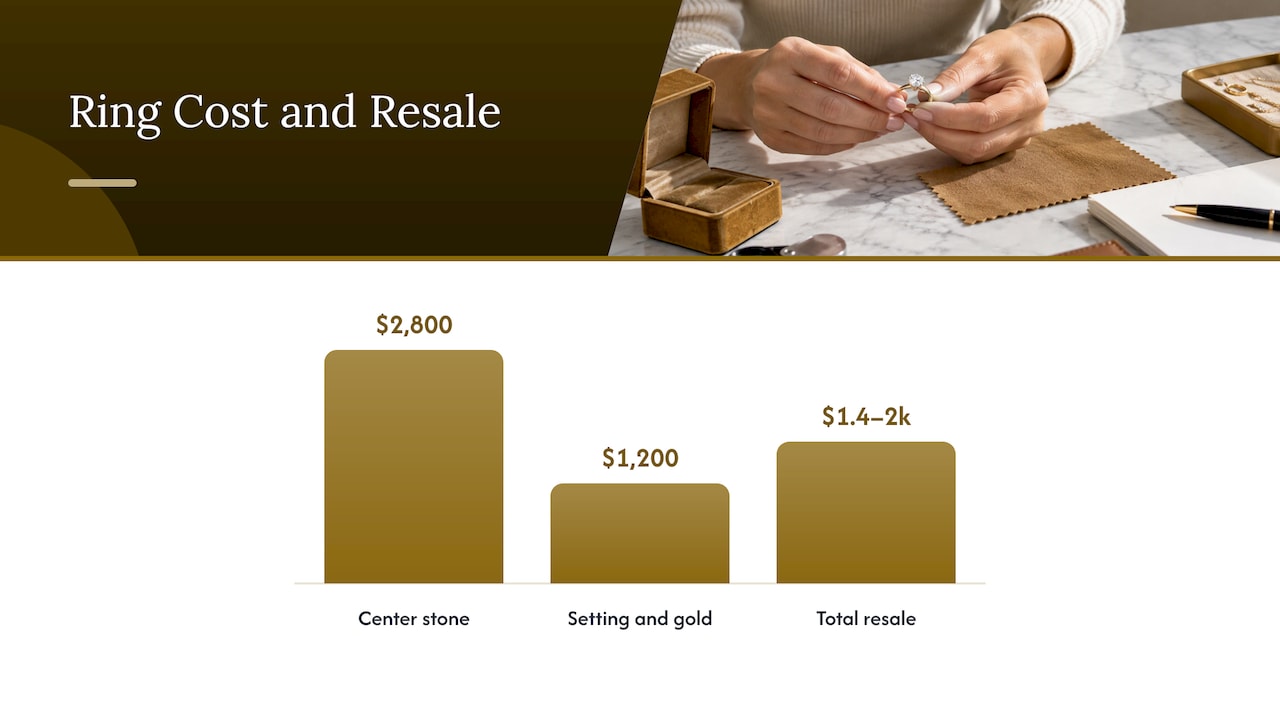
Say you buy a natural diamond ring for $4,000, of which about $2,800 is the center stone and $1,200 is the setting and gold. A buyer is mostly interested in the stone. If the stone sells at 50% of what you paid for it, that is about $1,400. The setting may add some value for its gold, but not at a retail price. Your total return might land somewhere between $1,400 and $2,000, which is 35% to 50% of the total. Selling back to the original seller as a trade-in credit can change the math, which we cover below.
What moves a diamond’s resale price
Five things do most of the work.
1. The grading report
A grading report (also called a certificate) is an independent lab’s written assessment of a diamond’s cut, color, clarity and carat weight. A buyer who can read one does not have to guess. Professional buyers report that whether a stone carries a GIA report is the single largest swing factor on an individual offer. GIA is the Gemological Institute of America, the lab buyers know best. If you are buying, pick a stone that comes with one. Our guide to GIA certification explains what the report shows, and our comparison of GIA, AGS and IGI shows how the labs differ.
2. Quality of the stone
Cut matters most for how a diamond looks, and buyers know it. Color and clarity then decide how much you pay. A well-cut stone in a near-colorless grade with no flaws visible to the eye is easy to resell. If you are weighing the trade-offs, our piece on cut first, then color versus clarity and the guide to color and clarity will help you spend where it counts.
3. Shape and size
Round stones and other classic shapes have the widest pool of buyers. Unusual shapes can take longer to sell. Our diamond shapes guide compares them.
4. Natural or lab-grown
Natural diamonds generally resell for a larger share of retail than lab-grown ones. Lab-grown prices have fallen steeply, and a used lab-grown stone competes with brand-new ones that cost less. That is the reason lab-grown stones cost less at the counter. Our explanation of why lab-grown diamonds cost less goes through it, and the lab diamond price guide shows what to expect to pay.
For most buyers the right comparison is the one at purchase. A lab-grown stone can give you a larger, higher-quality diamond for the same budget. If you want the full picture, read our lab-grown versus natural guide.
5. Where you sell
The buyer type changes the offer. A pawn shop is typically the lowest. A jeweler offers a middle path and may pay more as store credit. A private buyer can pay the most but takes the most time and carries the most risk. Specialized diamond buyers sit in between. Whichever you choose, get more than one offer, and sell only after you have your grading report and original receipt in hand.
Engagement ring resale: the ring is not the stone
Most engagement rings resell for between about 20% and 50% of the original price, with certified, well-documented rings toward the top of that range. A buyer values the center diamond first, then side stones, the metal, the condition of the ring and current demand.
Two things follow. First, the setting rarely brings back its retail price. Second, a ring with a respected report, a classic design and no wear is easier to move than a heavily customized one with no papers. If you plan to keep the ring for life, which most couples do, customize it freely. It is the personal details that make it yours.
Good habits protect whatever value there is:
- Keep the grading report, appraisal and receipt together.
- Have the prongs checked once a year and keep the stone clean.
- Insure the ring so a loss never becomes a total loss.
- Wear it and enjoy it. Cared-for jewelry sells better than neglected jewelry.
Should resale value decide what you buy?
For most people, no, and here is the reason in plain terms. Resale is a poor yardstick because it is uncertain, tied to market swings and reduced by every middleman between the mine and the shop. Three better questions:
- Am I paying a fair price for the quality I can see and verify? A direct price with no extra layers means more of your money sits in the stone and the gold.
- Is it built to last? Solid metal, not hollow or plated, wears for decades.
- Can it grow with us? An upgrade program lets you trade up later without starting over.
The second and third matter more than a guess about what a buyer might offer in 2036.
Gifts and first-time buyers
If you are choosing a gift, a child’s first fine piece or your first piece of fine jewelry, the same rule applies. Pick what will be worn and loved, and get the paperwork. A pendant or pair of earrings in 14K gold at a fair price delivers its value every time it is worn.
Perspective
We have been making jewelry for families since 1999, and the question we hear most is what a diamond will be worth later. Our honest answer is that a diamond is bought to be worn, and the best way to protect your money is on the way in.
That is why we make our jewelry in-house and sell direct. When there are no middlemen, you are not paying for layers of markup, and more of your budget goes into the diamond and the gold. We pair that with certified, conflict-free stones, solid construction and a lifetime diamond upgrade program, so your ring can change with your life.
If you want a number, expect the market to pay less than retail for any used diamond, and plan around it. If you want a piece you will treasure, choose a stone you love, with a report you can trust, from people who stand behind it.
Joseph
How to buy so you are protected from day one
Here is a short routine for any diamond purchase. At each step, we explain what we do.
- Set a budget, then choose the stone before the setting. The diamond carries most of the value. Our engagement ring buying guide walks through the order.
- Insist on a grading report. Every certified stone we sell is conflict-free, and our certified loose diamonds start at $142.
- Decide natural or lab-grown on what you value. If you want the strongest long-term footing, a natural stone usually holds a larger share of its price. If you want the most size and sparkle per dollar, lab-grown is the choice. Both are available from us, with lab-created diamond details to help you decide.
- Choose metal that lasts. Gold and platinum hold up for decades. We build our pieces solid, never hollow or plated.
- Check the terms. We offer free insured shipping and a 30-day money-back guarantee.
- Keep the paperwork. Report, receipt and appraisal go in one folder.
If you are curious how a trade-in or upgrade could work down the line, our article on estimating your diamond trade-in credit is the place to begin.
Design a ring built for keeping
If you would rather design it yourself, our design tool lets you pick the diamond shape, quality and metal. Design Your Own Diamond Ring starts at $399, and our engagement rings start at $346. Every piece is made in-house by our family, and the diamonds are eligible for our lifetime upgrade program.
For a gift or a child’s first piece, our fine jewelry collections start at $176, and platinum jewelry starts at $327.
FAQ
Do diamonds have resale value?
Yes, but it is a fraction of what you paid at retail. Most estimates fall between 20% and 60% for natural diamonds, and the figure depends on quality, paperwork and where you sell. Because there is no public record of used-diamond sales, these are estimates and not guarantees.
How much is a one-carat diamond worth for resale?
It depends on the grade, the cut and whether it has a grading report. A good natural stone with a report may bring around half of its retail price, and a lower-quality stone may bring much less. The best number is a written offer from a buyer who has seen your stone and your report.
What is an engagement ring worth after purchase?
Most engagement rings resell for roughly 20% to 50% of the original price, with the center diamond making up most of that. The setting adds less than its retail cost. Documented, well-kept rings reach the top of the range.
Are diamonds worth more now than ten years ago?
Not at market level. Rapaport data cited by the natural diamond producers’ association shows a standard one-carat price falling from about $8,007 in September 2021 to about $3,898 in September 2026. Prices move with the market, so a diamond is best bought to wear.
Does a lab-grown diamond hold its value?
Lab-grown stones resell for far less than natural ones because new lab-grown stones keep getting cheaper. The upside is the lower price you pay at the start. Our guide on whether lab-grown diamonds are worth it covers how to weigh that.
Sources
- Why mined diamonds are losing value, Marketplace
- Your Diamond Ring Isn’t Worth as Much as You Think, AARP
- Natural diamonds retain their value, Diamond Producers Association
Recommended
- Double the Original Price? Estimate Your Diamond Trade In Credit
- Diamond Pricing Guide: What Diamonds Cost
- Are Lab-Grown Diamonds Worth It? A Practical 2026 Guide

Deep Mehta is the Co-Owner of USA Jewels, a family-owned jewelry business she has led since 2013 in Deerfield Beach, Florida. With over 13 years of hands-on experience in fine jewelry retail, manufacturing, and diamond importing, Deep specializes in engagement rings, wedding bands, and custom jewelry design. She also co-manages Kaash Group Talent Acquisition. Deep is a University of Florida graduate and oversees every aspect of USA Jewels’ operations, from product development to marketing.
Fine Jewelry Collection

You May Also Like

How Engagement Ring Appraisal Works: 2026 Guide
Best Diamond Shapes for Short Fingers: What Flatters and Why