
How Engagement Ring Appraisal Works: 2026 Guide
An engagement ring appraisal is a certified professional evaluation that determines your ring’s true market value by analyzing its diamond quality, metal composition, craftsmanship, and overall condition. The process, formally called a jewelry appraisal, uses specialized equipment and established grading standards to produce a written report you can use for insurance, resale, or estate planning. Understanding how engagement ring appraisal works protects your investment from the moment you buy.
Appraisers trained as graduate gemologists examine every detail of your ring using tools like microscopes, refractometers, and XRF metal testers. They grade the diamond according to the 4Cs (cut, color, clarity, and carat weight) and cross-reference those grades with current market data. Certifications from organizations like GIA (Gemological Institute of America) play a central role in this process, though a GIA certificate and an appraisal are not the same thing. GIA certification grades the 4Cs scientifically but does not assign a monetary value. The appraisal takes those grades and translates them into what your ring would cost to replace today.
How engagement ring appraisal works: the step-by-step process
The appraisal process follows a clear sequence from your first phone call to the moment you receive the written report. Knowing each stage removes the mystery and helps you prepare.
1. Scheduling and documentation
You book an appointment with a certified appraiser, ideally one credentialed by the American Society of Jewelry Appraisers (ASA) or the American Gem Society (AGS). Bring any paperwork you have: the original receipt, a GIA or IGI grading report, previous appraisals, or any repair records. Honest disclosure about alterations or repairs matters here. A resized band or replaced prong can affect both the metal weight and the condition grade, which directly influences the final valuation.
2. Physical inspection
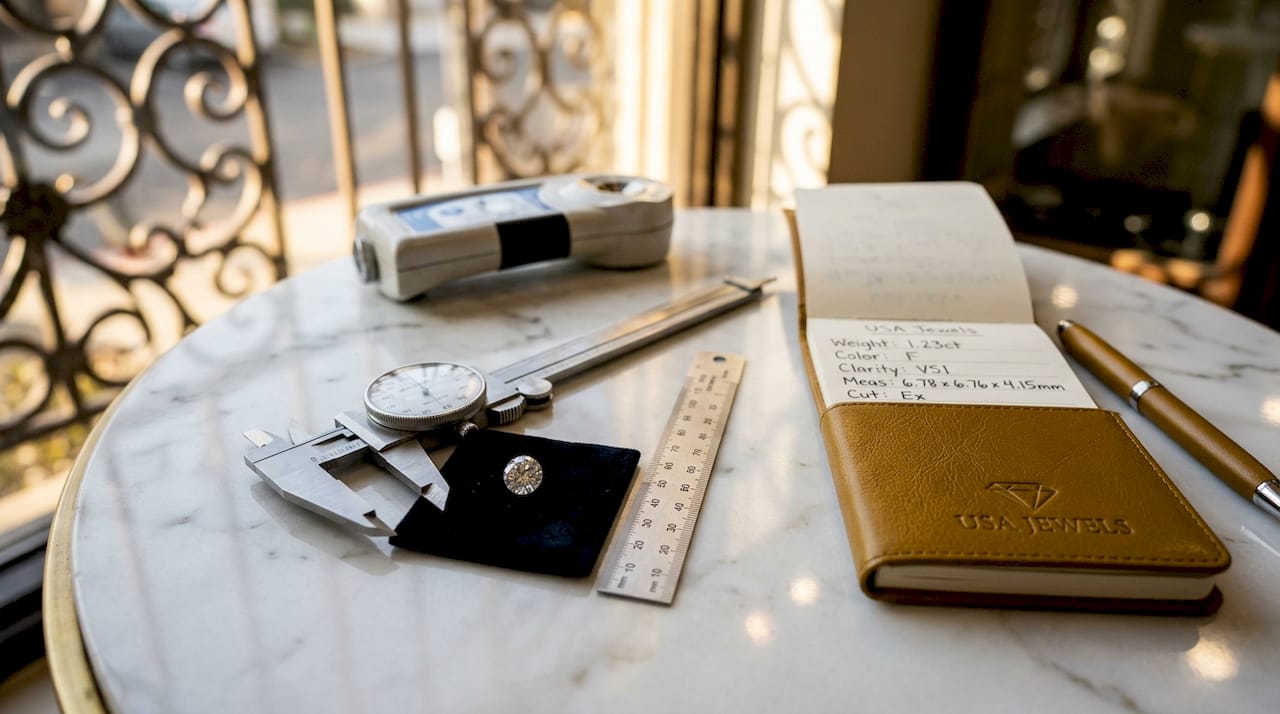
The appraiser examines the ring under magnification, measuring the diamond’s dimensions with a millimeter gauge and testing the metal with acid or an XRF analyzer to confirm karat and type. They check hallmarks stamped inside the band, assess prong integrity, and note any chips, scratches, or wear. Every characteristic is recorded in detail.
3. Stone grading and plotting
This is the most time-intensive step. The appraiser grades the diamond’s cut, color, clarity, and carat weight independently, then creates a plotting diagram. Stone plotting acts as a unique fingerprint of the diamond by mapping its internal inclusions and external blemishes. That diagram is critical for insurance claims and theft recovery because no two diamonds plot identically.
4. Report creation
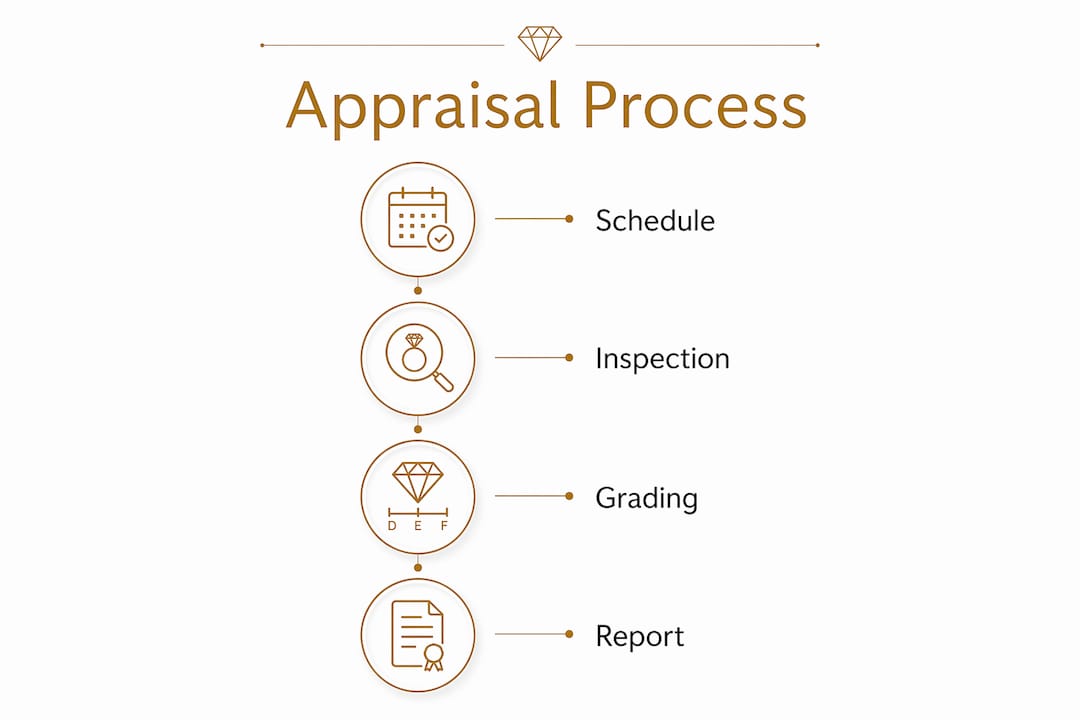
The appointment itself focuses on documentation and condition assessment. The written appraisal report synthesizes all inspection data with current 2026 market research to produce accurate replacement values, and appraisers typically deliver it within 1 to 5 days after the appointment. The report includes photos, measurements, grading details, and the final dollar figure.
Pro Tip: Many appraisers offer while-you-watch appointments for a small premium, letting you observe the entire inspection so your ring never leaves your sight. If peace of mind matters to you, it is worth asking about this option when you book.
What does an engagement ring appraisal cost in 2026?
Appraisal pricing follows two main structures, and knowing the difference helps you spot fair pricing versus a red flag.
- Flat fee for a single ring: Insurance appraisals generally cost between $100 and $250 as a flat fee. This structure is the industry standard for engagement rings and reflects the time, equipment, and professional liability involved.
- Hourly rate for collections or estates: Appraisers charge $50 to $150 per hour when evaluating multiple pieces. A large estate with 20 items will take significantly more time than a single solitaire.
- Travel fees and minimums: Some appraisers charge extra for on-site visits or apply a minimum billing time, usually one hour. Always ask upfront.
- Percentage-based fees: Avoid any appraiser who charges a percentage of the ring’s appraised value. Percentage-based fees conflict with USPAP standards (Uniform Standards of Professional Appraisal Practice) because they create a financial incentive to inflate the valuation.
- Too-low pricing: A $25 appraisal is not a bargain. It signals that the appraiser is skipping steps, lacks proper equipment, or carries no professional liability insurance.
Appraisal updates, which refresh the valuation without a full re-inspection, typically cost less than a new appraisal. Jewelry values shift with diamond market fluctuations and precious metal prices, so updating every two to three years keeps your insurance coverage accurate.
Pro Tip: Price transparency is a key indicator of a trustworthy appraiser. Any qualified professional will quote you a flat fee before the appointment begins, not after they see the ring.
How appraisals verify authenticity and detect misrepresentation
One of the most practical reasons to get an appraisal for your engagement ring is authentication. The jewelry market contains natural diamonds, lab-grown diamonds, and simulants like moissanite, and they can look identical to the naked eye.
- Natural vs. lab-grown vs. simulant: Natural diamonds form over billions of years underground. Lab-grown diamonds share the same chemical structure but are created in weeks. Moissanite is silicon carbide, a completely different material. All three can appear visually similar in a finished ring setting.
- Misidentification has real financial consequences: Appraisals can detect mislabeling such as distinguishing moissanite from a lab-grown or natural diamond, which can drastically alter the ring’s value. One documented case found a ring sold as a lab-grown diamond appraised at $65 after the stone was confirmed as moissanite under gemologist inspection.
- Certification alone is not enough: A seller’s verbal claim or even a printed certificate can be fabricated or misapplied to the wrong stone. An independent appraiser tests the actual stone in front of you, not a piece of paper.
- Plotting as a stone fingerprint: The inclusion map created during appraisal ties the physical stone to its documentation. If a stone is ever switched or substituted, the plot will not match.
Misidentification in an appraisal, such as moissanite being mistaken for a diamond, risks invalidating insurance claims and resale negotiations. Independent verification with specialized equipment is the only reliable protection against this risk.
For buyers comparing lab-grown vs. natural diamonds, understanding how appraisers distinguish between them is part of making a confident purchase decision.
Practical steps you can take: Request an independent appraisal from a certified gemologist before finalizing any significant purchase. Ask the appraiser to test the stone with a thermal and electrical conductivity tester, which reliably separates moissanite from diamond. Keep the appraisal report and the stone plot together in a secure location.
How to read an engagement ring appraisal report
The report is the deliverable you actually use. Understanding its components helps you act on the information rather than file it away and forget it.
What the report contains
A standard appraisal report describes the ring’s metal type and karat, the diamond’s 4Cs grades, any secondary stones, the overall condition, measurements, and photographs. It also includes the appraiser’s credentials, the date of the appraisal, and the purpose for which the valuation was prepared.
The three types of value
This is where most buyers get confused. The number on your appraisal report is not what your ring is worth in every context.
| Valuation type | What it means | When to use it |
|---|---|---|
| Retail replacement value | Cost to replace the ring at a retail jeweler today | Insurance coverage |
| Resale value | What a buyer would pay on the secondary market | Selling or trading in |
| Liquidation value | Lowest price in a forced or quick sale | Estate settlement |
Replacement value accounts for current market costs to replace the ring, not what you originally paid. Insurance companies require this figure because it reflects what they would actually spend to replace your ring if it were lost or stolen. Replacement value is almost always higher than what you paid at retail, and significantly higher than resale value.
Using the report practically
For insurance, submit the appraisal to your insurer to schedule the ring as a separate item on your homeowner’s or renter’s policy. For resale, use the report as documentation but expect offers closer to 20 to 50 percent of the replacement value. For estate or legal purposes, the report serves as formal documentation of the asset’s worth at a specific point in time.
Reviewing your engagement ring buying guide alongside your appraisal report gives you a fuller picture of what you own and what it is worth in today’s market.
Key takeaways
An engagement ring appraisal is the only reliable method to establish your ring’s current replacement value, authenticate its materials, and protect your investment through insurance or resale.
| Point | Details |
|---|---|
| Appraisal vs. certification | GIA grades quality; an appraisal converts those grades into a current dollar value. |
| Flat-fee pricing is standard | Expect $100 to $250 for a single ring; avoid percentage-based fees entirely. |
| Stone plotting protects you | The inclusion diagram uniquely identifies your diamond for insurance and recovery. |
| Report delivers the valuation | The appointment documents the ring; the written report, delivered within days, assigns the value. |
| Update every 2 to 3 years | Diamond and metal prices shift, so outdated appraisals can leave you underinsured. |
What I have learned from years of watching buyers navigate appraisals
Most buyers treat the appraisal as a formality, something they do once after the purchase and then forget. That is a mistake I have seen cost people real money.
The appraisal is not just paperwork. It is the moment when an independent professional either confirms what you were told about your ring or reveals something different. I have seen buyers discover that a stone graded as VS1 by a seller was actually SI2 under a certified gemologist’s loupe. That difference alone can represent thousands of dollars in value.
My strongest advice: choose an appraiser with no financial connection to where you bought the ring. A jeweler who sells you the ring and then appraises it has a conflict of interest, even if they are technically qualified. Independence is what gives the report its credibility.
Prepare for your appointment by gathering every document you have, including the original receipt, any grading certificates, and photos if you have them. Disclose any repairs or modifications honestly. An appraiser who finds an undisclosed alteration mid-inspection will note it in the report regardless, and it looks better if you mentioned it first.
Finally, do not let the appraisal sit in a drawer for a decade. Diamond prices and gold values move. An appraisal from 2019 does not reflect 2026 market conditions, and your insurance payout will reflect whatever figure is on file. A periodic update is a small cost compared to the gap it closes.
— Joseph
Find your perfect ring with confidence at Usajewels
At Usajewels, we believe every engagement ring purchase should come with complete confidence in what you are buying. Our family-owned team has been crafting and sourcing certified, conflict-free diamond jewelry since 1999, and we are here to help you understand exactly what you are getting.
Whether you are exploring our fine diamond jewelry collection or looking for guidance on diamond quality and certification, we provide the transparency and expertise you deserve. Our in-house manufacturing model means no middlemen and no inflated prices. Every piece we offer is built to be appraised with confidence. Reach out to our team directly or browse our collections to find a ring that tells your story.
FAQ
What is a ring appraisal and why do I need one?
A ring appraisal is a certified professional evaluation that documents your ring’s materials, quality, and current market value in a written report. You need one to obtain accurate insurance coverage, verify authenticity, and establish a documented value for resale or estate purposes.
How long does an engagement ring appraisal take?
The in-person inspection typically takes one to two hours, and the written report is delivered within 1 to 5 days after the appointment. Some appraisers offer same-day reports for an additional fee.
Does a GIA certificate replace an appraisal?
No. A GIA certificate grades the diamond’s physical characteristics but assigns no monetary value. An appraisal takes those grades and applies current market pricing to produce a dollar figure for insurance or resale purposes.
How often should I update my engagement ring appraisal?
Update your appraisal every two to three years. Diamond prices and precious metal values fluctuate, and an outdated appraisal can leave you significantly underinsured if the ring is lost or stolen.
Can an appraiser tell if my diamond is real?
Yes. A certified gemologist uses thermal and electrical conductivity testers, microscopes, and refractometers to distinguish natural diamonds from lab-grown diamonds and simulants like moissanite. Misidentification risks invalidating insurance claims, which is why independent testing matters.
Recommended
- Ring Guide: Engagement Settings & Styles | USA Jewels
- Engagement Ring Buying Guide: How to Choose the Perfect Ring | USA Jewels
- Engagement Ring Budget Guide | USA Jewels
- Diamond Shapes Guide: Every Shape Compared | USA Jewels

Deep Mehta is the Co-Owner of USA Jewels, a family-owned jewelry business she has led since 2013 in Deerfield Beach, Florida. With over 13 years of hands-on experience in fine jewelry retail, manufacturing, and diamond importing, Deep specializes in engagement rings, wedding bands, and custom jewelry design. She also co-manages Kaash Group Talent Acquisition. Deep is a University of Florida graduate and oversees every aspect of USA Jewels’ operations, from product development to marketing.
Frequently Asked Questions
Is a GIA certificate the same as an engagement ring appraisal?
How do ring repairs or resizing affect my appraisal value?
What is stone plotting and why does it matter for my appraisal?
Should I get my engagement ring appraised by the jeweler who sold it to me?
How often should I have my engagement ring reappraised?
Fine Jewelry Collection


You May Also Like

10 Engagement Ring Design Mistakes to Avoid
Last Minute Custom Jewelry Ordering: Your 2026 Guide