Diamond Carat Weight: What It Means and Why It Matters
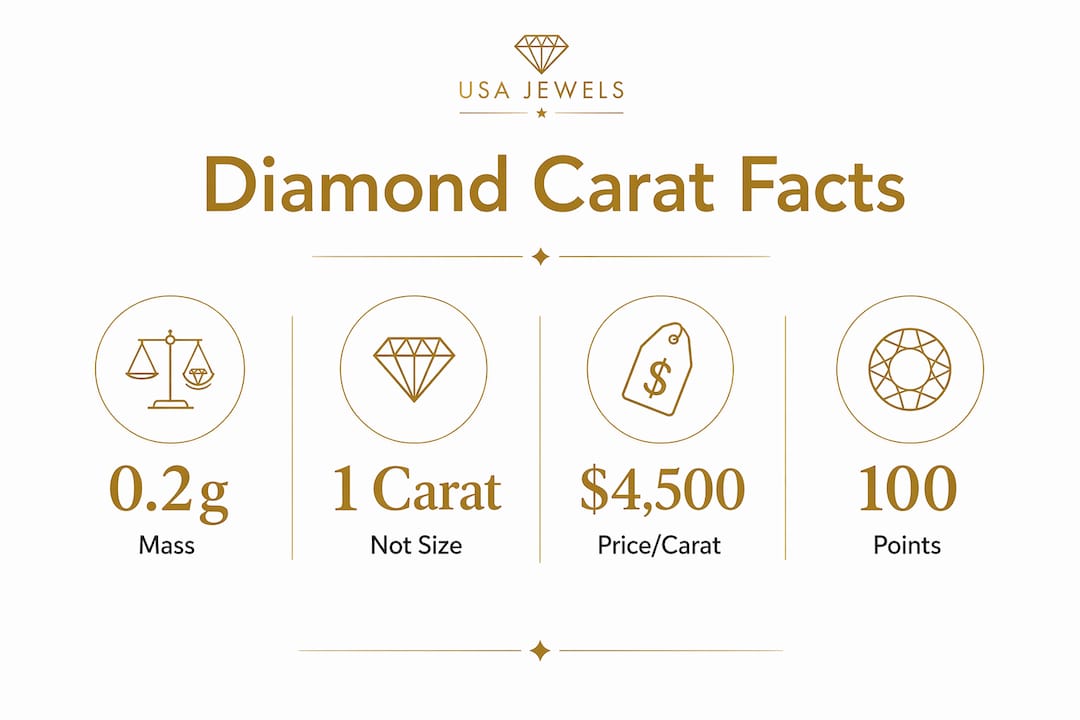
Diamond carat weight is defined as the precise mass of a diamond, where one carat equals exactly 200 milligrams (0.2 grams). This is not a measure of size, sparkle, or quality. It is purely a weight measurement, standardized globally so that every jeweler, gemologist, and certification lab speaks the same language. Carat is also divided into 100 points, meaning a 0.75-carat stone is listed as “75 points” on grading reports. Understanding what does carat weight mean in diamonds is the first step to shopping with real confidence.
What does carat weight mean for diamond appearance?
Carat weight measures mass, not the physical dimensions you see from above. Two diamonds at exactly 1.00 carat can look noticeably different in size depending on how they are cut.
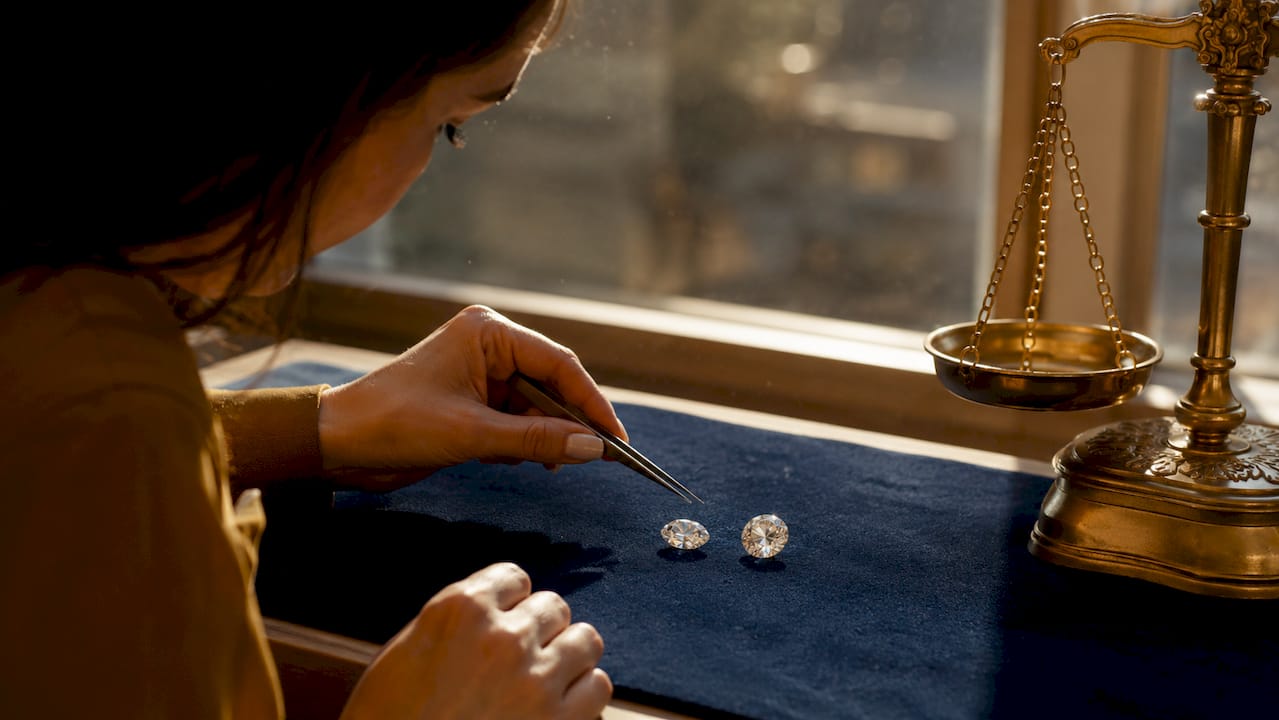
Shallow-cut stones appear larger face-up than deep-cut stones of the same weight because more of the diamond’s mass spreads across the top surface. A deep-cut stone hides weight in its pavilion, the lower portion, making it look smaller when you look straight down at it. This is one of the most overlooked facts in diamond shopping.
Shape also plays a major role in perceived size. Oval and marquise cuts tend to look larger than round brilliants at the same carat weight because their elongated outlines cover more finger surface. A 1.00-carat oval can appear close in size to a 1.20-carat round. Knowing your diamond shapes options before you shop helps you get more visual impact for your budget.
Here is a general guide to average face-up diameter ranges by shape at common carat weights:
| Carat Weight | Round (mm) | Oval (mm) | Princess (mm) | Marquise (mm) |
|---|---|---|---|---|
| 0.50 ct | 5.0–5.2 | 6.0×4.5 | 4.4×4.4 | 8.0×4.0 |
| 0.75 ct | 5.7–5.9 | 7.0×5.0 | 5.1×5.1 | 9.0×4.5 |
| 1.00 ct | 6.3–6.5 | 7.7×5.7 | 5.5×5.5 | 10.0×5.0 |
| 1.50 ct | 7.3–7.5 | 9.0×6.5 | 6.5×6.5 | 12.0×6.0 |
| 2.00 ct | 8.1–8.3 | 10.5×7.5 | 7.0×7.0 | 14.0×7.0 |
These are averages. Actual dimensions vary by cutter and proportions.
Pro Tip: Ask your jeweler for the millimeter dimensions of any diamond you are considering. A larger face-up diameter at the same carat weight almost always means a better visual result on the hand.
Why do diamond prices jump at certain carat weights?
Diamond pricing does not increase in a straight line. A 2-carat diamond can cost 4 to 5 times more than a 1-carat stone of similar cut, color, and clarity. That is not a typo. The jump is real, and rarity drives it.
Large rough diamonds are extraordinarily scarce. For every 10,000 one-carat diamonds of comparable quality, only a handful of three-carat stones exist. That scarcity pushes prices up exponentially at each size tier. The importance of carat in diamonds is not just about weight. It is about what that weight signals in terms of natural rarity.
The market also responds to what the industry calls “magic sizes.” These are milestone weights at 0.50, 1.00, and 2.00 carats where psychological and rarity factors drive significant price premiums. A diamond listed at exactly 1.00 carat commands a higher price per carat than a 0.98-carat stone that looks nearly identical. The premium is real, but the visual difference is almost invisible to the naked eye.
Understanding price per carat versus total price matters here. Price per carat rises at each milestone. Total price is price per carat multiplied by carat weight. A 1.00-carat stone at $6,000 per carat costs $6,000 total. A 2.00-carat stone at $10,000 per carat costs $20,000 total. The per-carat rate itself jumped, not just the size.
| Carat Weight | Approx. Price Per Carat (G/VS2, Excellent Cut) | Total Approx. Price |
|---|---|---|
| 0.90 ct | $4,500 | $4,050 |
| 1.00 ct | $6,000 | $6,000 |
| 1.50 ct | $8,000 | $12,000 |
| 2.00 ct | $10,500 | $21,000 |
Prices are illustrative ranges and vary by market, certification, and retailer.
Pro Tip: Comparing diamond pricing strategies before you set a budget helps you understand where the real price cliffs are and how to plan around them.
Carat vs. karat: common misconceptions explained
The two most confused terms in jewelry are “carat” and “karat.” They sound identical but mean completely different things.
Carat measures gemstone weight; karat measures gold purity. In American English, the distinction is clear in both spelling and abbreviation. Carat is abbreviated “ct” on diamond grading reports. Karat is abbreviated “kt” or “k” on gold jewelry. British English uses “carat” for both, relying on context to separate the two meanings. When you see a ring listed as “14kt gold with a 1.00ct diamond,” both terms are present and both are correct.
Total Carat Weight (TCW) is another term that trips up shoppers. A ring marked 2.00 ctw may have only a 0.50-carat center stone with smaller side stones making up the remaining 1.50 carats. TCW is the combined weight of every diamond in the piece. It tells you the total diamond content, not the size of the main stone.
Here are the most common carat-related pitfalls to avoid:
- Assuming TCW equals center stone weight. Always ask the jeweler to confirm the center stone carat weight separately.
- Confusing carat with size. A 1.00-carat diamond is not always “bigger” than a 0.90-carat stone. Cut depth and shape matter.
- Ignoring milestone pricing. Buying a 0.98-carat stone instead of a 1.00-carat stone can save hundreds of dollars with no visible size difference.
- Overlooking certification. A certified stone from GIA or AGS lists exact carat weight to the hundredth. Always request the certificate.
- Conflating carat with quality. Carat measures weight only. A heavy diamond can still have poor cut, color, or clarity grades.
Gemologists measure carat weight using precise digital scales accurate to the thousandth of a carat. That precision is why you see listings like 0.97ct or 1.03ct rather than rounded numbers.
How to shop smart using carat weight knowledge
Carat weight alone should never drive your purchase. The 4Cs of diamond quality are cut, color, clarity, and carat. Carat is the most visible number on a price tag, but cut quality has the greatest impact on how beautiful a diamond actually looks.
Here is a practical approach to using carat weight knowledge when you shop:
- Set your budget first, not your carat target. Decide what you can spend, then find the best combination of the 4Cs within that range.
- Prioritize cut grade. A 0.90-carat diamond with an excellent cut can look larger and more brilliant than a poorly cut 1.10-carat stone. Cut quality is the single biggest driver of visual impact.
- Shop just below milestone weights. Diamonds just under key carat thresholds, such as 0.90–0.98 carats, look nearly identical to 1.00-carat stones but avoid the premium pricing triggered at round numbers.
- Ask the right questions. When a jeweler quotes a carat weight, ask: “Is that the center stone weight or the total carat weight?” That one question prevents the most common shopping mistake.
- Compare millimeter dimensions. Two diamonds at the same carat weight can differ by half a millimeter in face-up diameter. Request the exact measurements before deciding.
- Consider lab-grown diamonds. Lab-created diamonds carry the same physical properties as mined stones at a significantly lower price per carat. You can often get a larger carat weight for the same budget without compromising on cut or clarity.
The goal is not to get the heaviest diamond. The goal is to get the most beautiful diamond your budget allows. Carat weight is one tool in that decision, not the whole answer.
Key takeaways
Diamond carat weight is a precise mass measurement equal to 0.2 grams, and its true significance lies in how it interacts with cut, shape, and pricing thresholds to determine both appearance and value.
| Point | Details |
|---|---|
| Carat measures weight, not size | Two diamonds at the same carat weight can look different in size based on cut depth and shape. |
| Pricing jumps at milestone weights | Stones at 0.50, 1.00, and 2.00 carats carry price premiums; buying just below saves money with no visible difference. |
| TCW is not center stone weight | Always confirm the center stone carat weight separately from the Total Carat Weight listed on the piece. |
| Cut quality drives visual size | An excellent-cut 0.90ct diamond can outshine a poorly cut 1.10ct stone in both size appearance and brilliance. |
| Lab-grown diamonds offer carat value | Lab-created stones deliver comparable carat weight and quality at a lower price, stretching your budget further. |
What i’ve learned after years of helping shoppers choose diamonds
Most people walk in asking for “at least a carat.” I understand the appeal. A 1.00-carat diamond is a milestone. It feels significant, and it is. But I have watched too many shoppers spend their entire budget chasing that round number and end up with a dull, lifeless stone because they sacrificed cut quality to hit the weight target.
The truth is that a beautifully cut 0.92-carat diamond will stop people in their tracks. A flat, poorly proportioned 1.05-carat stone will not. The carat number does not sparkle. The cut does.
I also see a lot of confusion around total carat weight in multi-stone rings. A halo ring marketed as “2.00 ctw” sounds impressive. But if the center stone is only 0.50 carats, the visual impact is very different from a solitaire at 1.00 carat. Always ask for the center stone weight specifically. Any jeweler worth trusting will give you that number without hesitation.
My honest advice: treat carat weight as a starting point, not a finish line. Use it to narrow your search, then let cut quality, certification, and your own eyes make the final call. And if you are working with a trusted jeweler who is transparent about every detail, including TCW versus center stone weight, you are already ahead of most shoppers.
— Joseph
Find your perfect diamond at Usajewels
Understanding carat weight is the foundation of a smart diamond purchase. At Usajewels, we believe every shopper deserves clear, honest information alongside beautiful jewelry at fair prices. Our family-owned team has been hand-selecting certified, conflict-free diamonds since 1999, and we are here to help you find the right stone for your story.

Browse our fine diamond jewelry collection, where every piece includes clear carat weight specifications for both center stones and total diamond content. Whether you are shopping for an engagement ring, anniversary gift, or a personal treat, our team will walk you through every detail so you shop with full confidence.
FAQ
What is a carat in diamonds?
A carat is a unit of weight equal to 200 milligrams (0.2 grams). It is divided into 100 points, so a 0.50-carat diamond is also described as 50 points.
Does a higher carat weight mean a bigger diamond?
Not always. Carat measures weight, not physical dimensions. Cut depth and diamond shape both affect how large a stone appears face-up, regardless of its weight.
What is the difference between carat and karat?
Carat (ct) measures the weight of a gemstone. Karat (kt) measures the purity of gold. In American English, the two terms are spelled and abbreviated differently on all jewelry documentation.
What does total carat weight (TCW) mean?
TCW is the combined weight of all diamonds in a jewelry piece, not just the center stone. A ring listed at 2.00 ctw may have a 0.50-carat center stone with smaller accent stones making up the rest.
How can i get the best value for my carat budget?
Choose a diamond just below a milestone weight, such as 0.90–0.98 carats instead of 1.00 carat, and prioritize an excellent cut grade. The visual difference is negligible, but the price savings are real.
Recommended
- Diamond Carat Weight Guide — Size, Price & Value Explained | USA Jewels
- Diamond Shapes Guide: Every Shape Compared | USA Jewels
- Diamond Clarity Chart — FL to I3 Grades Explained | USA Jewels
- Diamond Certification Guide: GIA vs AGS vs IGI Compared | USA Jewels

Deep Mehta is the Co-Owner of USA Jewels, a family-owned jewelry business she has led since 2013 in Deerfield Beach, Florida. With over 13 years of hands-on experience in fine jewelry retail, manufacturing, and diamond importing, Deep specializes in engagement rings, wedding bands, and custom jewelry design. She also co-manages Kaash Group Talent Acquisition. Deep is a University of Florida graduate and oversees every aspect of USA Jewels’ operations, from product development to marketing.
Frequently Asked Questions
If two diamonds have the same carat weight, why might one look bigger than the other?
What are diamond magic sizes and why do they affect the price so much?
How much more expensive is a 2-carat diamond compared to a 1-carat diamond?
Can I get a larger-looking diamond without paying for a higher carat weight?
Is carat weight the most important factor when choosing a diamond?
Fine Jewelry Collection


You May Also Like

Save 30–50% with Clarity Enhanced Diamonds: GIA Facts and What to Ask
What Is Coordinates Jewelry Design? A Buyer’s Guide