
How Diamond Quality Tiers Are Priced: A Buyer’s Guide
Diamond quality tiers are priced by locating each stone on the Rapaport price list and applying a negotiated discount or premium based on carat weight, color, and clarity. That benchmark drives every transaction in the diamond trade, from wholesale to retail. Understanding how diamond quality tiers are priced gives you real leverage when you shop. You stop guessing and start comparing stones the way professionals do. This guide breaks down each pricing layer so you can make a confident, informed decision.
How the Rapaport price list sets quality tier base prices
The Rapaport price list is released weekly and organizes diamonds into a grid of discrete tiers by carat weight, color grade, and clarity grade. Each cell in that grid carries a base price per carat. That base price is not the final sale price. It is the starting point for negotiation.
Here is how the tier structure works in practice:
- Carat weight bands: The list groups stones into weight ranges such as 0.90–0.99 ct, 1.00–1.49 ct, and 1.50–1.99 ct. Crossing a band boundary triggers a price jump, not a gradual increase.
- Color columns: Grades run from D (colorless) through Z (light yellow). Each column carries a different base price per carat within the same carat band.
- Clarity rows: Grades run from FL (flawless) through I3 (heavily included). Higher clarity rows carry higher base prices.
- Discount or premium applied: Traders then negotiate a percentage off or above the Rapaport base. Commercial quality rounds in the G–H color and VS–SI clarity range typically trade at 20%–35% below list price.
The table below shows how tier placement shapes the starting price before any negotiation:
| Quality tier example | Carat band | Typical market position vs. Rapaport |
|---|---|---|
| D color, IF clarity | 1.00–1.49 ct | Near list or slight premium |
| G color, VS2 clarity | 1.00–1.49 ct | 20%–35% below list |
| J color, SI1 clarity | 1.00–1.49 ct | 35%+ below list |
| D color, VVS1 clarity | 0.90–0.99 ct | Near list |
The Rapaport list is a benchmark, not a fixed price. Market demand and trade conditions shift the final price above or below the grid value every week.
How does carat weight affect diamond pricing tiers?
Carat weight is the single biggest driver of price jumps in the diamond grading system. Price increases are not linear. They are exponential at specific thresholds.
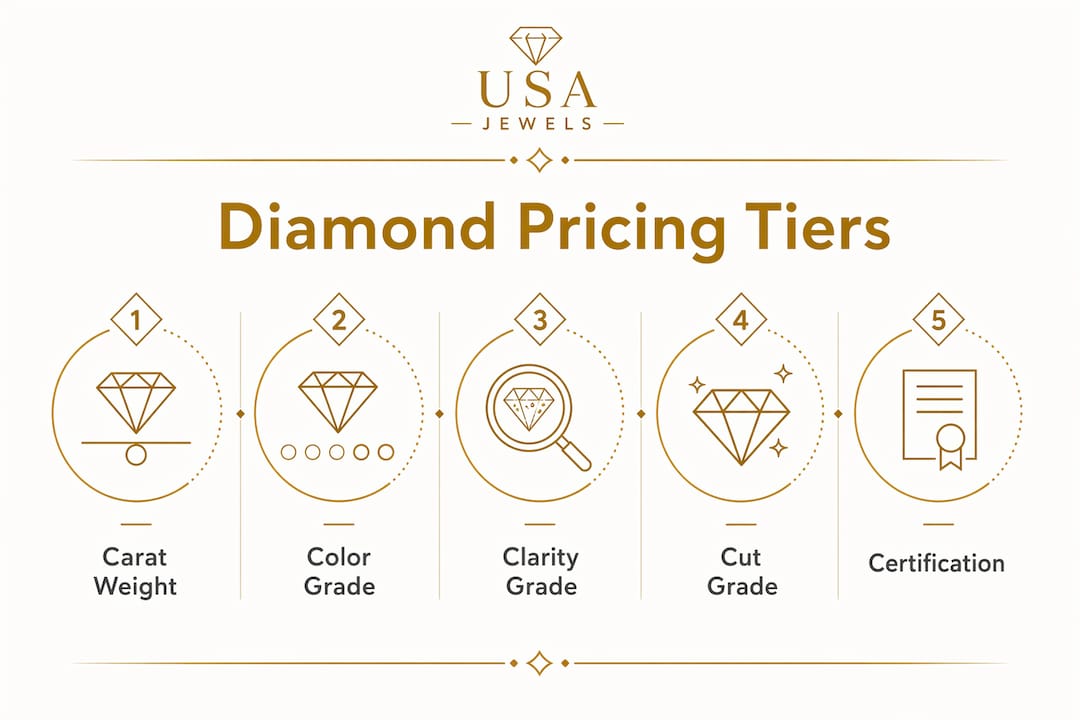
A 0.99 ct stone and a 1.00 ct stone may look nearly identical to the naked eye. The 1.00 ct stone crosses into a higher Rapaport carat band, which means its base price per carat resets at a significantly higher level. Matching a stone to its precise weight tier is critical because price jumps occur at discrete carat bands, not smoothly across a range. This is why a 0.90 ct stone often delivers far better value per carat than a 1.00 ct stone of identical color and clarity.
Within a single carat band, color and clarity grades then determine where the stone falls on the price grid. A 1.00 ct stone graded D/IF sits in a completely different price cell than a 1.00 ct stone graded H/SI1, even though both weigh exactly the same.
- A stone just below a carat threshold (0.89 ct, 0.99 ct, 1.49 ct) typically trades at a meaningful discount to the next band up.
- Buying just below a threshold gives you the same visual size at a lower price per carat.
- Fancy shapes like pear cuts reference their own Rapaport grid, so non-round shape pricing follows the same tier logic but with different base values.
Pro Tip: If your target is a 1.00 ct stone, ask to see certified stones in the 0.95–0.99 ct range. The size difference is invisible to the eye, but the price difference is real.
How do color and clarity grades change diamond value?
Color and clarity grades are the two axes of the Rapaport grid within any carat band. They determine which cell a stone occupies and therefore what base price applies before discounts.

The color scale runs from D (completely colorless) to Z (visibly yellow). D, E, and F grades are colorless and command the highest premiums. G and H grades are near colorless and represent the commercial sweet spot. Premium stones with D–F color and IF–VVS clarity trade at smaller discounts of 10%–20% from Rapaport or even at premiums. That rarity premium is real and significant.
The clarity scale runs from FL (flawless) through I3 (heavily included). The practical concept buyers need to understand is “eye-clean.” An eye-clean stone shows no inclusions visible to the naked eye, even if the grading report lists SI1 or SI2. An eye-clean SI1 stone can cost considerably less than a VS2 stone while looking identical in a ring setting.
| Color grade | Clarity grade | Market perception | Price position vs. Rapaport |
|---|---|---|---|
| D–F | FL–VVS2 | Premium, collector quality | 10%–20% below list or at premium |
| G–H | VS1–VS2 | Near colorless, excellent value | 20%–30% below list |
| G–H | SI1–SI2 | Commercial, eye-clean possible | 25%–35% below list |
| I–J | SI1–SI2 | Budget, slight warmth visible | 35%+ below list |
Understanding color and clarity grades together lets you find stones that look beautiful without paying for rarity you cannot see.
Pro Tip: Ask your jeweler to confirm a stone is eye-clean before purchase. An SI1 with no visible inclusions gives you VS-level beauty at SI pricing.
Why do cut grade and certification lab affect diamond pricing?
Cut grade and certification lab act as additional price modifiers on top of the carat, color, and clarity tier. They are not part of the Rapaport grid itself, but they directly affect what buyers will pay.
GIA cut grades run from Excellent through Very Good, Good, Fair, and Poor. An Excellent cut maximizes light return and visual brilliance. Buyers pay a premium for it. A Good cut on the same color and clarity stone trades at a discount because the stone performs less brilliantly. Cut grade impacts perceived beauty and therefore buyer willingness to pay, even though the carat weight and color tier remain unchanged.
Certification lab is what traders call a hidden sixth C. Lab grading differences mean that the same stated 4Cs from different labs price differently. GIA is the primary market anchor in the United States. An IGI-graded natural stone trades at roughly 75%–82% of the price of a GIA-equivalent stone. Buyers and traders calibrate to GIA baseline grades when setting prices.
- GIA certified: Highest buyer trust, commands full market price, strongest resale value.
- IGI certified: Reputable lab, trades at a discount to GIA equivalent, growing acceptance for lab-grown diamonds.
- Other labs: Pricing systems translate grades to GIA equivalents, which can result in further discounts.
“Lab grading differences act like a hidden sixth C. Same 4Cs from different labs price differently because buyers calibrate to GIA baseline grades.” — Stone Insights
Understanding diamond certification options before you buy protects both your purchase price and your resale value.
How to use quality tier pricing knowledge when buying
Knowing how diamond quality tiers are priced gives you a practical framework for finding the best value at any budget. The goal is not to buy the highest grade in every category. The goal is to find the right balance across all four Cs.
- Target just below carat thresholds. A 0.95 ct stone looks identical to a 1.00 ct stone but sits in a lower Rapaport band. The price per carat drops meaningfully.
- Prioritize cut above color and clarity. An Excellent cut in G color outperforms a Good cut in D color for visual beauty. Cut quality is the one factor that directly controls how much light the stone returns.
- Choose eye-clean SI1 over VS2 when budget is tight. The clarity difference is invisible in a set ring. The price difference is not.
- Verify GIA certification for natural diamonds. GIA certification protects your investment and makes resale straightforward. An IGI stone may save money upfront but trades at a discount if you ever sell.
- Use Rapaport as a reference, not a rule. Final prices reflect negotiation based on market demand and stone quality perception. A well-informed buyer can negotiate confidently.
Pro Tip: Ask your jeweler to show you the Rapaport discount applied to any stone you are considering. A transparent seller will share this without hesitation.
Key takeaways
Diamond quality tiers are priced by combining a Rapaport grid base price with a negotiated discount or premium driven by carat weight, color, clarity, cut, and certification lab.
| Point | Details |
|---|---|
| Rapaport sets the baseline | Every diamond price starts from the weekly Rapaport grid, then adjusts by negotiated discount or premium. |
| Carat thresholds drive big jumps | Buying just below a carat band boundary delivers the same visual size at a lower price per carat. |
| Eye-clean clarity saves money | An SI1 stone with no visible inclusions looks identical to VS2 in a setting but costs less. |
| Cut grade controls beauty | Excellent cut in G color outperforms a lower cut in D color for real-world sparkle and value. |
| GIA certification anchors resale | GIA-graded stones command full market price; IGI naturals trade at roughly 75%–82% of GIA equivalents. |
What I’ve learned after years of watching buyers get tier pricing wrong
Most buyers walk into a diamond purchase focused on carat weight and color. They want the biggest stone in the whitest grade their budget allows. That instinct costs them money every time.
The buyers who get the best value do the opposite. They drop one color grade, confirm the stone is eye-clean, and put the savings into cut quality. A 0.97 ct, G color, SI1, Excellent cut GIA stone will outshine a 1.00 ct, F color, VS2, Good cut stone in any lighting condition. The first stone also costs less.
The Rapaport price list is a tool, not a verdict. Prices move weekly based on supply and demand. A stone sitting just below a carat threshold or in a slightly warmer color grade can represent genuine value, not a compromise. The trade knows this. Most retail buyers do not.
Certification matters more than most buyers realize. I have seen buyers save a few hundred dollars by choosing a non-GIA stone, only to find the resale value dropped by far more. GIA certification is not a luxury. For a natural diamond, it is the price of confidence.
My honest advice: learn the Rapaport grid before you shop. Understand where the carat band breaks are. Know what eye-clean means for SI clarity. Ask every seller what discount off Rapaport they are applying. That one question separates informed buyers from everyone else.
— Joseph
Quality diamonds at direct prices, with no guesswork
Usajewels has been helping families find beautiful, certified diamond jewelry since 1999. As a family-owned, in-house manufacturer, we eliminate the middlemen that inflate retail prices. You get direct pricing on hand-selected, conflict-free diamonds with full certification transparency.

Whether you are choosing a stone for an engagement ring or a special gift, our team walks you through every quality tier so you understand exactly what you are paying for and why. Browse our fine diamond jewelry collections to see certified diamonds across a range of quality tiers and price points. If you want to apply everything you have learned here, our engagement ring design guide takes you step by step through selecting the right carat, color, clarity, and cut for your budget. We are here to help you find the stone that tells your story.
FAQ
What is the Rapaport price list?
The Rapaport price list is a weekly benchmark used by the diamond trade to set base prices per carat, organized by carat weight band, color grade, and clarity grade. Final sale prices are negotiated as a discount or premium from this base.
Why do diamonds cost more at certain carat weights?
Diamond prices jump at specific carat weight thresholds because the Rapaport grid organizes stones into discrete bands. Crossing from 0.99 ct to 1.00 ct moves a stone into a higher price band, which resets the base price per carat at a significantly higher level.
Does GIA certification affect diamond price?
GIA certification is the primary market anchor in the United States. An IGI-graded natural stone trades at roughly 75%–82% of the price of a GIA-equivalent stone because buyers and traders calibrate resale and pricing to GIA baseline grades.
What does “eye-clean” mean for diamond clarity?
Eye-clean means a diamond shows no inclusions visible to the naked eye, even if the grading report lists SI1 or SI2 clarity. An eye-clean SI1 stone looks identical to a VS2 stone in a ring setting but typically costs less.
How much below Rapaport do commercial diamonds trade?
Commercial quality round brilliants in the G–H color and VS–SI clarity range typically trade at 20%–35% below the Rapaport list price. Premium stones with D–F color and IF–VVS clarity trade at smaller discounts of 10%–20% or at premiums.
Recommended
- Natural Diamonds: Quality, Value & Origin | USA Jewels
- Lab-Created Diamonds: Process & Value | USA Jewels
- Diamond Buying Guide: The 4 C’s Explained | USA Jewels
- Diamond Pricing Guide: What Diamonds Cost | USA Jewels

Deep Mehta is the Co-Owner of USA Jewels, a family-owned jewelry business she has led since 2013 in Deerfield Beach, Florida. With over 13 years of hands-on experience in fine jewelry retail, manufacturing, and diamond importing, Deep specializes in engagement rings, wedding bands, and custom jewelry design. She also co-manages Kaash Group Talent Acquisition. Deep is a University of Florida graduate and oversees every aspect of USA Jewels’ operations, from product development to marketing.
Frequently Asked Questions
Why does a 0.99 carat diamond cost so much less than a 1.00 carat diamond if they look the same?
What does it mean when a diamond trades at 25% below Rapaport list price?
How do color and clarity grades within the same carat weight affect the price tier?
Should I always buy the highest clarity grade available in my carat weight range?
How do I use the Rapaport price list to negotiate a better deal on a custom diamond?
Fine Jewelry Collection


You May Also Like
59–62.6% Depth: Verify Diamond Table and Depth Before You Buy
Diamond Fluorescence: Does It Actually Matter to You?