Pick One of 3 Paths to an Ethical Engagement Ring You Can Verify
An ethical engagement ring is one you can trace, question, and verify, not just one labeled “conflict-free.” Most couples land on one of three practical paths: a lab-grown diamond, a recycled or estate stone, or a responsibly sourced mined diamond backed by real paperwork. Which path fits you depends on how much you weigh values against budget, and how much verification you’re willing to demand from a jeweler before you buy.
TL;DR:
- Lab-grown diamonds are the most straightforward choice for verification, as they have no mining footprint and lower resale value, but they lack traditional provenance.
- Recycled and estate diamonds carry a stronger historical and ethical appeal, provided independent grading confirms their origin and condition.
- Responsible mined diamonds are traditional but require rigorous documentation, such as chain-of-custody reports and third-party certifications, to verify ethical practices.
- Recycled metals like gold, platinum, and silver eliminate new mining impacts, especially when supported by certifications like Fairmined or Fairtrade.
- Buyers should demand transparent documentation on origin, certifications, and supply chain details from jewelers, rather than relying solely on vague ethical labels or certifications like conflict-free.
Table of Contents
- What Does “Ethical” Actually Mean vs. “Conflict-Free”?
- Comparing Your Diamond Sourcing Options
- What About the Metal and Any Colored Gemstones?
- How Do You Verify a Jeweler’s Ethical Claims?
- How Do You Choose the Right Ring for Your Values and Budget?
- What If You Skip Diamonds Entirely?
- Our Approach to Ethical Sourcing at Usajewels
- An Editorial Take on the “Ethical” Label
- Ready to Design a Ring You Can Actually Verify
- Sources
- FAQ
What Does “Ethical” Actually Mean vs. “Conflict-Free”?
“Conflict-free” and “ethical” get used as if they’re the same promise. They aren’t, and the gap between them is where most misleading marketing lives.
Conflict-free means one specific thing: the diamond’s sale didn’t finance an armed rebel group. That’s the entire scope of the Kimberley Process, the international certification scheme created in 2003 to stop “blood diamonds” from reaching the market. It doesn’t touch wages, worker safety, or environmental damage. “Ethical” covers all of that. It means fair labor conditions, environmental stewardship, community benefit, and transparency about how a stone got from the ground to a ring setting, as industry guidance from the International Gem Society makes clear.
Here’s why the distinction matters practically: as of 2026, about 99% of diamonds in the global marketplace are considered conflict-free per GIA guidance. That number sounds reassuring, but it also means “conflict-free” has become nearly meaningless as a differentiator. Almost every diamond you’ll be shown already carries that label. It tells you almost nothing about labor conditions, mine safety, or environmental cleanup.
When you’re evaluating a jeweler’s claims, check for these signals instead of taking “conflict-free” at face value:
- A written statement of origin, not just a verbal assurance
- Chain-of-custody documentation tracing the stone past the point of sale
- Specific labor and environmental certifications, not general ethics language
- Willingness to answer direct questions about mine location and sourcing partners
Comparing Your Diamond Sourcing Options
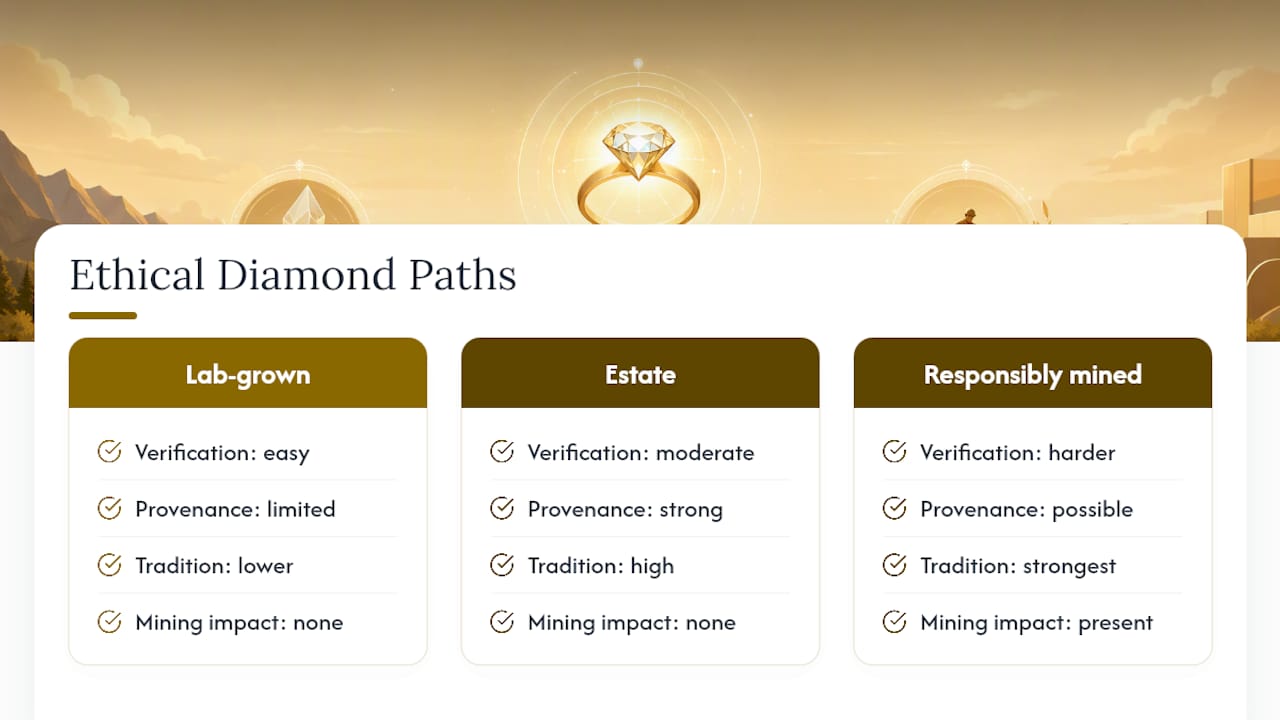
Three paths dominate the ethical diamond market, and each comes with real tradeoffs worth understanding before you commit.
Lab-grown diamonds are created in controlled facilities using high pressure or chemical vapor deposition, not dug from the earth. There’s no mining footprint and no artisanal labor question to untangle. The tradeoff is resale value, which for lab-grown stones tends to be lower than mined diamonds since the market still prices them as a different category. Our breakdown of how lab-grown diamonds are ethically produced covers the manufacturing side in more depth.
Recycled and estate diamonds are stones pulled from older jewelry and reset. Nothing new comes out of the ground, so the ethical question shifts entirely to verification of origin and condition. A reputable jeweler will have the stone independently graded rather than relying on the original mounting’s paperwork, which may be decades old or missing entirely.
Responsibly sourced mined diamonds carry the strongest emotional and traditional appeal, but verification is harder. Artisanal mining accounts for roughly 15% of global diamond production and can meet Kimberley Process standards while still lacking meaningful labor or environmental oversight. Kimberley Process compliance is a floor, not a ceiling.
A simple rubric: if verification ease matters most, choose lab-grown. If provenance and history matter most, choose estate. If tradition matters most and you’re willing to push hard on documentation, choose responsibly sourced mined. Our lab-grown versus conflict-free mined comparison walks through this decision in more detail.
What About the Metal and Any Colored Gemstones?
The stone gets most of the attention, but the band itself carries its own sourcing story. Gold mining is one of the more environmentally destructive extraction industries on the planet, and that’s before accounting for labor conditions at small-scale operations.
Recycled gold, platinum, and silver solve the extraction problem directly. Metal that’s already above ground gets refined and reused, so there’s no new mining tied to your ring. Ask your jeweler what percentage of their metal stock is recycled and whether they can document it, since “recycled” claims without a paper trail are just as soft as unverified “conflict-free” claims.
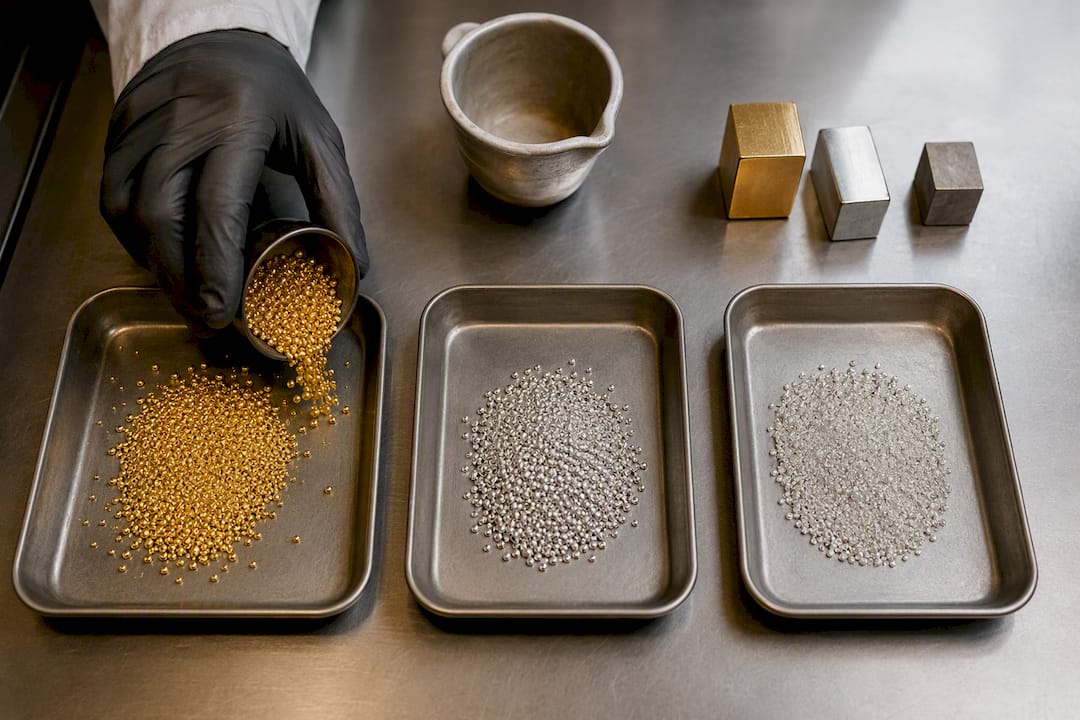
Fairmined certification is the strongest signal available for artisanal gold specifically. It guarantees fair prices to small-scale miners, safer working conditions, and defined environmental standards for the mining community involved. Fairtrade gold operates on a similar principle. Neither is common at every jeweler, so ask directly if it’s an option for your build.
Colored gemstones are the hardest category to verify. Sapphires, rubies, and emeralds often pass through multiple countries and cutting houses before reaching a retail setting, and most have no equivalent to the Kimberley Process tracking their origin. If a colored stone matters to your design, ask for:
- The country of origin, specifically, not just “ethically sourced”
- Any lab report noting geographic origin (some gemological labs do this for corundum and emerald)
- Whether the stone passed through a single traceable supplier or multiple unnamed brokers
How Do You Verify a Jeweler’s Ethical Claims?
The Kimberley Process is the backbone of conflict-free certification, but it has a structural limit worth understanding before you rely on it. The KP FAQ confirms it reduces the flow of conflict diamonds internationally, but it doesn’t guarantee fair wages or environmental protection. It also doesn’t track individual stones down to the specific mine. That means a documented chain-of-custody report, with serial numbers or a supply-chain audit trail, is stronger evidence than a jeweler simply stating “this diamond is Kimberley Process certified.”
Here’s a practical sequence for checking any seller’s claims:
- Ask what certification standards apply to both the stone and the metal, separately.
- Request written documentation, not verbal assurance, for country of origin.
- Ask whether they can name specific third-party certifications like Fairmined, Fairtrade, or Canadamark, each of which guarantees a different slice of the supply chain (artisanal gold community standards, fair-trade pricing, or Canadian-origin tracking, respectively).
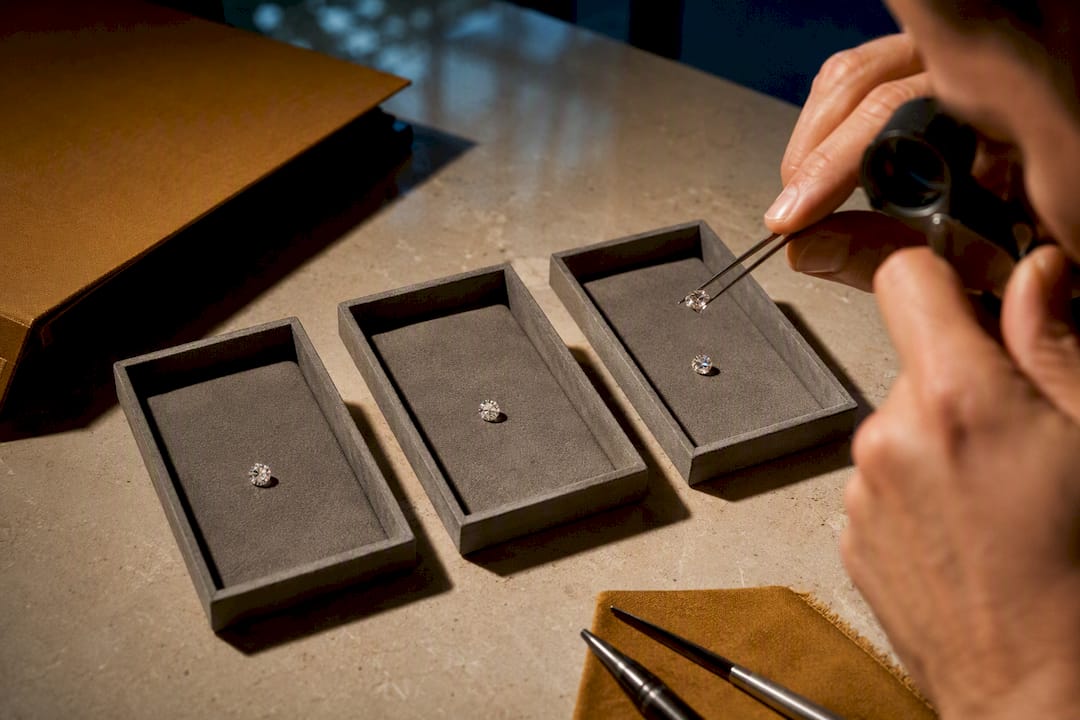
- Request an independent grading report from a recognized lab for any diamond over roughly half a carat.
- Ask directly how they’d respond if you wanted proof beyond their marketing language.
Human Rights Watch’s reporting on jewelry supply chains documents real gaps between industry claims and ground-level labor practices, which is exactly why documentation matters more than a brand’s tagline. If a jeweler gets vague or defensive when you ask for paperwork, treat that as a red flag, not a formality.
Pro Tip: Ask to see a supplier warranty in writing before you place a custom order. A jeweler confident in their sourcing will hand it over without hesitation; one relying on marketing language usually won’t. Our guide to choosing a certified ethical diamond jeweler covers additional questions worth asking before you commit.
How Do You Choose the Right Ring for Your Values and Budget?
Start by ranking what actually matters to you, because trying to maximize every ethical attribute at once usually blows the budget or the timeline.
- Decide whether verification ease, provenance history, or traditional mined origin matters most to you.
- Set a metal budget separately from a stone budget. Recycled gold typically costs the same as new gold, so it’s rarely the expense driver.
- Expect lab-grown center stones to run noticeably below mined equivalents of the same carat and clarity.
- Expect estate stones to vary widely in price depending on cut quality and how dated the original setting is.
- Budget extra time for responsibly sourced mined diamonds if you’re requesting origin documentation, since sourcing verified stones takes longer than pulling from general inventory.
Custom design work generally takes several weeks from approved design to delivery, longer if you’re waiting on a specific certified stone. Ready-to-ship pieces move faster but limit how much sourcing detail you can specify in advance. Ask about return policies and any lifetime upgrade options before you order, since ethical sourcing and buyer protection should come as a package, not separate considerations.
What If You Skip Diamonds Entirely?
Diamonds aren’t the only option, and for some buyers, they’re not even the best one on ethical grounds.
It has no mining footprint at all, and modern cutting has closed much of the visual gap with diamonds, though moissanite throws slightly more rainbow-colored fire under direct light. Our gemstone alternatives guide covers how it compares side by side with mined and lab-grown stones.
Colored gemstones like sapphire and morganite offer distinct looks, but carry the same traceability challenge described earlier. Treat provenance questions the same way you would for a colored stone set beside a diamond.
Heirloom and estate settings offer the strongest ethical story of all: nothing new gets extracted, and the stone often carries family history. Have any inherited stone independently graded and appraised before resetting it, since older cuts sometimes need reshaping to meet current safety standards for daily wear.
Our Approach to Ethical Sourcing at Usajewels
We’ve operated as a family-owned jeweler since 1999, and everything we build happens in-house rather than through outside manufacturing partners. That’s not a marketing detail. It means we control sourcing decisions directly instead of relying on a chain of subcontractors we can’t verify ourselves.
When you design a ring with us, you choose your diamond quality and metal type directly, including certified natural or lab-grown stones purchased as loose diamonds before setting. Every custom build comes with our lifetime diamond upgrade program, and our approach has earned trust from customers reflected in over 222 Google reviews. If you’re working through the sourcing questions raised in this guide, our design-your-own guide walks through exactly how those choices get made, stone by stone and metal by metal.
An Editorial Take on the “Ethical” Label
The conventional advice treats “ethical engagement ring” as a checkbox you tick by picking a brand with the right buzzwords. That’s backwards. Ethical sourcing is a supply-chain question, and supply chains are made of paperwork, not adjectives. A jeweler who hands you a Kimberley Process statement and calls it a day is giving you the floor, not the ceiling. That certification was never designed to touch wages or environmental practices in the first place.
What the research here actually supports is a shift in what buyers should demand first: documentation over description. Ask for the chain-of-custody report before you ask about carat weight. Push for a written origin statement before you fall for a setting you love. The stones and metals matter, but the paper trail behind them is what separates a genuinely traceable ring from one that simply sounds responsible in a product description.
If you take one thing from this guide, let it be this: a jeweler’s willingness to produce documentation, without hesitation or vague deflection, tells you more than any label on the box.
— Joseph
Ready to Design a Ring You Can Actually Verify
Some jewelers offer direct control over your stone and metal sourcing, without a markup for a middleman you never get to question. Because some manufacturers produce in-house rather than outsourcing production, customers can ask the exact verification questions this guide walks through and receive direct answers.
If you’re ready to start, our engagement ring collection lets you choose your diamond type, whether lab-grown or responsibly sourced mined, along with your metal and setting. Prefer to build from scratch? Our design-your-own guide walks you through every decision point, including the sourcing questions raised above, before you place an order. And if you want a deeper primer before you commit to a design, our engagement ring buying guide covers pricing and timeline expectations in plain terms. Start your design, ask us the hard sourcing questions directly, and get a ring backed by documentation you can actually check.
Sources
- GIA — Conflict-Free Diamonds FAQ
- Kimberley Process — overview and FAQ
- International Gem Society — conflict-free vs ethical
- Human Rights Watch — Hidden cost of jewelry
- Fairmined
FAQ
What Is the Most Ethical Engagement Ring?
There’s no single “most ethical” ring, since it depends on which supply-chain factor you weigh heaviest. A lab-grown diamond in recycled gold offers the easiest verification path, while a Fairmined-certified mined stone offers stronger traditional provenance if you’re willing to push for documentation.
What Is the 3-Month Ring Rule?
The “3-month rule” is an old, informal guideline suggesting an engagement ring should cost roughly three months’ salary. It’s not a financial or ethical standard, and most modern buyers, especially those prioritizing certified or ethically sourced stones, set budgets based on their own finances rather than this outdated benchmark.
What Is the Most Ethical Jewelry Brand?
No single brand holds an official “most ethical” title, since ethics claims vary by supply chain, not by brand name alone. Look for jewelers who provide chain-of-custody documentation and named certifications like Fairmined rather than general marketing language, and confirm the details directly before you buy.
Where Can I Buy Ethically Sourced Diamonds?
You can buy ethically sourced diamonds directly from jewelers who provide written origin statements, independent lab reports, and specific certifications rather than vague conflict-free claims. Some jewelers sell certified natural and lab-grown loose diamonds directly, allowing buyers to review sourcing details before committing to a setting.
Recommended
- How to Choose a Certified Ethical Diamond Jeweler
- Engagement Ring Buying Guide: How to Choose the Perfect Ring
- Ring Guide: Engagement Settings & Styles
- Best Gemstone Alternatives to Diamonds for Rings

Deep Mehta is the Co-Owner of USA Jewels, a family-owned jewelry business she has led since 2013 in Deerfield Beach, Florida. With over 13 years of hands-on experience in fine jewelry retail, manufacturing, and diamond importing, Deep specializes in engagement rings, wedding bands, and custom jewelry design. She also co-manages Kaash Group Talent Acquisition. Deep is a University of Florida graduate and oversees every aspect of USA Jewels’ operations, from product development to marketing.
Fine Jewelry Collection


You May Also Like

Why Jeweler Reputation Matters When Buying Fine Jewelry
Bar Setting Rings: How to Balance Sparkle and Resizing With USA Jewels