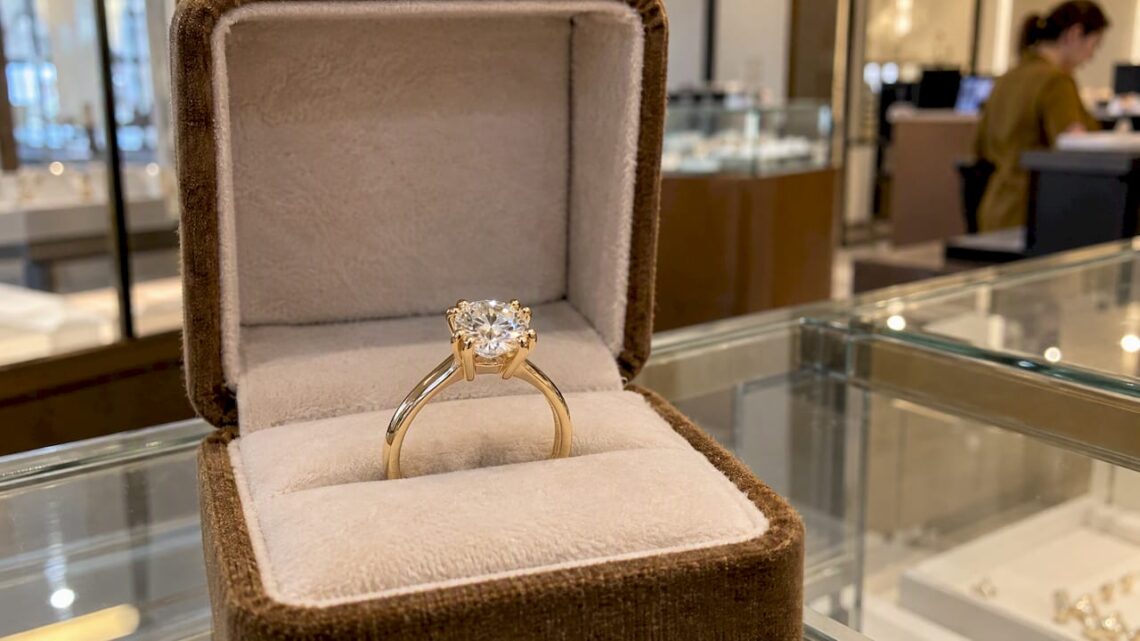
Double Prong Settings: Two Claws Add Grip, Not More Contact Points
A double prong setting places two small claws at each contact point to give a refined four-prong look with extra local support compared with single prongs. We recommend this style when you want that classic four-prong silhouette with added corner strength, and we point couples toward six prongs when maximum redundancy matters most, especially on larger center stones.
TL;DR:
- GIA generally favors six prongs for diamonds around half a carat or larger; pointed cuts need claws that directly cradle vulnerable corners.
- Ask a jeweler to inspect the prong tips during every cleaning, since gradual wear can go unnoticed until a stone loosens or catches fabric.
- Check that each claw contacts one third to one half of the distance from the girdle to the table, with no visible gaps.
- Platinum resists metal loss better, while 18K gold costs less; carefully finished double claws can still catch clothing more readily than rounded single prongs.
Table of Contents
- What a Double Prong Setting Looks Like and How It’s Built
- How Double Prongs Compare With Single Prongs and Higher Prong Counts
- Suitability for Larger Diamonds and Compatibility With Shapes
- Materials and Craftsmanship Signals to Inspect
- USA Jewels Perspective: When We Recommend Double Prongs
- History and Evolution of Double Prong Settings in Jewelry Design
- Double Prong Settings in Vintage Versus Modern Designs
- How Double Prong Settings Affect Diamond Visibility and Light Performance
- Impact of Double Prong Settings on Ring Resizing and Modifications
- Common Myths and Misconceptions About Double Prong Settings
- Our Take on Choosing a Double Prong Setting
- How to Get a Custom Double Prong Ring From USA Jewels
- FAQ
- Sources
What a Double Prong Setting Looks Like and How It’s Built
Picture a standard four-prong mount, then split each prong into two slender claws that meet the stone at the same point. That pairing sits where the crown meets the girdle, cradling the diamond while keeping the overall silhouette light and open. Finished well, the claws taper evenly and sit flush against the stone with no visible gap between metal and diamond.
We see a few common variations on this theme:
- Double claws built onto a classic four-prong mount, the most familiar version of this style
- Double prongs paired with a hidden halo, where the small claws disappear visually into a ring of pavé diamonds beneath the center stone
- V-prong doubles, which wrap around a pointed corner (like the tip of a princess or marquise cut) with two thin claws instead of one thick one
The visual payoff is detail. Because the load is shared between two thinner claws rather than one thick prong, a jeweler can make each claw finer without losing the support the stone needs at that contact point. That means less metal covering the diamond’s face and a more intricate look at the crown, which is why this setting has become a favorite for brides who want a four-prong ring that still feels detailed up close. If you are comparing this against other mount styles more broadly, our guide to prong style selection walks through the full range.
How Double Prongs Compare With Single Prongs and Higher Prong Counts
Security in a prong setting comes down to two different things: how firmly each prong grips the stone, and how many total points of contact the stone has around its perimeter. Double prongs improve the first. Six-prong settings improve the second.
GIA’s own guidance on choosing between four and six prongs notes that six prongs give extra redundancy for larger stones, while four-prong styles, including double-pronged variants, tend to suit a more minimalist look and work especially well on square or rectangular cuts. A double prong adds refined detail and local support at each corner, but it does not automatically match the redundancy of having six separate prongs spread around the stone. Fit and bearing matter more than claw count alone.
Wear happens gradually at every contact point, no matter how many prongs a ring has:
- Metal thins slightly at the tip over years of daily contact, friction, and cleaning
- A jeweler re-tips the prong by adding new metal to restore thickness, the more common and less invasive repair
- When wear has gone further and the prong geometry itself is compromised, the jeweler replaces the whole head rather than patching the tip
Jewelers of America recommends professional inspections on a regular basis specifically because this kind of wear is gradual and easy to miss until a prong catches on fabric or a stone sits loose.
Pro Tip: Ask your jeweler to check prong tips at every ring cleaning, not just when something feels loose.
The trade-off worth understanding before you choose: double prongs can be made thinner than a single thick prong while offering similar grip at that point, which is part of their appeal. They also show slightly more metal detail at the crown and, because there are more edges, a marginally higher chance of catching on clothing than a single rounded prong, though careful finishing minimizes this.
Suitability for Larger Diamonds and Compatibility With Shapes
Stone size changes the calculus. GIA notes that for larger diamonds, typically those around half a carat and larger, six-prong settings are often recommended for the combination of security and balanced aesthetics they provide. Smaller stones can look dwarfed by six separate prongs, which is part of why four-prong and double-prong designs remain popular at that end of the size range.
Double prongs let us keep that four-prong silhouette while adding meaningful support exactly where a larger stone needs it most, at the corners and along the girdle. This makes them a practical middle ground for couples who love the open, minimal look of four prongs but want more reassurance once the stone grows past half a carat.
Shape matters just as much as size:
- Round brilliants pair naturally with double prongs since there are no corners to protect, just even support around the stone
- Princess, cushion, and radiant cuts have vulnerable corners that benefit from V-prongs or double claws angled to cradle the point directly
- Emerald and asscher cuts, with their long open facets, often do better with single sturdy prongs or a basket setting rather than doubled claws
Our princess cut guide goes deeper into corner protection for pointed shapes if that is the cut you are considering.
Materials and Craftsmanship Signals to Inspect
Setting quality comes down to measurements you can actually ask about before you buy, not just how a ring photographs. GIA’s quality assurance benchmarks for platinum prong settings give bench jewelers (and buyers) a real standard to check against.
Prong contact typically runs between about one-third and half of the distance from the girdle to the table, which tells you how much of the stone’s crown is actually gripped rather than just resting against metal.
Beyond that ratio, a few other signals separate careful work from rushed work:
- Prong height usually falls within a consistent proportional range relative to the table, typically above half the table height, so prongs do not sit oddly high or disappear below the crown
- Finishing should be even across all prongs, with no visible file marks or rough edges where metal meets skin
- There should be full, flush contact with the stone’s crown and no visible daylight between claw and diamond
Metal choice affects how all of this holds up over time. Platinum is denser and more resistant to metal loss than gold alloys, which is part of why GIA’s notes on platinum prong dimensions point out that platinum prongs are often sized differently than white gold to avoid distortion under the same wear. Gold, especially 18K, is a strong and classic choice for everyday wear at a lower price point, while platinum tends to suit buyers who want the longest possible stretch between re-tipping visits.
Before buying, it is worth asking a few direct questions: does the bearing (the ledge the stone rests on) fit the stone’s exact measurements, is the gallery underneath built to support the prongs rather than just decorate the ring, and is the piece hand-finished rather than left as-cast. A warranty or included inspection policy is also worth confirming up front.
USA Jewels Perspective: When We Recommend Double Prongs
We build every double prong mount to consistent contact and finishing standards: full crown contact, even height, and a hand-finished edge with no rough spots. Our design-your-own process lets you choose metal type and metal quality alongside your diamond shape and quality, so the setting matches both your stone and how you live day to day.
We tend to recommend double prongs to couples who love a classic four-prong silhouette but want extra reassurance on a stone at or above half a carat, and we steer buyers toward six prongs when a looser lifestyle or a larger stone calls for maximum redundancy. We offer a lifetime diamond upgrade program to support your setting as your stone changes.
History and Evolution of Double Prong Settings in Jewelry Design
Prong settings as a category trace back to the late 1800s, when Tiffany popularized the six-prong mount to lift a diamond above the band and let light reach it from every angle. That innovation shifted jewelry design away from closed, bezel-heavy mountings toward open settings that showed off a stone’s cut.
Double prongs emerged as designers looked for a way to keep that open, airy four-prong profile while adding a bit more reassurance at each contact point, particularly as diamonds grew larger through the twentieth century and couples wanted both security and a delicate look. Rather than simply thickening a single prong, which adds visible metal and bulk, jewelers began splitting the claw into two finer points that shared the load.
The style gained particular traction with Art Deco and mid-century designs, where symmetry and geometric precision were prized, and a pair of matched slender claws fit that aesthetic more naturally than a single thick prong. Over the following decades, double prongs moved from a niche detail into a mainstream option across both vintage-inspired and contemporary engagement ring design, now available across round, princess, and cushion cut mountings.
Double Prong Settings in Vintage Versus Modern Designs
In vintage and Art Deco pieces, double prongs typically appear as part of elaborate filigree work, often paired with milgrain edging or engraved shoulders that echo the paired-claw symmetry elsewhere in the design. The style fit naturally into an era that favored intricate metalwork and geometric balance over minimalism.
Modern double prong settings take a cleaner approach. Many contemporary mountings pair the claws with a hidden halo beneath the center stone or a simple polished band, letting the double prongs stand out as the single decorative detail rather than one element among many. This stripped-back styling suits buyers who want a ring that reads as minimalist from a distance but reveals extra detail on close inspection.
Both approaches rely on the same underlying construction, two claws sharing one contact point, but the surrounding design changes the ring’s overall character. A vintage-inspired setting tends to use more metal and ornamentation around the prongs, while a modern setting lets the double claws read as a quiet, deliberate detail against an otherwise simple band.
How Double Prong Settings Affect Diamond Visibility and Light Performance
Every prong that touches a diamond’s crown blocks a small amount of light from entering and exiting the stone at that point. Because double prongs can be made thinner than a single thick prong while still providing comparable grip, they often cover less surface area in total, which can mean slightly more of the stone’s crown is left open to light.
This is part of why double prongs pair so well with larger stones: the added support at each corner comes without the heavier metal coverage a thicker single prong would require. The open, airy look that makes four-prong settings popular for showcasing brilliance carries over to double-pronged versions, just with a touch more detail at each claw.
Finishing quality affects this as much as prong count. A well-finished double prong sits flush against the stone with no gaps and no excess metal creeping over the facets, which keeps the diamond’s face as open as the design allows. A poorly finished setting, regardless of how many prongs it has, can shadow facets and dull the stone’s sparkle.
Impact of Double Prong Settings on Ring Resizing and Modifications
Resizing a ring means stretching or compressing the band, typically at the bottom, away from the setting itself. For most double prong rings, this process does not touch the prongs directly, so resizing has little effect on how securely the stone sits.
The exception comes with rings that have a continuous design wrapping from the shank into the gallery and prongs, such as certain eternity-style or heavily decorated mountings. On those pieces, a jeweler needs to work more carefully to avoid disturbing the prong alignment during resizing, and it is worth asking in advance whether your specific design falls into that category.
Modifications like adding a hidden halo later, switching metal color, or upgrading the center stone are all compatible with double prong mounts, since the prongs themselves are a separate element from the band and gallery. If you plan to upgrade your diamond down the road, confirm with your jeweler that the bearing can be adjusted to fit a new stone’s exact measurements, since a mismatched bearing undermines even the best prong work.
Common Myths and Misconceptions About Double Prong Settings
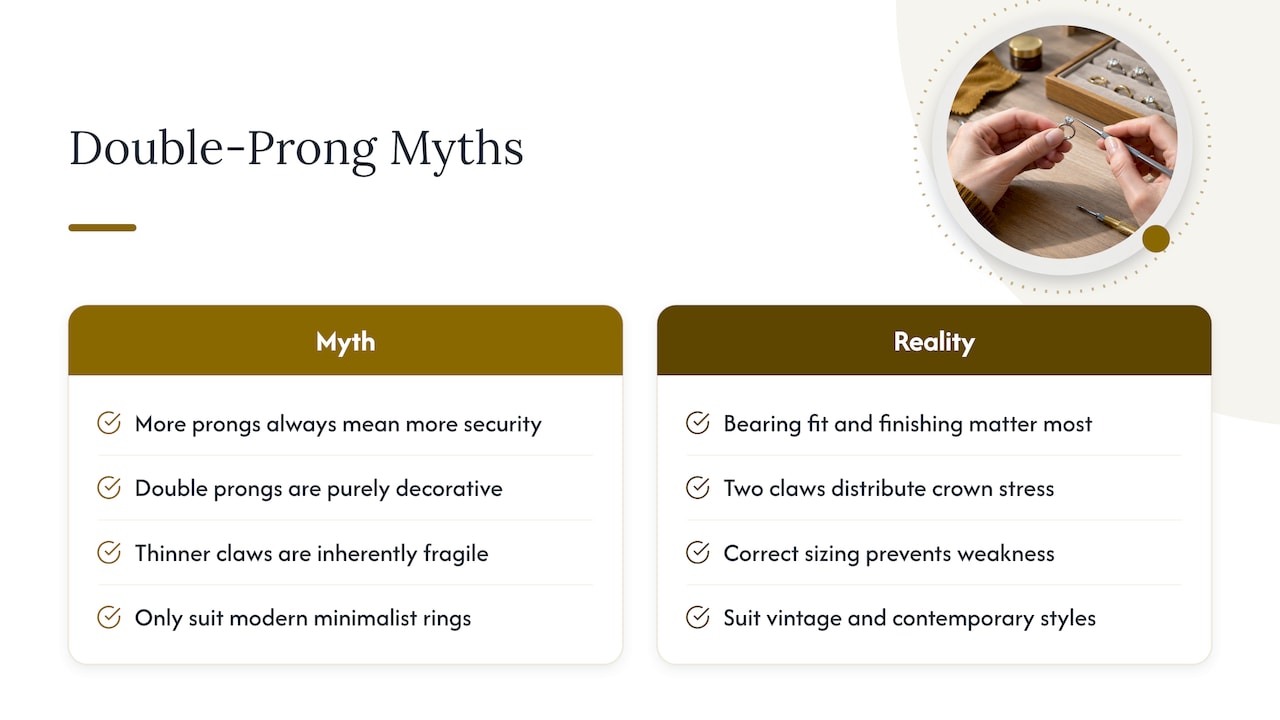
A persistent myth is that more prongs always mean more security, full stop, which skips over the fact that two thin claws sharing one contact point can grip a stone just as firmly as a single thick prong in the right hands. What matters most is bearing fit and finishing, not just a raw count of metal points.
Another misconception is that double prongs are purely decorative with no functional benefit. In reality, splitting a prong into two claws distributes stress across a slightly wider area of the crown, which is part of why jewelers use the style on stones that benefit from extra local support without the bulkier look of six total prongs.
Some buyers also assume double prongs are inherently fragile because the claws look thinner than a standard single prong. Thinner does not mean weaker when the metal and geometry are sized correctly for the stone, which is exactly what GIA’s prong contact and height benchmarks are designed to verify.
Finally, there is a belief that double prongs only suit modern minimalist rings. As their history shows, the style has moved comfortably between ornate vintage settings and clean contemporary ones, which makes it one of the more adaptable prong styles rather than a trend tied to one aesthetic.
Our Take on Choosing a Double Prong Setting
Most advice on prong settings focuses on counting claws, four versus six, as if the number alone determines safety. That misses the real variable: bearing fit and finishing quality matter more than how many prongs a ring has. A six-prong setting with a sloppy bearing is less secure than a well-built double prong mount, and we think buyers would make better decisions if they asked about contact ratios and finishing before they asked about prong count.
Where double prongs genuinely shine is the half-carat-and-up range on round, cushion, or princess stones, where you want a four-prong silhouette without giving up the local support a larger diamond needs. Below that size, a classic single four-prong is often simpler and just as secure.
If we had one piece of advice to add to the standard GIA guidance, it would be this: ask your jeweler to show you the bearing before the stone goes in. That single check tells you more about long-term security than any prong-count debate.
— Joseph
How to Get a Custom Double Prong Ring From USA Jewels
We build every double prong setting with full control over bearing fit, prong contact, and finishing, managed consistently rather than passed between outside vendors. If a double prong mount fits your stone and your style, our Design Your Own Engagement Ring process lets you choose the metal, from 14K and 18K gold to platinum, and pair it with a certified diamond from our certified loose diamonds selection.

We offer a lifetime diamond upgrade program to help your setting accommodate a larger stone later without starting over. If you prefer to see finished examples first, browse our engagement ring collection for ready-to-ship double prong styles, or start your own design when ready.
FAQ
What is the most secure prong setting for a ring?
Security depends more on bearing fit and finishing than on prong count alone, though GIA notes that six-prong settings offer extra redundancy, which is especially useful for larger stones. A well-built double prong or four-prong setting with a precise bearing can be just as reliable for smaller stones.
What is a divorce ring?
A divorce ring is a piece a person commissions or redesigns for themselves after a divorce, often repurposing an existing stone into a new setting as a personal milestone marker rather than a traditional engagement or wedding symbol. There is no fixed design associated with the term, and it can use any prong style, including double prongs.
What is the strongest setting for an engagement ring?
Bezel settings, which surround the stone’s edge entirely in metal, are generally considered the most protective style since they shield the diamond from impact on all sides. Among prong styles, GIA points to six-prong settings as offering added redundancy, particularly for larger center stones.
How many prongs should a 2 carat diamond have?
For a stone at this size, GIA’s guidance generally favors six prongs for the extra security and balanced look larger diamonds benefit from. A well-engineered double prong or four-prong setting can still work if the bearing and prong contact meet proper benchmarks, but six prongs remain the more cautious choice at this size.
Sources
- How to Decide: Four Prongs versus Six Prongs for Your Engagement Ring
- Setting a round center stone in a ring with platinum prongs (GIA quality-assurance benchmarks)
- Jewelry Repair | Jewelers of America
Recommended
- Settings Guide: Prong, Bezel & Channel
- Engagement Ring Prong Style Selection: 2026 Guide
- Engagement Ring Settings Explained: Solitaire, Halo & More
- Pick Ring Setting Style Guide for Every Buyer

Deep Mehta is the Co-Owner of USA Jewels, a family-owned jewelry business she has led since 2013 in Deerfield Beach, Florida. With over 13 years of hands-on experience in fine jewelry retail, manufacturing, and diamond importing, Deep specializes in engagement rings, wedding bands, and custom jewelry design. She also co-manages Kaash Group Talent Acquisition. Deep is a University of Florida graduate and oversees every aspect of USA Jewels’ operations, from product development to marketing.
Fine Jewelry Collection

You May Also Like
Anniversary Jewelry Milestone Gifts That Last a Lifetime
Pendant Bail Size: 6–8mm, 8–11mm, or 15mm+ for Buyers & DIYers