How Synthetic Diamond Creation Works: A Buyer’s Guide
Synthetic diamonds are real diamonds grown in a laboratory using two primary methods: High Pressure High Temperature (HPHT) and Chemical Vapor Deposition (CVD). According to the Gemological Institute of America, these lab-grown stones are chemically and physically identical to natural diamonds, yet they can be produced in days to weeks rather than millions of years. At Usajewels, we believe that understanding how synthetic diamond creation works helps you shop with confidence and make choices that reflect your values.
- Growth time: Days to a few weeks, depending on the method
- Seed crystal role: Every lab diamond grows on a tiny diamond “seed” that acts as a crystalline template
- Common uses: Jewelry-grade gems (CVD) and industrial applications (HPHT)
- Certification labs to check: GIA and IGI both issue grading reports for lab-grown stones
Table of Contents
- How are synthetic diamonds made in the lab?
- What does the step-by-step production process look like?
- HPHT vs. CVD: which method matters for your purchase?
- How are lab-grown diamonds identified and graded?
- Are lab-grown diamonds better for the environment and ethics?
- What should you check before buying a lab-grown diamond?
- Key Takeaways
- Why transparency is the real standard in lab-grown diamonds
- Certified lab-grown diamonds, designed around you
- Useful sources
- FAQ
How are synthetic diamonds made in the lab?
Two methods dominate the synthetic diamond process, and each mimics a different aspect of how carbon becomes diamond.
HPHT: recreating earth’s pressure
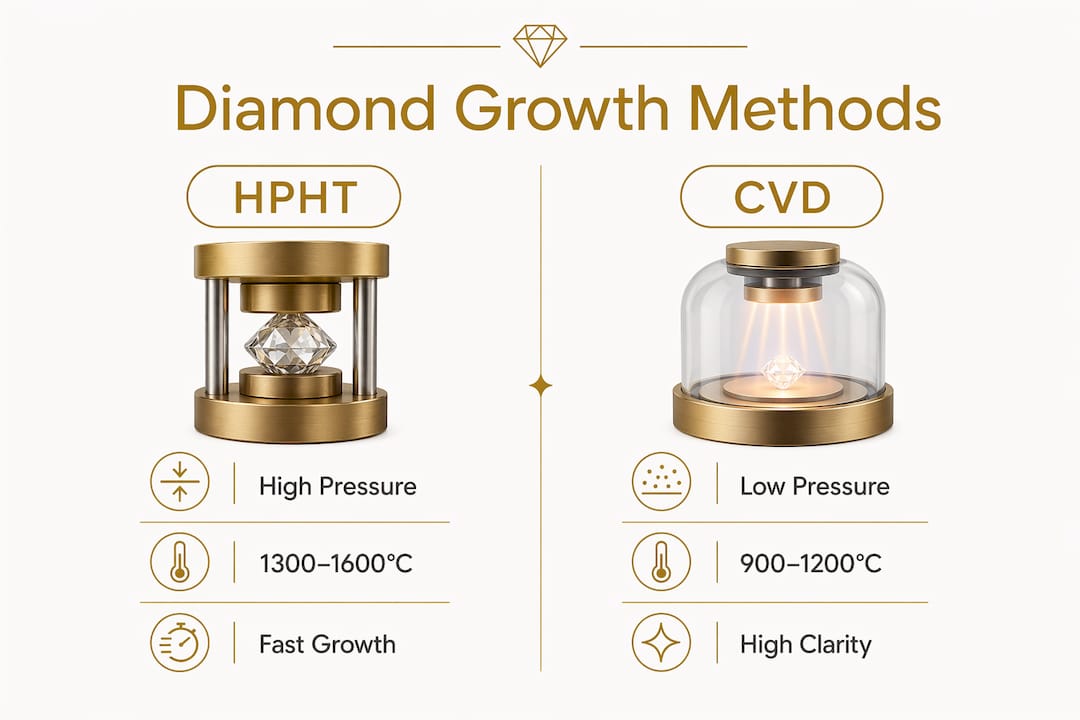
HPHT presses recreate the extreme conditions deep inside the earth that enable natural diamond formation. A carbon source, typically graphite, is placed with a metal solvent-catalyst (iron, nickel, or cobalt) and a diamond seed inside a press. The press heats the cell to roughly 1,300–1,600 °C at pressures above 870,000 psi. The molten metal dissolves the carbon, which then migrates toward the cooler seed and crystallizes as diamond. Three press designs are used commercially: the belt press, the cubic press, and the BARS (split-sphere) press. Each can weigh hundreds of tons.
CVD: building diamond from gas
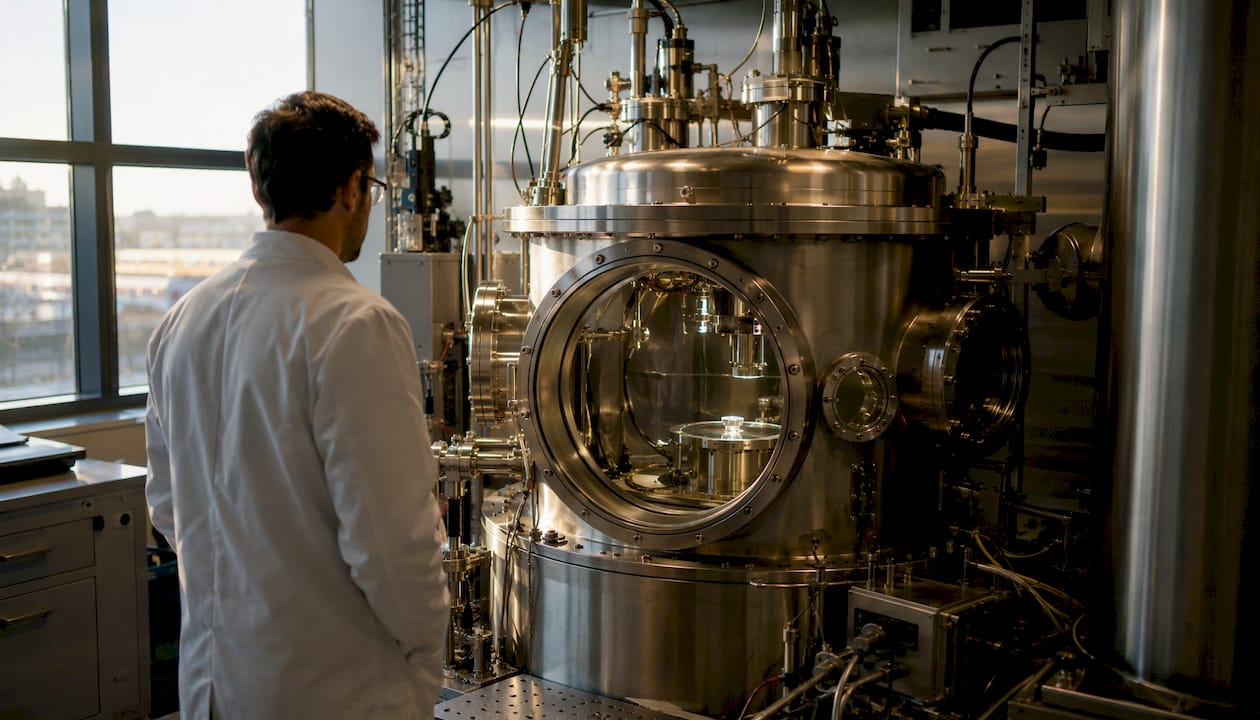
CVD works at far lower pressures. A diamond seed sits inside a vacuum chamber filled with a methane-and-hydrogen gas mixture. The chamber is heated to roughly 900–1,200 °C, and microwave plasma (or a hot filament) breaks the gas into reactive carbon radicals. Those radicals deposit, atom by atom, onto the seed’s surface. Hydrogen gas plays a critical role: it selectively etches away non-diamond carbon, keeping the growing crystal pure. CVD requires no extreme pressure, which makes the equipment less costly to build and easier to control for impurity levels.
| Parameter | HPHT | CVD |
|---|---|---|
| Temperature | 1,300–1,600 °C | 900–1,200 °C |
| Pressure | Above ~870,000 psi | Low (sub-atmospheric) |
| Carbon source | Graphite + metal catalyst | Methane/hydrogen gas mix |
| Typical growth duration | On the order of days to weeks, varying by process and conditions | |
| Crystal shape produced | Cuboctahedral | Tabular/plate-like |
What does the step-by-step production process look like?
Every lab-grown diamond follows a clear sequence from raw seed to finished gem.
- Seed inspection and preparation. Technicians select tiny diamond seeds, laser-trim them to precise dimensions, and clean them in ultrasonic baths to remove any surface contamination. Defects on a seed propagate into the grown crystal, so this step is critical.
- Mounting. Seeds are fixed to holders, sometimes dozens per run, and placed inside the reactor or press.
- Growth cycle. In HPHT, the press runs as a single continuous cycle. In CVD, growth often happens in repeated stop/start cycles, with technicians polishing the top surface between runs to remove graphite-like deposits and keep growth uniform.
- Removal. Once the crystal reaches the target size, it is removed and inspected under magnification.
- Post-growth treatment. CVD crystals commonly emerge with a brownish tint and graphite-edged surfaces. Annealing or HPHT treatment corrects the color and removes non-diamond carbon before any cutting begins.
- Laser sawing. The rough crystal is cut into workable pieces using a laser saw.
- Bruting. The girdle (the widest edge) is shaped by spinning two diamonds against each other.
- Faceting. A skilled cutter facets the stone on rotating wheels coated with diamond powder, the same process used for natural rough.
- Grading. The finished stone goes to a certified lab (GIA or IGI) for a full grading report.
Pro Tip: Ask your seller whether the stone’s girdle carries a laser inscription matching the grading report number. GIA inscribes lab-grown diamonds with a report number and the words “Laboratory Grown,” making origin traceable at a glance.
HPHT vs. CVD: which method matters for your purchase?
| Method | Typical clarity range | Typical sizes | Primary uses | Post-growth treatments | Detection signals |
|---|---|---|---|---|---|
| HPHT | VS2–SI1 (varies widely) | Up to several carats; scalable for industrial grit | Industrial abrasives, mass-market gems | Minimal; some color enhancement possible | Metallic inclusions, cuboctahedral growth patterns |
| CVD | VVS2–VS1 (often higher clarity) | Typically under 3 ct for jewelry | Jewelry-grade stones, electronics | Annealing or HPHT color treatment common | Tabular shape, brown tint before treatment, strain patterns |
For jewelry buyers, CVD tends to deliver higher clarity grades more consistently. HPHT remains the workhorse for cost-effective industrial production, though it also produces gem-quality stones. Neither method is detectable by the naked eye. Labs identify them through growth patterns, fluorescence behavior, and, in HPHT stones, microscopic metallic inclusions left by the iron-nickel catalyst.
How are lab-grown diamonds identified and graded?
GIA and IGI both grade lab-grown diamonds using the same 4Cs framework applied to natural stones: cut, color, clarity, and carat weight. A GIA report for a lab-grown diamond states “Laboratory Grown” clearly on the document and includes the laser inscription number. IGI reports follow a similar format.
When you receive a grading report, check three things: the origin statement (it should say “laboratory grown” or equivalent), the report number, and whether that number matches the inscription on the stone’s girdle. Labs also note any post-growth treatments, such as HPHT color enhancement, which affects value and resale. Understanding diamond clarity grades from FL to I3 helps you interpret what VVS2 or VS1 actually means for the stone in your hand.
Are lab-grown diamonds better for the environment and ethics?
Lab-grown diamonds eliminate the land disruption and labor concerns tied to mining, and they carry no conflict-diamond risk. That is a genuine advantage for ethically minded buyers. The tradeoff is energy: both HPHT presses and CVD reactors consume significant electricity, and the carbon footprint depends heavily on whether the facility runs on renewable or fossil-fuel power.
In the United States, the Federal Trade Commission requires sellers to disclose that a diamond is lab-grown. Phrases like “lab-created,” “laboratory-grown,” or “man-made” must appear clearly in any sale. Sellers who omit this disclosure violate FTC guidelines. For ethically produced lab-grown diamonds, chain-of-custody documentation and energy-source transparency are the markers that separate responsible producers from those simply marketing a “green” story.
On resale value: lab-grown diamonds currently sell at a significant discount to natural diamonds of comparable grades. That gap has widened as production volume has grown. If resale matters to you, factor it into your decision alongside the ethical and cost benefits.
Pro Tip: Ask any seller: “What energy source powers your production facility?” and “Do you offer a lifetime upgrade or exchange policy?” Honest answers to both questions are a reliable trust signal.
What should you check before buying a lab-grown diamond?
A short checklist protects you whether you are shopping online or in a store.
- ✅ Certified lab report: Insist on a GIA or IGI grading report, not just a seller’s in-house certificate
- ✅ Laser inscription match: Confirm the report number matches the inscription on the stone’s girdle
- ✅ Method disclosure: Ask whether the stone is HPHT or CVD grown; both are legitimate, but treatments differ
- ✅ Post-growth treatment disclosure: CVD stones often receive color treatment; this should appear on the report
- ✅ Return and warranty policy: A reputable seller offers a clear return window and, ideally, a lifetime upgrade option
- ✅ Insurance documentation: A grading report is the document your insurer needs to cover the stone at replacement value
For a broader look at how lab-grown and natural diamonds compare on value and resale, it helps to read up before you commit.
Key Takeaways
Both HPHT and CVD produce chemically real diamonds in a laboratory in days to weeks, and a certified grading report from GIA or IGI is the single most important document a buyer should request.
| Point | Details |
|---|---|
| Two methods, one result | HPHT and CVD both produce diamonds identical in chemistry and hardness to natural stones. |
| CVD clarity advantage | CVD-grown diamonds often grade VVS2–VS1, typically higher than many natural stones at comparable prices. |
| Post-growth treatments matter | CVD stones commonly receive annealing or HPHT color treatment; always check the grading report for disclosures. |
| Certification is non-negotiable | Insist on a GIA or IGI report and verify the laser inscription matches the report number before purchase. |
| Usajewels supports informed buying | Usajewels offers certified lab-grown options, lifetime diamond upgrades, and transparent disclosure to help you choose with confidence. |
Why transparency is the real standard in lab-grown diamonds
The technical story of how a diamond grows in a reactor is genuinely fascinating. But what matters most to a buyer is not the method itself. It is whether the seller can prove what they are selling. A CVD stone with a GIA report and a laser inscription is a far safer purchase than an HPHT stone sold with only a verbal assurance. The certification is the trust, not the chemistry.
What I find underappreciated is the seed crystal question. Lab-grown diamonds are not created from nothing. They start from a real diamond seed, which means every lab-grown stone carries a crystalline lineage. That detail does not diminish the stone, but it does complicate the “100% man-made” marketing claim some sellers use. Honest sellers acknowledge it. At Usajewels, that kind of transparency is exactly what we look for when we curate our certified selections, and it is what we encourage every buyer to demand.
Certified lab-grown diamonds, designed around you

Usajewels has been a family-owned jeweler since 1999, and our in-house manufacturing model means you get certified, conflict-free diamonds without the markups that come from middlemen. Every lab-grown stone we carry comes with a named lab report (GIA or IGI), full method and treatment disclosure, and our lifetime diamond upgrade policy. You can design your own ring from scratch, choosing your stone’s clarity, color, and shape, or browse our ready-to-wear collections. Our team is here to walk you through every grading report, answer your questions about HPHT versus CVD, and help you find a piece that tells your story. View our diamond ring collections and reach out to our family team for a personal consultation.
Useful sources
- GIA: Lab-Grown Diamonds — What Are Synthetic Diamonds? — GIA’s consumer-facing explanation of lab-grown diamond chemistry, methods, and grading
- GIA: HPHT and CVD Diamond Growth Processes — Technical detail on reactor conditions, temperatures, pressures, and post-growth treatments
- GIA: Man-Made Diamonds — Questions and Answers — GIA’s authoritative FAQ on synthetic diamond identification and disclosure
- Washington Post: How Lab-Grown Diamonds Are Made, Step by Step — Visual, step-by-step production walkthrough including seed prep and finishing
- AZoM: How Are Synthetic Diamonds Made? — Materials-science perspective on CVD stop/start cycles and equipment comparisons
- Wikipedia: Synthetic Diamond — Broad historical and technical overview of all production methods, including detonation synthesis
- Britannica: Synthetic Diamond — Concise reference on industrial versus gem-quality production and key physical properties
This article is general educational information, not professional gemological or legal advice. Verify current FTC disclosure requirements and grading standards with GIA, IGI, or a qualified gemologist for your specific purchase.
FAQ
What makes a synthetic diamond chemically different from a natural one?
Nothing. Both are pure carbon crystallized in the same isotropic structure, giving them identical hardness, thermal conductivity, and optical properties.
How long does it take to grow a lab diamond?
HPHT growth typically takes days to about two weeks in a single run. CVD growth often takes two to four weeks because of repeated stop/start cycles and surface polishing between runs.
Can jewelers tell HPHT and CVD diamonds apart from natural diamonds?
Not with the naked eye. Trained gemologists and lab instruments identify them through growth patterns, fluorescence, and, in HPHT stones, microscopic metallic inclusions from the iron-nickel catalyst.
Does a lab-grown diamond hold its value like a natural diamond?
Lab-grown diamonds currently resell at a significant discount to natural diamonds of comparable grades, and that gap has widened as production volume has increased. Factor resale value into your decision alongside the cost and ethical benefits.
What certification should I require when buying a lab-grown diamond?
Request a grading report from GIA or IGI, confirm the report number matches the laser inscription on the stone’s girdle, and check that any post-growth treatments are disclosed on the report.
Recommended
- Lab-Created Diamonds: Process & Value | USA Jewels
- How Diamond Simulants Compare to Real Diamonds
- Lab-Grown vs Natural Diamonds Guide | USA Jewels
- Diamond Pricing Guide: What Diamonds Cost | USA Jewels

Deep Mehta is the Co-Owner of USA Jewels, a family-owned jewelry business she has led since 2013 in Deerfield Beach, Florida. With over 13 years of hands-on experience in fine jewelry retail, manufacturing, and diamond importing, Deep specializes in engagement rings, wedding bands, and custom jewelry design. She also co-manages Kaash Group Talent Acquisition. Deep is a University of Florida graduate and oversees every aspect of USA Jewels’ operations, from product development to marketing.
Fine Jewelry Collection


You May Also Like
Ring Resizing Cost: A U.S. Budgeting Guide for 2026
Double Prong Settings: Two Claws Add Grip, Not More Contact Points