Finger Shape vs Diamond Shape: How to Pick the Right Match
Elongated shapes such as oval, marquise and pear tend to make short fingers look longer, while round and cushion cuts sit comfortably on long, slender fingers. That is the starting point, not a rule. The best diamond shape for your hand is the one that matches your finger proportions, your daily life and your taste, and the only real test is seeing it on your own finger. Below we walk through each finger type, the shapes that flatter it, and the details (length-to-width ratio, band width, setting) that change how a stone looks on you.
TL;DR
- Short or wide fingers: oval, marquise, pear and rectangular stones have a north-south axis that can make fingers look longer.
- Long or slim fingers have the most freedom. Round, cushion, princess, emerald and Asscher cuts all look balanced.
- Small hands usually look best with a simple design and a stone in proportion with the finger, not the biggest one you can buy.
- Ratio, band width and setting matter as much as the shape name, so check the proportions, not just the label.
- Try rings on before you commit. Hand-shape advice is a guide, and comfort and personal style come first.
Table of Contents
- Finger shape and diamond shape: what each one means
- How a diamond’s outline changes the look of your finger
- Which diamond shapes suit which finger type
- Diamond shape for small hands
- Ratio, band and setting: the details that change the effect
- Why trying rings on beats any chart
- Our perspective at USA Jewels
- Build the ring around your hand
- Common questions about finger shape and diamond shape
- Sources
Finger shape and diamond shape: what each one means
People use “shape” for both the finger and the stone, so it helps to separate them.
A diamond’s shape is its outline when you look at it from above: round, oval, pear, marquise and so on. GIA says shape refers to the outline, while cut refers to the arrangement of the facets. The facets decide how the stone handles light. The outline decides how it sits on your hand. A well-cut oval and a poorly cut oval look the same in silhouette but very different in sparkle.
Shape and cut style also affect perceived size and how the stone suits a setting or a personal style, according to GIA’s guide to engagement ring shapes. If you want the cut side in more depth, our diamond cut guide explains how cut grades affect brilliance, and our diamond cut comparison shows the styles side by side.
Your finger shape is simply your finger’s proportions: short or long, narrow or wide, tapered or square-looking at the knuckle. A diamond shape either echoes those lines or contrasts with them. That interplay is the whole idea behind matching the two.
How a diamond’s outline changes the look of your finger
Three things do most of the work.
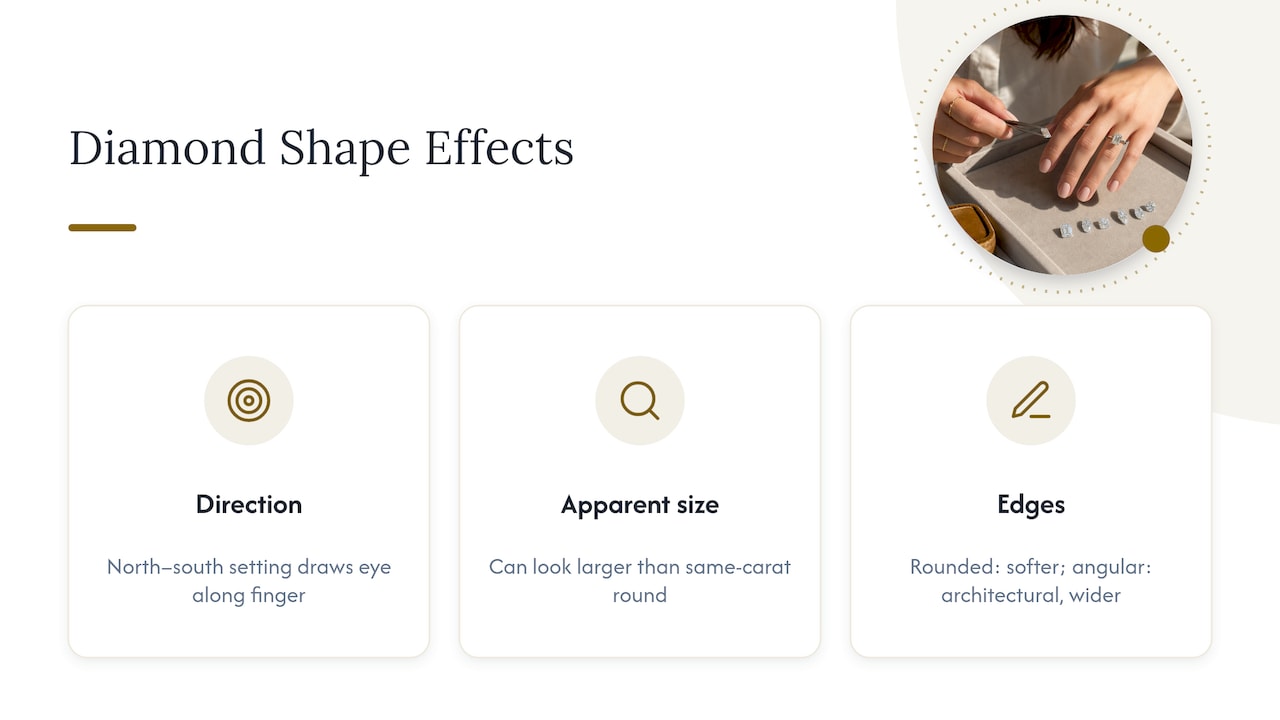
Direction. A stone that is longer than it is wide, set north to south, draws the eye along the finger. GIA notes that marquise, oval, rectangular and pear-shaped diamonds can make shorter fingers appear longer for exactly this reason.
Apparent size. Elongated outlines can look larger face-up than a round diamond of the same carat weight, according to GIA. That matters if you want maximum presence from a set budget.
Edges and corners. Rounded outlines read softer. Square and angular outlines read more architectural, and they cover more of the finger’s width.
None of this is magic. It is a visual effect, and it depends on the ratio of the stone, the band and the setting, which we cover below.
Which diamond shapes suit which finger type
Here is a practical overview. Use it to build a shortlist of two or three shapes, not to rule everything else out.
| Finger type | Shapes that tend to flatter | Why it works | Keep in mind |
|---|---|---|---|
| Short | Oval, marquise, pear, rectangular (such as emerald) | North-south axis lengthens the line of the finger | A round or princess center with small side stones and a narrow band can also work |
| Wide or broad | Oval, pear, emerald, radiant | Elongated outline balances the width | A medium to wide band suits a larger finger, but it should not feel tight |
| Long | Round, cushion, princess, Asscher, emerald | Long fingers carry most shapes without distortion | Very elongated stones can exaggerate length |
| Narrow or slim | Round, princess, cushion, oval | Compact stones keep proportion | A very large stone can overwhelm a slim finger |
| Square-looking | Round, oval, pear | Curved outlines soften angular lines | Match the stone’s curves to the band |
The first row comes straight from GIA’s guidance on flattering every finger type. The other rows follow the same logic of direction and proportion, and they are suggestions rather than laws.
Short fingers
Oval, marquise and pear are the classic answers. GIA says an oval’s elongated outline creates the illusion of a longer, slimmer finger, and you can choose its width to taste (GIA, How Diamonds Shape Up). GIA also says marquise stones can make a finger look longer and more slender, and that both marquise and oval look relatively large face-up (GIA, engagement ring styles).
If you love the look of a round brilliant or a princess cut, you do not have to give it up. GIA says a round or princess center with small side stones and a narrow band can flatter short fingers without drawing attention to their length. Our round vs oval comparison helps if you are torn between those two.
Wide fingers
A wider finger can carry a stone with presence. Elongated shapes keep the eye moving along the finger rather than across it. On the band, GIA says a medium to wide band looks best on a larger finger, but it should be comfortable and not look tight, since a tight ring can accentuate finger width. Sizing matters here as much as style.
Long and slim fingers
If your fingers are long, you have the most flexibility. Round, cushion, princess, emerald and Asscher all look balanced. The only caution is to avoid pushing length further with a very narrow marquise unless you love that look. If you want the square-cut look, our princess cut guide covers what to expect.
Diamond shape for small hands
Small hands and short fingers overlap, but they are not the same thing. Small hands are about overall scale. Here the guidance is consistent: GIA says petite fingers are flattered by simple designs and small rings, and that a big ring or gem can overwhelm the hand.
Jewelry designer Buckley Kayel, speaking to InStyle, recommends oval and pear diamonds for elongating the finger, and says a minimal diamond shape is generally more proportionate on smaller hands.
In practice that gives you three approaches:
- Go elongated. An oval or pear in a modest size gives the lengthening effect and looks larger than its carat weight suggests.
- Go classic and small. A round brilliant in a simple solitaire keeps everything in scale.
- Keep the setting quiet. A complicated design can overwhelm short fingers, according to GIA. A slim band and a clean setting let the stone do the talking.
Carat weight is a separate decision, and for small hands it deserves its own look. We cover it in our practical guide to carat size for small hands.
Ratio, band and setting: the details that change the effect
Two ovals can look completely different on the same finger. The reason is usually the length-to-width ratio.
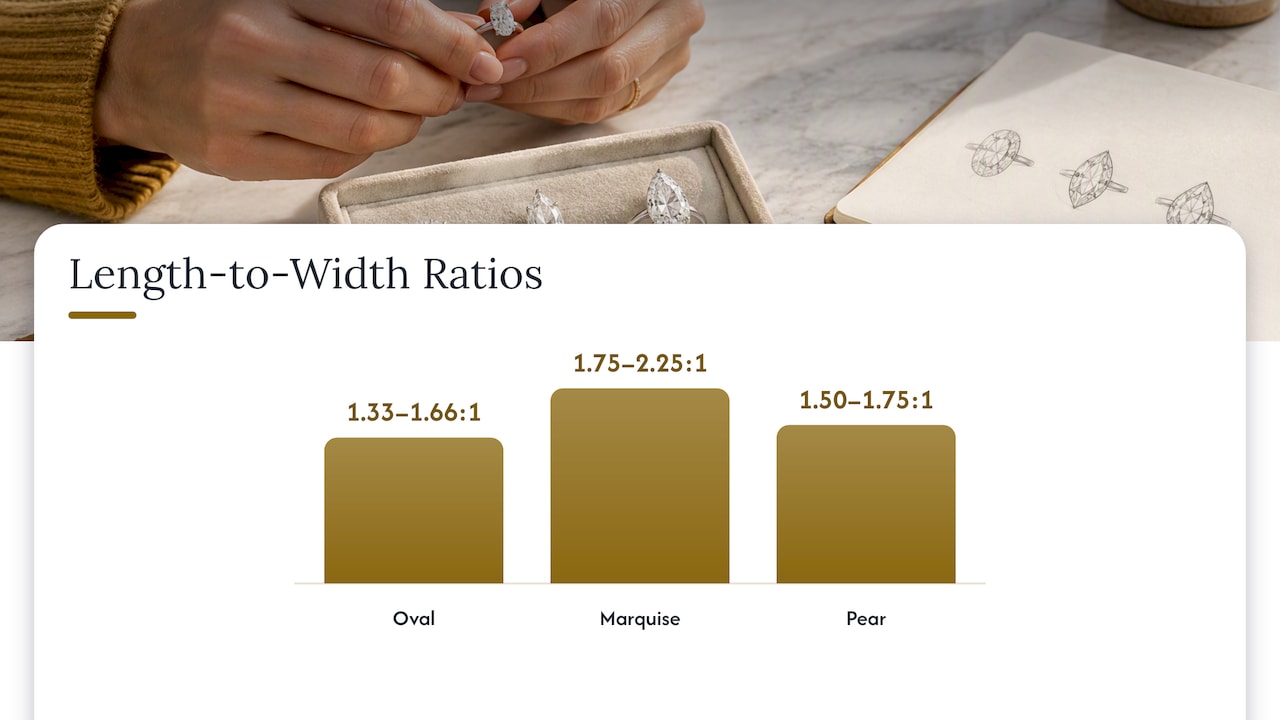
A ratio tells you how much longer a stone is than it is wide. GIA’s buying guide gives typical ranges of 1.33 to 1.66 to 1 for ovals, 1.75 to 2.25 to 1 for marquises and 1.50 to 1.75 to 1 for pears. It also stresses symmetry and protective settings for pointed shapes.
What that means for you:
- A higher ratio gives a longer, leaner look. That is the choice for maximum elongation on short fingers.
- A lower ratio gives a fuller, rounder look. That suits fingers where you want presence without extra length.
- Pointed ends (on a marquise or pear) need a setting that protects them. GIA’s oval guide notes that rounded edges are less prone to chipping than sharp-cornered shapes such as princess or marquise, which is worth weighing if you work with your hands.
If you are choosing between two elongated shapes, our comparison of oval vs pear and the 1.3 to 1.5 ratio range explains the bow-tie effect to look for. If you are weighing a square cut against a round, see how custom design balances sparkle, size and safety in princess vs round.
Band width works with the stone. A narrow band keeps a small hand looking delicate, while a wider band balances a broad finger. Setting height matters too: a low setting sits close to the finger and feels secure, a high one adds drama.
Why trying rings on beats any chart
Proportion is a starting point. The experts quoted by Brides say the same: consider hand size, how much of the finger you want covered, brilliant versus step cut, symmetry, how a wedding band will sit alongside, and your own taste. Then try different rings on and choose what suits your style and personality.
A few things to notice when you try one on:
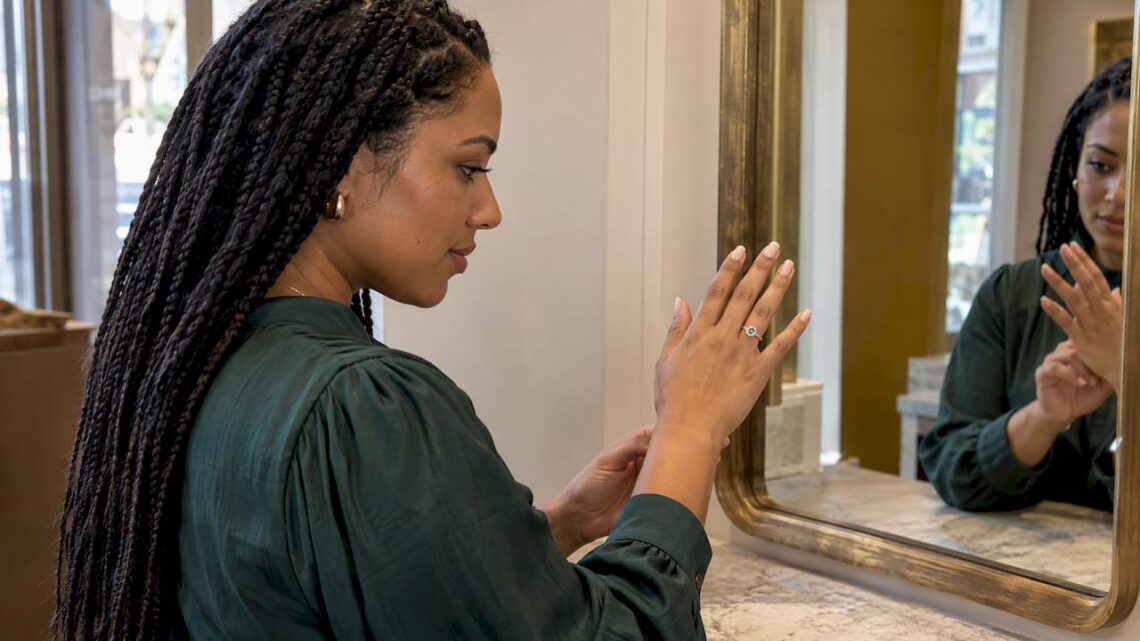
- Look at your hand at arm’s length and in a mirror, not only down at your finger.
- Move your hand the way you do all day: typing, holding a cup, waving.
- Check how the stone sits next to a plain wedding band.
If you are shopping as a surprise, a good habit is to ask about the wearer’s other jewelry. Do they wear delicate pieces or bold ones? A partner who loves fine, minimal necklaces will probably love a smaller, simple stone. And many couples like to capture the moment the ring is revealed, so it is worth reading about what an engagement video is before the proposal.
Our perspective at USA Jewels
We have been a family-owned jewelry business since 1999, and we make our pieces in-house. In all that time, the question we hear most is not “what is the best shape?” It is “will I love looking at this every day?”
Hand-shape guidance is useful, and we use it when we help someone narrow a shortlist. But we never want it to talk you out of the shape you love. If a round brilliant is the ring you have pictured for years, a narrow band and a quiet setting can make it work on almost any finger. If you adore the long line of a marquise, we can set it so the points are protected.
That is the advantage of designing a ring rather than picking from a case. You choose the diamond shape, the quality and the metal, and we build it solid, not hollow or plated. Because we sell direct, you are not paying a middleman’s markup for the choice. Our diamonds are certified and ethically sourced, and our lifetime diamond upgrade program means the stone you pick today does not have to be the last one.
Our advice is simple. Pick two or three shapes from the chart above. Look at them on a real hand, ideally your own or your partner’s. Then choose the one that makes you smile.
— Joseph
Build the ring around your hand
If you are ready to see how a shape looks in a real design, you can design your own diamond ring with us, starting from $399, and choose the shape, diamond quality and metal yourself. If you would rather start from the stone, browse our certified loose diamonds, from $142, in natural and lab-grown options. Prefer to start from a finished design? Our engagement rings start at $346. Every order ships free and insured, with a 30-day money-back guarantee.
Not sure where to begin? Our step-by-step design guide walks you through each choice.
Common questions about finger shape and diamond shape
What is the best diamond shape for short fingers?
Oval, marquise and pear are the shapes most often recommended, because their north-south axis can make a finger look longer. A round or princess center with small side stones and a narrow band is also a good option. Try a few on, since band width and setting change the effect.
What diamond shape is best for small hands?
A simple design in proportion with the hand tends to work best. GIA says a big ring or gem can overwhelm petite fingers, and designers suggest oval or pear for added length. A modest-size round in a slim solitaire is another reliable choice.
Do I need to match my diamond shape to my finger shape?
No. Matching is a way to get a flattering look, not a requirement. Comfort, lifestyle and personal taste matter more, and the experts quoted by Brides say proportion is only a starting point. If you love a shape that is not on the “recommended” list, adjust the band and setting to balance it.
Which diamond shape is the most flattering overall?
Oval is often named as the most versatile, because its lengthening effect helps many finger types and it can look large for its carat weight. Round remains the classic, and it works on nearly every hand. Our ranking of the best diamond shapes compares them in detail.
Does diamond shape change how sparkly the stone is?
Shape sets the outline, but the cut, meaning the facet arrangement, drives brilliance. A well-cut stone in any shape will outshine a poorly cut one. Our guide to every diamond shape explains how each one behaves.
Sources
- Guide to Diamond Engagement Ring Shapes, GIA 4Cs
- How Diamonds Shape Up, GIA 4Cs
- Engagement Ring Styles to Flatter Every Finger Type, GIA 4Cs
- Engagement Ring Styles: Discover 7 Stunning Designs, GIA 4Cs
- Oval Cut Diamond Buying Guide, GIA 4Cs
- Expert Tips for Buying Fancy Shaped Diamonds, GIA 4Cs
- How to Choose an Engagement Ring That’s Right for You, InStyle
- How to Choose the Right Diamond Shape for Your Hand Size, Brides
Recommended
- Diamond Shapes Guide: Every Shape Compared
- Oval vs Pear: Pick the Right 1.3–1.5 Ratio and Avoid Bow Tie Traps
- Best Diamond Shapes for Engagement Rings Ranked
- Round vs Oval Diamond: Which Shape Is Right for You?

Deep Mehta is the Co-Owner of USA Jewels, a family-owned jewelry business she has led since 2013 in Deerfield Beach, Florida. With over 13 years of hands-on experience in fine jewelry retail, manufacturing, and diamond importing, Deep specializes in engagement rings, wedding bands, and custom jewelry design. She also co-manages Kaash Group Talent Acquisition. Deep is a University of Florida graduate and oversees every aspect of USA Jewels’ operations, from product development to marketing.
Fine Jewelry Collection

You May Also Like
Hearts and Arrows vs GIA Excellent: When the Premium Is Worth It
Are Lab-Grown Diamonds Worth It? A Practical 2026 Guide