Is Buying Diamonds Online Safe? A Buyer’s Checklist
Yes, buying a diamond online is safe when you buy from an established seller, a certified stone, and a clear return policy, and when you confirm the stone in your hands matches its paperwork. The risks are real but specific, and each one has a check you can run before you pay. Our family has been selling diamonds and jewelry since 1999, and this is the checklist we would hand to a relative.
TL;DR
- Online diamond buying is safe when the seller has a track record, written return terms and insured, signature-required shipping.
- Insist on an independent grading report, then verify it with the lab and match it to the stone’s laser inscription.
- Pay by credit card, keep every document, and have an independent appraiser check the stone when it arrives.
- If something is wrong, go to the seller first, then the FTC, your state attorney general or the Jewelers Vigilance Committee.
Table of Contents
- What can actually go wrong when you buy a diamond online
- Step 1: Check the seller before you check the stone
- Step 2: Demand an independent grading report
- Step 3: Read the listing like an inspector
- Step 4: Protect your payment and your shipment
- Step 5: Inspect the diamond the day it arrives
- If the diamond is not what you were sold
- Our perspective: how we think about safe online buying
- Shop certified diamonds with the checks built in
- Your pre-purchase checklist
- FAQ
- Sources
What can actually go wrong when you buy a diamond online
Most online buyers worry about the same thing: paying thousands of dollars for a stone they cannot hold. That worry is fair. You cannot see the sparkle, check the color against a master set or ask someone to put it under a loupe in front of you.
The problems that do happen fall into a few groups:
- A stone that is not what the listing said. The grade, size or treatment differs from the description.
- A report that does not belong to the stone. The certificate is real, but it was issued for a different diamond.
- A seller who is hard to reach afterward. GIA’s guidance warns that working with foreign sellers can greatly reduce your options for recourse if a sale turns out to be fraudulent.
- Vague listings. Ranges instead of exact grades, thin photos, no independent report.
- Weak return terms. Refunds that apply only in cases of “proven fraud” are a flashing warning sign, not a guarantee.
None of these is unique to the internet. A showroom can also sell a mismatched stone. The difference is that online, you must do the verification yourself, and the rest of this guide shows how.
Step 1: Check the seller before you check the stone
A good diamond from a bad seller is still a bad purchase. GIA suggests you look at how long the company has been in business, its reviews, trade-association membership, secure transactions, customer service, return policy and shipping. The Federal Trade Commission adds that you should look for complaints or reviews and get all refund and return policies in writing.
In practice, that means:
- Look for years, not months. A seller with a long history has more to lose from a bad sale.
- Read reviews in several places. Look for detailed reviews that mention a specific purchase, a delay that was fixed, or a return that went smoothly.
- Find a real address and a real person. Call or use the chat. Ask a hard question, such as how they handle a stone that does not match its report, and see whether you get a straight answer.
- Confirm the seller is in the United States. If something goes wrong, U.S. agencies and state attorneys general are far easier to reach when the seller is on U.S. soil.
- Check the checkout. The page should be secure and show the total, including shipping and insurance.
We have operated since 1999 as a family-owned business, and more than 222 customers have left Google reviews about us. Read them, and read those of any other seller you are considering with the same care.
Step 2: Demand an independent grading report
A diamond’s price rests on its grades: carat weight, cut, color and clarity. The FTC advises buying diamonds with an independent grading report from a reputable laboratory so the evaluation is unbiased. A seller grading its own stones has an obvious interest in grading them generously.
Two things matter here: who issued the report, and whether the report matches the stone.
Not all reports are equal
Labs are not interchangeable. Their standards differ, and so does how strictly they grade color and clarity. If you want to compare, our diamond certification guide on GIA, AGS and IGI explains how they differ, and our article on what buyers need to know about GIA certification goes deeper on the most widely requested one.
Verify the report with the lab
A PDF or a photo of a certificate can be edited. The safer habit is to take the report number and look it up with the issuing laboratory. GIA offers an online Report Check for this, and a lab lookup is the first step the GIA advises. We walk through the process in how to read a GIA report.
Then match the report to the stone
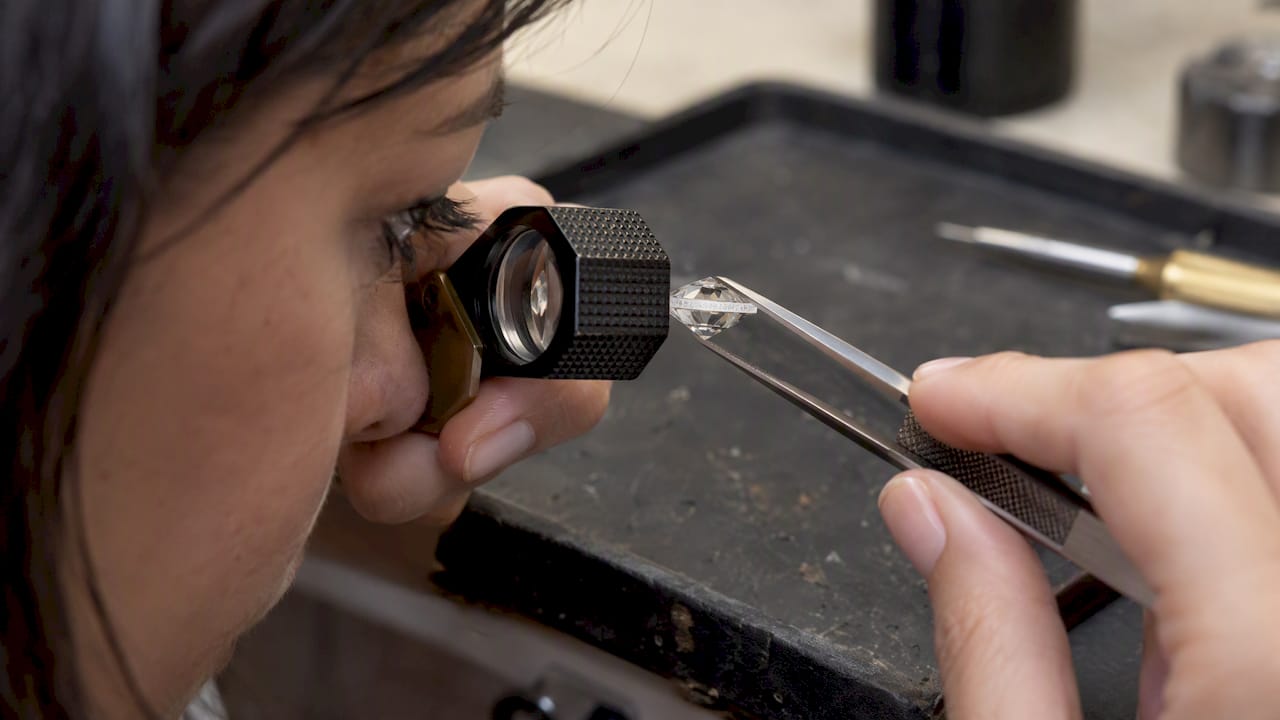
A lookup alone is not enough. IDGL notes that the physical stone must be matched to the report using measurements, inscriptions or identifying features. Many diamonds carry a laser inscription on the girdle, the thin edge around the stone, that repeats the report number. GIA points to girdle laser inscriptions as a link between the physical gem and its documentation.
When your diamond arrives, a 10x loupe lets you read that number yourself. Our guide to verifying a GIA laser inscription takes about two minutes. For a deeper check, the girdle itself tells you something about the stone: see our five checks for girdle thickness.
Step 3: Read the listing like an inspector
A trustworthy listing gives you enough to judge the stone without guessing. According to GIA, listings should show specific 4Cs rather than ranges, high-resolution magnified images and an independent grading report.
Use this table as a quick screen.
| What to look for | Good sign | Warning sign |
|---|---|---|
| Grades | Exact color, clarity and cut grade | “G-H color” or “VS-SI” ranges |
| Carat weight | Exact weight to the hundredth of a carat | Only a rounded or fractional weight with no range |
| Images | Magnified, high-resolution photos or video of the actual stone | Stock images of a generic diamond |
| Report | Independent lab report with a number you can verify | In-house certificate or no report |
| Pricing | Consistent with similar certified stones | Far below the market, or suspiciously “perfect” grades at a bargain |
| Return terms | Clear written window for any reason | Refund only for “proven fraud” |
One detail about weight: the FTC says that if a seller states diamond weight in fractions, they should tell the consumer the weight is not exact and give the reasonable range. More broadly, the FTC’s Jewelry Guides require claims about jewelry to be accurate and non-deceptive, with all material information disclosed. A seller who is vague on purpose is telling you something.
Grades are not the whole picture
Two diamonds with identical grades can look different. Cut drives most of the sparkle, so learn what the levels mean in our explainer on GIA’s five cut grades. Clarity is the grade people most often overpay for, and our diamond clarity chart shows where you can save without a visible difference.
Step 4: Protect your payment and your shipment
Safe buying is also about money and logistics, not just the stone.
- Return policy first. GIA advises you to check the seller’s return policy and whether the shipment is insured and requires a signature. Get the return window, who pays shipping on a return, and any restocking fee in writing.
- Use a credit card. Jewelers of America recommends a credit card over a debit card because it gives you consumer protection and possible recourse if there is a problem. Wire transfers and gift cards leave you little recourse if something goes wrong, so be wary of a seller who pushes them.
- Insure it the day it arrives. GIA notes that homeowners or renters insurance may cover theft but not always damage or loss, so read the specific jewelry coverage. We cover options in our jewelry insurance guide.
Step 5: Inspect the diamond the day it arrives
The return window is your safety net, so use it. When the package arrives:
- Open it with the signature on file and photograph the packaging and the stone.
- Compare the stone to the report: carat weight, measurements and the laser inscription number.
- Take it to an independent appraiser. GIA suggests having an independent appraiser confirm the physical stone matches the description and report. Do this inside the return window, not after it.
- Keep the complete report, written description, images, invoice and correspondence. IDGL’s checklist says to keep all of it.
Our step-by-step guide to verifying loose diamonds with five checks goes into each one in more detail.
If the diamond is not what you were sold
Start with the seller. Explain the mismatch, attach your photos and appraisal, and ask for the remedy the written policy promises. Most legitimate sellers want to fix it.
If you are not satisfied, the FTC, GIA and Jewelers of America point to the same next steps. You can report the seller to the FTC, file a complaint with your state attorney general, or use the mediation services of the Jewelers Vigilance Committee. Your paperwork from Step 5 is what makes any of those routes work.
Our perspective: how we think about safe online buying
We are a family business, and we make our jewelry in-house. That matters for safety because there is no chain of middlemen between the person who sets your stone and the person who answers your email. If something is off, you reach us, not a distributor.
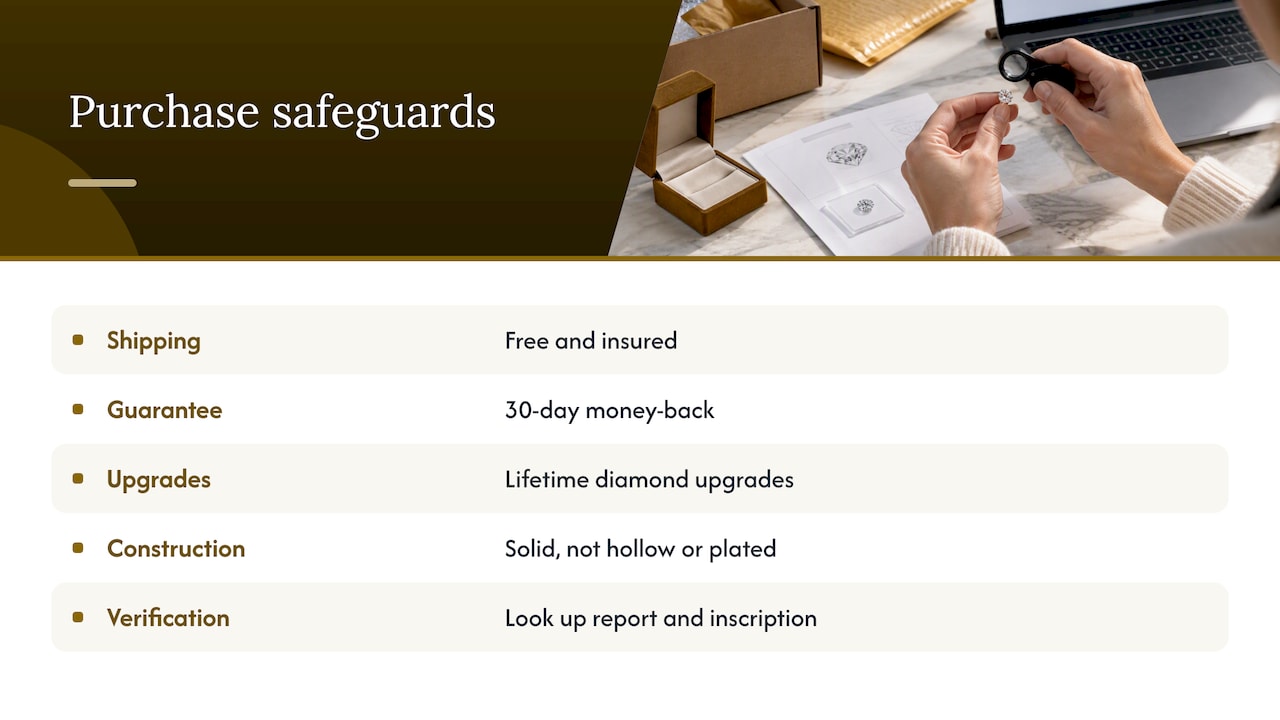
We believe a seller earns trust by making verification easy. Our loose diamonds are certified, ethically sourced and conflict-free, and we encourage every customer to look up the report and read the inscription under a loupe. We back purchases with free insured shipping, a 30-day money-back guarantee and lifetime diamond upgrades, and our rings and chains are solid, not hollow or plated.
Our advice is simple. Never skip the verification just because the price looks good, and never buy from a seller who makes verification hard. A confident seller wants you to check.
— Joseph
Shop certified diamonds with the checks built in
If you are ready to look at stones, browse our certified loose diamonds, which start at $142. If you want a finished ring, you can design your own diamond ring, choosing the diamond shape, quality and metal type, from $399. Prefer to see ready-made styles? Our engagement rings start at $346. Our full buying walkthrough is in how to buy a diamond online safely.
Your pre-purchase checklist
Print this or save it before you order.
- The seller has years of history, reviews you have read and a U.S. address.
- The listing shows exact grades, exact weight and magnified images.
- An independent lab report exists, and you verified its number with the lab.
- The return policy, shipping insurance and signature requirement are in writing.
- You are paying by credit card.
- You have scheduled an independent appraisal inside the return window.
- You will keep the report, description, images, invoice and emails.
FAQ
Is it safe to buy a diamond online?
Yes, if you choose an established seller, require an independent grading report and verify it, and confirm that the stone matches the report when it arrives. Pay by credit card and keep the return window open until an appraiser has checked the stone.
How do I know a diamond certificate is real?
Take the report number to the issuing lab’s own online verification tool, such as GIA’s Report Check. Then confirm that the laser inscription on the stone’s girdle carries the same number, because a lookup alone does not prove the report belongs to your diamond.
What should I do if the diamond is different from the description?
Contact the seller first with photos, your appraisal and your paperwork. If that does not resolve it, you can report the seller to the FTC, file with your state attorney general or ask the Jewelers Vigilance Committee for mediation.
Should I pay by credit card or debit card?
A credit card. Jewelers of America recommends it because it gives you consumer protection and possible recourse if something goes wrong, which a debit card or wire transfer may not.
Sources
- Tips for Online Diamond Buying, GIA 4Cs
- How to Buy a Diamond, GIA 4Cs
- Buying Gemstones, Diamonds, and Pearls, Federal Trade Commission
- Buying a Diamond or Gemstone: A Documentation Checklist, IDGL
Recommended
- 5 Step Verification to Buy Loose Diamonds Confidently
- Diamond Certification Guide: GIA vs AGS vs IGI Compared
- How to Choose a Certified Ethical Diamond Jeweler
- How to Buy a Diamond Online Safely: Complete Guide

Deep Mehta is the Co-Owner of USA Jewels, a family-owned jewelry business she has led since 2013 in Deerfield Beach, Florida. With over 13 years of hands-on experience in fine jewelry retail, manufacturing, and diamond importing, Deep specializes in engagement rings, wedding bands, and custom jewelry design. She also co-manages Kaash Group Talent Acquisition. Deep is a University of Florida graduate and oversees every aspect of USA Jewels’ operations, from product development to marketing.
Fine Jewelry Collection

You May Also Like

Fair Trade Gemstone Examples: What to Ask and Buy
Hidden Halo Ring: Spot Under Prong Quality and Care Twice a Year