5 Bench Steps Every Buyer Should Check for a Flush Setting Ring
A flush setting ring holds its stone in a precision-cut recess so the table sits level with the metal, with no prongs above the surface. We recommend it to anyone who wants a durable, snag-free ring for daily wear, especially active hands or work-heavy schedules. The trade-off is honest: a flush stone throws less side light and reads smaller than the same carat in a prong setting.
TL;DR:
- Flush setting is ideal for everyday wear and active lifestyles due to its snag-free design and protective low profile, especially with smaller to mid-size stones.
- Proper bench technique is crucial for longevity, requiring precise cutting of the seat, a tight press fit, and careful burnishing to avoid stone cracking or loosening.
- Diamonds, moissanite, sapphires, and rubies are suitable stones for flush setting, while softer gems like opal and emerald are not recommended due to their fragility.
- Metal choices vary in durability: platinum and 14K gold are most reliable, whereas 18K gold wears faster, and sterling silver is generally unsuitable for daily flush-set rings.
- Band width must be sufficient to support the stone; generally, 2mm for small accents and up to 8mm for larger centers, with custom widths necessary for very sizable stones.
Table of Contents
- What Makes a Ring a Flush Setting?
- Why Choose a Flush Setting Over Prongs or a Bezel?
- How Is a Flush Setting Made?
- Which Stones and Metals Actually Hold Up in a Flush Setting?
- How Wide Should the Band Be for a Flush Stone?
- Flush vs. Bezel vs. Prong: Which Setting Fits Your Life?
- What Does It Take to Care for a Flush-Set Ring?
- What Should You Ask Before Trusting a Jeweler With a Flush Setting?
- Ready to Design Your Own Flush-Set Ring?
- Where to Learn More About Flush Setting Technique
- Sources
- FAQ
What Makes a Ring a Flush Setting?
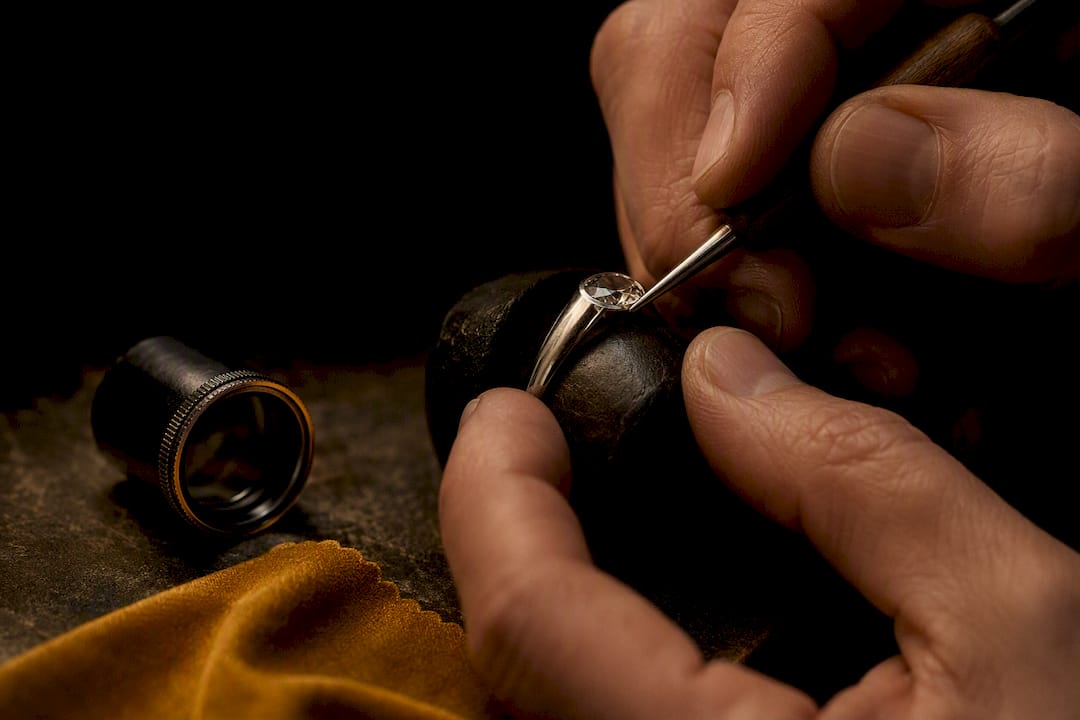
A flush setting, also called a gypsy setting or burnish setting, seats a gemstone directly into the metal so its table lies level with the band’s surface. There’s no rim standing above the metal, no claws reaching up to hold the stone. The jeweler cuts a recess to the exact shape of the stone, drops it in, and hammers the surrounding metal over the edge to lock it in place.
That’s different from a bezel, where a metal rim rises above the surface and wraps around the stone’s edge like a collar. It’s also different from prongs, which use raised claws to grip the stone from four or six points, lifting it above the band so light can hit it from every angle. Flush setting removes both the rim and the claws. The metal itself becomes the container.
We see a few common variations on this technique:
- Single flush center: one stone set into the band, often the whole design.
- Flush accents: small stones flush set along the shank, usually flanking a prong-set or bezel-set center stone.
- Multiple flush stones: a cluster or row of flush-set stones for a textured, all-metal look.
Designers now lean on flush setting as a “stealth-luxe” style, quiet on the outside but unmistakably fine jewelry up close, which is why it shows up in both traditional men’s bands and minimalist engagement rings.
Why Choose a Flush Setting Over Prongs or a Bezel?
Flush settings earn their reputation for a simple reason: there’s nothing above the metal to catch on a glove, a gym bag strap, or a car door. That makes them a favorite for people who work with their hands, whether that’s a surgeon scrubbing in, a mechanic under a hood, or a parent lifting a toddler ten times a day. The stone sits below the surface, so it’s harder to chip and impossible to snag.
The look matters just as much as the durability. Flush setting gives you a low-profile engagement ring or wedding band that reads as understated from across a room but reveals its detail the closer you look. Compare that to a traditional solitaire, which announces itself with height and visible prongs.
Flush setting isn’t the right call for every buyer, though. If your priority is maximum sparkle or you’re set on a large center stone, a raised setting captures more light from more angles. Flush stones, by nature, get less light entry from the sides.
- Best fit: everyday wear, active lifestyles, minimalist taste, smaller to mid-size stones.
- Less ideal: statement solitaires, maximum brilliance, very large center stones that need airflow underneath to perform.
Pro Tip: If you love the flush look but still want a strong sparkle moment, ask your jeweler about a flush center paired with a halo of tiny flush accents. You keep the snag-free profile while adding visual weight around the stone.
How Is a Flush Setting Made?
This is where a flush setting either becomes a lifetime piece or a liability, and the difference comes down to bench technique, not luck.
- Bore the seat. The setter drills a recess into the metal using a 156C or 45-degree undercutting bur, sized to match the stone’s diameter and depth.
- Cut the bearing ledge. A bearing burr carves a small ledge inside the seat that the stone’s girdle will rest on, so the table sits flush with the surface once seated.
- Check the fit. The seat is cut to a press-fit tolerance, tight enough that the stone needs only minimal metal movement to lock in. An oversized seat forces the setter to hammer more metal over the girdle than necessary, which is one of the most common causes of bench damage during flush setting.
- Seat the stone. The stone drops into the recess table down, or table up depending on the design, and gets checked for level before any hammering begins.
- Burnish the rim. Using a polished steel punch, chasing hammer, and soft pushers, the setter works the metal over the stone’s edge in small, even passes until the rim fully covers the girdle.
The full bench process demands patience: rushing the burnishing step, or trying to close the metal in one heavy strike instead of several light ones, is exactly how stones crack.
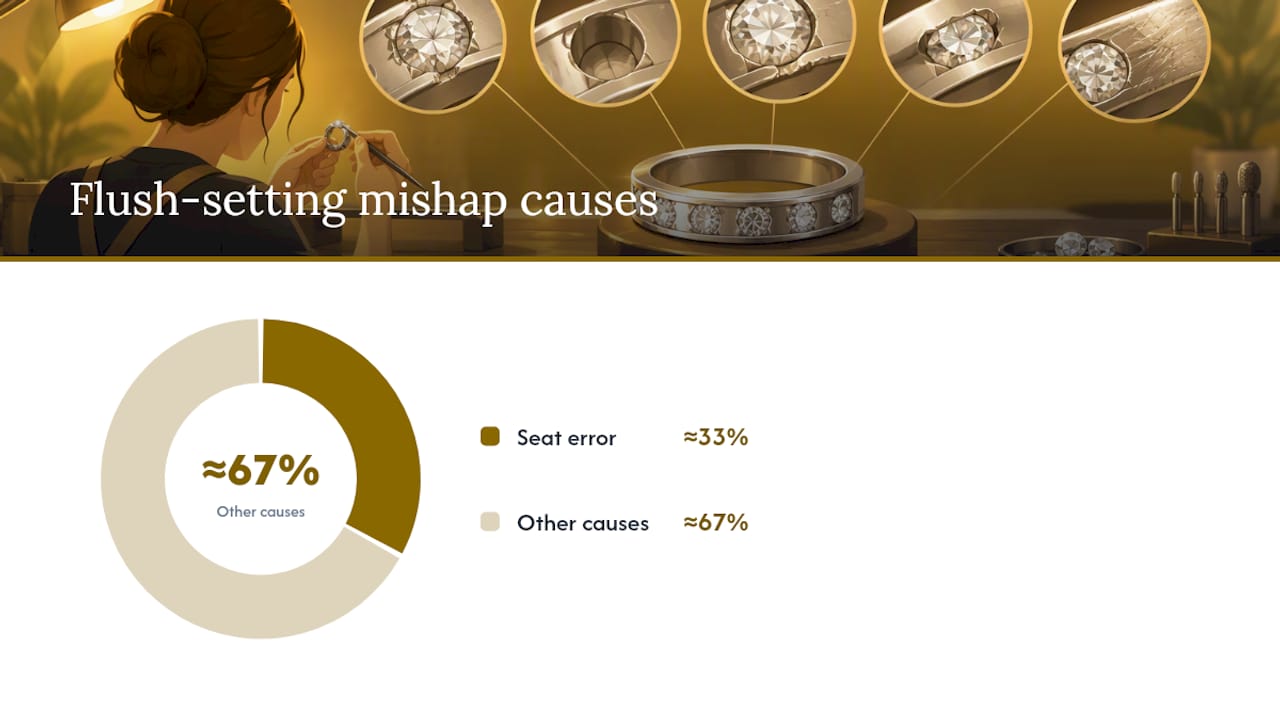
After setting, a competent bench checks the work under a 10x loupe for feathering or hairline cracks, confirms the rim is even all the way around, and runs a light tap and push test to confirm the stone won’t shift. Roughly a third of flush-setting mishaps trace back to an oversized or unevenly cut seat, according to bench guidance from Ganoksin’s trade community, not the stone itself or the metal choice.
Which Stones and Metals Actually Hold Up in a Flush Setting?
Not every gem belongs in a flush setting, and the reason has nothing to do with color or brilliance. It’s about how the stone tolerates pressure.
Diamond, moissanite, sapphire, and ruby are the standard choices because they’re hard enough to survive the hammering and burnishing that locks the metal over the girdle. Softer or more fragile gems, like opal, emerald, or tanzanite, are poor candidates. Their internal structure is more prone to fracturing under the same pressure that a diamond shrugs off.
Girdle thickness matters as much as the stone type. A thick to slightly thick girdle gives the setter margin for error and distributes the burnishing force evenly. A thin or bruised girdle is a known failure point: stones with damaged or overly thin girdles are more likely to chip or split the moment metal is worked over them. If you’re supplying your own stone, ask for the girdle thickness before you commit to a flush design. If you’re comparing cuts, our diamond shapes guide breaks down how girdle and facet structure affect both sparkle and setting safety, and it’s worth a look before you settle on a stone.
Metal choice carries its own trade-offs:
- Platinum work hardens as it’s hammered, which means it grips the burnished rim more securely over time. It’s the most forgiving metal for this technique.
- 14K gold is a practical, durable middle ground for everyday flush-set pieces.
- 18K gold looks richer but runs softer, so it can wear down at the rim faster under heavy daily use.
- Sterling silver is generally avoided for flush settings meant for daily wear. It’s too soft to hold a burnished edge under repeated stress.
Pro Tip: Ask to see the girdle measurement in millimeters, not just a verbal “it’s thick enough.” A reputable setter will have that number on hand before they touch a bur to metal.
How Wide Should the Band Be for a Flush Stone?
Band width isn’t a style choice with flush setting. It’s structural.
Most single flush centers run between 0.20 and 1.00 carat, and the band has to carry enough metal thickness to bore a seat without compromising the shank’s strength. As a baseline, designers recommend at least 2mm of width for small flush accents, and 4mm or wider for larger center stones, scaling up as the carat weight climbs.
- Small accents (under 0.10 ct): 2mm minimum band width.
- Mid-size centers (0.20 to 0.50 ct): 4 to 5mm width typically required.
- Larger centers (0.50 ct and up): 6 to 8mm or a custom-thickness band, depending on the stone’s diameter and depth.
If your heart is set on a stone bigger than what a standard band can safely house flush, ask your jeweler about a custom wider or thicker shank, or consider a hybrid design where the center sits in a low bezel while accent stones stay flush along the band. There’s no shame in adjusting the plan. A ring that’s structurally sound will always outlast one that was forced into a size it couldn’t support.
Flush vs. Bezel vs. Prong: Which Setting Fits Your Life?
Every setting style makes a different trade between sparkle, safety, and upkeep, and the right one depends on what you actually do with your hands all day.
Prong settings lift the stone highest, which maximizes light entry and makes the stone look larger than its actual carat weight. They also snag the most and need periodic prong tightening. Bezel settings offer a middle ground: the stone sits protected inside a metal rim, slightly raised, with moderate sparkle and moderate snag risk. Flush settings sit lowest of the three, with the least light entry and the smallest apparent size, but the lowest snag risk and the least maintenance of the group.
- Sparkle ranking: prong > bezel > flush.
- Snag risk ranking: prong > bezel > flush (flush wins here).
- Stacking: flush bands are usually the easiest to stack flat against a wedding band, since there’s no raised rim or prong to interfere with a flush fit against a second ring.
If you’re planning to stack rings, bring both to your jeweler and test the fit in person before ordering. Small width mismatches show up fast once two bands sit side by side.
What Does It Take to Care for a Flush-Set Ring?
Flush settings are low-maintenance by design, but “low” doesn’t mean “none.” A soft brush and mild soap once a week keeps the seat clear of buildup, and an annual bench inspection catches wear before it becomes a repair.
Common repairs include re-burnishing a rim that’s worn thin, recutting a seat if the original tolerance loosens, or replacing a stone that’s chipped from years of impact. Each of these is routine work for an experienced setter, though re-burnishing carries some risk to the stone if it’s done too aggressively.
Resizing deserves special attention. Rings with multiple flush stones or deep seats are harder to resize because the band often has to be cut and the seats re-established to exact tolerances, which risks stone movement. Ask about resizing limits before you buy, not after.
Pro Tip: If you expect your ring size to change, over pregnancy, weight fluctuation, or growing joints, ask your jeweler how many resizes a flush design can safely handle before you commit to the setting.
What Should You Ask Before Trusting a Jeweler With a Flush Setting?
Flush setting rewards skill and punishes shortcuts, which is exactly why it’s more common among custom jewelers than mass-market retail chains. The technique demands stone evaluation and steady bench hands that assembly-line production doesn’t always prioritize.
Some jewelers build reputations on family ownership, in-house manufacturing, ethically sourced diamonds, lifetime upgrade programs, and customer reviews.
Before you commit to any jeweler for a flush-set piece, ask direct questions: How do they check girdle thickness before setting? What seat tolerance do they cut to? Do they perform a tap or push test after burnishing? What’s their resizing policy for flush designs? A jeweler who can’t answer clearly, or who has no before-and-after photos of past flush work, is a signal to keep looking.
— Joseph
Ready to Design Your Own Flush-Set Ring?
Once you know the technique, the real question becomes execution, and that’s where an in-house bench makes the difference between a ring that lasts and one that doesn’t. Some jewelers manufacture custom pieces in-house rather than outsourcing to third parties, enabling the same team to evaluate the stone’s girdle, cut the seat, and perform burnishing, reducing handoffs where quality control might slip.
If you already have a stone in mind, start with our certified loose diamonds selection, where girdle and cut details are listed so you can confirm compatibility before committing to a flush design. If you’re building from scratch, our Design Your Own Diamond Ring tool lets you submit stone specs and metal preference for a custom mockup before anything touches metal. Prefer to browse finished styles first? Our engagement rings collection includes ready-to-ship options starting from $346. Either way, request a bench consult and let us confirm your stone’s girdle and your metal choice can handle the setting you want, before you spend a dollar on the wrong combination.
Where to Learn More About Flush Setting Technique
For readers who want the bench-level detail behind everything covered here, the Ganoksin flush mount setting guide walks through the full tool list and process from a working jeweler’s perspective. It’s a solid next stop if you want to go deeper on technique before your next fitting.
Sources
- Flush Mount Diamond Setting – Ganoksin Jewelry Making Community
- Flush Setting Lab Grown Diamond: Avoid Cracking the Stone | Wentworth Diamonds
- Flush / Gypsy Setting: Indestructible Diamond Rings – Vanhess
FAQ
What Is a Flush Setting in a Ring?
A flush setting seats a gemstone into a precision-cut recess so its table sits level with the metal surface, with no prongs or raised rim. It’s also called a gypsy setting or burnish setting, and it’s prized for being snag-free and durable for daily wear.
What Is the Difference Between a Bezel Setting and a Flush Setting?
A bezel setting uses a metal rim that rises above the surface and wraps around the stone’s edge, while a flush setting sinks the stone below the surface with no rim standing above the metal. Bezels offer moderate sparkle and moderate snag risk; flush settings sacrifice some sparkle for the lowest snag risk of any common setting style.
What Does “Flush” Mean for a Ring?
“Flush” describes a stone that sits level, or flush, with the surrounding metal rather than raised above it on prongs. The term comes from the setting technique itself, where the metal is burnished directly over the stone’s girdle to hold it in place.
Can a Flush-Set Stone Crack During Setting?
Yes, cracking is the primary risk of flush setting, and it usually happens when a stone has a thin or bruised girdle, or when the seat was cut too large and required excessive hammering. Stones with thick, undamaged girdles set by an experienced bench rarely have this problem.
Who Should Choose a Flush Setting Ring?
Flush setting suits anyone who wants a durable, low-profile ring for daily wear, especially people with active hands or hands-on jobs. It’s less ideal for buyers chasing maximum sparkle or planning a very large center stone, since raised settings let in more light from the sides.
Recommended
- Ring Guide: Engagement Settings & Styles
- Pick Ring Setting Style Guide for Every Buyer
- Settings Guide: Prong, Bezel & Channel
- Cathedral Ring Setting: What It Is and How to Choose One

Deep Mehta is the Co-Owner of USA Jewels, a family-owned jewelry business she has led since 2013 in Deerfield Beach, Florida. With over 13 years of hands-on experience in fine jewelry retail, manufacturing, and diamond importing, Deep specializes in engagement rings, wedding bands, and custom jewelry design. She also co-manages Kaash Group Talent Acquisition. Deep is a University of Florida graduate and oversees every aspect of USA Jewels’ operations, from product development to marketing.
Fine Jewelry Collection

You May Also Like
Tennis Bracelet Costs: What 2–3 Carats Buy and How to Save 40–70%
Cut First, Then Color vs Clarity for Engagement Rings