Kimberley Process Diamonds: What the Certificate Means
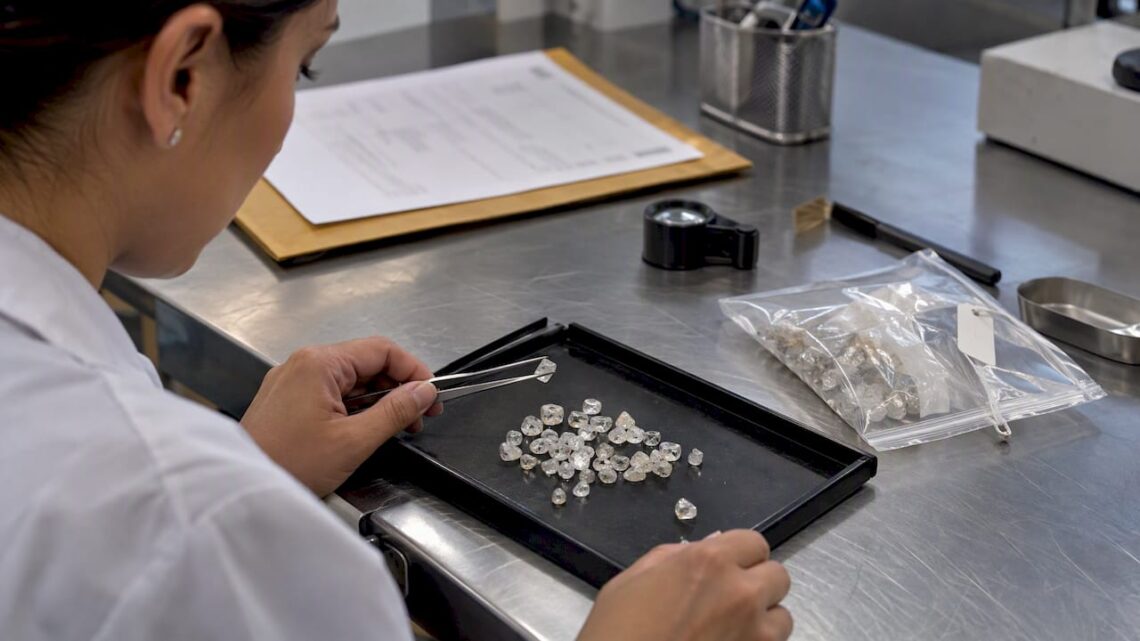
The Kimberley Process is an international system, created in 2003, that tracks rough diamonds from the mine to export so that stones funding rebel wars stay out of the legal trade. A Kimberley Process certificate covers a sealed shipment of rough diamonds. It does not cover the polished diamond in a ring, and it says nothing about working conditions or how a stone was mined. If you are shopping for a diamond, the certificate is a floor, not the finish line. Below we explain what it does, where it stops, and what to ask a jeweler.
TL;DR
- The Kimberley Process (KP) is a government, industry and civil society program that certifies rough diamond shipments as free of rebel financing.
- Its definition of a “conflict diamond” is narrow: it focuses on rebel movements fighting legitimate governments, not on other human rights or labor abuses.
- In the U.S., the Clean Diamond Trade Act bars importing or exporting rough diamonds that are not controlled through the scheme.
- Once a diamond is cut and polished, the KP certificate no longer travels with it. Your protection comes from your jeweler’s sourcing and paperwork.
- Ask for a grading report, a written sourcing statement and a clear return policy before you buy.
Table of Contents
- What is the Kimberley Process?
- What the Kimberley Process certifies, and what it doesn’t
- How certification works for rough diamonds in the United States
- Does the Kimberley Process actually work?
- What this means when you buy a diamond ring
- Natural, lab-grown and the Kimberley Process
- Our perspective: a certificate is where trust starts
- Shop with confidence at USA Jewels
- FAQ
- Sources
What is the Kimberley Process?
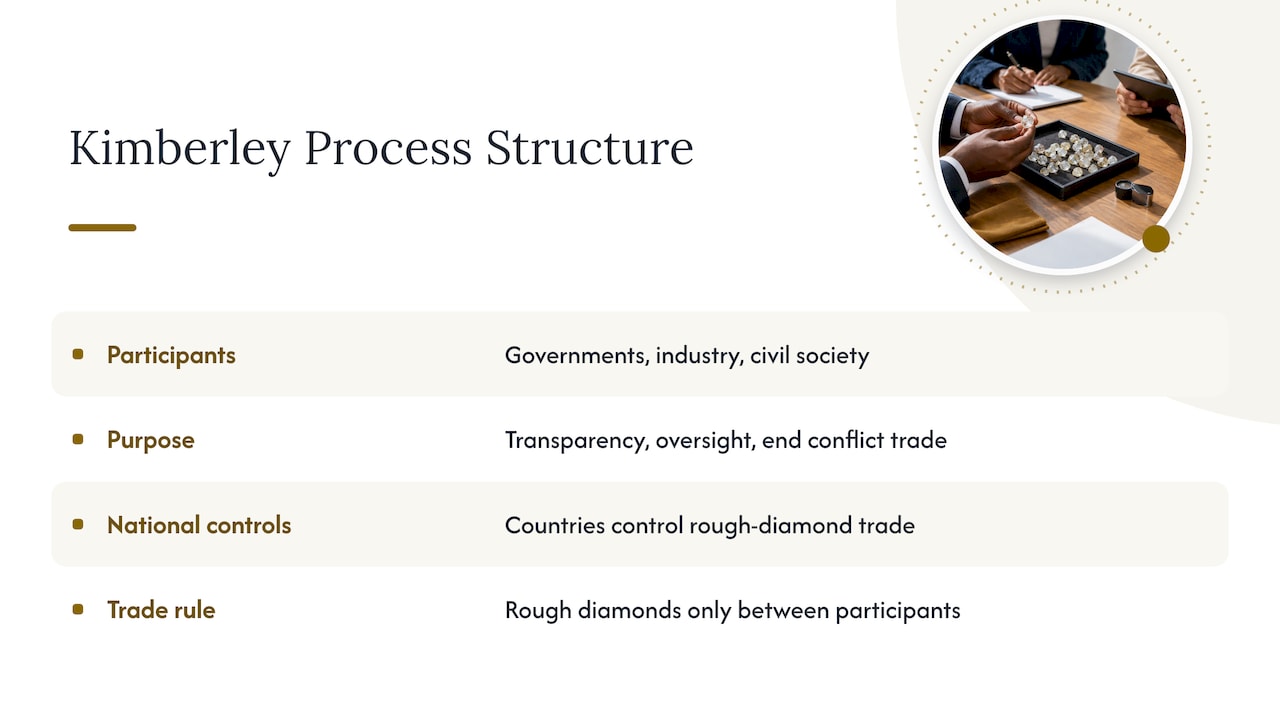
The Kimberley Process is a multi-stakeholder trade regime created in 2003 to increase transparency and oversight in the diamond supply chain and to eliminate trade in conflict diamonds. It began after wars in parts of Africa were financed by rough stones sold on the open market, which is where the term “blood diamonds” comes from.
The structure is tripartite. Governments, industry representatives and civil society organizations all take part. Countries that join agree to national controls on rough diamonds, and they only trade rough stones with other participants.
The process is still active. In 2026, India holds the chair, and the year’s intersessional meeting in Mumbai covered compliance, monitoring, artisanal production and consumer confidence. The chair rotates, so check the Kimberley Process site for the current one.
What the Kimberley Process certifies, and what it doesn’t
This is the part most shoppers get wrong, so it is worth being exact.
The Kimberley Process Certification Scheme (KPCS) applies to rough diamonds: unworked or simply sawn, cleaved or bruted stones under customs codes 7102.10, 7102.21 and 7102.31. A conflict diamond, in the scheme’s terms, is a rough diamond used by rebel movements or their allies to finance conflict aimed at undermining legitimate governments, as described in relevant United Nations Security Council resolutions.
A KP certificate tells you that a shipment of rough diamonds has not benefited rebel movements. That is its whole promise.
Here is what that means in practice:
| Question a buyer might ask | Does the KP certificate answer it? |
|---|---|
| Was this rough shipment kept out of rebel financing? | Yes, that is its purpose |
| Was the polished stone in my ring individually tracked? | No, the certificate covers rough shipments |
| Were miners paid fairly and kept safe? | No, it is outside the scheme’s definition |
| Which mine did my diamond come from? | Not on its own |
| Is this a lab-grown or natural stone? | Not relevant, since it covers mined rough |
The certificate is a government document for customs and trade, not a consumer label. A diamond you hold may have passed through several countries, cutters and traders after the rough stone was certified.
How certification works for rough diamonds in the United States
The U.S. enforces the scheme through the Clean Diamond Trade Act of 2003. Under it, the importation or exportation of any rough diamond is prohibited unless it is controlled through the KPCS. When Congress passed the law, it found that failing to curtail the conflict-diamond trade could provoke consumer backlash that would damage the economies of countries not involved in it.
The practical rules for shipments are specific:
- Each rough shipment entering or leaving the U.S. must travel with an original Kimberley Process Certificate.
- The shipment must be sealed in a tamper-resistant container, under OFAC regulations at 31 C.F.R. 592.301.
- U.S. export certificates may be issued by the U.S. Kimberley Process Authority or an entity it licenses, and the Department of State reviews the authority’s standards and procedures every year.
- The ultimate consignee of imported rough diamonds must keep the original certificate for at least five years from the date of importation.
Notice who these rules bind: importers, exporters and consignees of rough stones. A shopper buying a finished ring from a store never receives a KP certificate, and a seller who says otherwise is describing the paperwork loosely.
Does the Kimberley Process actually work?
Readers ask this a lot, and the honest answer has two sides.
What it achieved. The scheme created a shared legal framework and made participating governments account for rough diamond exports. It has grown to 60 members as of November 2024, and that year it delivered a proof of concept for moving from paper certificates to blockchain-based ones. It is often cited that 99.8% of diamonds traded in participating states are conflict-free, though the same legal review argues that the scheme’s vague standards and weak enforcement cannot support that number.
Where critics say it falls short.
- A narrow definition. The scheme’s definition focuses on rebel financing. Critics argue it leaves out violence by state forces and other abuses, a point made in the Hofstra Law Review.
- Hard-to-trace stones. The U.S. Government Accountability Office noted early on that diamonds are high-value, easily concealed and virtually untraceable once mixed, which makes any certification scheme hard to run.
- Origin gaps. The GAO also observed that the scheme as first proposed lacked ways to verify country of origin once diamonds were mixed or processed, so stones could enter legitimate channels through intermediary countries.
- Self-regulation downstream. After rough diamonds reach a foreign port and until sale, the GAO described monitoring and enforcement as voluntary and self-regulated by industry.
Those GAO findings are from 2002, when the scheme was being designed, so read them as the history of its known weak points, not as a current audit. The KP itself keeps reviewing its framework through an Ad Hoc Committee on Review and Reform, which looks at governance, compliance and new challenges.
Our read: the Kimberley Process is a real and useful baseline that keeps the worst financing of war out of the legal trade. It was never designed to be a full ethical guarantee, and nobody should treat it as one.
What this means when you buy a diamond ring
A jeweler who says “all our diamonds are Kimberley Process compliant” is telling you the minimum. It is a fair thing to hear, but you can ask for more. Here are questions that get real answers:
- Can you put your sourcing policy in writing? A trustworthy seller can explain where its stones come from and which suppliers it works with.
- Is there an independent grading report? A lab report describes the stone itself: carat, cut, color, clarity. Our diamond certification guide compares GIA, AGS and IGI reports so you know what each tells you.
- Can you trace the stone’s path? Provenance is a spectrum, from a country of origin to a mine-to-finger record. We explain the levels in what diamond provenance means for your purchase.
- What happens if I change my mind? A clear return window and insured shipping tell you a lot about a seller.
- Is the jeweler itself vetted? Our guide to choosing a certified ethical diamond jeweler lists what to look for.
If you want a purchase you can verify more directly, there are several routes, and we lay out three in our guide to ethical engagement rings.
Natural, lab-grown and the Kimberley Process
Because the scheme covers mined rough diamonds, it does not apply to lab-grown stones at all. That is not a loophole, it is simply a different supply chain. A lab-grown diamond is made in a controlled facility, so the question of rebel-financed mining does not arise, though energy use and the seller’s honesty about the stone’s origin still matter.
If you are weighing the two, our conflict-free versus lab-grown buyer’s guide goes through price, resale, appearance and ethics side by side. For how lab stones are made, see how lab-grown diamonds are ethically produced.
There is also a third path for buyers who care most about sourcing: skipping diamonds as the center stone. Colored stones and other gems can be striking and are often more affordable. Our piece on gemstone alternatives to diamonds for rings is a good place to start.
Our perspective: a certificate is where trust starts
We have been a family business since 1999, and we make our jewelry in-house. That shapes how we think about this topic.
When couples come to us, many have read about the Kimberley Process and feel uneasy. They have heard it is a perfect safeguard, then heard it is useless. We think neither is fair. The scheme is a legal baseline for rough diamonds. It does not follow a stone through the cutter’s hands, and it does not promise anything about how a stone was mined. We would rather say that plainly than sell you a comforting slogan.
So here is how we approach it. We offer certified, ethically sourced loose diamonds, natural and lab-grown, and we keep our model direct, with no middlemen between our workshop and you. We believe the best way to earn trust is to let you check things: a grading report you can read, solid (not hollow or plated) construction you can inspect, free insured shipping, a 30-day money-back guarantee, and a lifetime diamond upgrade program for when your life and budget change.
If a jeweler can’t explain its sourcing in plain words, keep looking. If it can, you are in good hands. A ring is meant to tell your story, and the story should be one you can feel good about.
— Joseph
Shop with confidence at USA Jewels
If you are ready to look at stones, our certified loose diamonds start from $142, with both natural and lab-grown options. You can compare shapes, qualities and metals, then pair a stone with a setting.
Prefer to start from the ring? Browse our engagement rings, which start from $346, or build your own with our design-your-own tools, where a diamond ring starts from $399. We can walk you through the choices at every step.
FAQ
Do they still mine diamonds in Kimberley?
The process is named after the city of Kimberley, South Africa, where the founding talks took place in 2000, not after a current mining region. Diamonds are mined in many countries, and each participant controls its own rough exports under the scheme. Check the Kimberley Process site for the current list of participants and production statistics.
Is a Kimberley Process certificate the same as a GIA or IGI report?
No. A KP certificate covers a shipment of rough diamonds for customs and trade purposes. A GIA, AGS or IGI report grades one finished stone on carat, cut, color and clarity. They answer different questions, and a careful buyer wants a grading report plus a clear sourcing statement.
Are Kimberley Process diamonds completely conflict-free?
Not in the broad sense many people mean. The scheme certifies that rough shipments did not finance rebel movements, but its definition is narrow and critics point to gaps in traceability and enforcement. That is why we suggest asking your jeweler about sourcing beyond the certificate.
Do lab-grown diamonds need Kimberley Process certification?
No, because the scheme covers mined rough diamonds. Lab-grown stones come from a different supply chain. A reputable seller will still label them clearly and provide a grading report.
Sources
- Conflict Diamonds and the Kimberley Process, U.S. Department of State
- What Is The Kimberley Process?, Kimberley Process
- Clean Diamond Trade Act findings, U.S. Department of State
- Kimberley Diamonds Process Certification, U.S. Customs and Border Protection
- Importation Requirements under the Kimberley Process, U.S. Customs and Border Protection
- 31 CFR 592.301, eCFR
- GAO-02-678, International Trade: Critical Issues Remain
- GAO-02-425T, International Trade: Significant Challenges
- Ad Hoc Committee for Review and Reforms, Kimberley Process
- UAE Concludes Kimberley Process Plenary in Dubai, Kimberley Process
- India Begins Kimberley Process Intersessional Meeting 2026, Diamond World
- Failure of the Kimberley Process, Hofstra Law Review
Recommended
- Diamond Certification Guide: GIA vs AGS vs IGI Compared
- How to Choose a Certified Ethical Diamond Jeweler
- Why Diamond Certifications Differ Globally: 2026 Guide
- What Does Diamond Provenance Mean for Your Purchase?

Deep Mehta is the Co-Owner of USA Jewels, a family-owned jewelry business she has led since 2013 in Deerfield Beach, Florida. With over 13 years of hands-on experience in fine jewelry retail, manufacturing, and diamond importing, Deep specializes in engagement rings, wedding bands, and custom jewelry design. She also co-manages Kaash Group Talent Acquisition. Deep is a University of Florida graduate and oversees every aspect of USA Jewels’ operations, from product development to marketing.
Fine Jewelry Collection

You May Also Like

The Best Push Present Jewelry Ideas for New Moms

Diamond Carat Weight: What It Means and Why It Matters