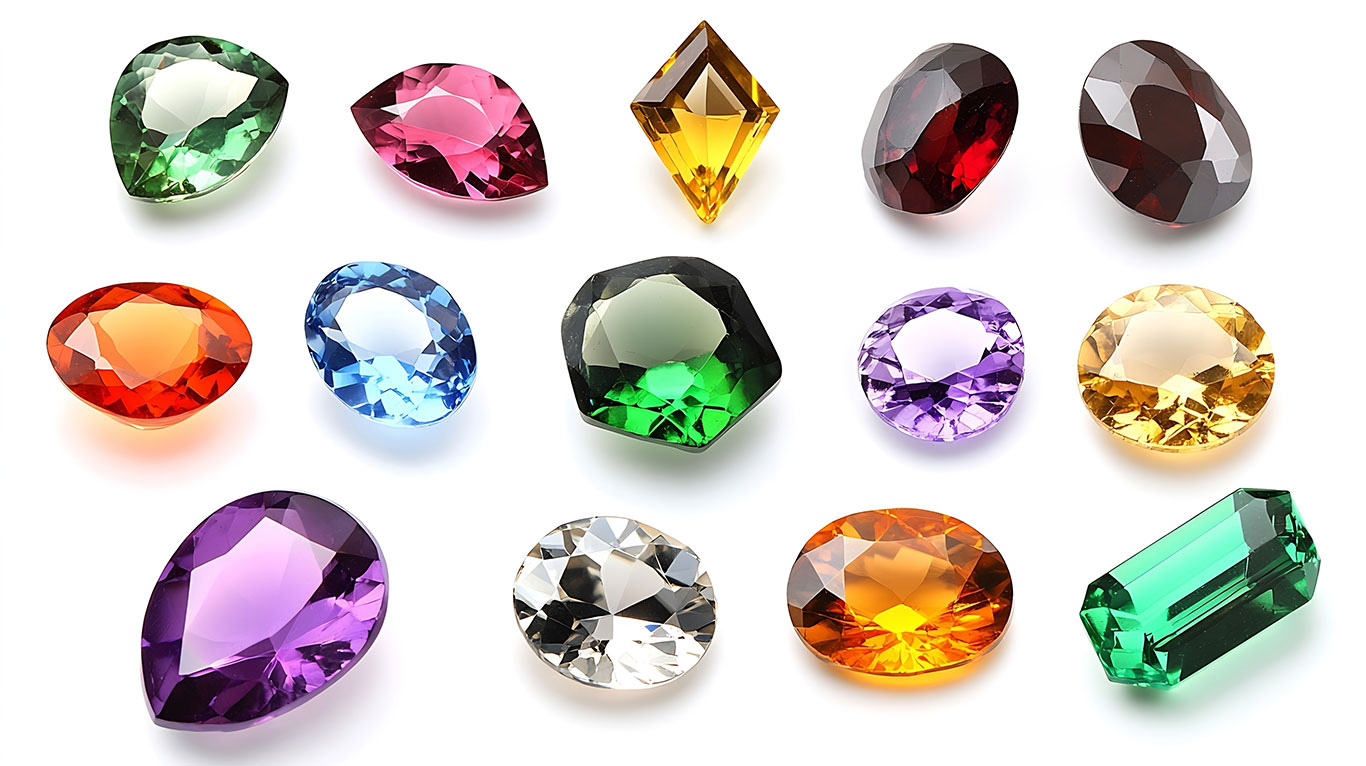
Quartz
| Property | Details |
|---|
| Mineral | Quartz (silicon dioxide) |
| Mohs Hardness | 7 |
| Refractive Index | 1.544 – 1.553 |
| Birthstone | Varieties: February (amethyst), November (citrine) |
| Major Sources | Brazil, Madagascar, USA, Zambia, India |
| Treatments | Heat, irradiation (common for many varieties) |
Overview
Quartz is the second most abundant mineral in Earth’s crust and one of the most diverse gemstone families. While amethyst and citrine are the best-known quartz varieties (each with their own guide on our site), the quartz family encompasses dozens of beautiful gemstones in virtually every color. From the romantic blush of rose quartz to the mysterious depths of smoky quartz, this family offers something for every taste and budget.
Varieties
Rose quartz: Soft pink, translucent to opaque. The stone of unconditional love. Usually cabochon-cut; transparent faceted specimens are rare and valuable. Smoky quartz: Light brown to nearly black. Elegant, understated, and increasingly popular in modern jewelry. Rutilated quartz: Transparent quartz shot through with golden, copper, or silver needle-like inclusions of rutile. Each stone is unique. Prasiolite (green amethyst): Pale green quartz, usually produced by heating amethyst. Rock crystal: Colorless, transparent quartz—used in jewelry and decorative arts for millennia. Milky quartz: White, translucent quartz. Tiger’s eye: Golden-brown with chatoyant bands, a form of fibrous quartz. Aventurine: Green quartz with sparkling inclusions of fuchsite mica.
Quality & Value Factors
Value varies enormously across quartz varieties. Star rose quartz with a sharp, well-defined six-rayed star is the most valuable. Transparent, deeply saturated rose quartz commands a premium over common translucent material. For rutilated quartz, evenly distributed, well-defined golden needles in clear quartz are most desirable. Smoky quartz should be medium brown—too dark appears nearly black and lifeless, while too light lacks character. Overall, quartz offers exceptional value: large, eye-clean gemstones in beautiful colors at a fraction of the cost of rarer stones.
Care & Cleaning
Quartz ranks 7 on the Mohs scale, making it durable enough for most jewelry. Clean with warm soapy water and a soft brush. Ultrasonic cleaners are generally safe for solid quartz varieties but should be avoided for included varieties (rutilated quartz) and dyed or treated material. Important: Amethyst, citrine, and rose quartz can fade with prolonged exposure to direct sunlight or intense heat. Store colored quartz away from windows and remove before extended sun exposure.
Frequently Asked Questions
What are the most popular quartz gemstone varieties?
The most popular quartz varieties in jewelry are amethyst (purple), citrine (golden), rose quartz (pink), smoky quartz (brown), and rutilated quartz (clear with golden needle inclusions). Tiger's eye (golden-brown with chatoyancy) and aventurine (green with sparkle) are also widely used. Amethyst and citrine are the best-known and each have their own dedicated guides on our education pages. The quartz family offers beautiful gemstones at every price point.
Is rose quartz valuable?
Common rose quartz is quite affordable, making it accessible for everyone. However, transparent, facet-quality rose quartz with strong, even color is genuinely rare and can command significant prices. Star rose quartz that displays a sharp, well-defined six-rayed star is the most valuable variety. Rose quartz's association with love and romance has made it extremely popular in both fine jewelry and fashion accessories. Its gentle pink color complements rose gold beautifully.
What is rutilated quartz?
Rutilated quartz is transparent quartz that contains needle-like inclusions of the mineral rutile. These inclusions can be golden, copper-colored, silver, or rarely green or red. Each stone is unique because the rutile needles form in different patterns and densities. The most prized rutilated quartz has evenly distributed, well-defined golden needles in clear quartz. Rutilated quartz has been used in jewelry since ancient times and is sometimes called Venus hair stone or angel hair quartz.
Does quartz fade in sunlight?
Some quartz varieties can fade with prolonged exposure to direct sunlight or intense heat. Amethyst, citrine, rose quartz, and smoky quartz are all susceptible to fading because their colors are caused by iron impurities in radiation-sensitive oxidation states. The fading is gradual and requires extended exposure, not brief everyday wear. To protect colored quartz, store jewelry away from windows, avoid leaving it on car dashboards, and remove before extended outdoor sun exposure.
Is quartz durable enough for rings?
At 7 on the Mohs hardness scale, quartz is durable enough for most ring styles and can handle regular wear with reasonable care. It is harder than glass and most common materials encountered daily. However, quartz is softer than sapphire (9), topaz (8), and diamond (10), so it can accumulate fine scratches over many years of daily ring wear. For maximum longevity, choose a protective setting and remove quartz rings during heavy physical activities. Quartz earrings and pendants face virtually no durability concerns.
Specialty & Collector Gemstones