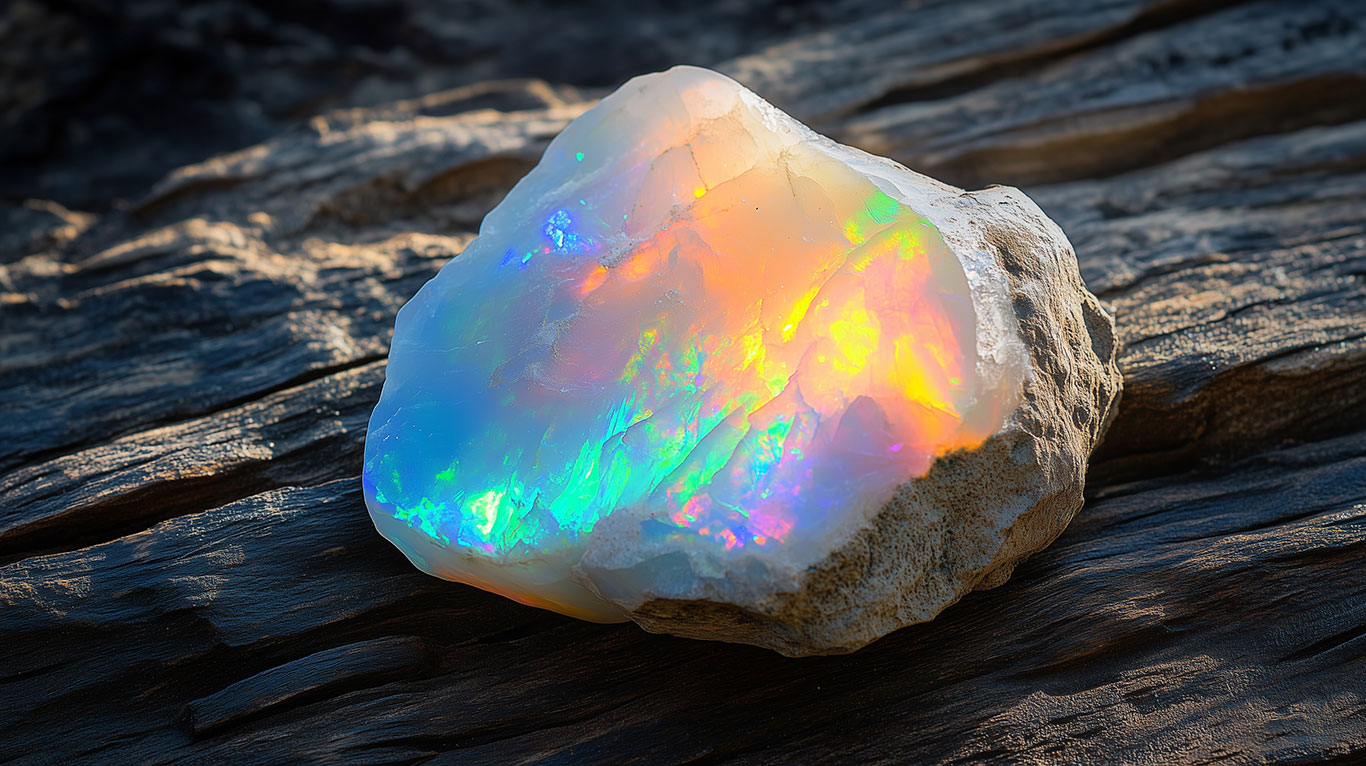
Opal and diamond could not be more different. Diamond dazzles with precise, predictable brilliance born of crystalline carbon and mathematical geometry. Opal captivates with an unpredictable, ethereal play of color that shifts and dances like a living kaleidoscope. If you are choosing between these two stones, you are really choosing between two fundamentally different philosophies of beauty.
This guide provides an honest comparison of opal and diamond, covering their optical properties, durability, pricing, and practical considerations for different types of jewelry. Understanding these differences will help you choose the right stone for your specific needs.
What Is Opal?
Opal is not a crystalline mineral like diamond but rather an amorphous (non-crystalline) form of hydrated silicon dioxide. Its internal structure consists of microscopic spheres of silica arranged in a grid-like pattern. When these spheres are uniform in size and regularly arranged, they diffract light and produce opal's famous play of color — flashes of spectral color that shift and move as the stone is turned.
The most valued opals are black opals from Lightning Ridge, Australia, which display vivid play of color against a dark body tone. White opals from Coober Pedy, Australia, show play of color against a light or translucent body. Boulder opals feature thin seams of opal naturally attached to their ironstone host rock. Ethiopia has emerged as an important source of hydrophane opals with vivid color play.
Unlike virtually every other gemstone, opal contains water — typically 3% to 21% by weight. This water content is fundamental to opal's structure and properties but also makes it vulnerable to dehydration, which can cause cracking (known as "crazing"). This unique composition is one of the key factors to consider when comparing opal to diamond, which is one of the most chemically stable substances on Earth.
Side-by-Side Comparison
| Property |
Diamond |
Opal |
| Composition | Pure carbon (C) | Hydrated silicon dioxide (SiO₂·nH₂O) |
| Hardness (Mohs) | 10 | 5.5 – 6.5 |
| Refractive Index | 2.42 | 1.37 – 1.47 |
| Fire (Dispersion) | 0.044 | N/A (play of color) |
| Color Range | Colorless to light yellow/brown | All colors (play of color) |
| Price (1ct) | $5,000 – $8,000 (natural) | $50 – $3,000 (fine black opal higher) |
| Birthstone | April | October |
| Resale Value | Moderate to good (natural); Limited (lab) | Limited |
| Common Treatments | Laser drilling, fracture filling (uncommon) | Stabilization, smoking, sugar/acid treatment |
| Best For | Engagement rings, all jewelry, heirloom | Pendants, earrings, collector pieces |
Color Comparison
Opal's play of color is unlike anything else in the gemstone world. Rather than displaying a single body color like sapphire or ruby, opal produces shifting patches and flashes of spectral color — red, orange, green, blue, violet — that move and change with every slight shift in viewing angle or lighting. This effect is not refraction or dispersion (as in diamond) but diffraction, a fundamentally different optical phenomenon.
The most valued play of color includes red and orange flashes against a dark body tone. A fine black opal from Lightning Ridge showing vivid, broad-flash red play of color is one of the most visually spectacular gemstones in existence and can command prices exceeding $10,000 per carat. Pattern also matters: "harlequin" (regular, blocky patches), "pinfire" (tiny dots), and "broadflash" (large sweeping areas) are among the recognized patterns.
Diamond's beauty is more structured and predictable. The cut quality determines how light is reflected and refracted, producing consistent brilliance and fire across the stone. Opal is inherently unpredictable and unique — no two opals display the same pattern. If you value uniqueness and surprise in your gemstone, opal offers an experience diamond cannot match.
Hardness and Durability
This is the single most important distinction between opal and diamond, and it strongly favors diamond. Opal scores only 5.5 to 6.5 on the Mohs hardness scale, making it softer than steel and vulnerable to scratching from many common materials. Diamond, at 10, is roughly 10 times harder in absolute terms than opal.
Beyond hardness, opal has several additional vulnerabilities that diamond does not share. Its water content makes it susceptible to dehydration and thermal shock. Rapid temperature changes (leaving the stone in a hot car, then bringing it into air conditioning) can cause "crazing" — a network of fine cracks within the stone. Opal should never be cleaned with ultrasonic or steam cleaners, exposed to chemicals, or stored in extremely dry environments.
For these reasons, opal is best suited for pendants, earrings, brooches, and collector display rather than rings worn daily. If you want opal in a ring, treat it as an occasional-wear piece, choose a protective bezel setting, and accept that the stone will need more careful handling than any crystalline gemstone. For engagement rings, diamond is overwhelmingly the more practical choice.
Price Comparison
| Size |
Opal |
Natural Diamond |
Lab Diamond |
| 0.5 ct | $25 – $500 | $1,500 – $3,000 | $400 – $700 |
| 1.0 ct | $50 – $3,000 | $5,000 – $8,000 | $800 – $1,500 |
| 1.5 ct | $100 – $5,000 | $8,000 – $15,000 | $1,200 – $2,500 |
| 2.0 ct | $200 – $8,000 | $15,000 – $30,000 | $2,000 – $4,000 |
Prices are approximate for good to fine quality stones. Diamond prices assume VS2 clarity, G color, Excellent cut.
Opal pricing spans an enormous range depending on type, body tone, color play, and pattern. Common white opals with weak play of color can be very inexpensive ($10–$50 per carat), while top-quality black opals from Lightning Ridge with vivid red-on-black play of color can exceed $10,000 per carat — rivaling fine diamonds in price.
At the mid-range, a nice 1-carat opal with good play of color and attractive pattern typically costs $200 to $1,000, which is well below comparable natural diamond pricing ($5,000–$8,000 per carat). Ethiopian opals have expanded the market with attractive, affordable material, though they tend to be more hydrophane (water-absorbing) and require extra care.
Lab-grown diamonds at $800–$1,500 per carat are more expensive than most opals but dramatically more durable. Synthetic opals exist (marketed as "Gilson" or "lab-created opal") and are very affordable, but they lack the character and value of natural opal. If you want opal, we recommend investing in a quality natural stone from a reputable source.
Brilliance and Sparkle
Diamond and opal produce beauty through fundamentally different optical mechanisms. Diamond's brilliance comes from refraction and total internal reflection — light enters the stone, bounces around the faceted interior, and exits in concentrated flashes of white and colored light. This is engineered by the diamond cut to maximize visual impact.
Opal does not work this way at all. Its play of color is caused by diffraction — light bending around the microscopic silica spheres within the stone. The size of the spheres determines which colors are produced (smaller spheres produce blue and violet; larger spheres produce red and orange). The arrangement of the spheres determines the pattern. There is no faceting involved; opals are typically cut as cabochons (smooth, domed shapes) to best display their color play.
Comparing opal's "sparkle" to diamond's is like comparing a sunset to a spotlight — both are beautiful, but they are different categories of beauty. Diamond is precise, geometric, and repeatable. Opal is organic, unpredictable, and unique. If you want classic jewelry sparkle, diamond is the answer. If you want a one-of-a-kind light show that changes every time you look at it, opal offers something truly special.
When to Choose Opal Over Diamond
Opal may be the better choice if any of the following resonate with you:
- You want a one-of-a-kind gemstone — no two opals display the same play of color pattern
- You are looking for a pendant, earrings, or collector piece rather than a daily-wear ring
- You appreciate the mesmerizing, shifting play of color that no other gemstone can produce
- You want a meaningful gift for an October birthday
- You are willing to provide the extra care that opal requires (avoiding heat, chemicals, and impacts)
- You value uniqueness and artistry over standardized grading and precision-cut brilliance
When to Choose Diamond Over Opal
Diamond may be the better choice if any of the following are important to you:
- You need a stone for daily wear, especially an engagement ring, that can handle years of constant use
- Maintenance-free durability is essential — you do not want to worry about heat, chemicals, or dehydration
- You prefer precise, consistent brilliance and fire over organic, shifting play of color
- Long-term resale value and heirloom potential are important considerations
- You want standardized grading (clarity, color, cut) for purchase confidence
- You want to design your own ring with a certified stone
Can You Use Opal in an Engagement Ring?
We strongly advise against using opal as the center stone in a daily-wear engagement ring. At 5.5–6.5 on the Mohs scale, opal is too soft for constant ring wear. It will scratch, and over time the surface will become dull and damaged. The water content makes it vulnerable to thermal shock and crazing. These are not minor concerns — opal is genuinely fragile compared to gemstones traditionally used in engagement rings.
If you love opal and want it in your engagement jewelry, consider these alternatives: use opal as accent stones in a diamond engagement ring halo; incorporate opal into a matching pendant or earring set to complement your diamond ring; or have an opal ring as a "dress ring" for special occasions alongside a more durable everyday engagement ring.
For engagement rings worn daily, diamond, sapphire, or ruby are the recommended choices. Browse our engagement ring collection for durable options that will last a lifetime.
Our Recommendation
Opal and diamond serve fundamentally different roles in a jewelry collection. Diamond is the practical, durable, versatile stone that works in every setting from engagement rings to everyday earrings. Opal is the artistic, unique showpiece that demands special care but rewards it with a visual experience no other gemstone can offer.
We recommend opal for pendants, earrings, brooches, and collector display where its extraordinary play of color can be enjoyed without the wear risks of daily ring use. For engagement rings and daily-wear jewelry, diamond is the clear winner. At USA Jewels, we carry a variety of gemstone earrings, gemstone pendants, and diamond engagement rings to suit every need.
Frequently Asked Questions
Is opal a good diamond alternative?
Opal is not a practical diamond alternative for engagement rings or daily-wear jewelry due to its low hardness (5.5–6.5 Mohs), water content, and vulnerability to thermal shock. However, opal is an excellent choice for pendants, earrings, and occasional-wear pieces where its extraordinary play of color can be showcased. Opal and diamond are best viewed as complementary gemstones for different types of jewelry rather than alternatives to each other.
How does opal compare to diamond in durability?
Opal is significantly less durable than diamond. It scores 5.5–6.5 on the Mohs scale (diamond is 10), contains water that makes it vulnerable to dehydration and thermal shock, and can craze (develop fine cracks) if exposed to rapid temperature changes or dry conditions. Diamond is the hardest natural substance and is chemically stable under virtually all conditions. For durability, diamond is overwhelmingly superior.
Can I use opal for an engagement ring?
We strongly advise against opal for a daily-wear engagement ring. Its low hardness means it will scratch from normal wear, and its water content makes it vulnerable to damage from heat, chemicals, and dry environments. If you love opal, consider it in a pendant or earrings alongside a more durable engagement ring, or use it as a special occasion ring rather than an everyday piece.
Does opal hold its value?
Most opals have limited resale value on the secondary market. The exception is top-quality black opal from Lightning Ridge, which has historically held value well and can appreciate, with exceptional pieces selling for thousands to tens of thousands per carat. White opals and Ethiopian opals generally have limited resale value. Opal should primarily be purchased for its beauty and personal enjoyment.
How can I tell opal from diamond?
Opal and diamond look completely different. Opal displays play of color (shifting spectral flashes) against a white, black, or translucent body, and is typically cut as a smooth cabochon. Diamond is faceted, colorless, and displays white brilliance with rainbow fire. The two stones have entirely different refractive indices, hardness, and physical properties. No one would confuse them visually, and any gemological test immediately distinguishes them.
Will opal crack or craze over time?
Some opals can develop crazing (fine internal cracks) over time, particularly if exposed to rapid temperature changes, very dry environments, or chemical exposure. This risk is highest with thin opals, Ethiopian hydrophane opals, and stones with high water content. Quality Australian opals that have been properly cured are generally stable. To minimize risk, store opal away from heat, avoid ultrasonic or steam cleaners, and keep the stone away from harsh chemicals.
Gemstone vs Diamond Comparisons