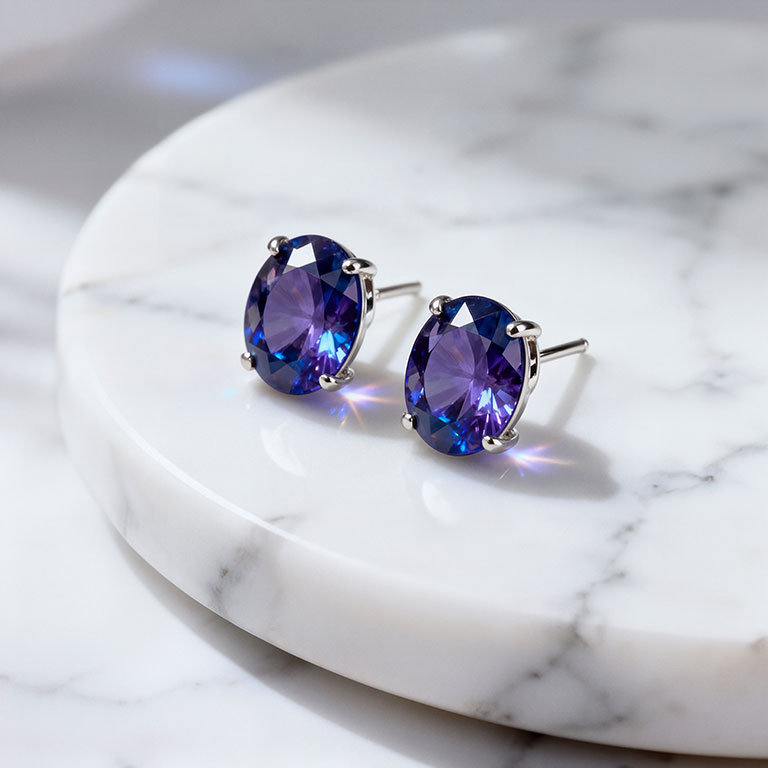
Tanzanite is one of the most captivating colored gemstones discovered in the modern era. Its unique blue-violet color, found nowhere else in the gemstone world, has made it a favorite for fine jewelry since its discovery in 1967. If you are considering tanzanite alongside diamond for your next jewelry piece, this comparison will help you understand how these two very different stones stack up.
While diamond and tanzanite occupy different tiers of durability and value, they each offer something unique. Diamond delivers unmatched hardness and brilliant sparkle, while tanzanite provides a mesmerizing color that shifts between blue and violet depending on the viewing angle and lighting.
What Is Tanzanite?
Tanzanite is the blue-violet variety of the mineral zoisite (calcium aluminum silicate). It was discovered in 1967 by Maasai herders in the Merelani Hills of northern Tanzania, near Mount Kilimanjaro, and named by Tiffany & Co., which recognized its gem potential and introduced it to the market. Tanzanite is found in only one location on Earth, making it roughly a thousand times rarer than diamond in terms of geographic occurrence.
What makes tanzanite unique among gemstones is its strong trichroism — it shows three different colors when viewed from different crystallographic directions: blue, violet, and burgundy/red. Most tanzanite is heat-treated to shift the color toward the preferred blue-violet range. This treatment is permanent, universal, and fully accepted in the trade.
Tanzanite's single-source origin has raised questions about long-term supply. The Merelani mines are expected to be depleted within the next few decades, which has contributed to interest in tanzanite as a collectible gemstone. However, supply predictions in the gem trade are notoriously unreliable, and new deposits within the tanzanite-bearing zone could extend production. Currently, fine tanzanite remains readily available in the market.
Side-by-Side Comparison
| Property |
Diamond |
Tanzanite |
| Composition | Pure carbon (C) | Calcium aluminum silicate / Zoisite |
| Hardness (Mohs) | 10 | 6 – 7 |
| Refractive Index | 2.42 | 1.691 – 1.700 |
| Fire (Dispersion) | 0.044 | 0.030 |
| Color Range | Colorless to light yellow/brown | Blue-violet to violet-blue |
| Price (1ct) | $5,000 – $8,000 (natural) | $300 – $3,000 |
| Birthstone | April | December |
| Resale Value | Moderate to good (natural); Limited (lab) | Limited to moderate |
| Common Treatments | Laser drilling, fracture filling (uncommon) | Heat treatment (virtually all) |
| Best For | Engagement rings, all jewelry, heirloom | Pendants, earrings, special occasion |
Color Comparison
Tanzanite's color is its signature feature and unlike anything else in the gemstone world. The finest tanzanite displays a vivid, saturated blue-violet that shifts between blue and violet as the stone is turned or as lighting changes. This color-change effect (pleochroism) adds visual interest and depth that static-colored gemstones cannot match.
The most valued tanzanite color is a vivid, medium-dark blue with strong violet overtones. Lighter stones appear more lavender, while very dark stones can appear almost inky. The best stones show a vibrant blue-violet in daylight and a more violet-purple hue under incandescent lighting. This makes tanzanite a dynamic, living stone that looks different in every setting.
Diamond, by contrast, is valued for being colorless in the traditional D–Z range. Fancy blue diamonds and fancy violet diamonds exist but are extraordinarily rare and expensive. A fine 1-carat fancy vivid blue diamond can cost well over $500,000. Tanzanite offers comparable blue-violet beauty at a tiny fraction of that price, making it the practical choice for anyone who wants blue-violet color in their jewelry.
Hardness and Durability
Durability is the most important consideration in the tanzanite-vs-diamond comparison, and it is where diamond has a clear advantage. Tanzanite scores only 6 to 7 on the Mohs hardness scale, which means it can be scratched by quartz (7 Mohs) — a common component of everyday dust. Diamond, at 10, is in a completely different league of hardness.
Tanzanite also has one direction of perfect cleavage, meaning it can potentially split along a specific crystal plane if struck at the right angle with sufficient force. This makes tanzanite more vulnerable to chipping from impacts than stones without cleavage, such as sapphire or ruby. Jewelers must take special care when setting tanzanite to avoid damaging the stone.
For these reasons, tanzanite is best suited for pendants, earrings, and occasional-wear rings rather than engagement rings worn daily. If you want tanzanite in a ring, choose a protective bezel setting and treat it as a special occasion piece rather than an everyday ring. For daily wear, diamond is the vastly superior choice.
Price Comparison
| Size |
Tanzanite |
Natural Diamond |
Lab Diamond |
| 0.5 ct | $100 – $800 | $1,500 – $3,000 | $400 – $700 |
| 1.0 ct | $300 – $3,000 | $5,000 – $8,000 | $800 – $1,500 |
| 1.5 ct | $600 – $5,000 | $8,000 – $15,000 | $1,200 – $2,500 |
| 2.0 ct | $1,000 – $8,000 | $15,000 – $30,000 | $2,000 – $4,000 |
Prices are approximate for good to fine quality stones. Diamond prices assume VS2 clarity, G color, Excellent cut.
Tanzanite offers excellent value compared to diamond, especially considering its rarity as a single-source gemstone. A fine 1-carat tanzanite with vivid blue-violet color costs $1,000 to $3,000, while a comparable natural diamond costs $5,000 to $8,000. The savings become even more significant at larger sizes.
Tanzanite pricing is primarily driven by color saturation and size. Vivid, intensely saturated stones command the highest prices, while lighter lavender stones are much more affordable. Stones over 5 carats with vivid color are rare and command premium per-carat prices. Unlike diamonds, tanzanite does not have standardized grading, so quality assessment relies more on visual evaluation and trust in your jeweler.
Lab-grown diamonds at $800–$1,500 per carat overlap with tanzanite pricing at mid-range quality levels. If you want a colorless stone with maximum brilliance, a lab diamond may be comparable in price to a fine tanzanite. But if you want tanzanite's unique blue-violet color, there is simply no substitute — no other natural gemstone produces this exact combination of hues.
Brilliance and Sparkle
Diamond and tanzanite sparkle differently, though tanzanite actually has respectable optical properties for a colored gemstone. Tanzanite's dispersion is 0.030 — higher than sapphire (0.018) and approaching diamond's 0.044. This gives tanzanite noticeable fire, though it is often masked by the stone's body color in darker specimens.
Diamond's higher refractive index (2.42 vs tanzanite's 1.69–1.70) gives it significantly more brilliance — the white light return that makes diamonds appear so lively and bright. Diamond also has a more dramatic critical angle, meaning more light is reflected back to the viewer rather than passing through the stone.
In practice, tanzanite's appeal is not about competing with diamond's brilliance but about its unique color behavior. The trichroic color play — shifting between blue, violet, and subtle burgundy tones as the stone moves — creates a visual dynamism that flat-colored stones and even diamonds cannot replicate. Each viewing reveals a slightly different character, which many collectors find deeply engaging.
When to Choose Tanzanite Over Diamond
Tanzanite may be the better choice if any of the following resonate with you:
- You want a unique blue-violet color that no other gemstone can replicate
- You are looking for a pendant, earrings, or special occasion ring rather than a daily-wear engagement ring
- You appreciate the rarity of a single-source gemstone found only in Tanzania
- You want a meaningful gift for a December birthday
- You love the idea of a stone that shifts color with lighting and viewing angle
- You want vivid blue-violet color at a fraction of what a fancy blue diamond would cost
When to Choose Diamond Over Tanzanite
Diamond may be the better choice if any of the following are important to you:
- You need a stone that can handle daily wear in an engagement ring without special care
- Maximum hardness and scratch resistance are essential for your lifestyle
- Brilliant white fire and scintillation are your top visual priorities
- Long-term resale value and heirloom durability matter to you
- Standardized grading (GIA cut, clarity, carat) are important for purchase confidence
- You want a stone that requires zero maintenance over a lifetime of wear
Can You Use Tanzanite in an Engagement Ring?
We generally do not recommend tanzanite for engagement rings that will be worn daily. At 6–7 on the Mohs scale with a direction of perfect cleavage, tanzanite is too soft and too vulnerable for the demands of everyday ring wear. It can be scratched by common household dust (quartz, 7 Mohs), and the cleavage makes it susceptible to chipping from knocks and impacts.
If you absolutely love tanzanite's color and want it in an engagement ring, consider a design that protects the stone: a bezel setting with a diamond halo, for example, provides physical protection while letting the tanzanite's color shine through. Treat the ring as a special occasion piece, removing it for physical work, exercise, and household tasks. Have a backup ring (a simple band) for active days.
A better approach might be to use tanzanite in your wedding pendant or earrings — pieces that receive far less wear than rings — and choose a diamond or sapphire for your engagement ring where durability matters most.
Our Recommendation
Tanzanite and diamond are best suited for different purposes. Diamond is the clear winner for engagement rings and daily-wear jewelry due to its unmatched hardness and durability. Tanzanite excels in pendants, earrings, and special occasion jewelry where its extraordinary blue-violet color can be showcased without the risks of heavy daily wear.
If you want tanzanite's unique color, consider incorporating it into your jewelry wardrobe alongside diamond pieces rather than choosing one over the other. At USA Jewels, we offer both tanzanite jewelry and diamond engagement rings, so you can enjoy the best of both worlds.
Frequently Asked Questions
Is tanzanite a good diamond alternative?
Tanzanite is an excellent colored gemstone for pendants, earrings, and special occasion rings, but it is not ideal as a diamond alternative for daily-wear engagement rings. Its Mohs hardness of 6–7 and perfect cleavage in one direction make it too vulnerable for constant wear. For jewelry that receives less wear, tanzanite offers stunning blue-violet color at a fraction of diamond prices.
How does tanzanite compare to diamond in durability?
Tanzanite is significantly less durable than diamond. It scores 6–7 on the Mohs scale (diamond is 10), can be scratched by common quartz dust, and has a direction of perfect cleavage that makes it vulnerable to chipping. Diamond has no cleavage concerns and is the hardest natural substance. For daily-wear rings, diamond is the vastly superior choice. Tanzanite is better suited for pendants and earrings.
Can I use tanzanite for an engagement ring?
While it is possible, we do not generally recommend tanzanite for daily-wear engagement rings due to its relatively low hardness (6–7 Mohs) and cleavage vulnerability. If you insist on tanzanite, use a protective bezel setting, remove the ring during physical activities, and consider it a special occasion piece. For daily wear, sapphire (9 Mohs) or diamond (10 Mohs) are much more practical choices.
Is tanzanite worth the investment?
Tanzanite's investment potential is debated. As a single-source gemstone with finite supply, some argue prices will increase as mines deplete. However, the resale market for tanzanite is less liquid than for diamonds, and prices have fluctuated significantly over the decades. Fine, large, vividly colored tanzanite specimens may hold value better than average stones. Most buyers should purchase tanzanite for its beauty rather than as a financial investment.
How can I tell tanzanite from diamond?
Tanzanite and diamond look completely different. Tanzanite displays a vivid blue-violet body color with visible trichroism (color shifts between blue, violet, and subtle burgundy), while diamond is typically colorless with white brilliance and rainbow fire. Tanzanite is also noticeably softer and lighter (lower specific gravity) than diamond. Any gemological test or diamond tester will easily distinguish the two.
Will tanzanite supplies run out?
Tanzanite comes from a single deposit in the Merelani Hills of Tanzania, and the mines are expected to be depleted eventually, though exact timelines are speculative. Some estimates suggest productive mining could continue for 20–30 more years, while others are more pessimistic. This finite supply adds to tanzanite's allure as a collectible gemstone. However, significant stockpiles exist in the market, so immediate scarcity is unlikely.
Gemstone vs Diamond Comparisons