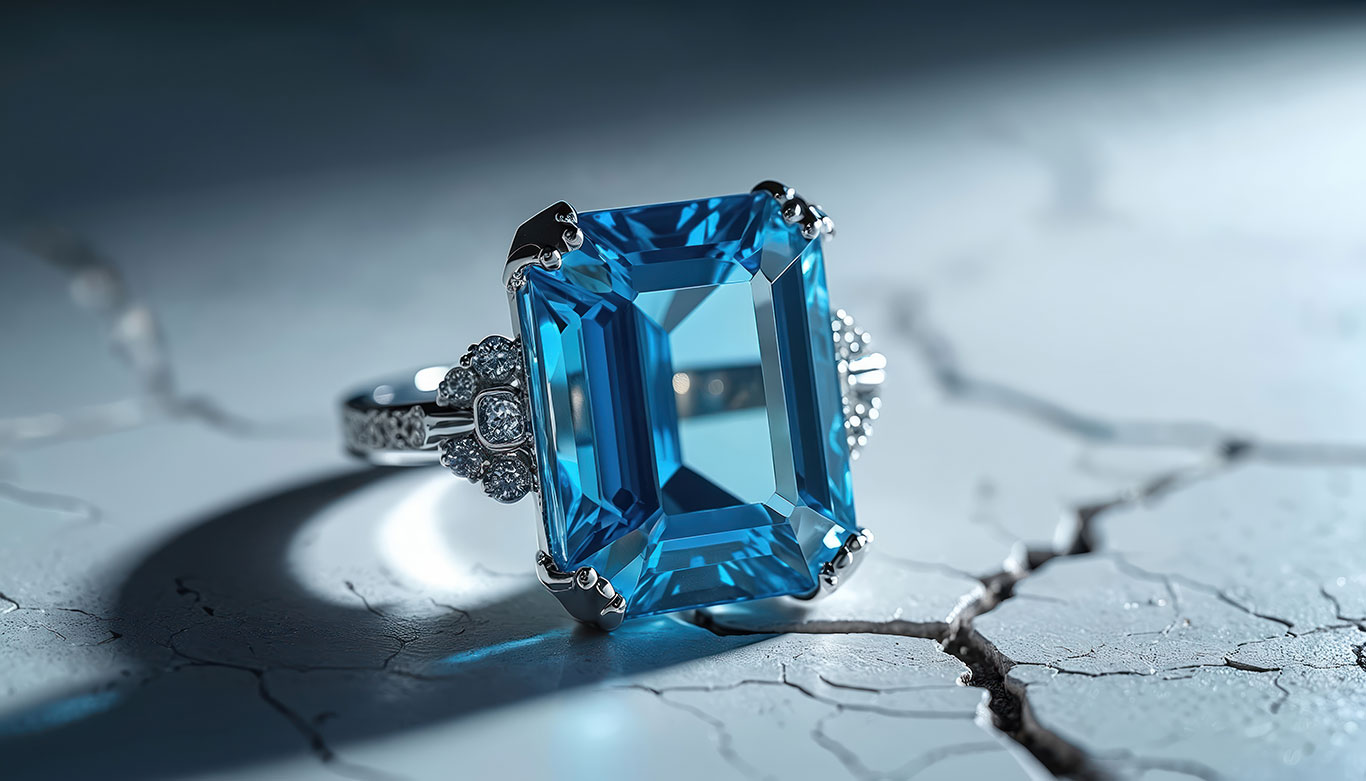
Topaz
| Property | Details |
|---|
| Mineral | Topaz |
| Mohs Hardness | 8 |
| Refractive Index | 1.619 – 1.627 |
| Birthstone | December |
| Anniversary | 4th (Blue) & 23rd (Imperial) |
| Major Sources | Brazil, Nigeria, Sri Lanka, Pakistan, USA |
| Treatments | Irradiation + heat for blue (standard, permanent) |
Overview
Topaz is a versatile gemstone available in a wide range of colors, including blue, yellow, orange, pink, and colorless. Imperial topaz, a rare orange-pink to reddish-orange variety from Brazil, is the most valuable form. Blue topaz is the most popular commercial variety.
Blue Topaz Varieties
Blue topaz is available in three recognized shades: Sky Blue (light, delicate pastel blue), Swiss Blue (vivid, saturated medium blue), and London Blue (deep, inky grayish-blue). Most blue topaz is produced by treating colorless topaz with irradiation and heat, a permanent and standard process. Swiss Blue is the most popular of the three.
Imperial Topaz
Imperial topaz is named after the Russian Czars of the 1800s and features a magnificent reddish-orange to orange-pink body color. Mined primarily in Ouro Preto, Brazil, fine Imperial topaz is rare and valuable. It is one of the most prized colored gemstones and is typically untreated.
Quality & Value Factors
For blue topaz, color saturation and evenness are the key factors. For Imperial topaz, color rarity drives value—reddish-pink shades command the highest prices. Clarity should be eye-clean for all varieties. Cut quality affects brilliance and color presentation.
Care & Cleaning
Topaz ranks 8 on the Mohs scale, making it durable. However, topaz has a cleavage plane that can cause it to split if struck sharply at the right angle. Set topaz in protective mountings for rings and handle with reasonable care. Clean with warm soapy water. Ultrasonic cleaners are generally safe, but avoid steam cleaning.
Frequently Asked Questions
What is the difference between London Blue, Swiss Blue, and Sky Blue topaz?
The three blue topaz varieties differ primarily in color depth. Sky Blue is a light, delicate pastel blue similar to a clear sky. Swiss Blue is a brighter, vivid medium blue and the most popular variety. London Blue is the deepest shade, a rich, saturated grayish-blue with a sophisticated, inky quality. All three are produced by permanently treating colorless topaz with irradiation and heat. The choice between them is a matter of personal preference for color intensity.
What is Imperial topaz?
Imperial topaz is the most prized and valuable variety of topaz, featuring a magnificent reddish-orange to orange-pink body color. The name originated in 19th-century Russia, where only the Czar was permitted to own this color. Today, Imperial topaz is found primarily in Ouro Preto, Minas Gerais, Brazil. It is significantly rarer and more valuable than blue topaz, with fine stones rivaling sapphire in per-carat price. Imperial topaz is typically untreated, adding to its collector appeal.
What is topaz cleavage and why does it matter?
Topaz has perfect basal cleavage, meaning it can split cleanly along a flat plane if struck with sufficient force at the right angle. This is an inherent property of the crystal structure and affects how topaz should be handled and set in jewelry. While topaz is very hard (Mohs 8), its cleavage means it is less tough than some softer stones. Choose protective settings for topaz rings, avoid dropping topaz jewelry on hard surfaces, and handle with reasonable care.
Is blue topaz natural?
Most blue topaz starts as colorless or very lightly tinted natural topaz. The blue color is produced through a combination of irradiation (exposure to controlled radiation) followed by heat treatment. This process permanently alters the crystal structure to produce the blue color. The resulting color is completely stable and will not fade. All treated blue topaz is safe to wear. Natural blue topaz does exist but is extremely rare and typically very pale.
Is topaz durable for everyday wear?
With a hardness of 8 on the Mohs scale, topaz is quite hard and scratch-resistant. However, its perfect basal cleavage means it can split if struck sharply at the right angle. For everyday rings, choose protective settings and avoid sharp impacts. Topaz earrings and pendants are excellent for daily wear since they face less risk of impact. With reasonable care, topaz jewelry will last a lifetime.
Specialty & Collector Gemstones