Mabe Cultured Pearls
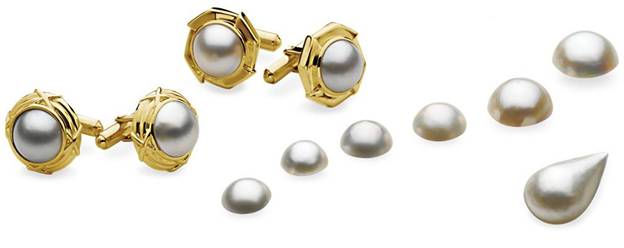
Mabe cultured pearls are a distinctive category of pearl that differs from round cultured pearls in both how they form and how they are used in jewelry. Often called cultured half pearls or blister pearls, Mabe pearls are grown against the inside of the oyster shell rather than free-floating within the oyster's body. The result is a dome-shaped pearl with a flat back—an elegant, eye-catching gem that is ideally suited for earrings, brooches, rings, and pendants where the flat back sits flush against a mounting.
How Mabe Pearls Form
To cultivate a Mabe pearl, a half-sphere nucleus (usually made from resin or shell material) is glued against the inner wall of the oyster shell. The oyster responds by coating the dome with layers of nacre over a period of several months to a year. Once harvested, the pearl dome is carefully cut away from the shell, the nucleus is removed, and the hollow interior is filled with resin and backed with a piece of mother-of-pearl to create a finished, flat-backed gem. This construction gives Mabe pearls their characteristic dome shape and large face-up size at a fraction of the cost of a comparable round pearl.
Because the nacre is deposited directly onto the shell surface, Mabe pearls can achieve impressive diameters—commonly 12 to 20 mm—that would be extremely rare and expensive in round cultured pearls. This large size makes them particularly dramatic in earrings and pendants, where their broad, luminous surface catches light beautifully.
Color and Varieties
Mabe pearls are produced by several oyster species, and the resulting colors vary accordingly. The most traditional and popular color is white with pink overtones, prized for its soft, feminine glow. However, there is growing interest in Mabe pearls with dark, smoky, and blue-gray tones produced by the Pinctada margaritifera (the same black-lipped oyster that produces Tahitian pearls). Some Mabe pearls display rainbow iridescence caused by thin-film interference in the nacre layers, creating a dramatic play of color across the dome surface.
Mabe pearls from the Pteria penguin oyster (commonly known as the rainbow-lipped pearl oyster) of the Indo-Pacific produce some of the most spectacular iridescent Mabe pearls, with vivid overtones of pink, green, gold, and blue playing across the surface. Japanese Mabe pearls from Amami-Oshima are especially renowned for their quality and iridescence.
Evaluating Mabe Pearl Quality
The same fundamental quality factors apply to Mabe pearls as to round cultured pearls. Luster should be bright and reflective—the dome shape of a Mabe pearl creates a broad, mirror-like surface when the luster is high. Surface quality is assessed by the number and visibility of blemishes. Color should be even and consistent across the dome, with desirable overtones adding depth. Shape in Mabe pearls refers to the symmetry and evenness of the dome—a well-formed Mabe pearl has a smooth, evenly curved dome without flat spots or irregularities. The nacre should appear thick enough to show good luster without any translucency that reveals the backing material underneath.
Mabe Pearl Jewelry and Care
The flat-backed, dome-shaped profile of Mabe pearls makes them ideal for earrings (both clip-on and post-back), brooches, cocktail rings, and pendants. Their large face-up size delivers visual impact comparable to much more expensive round South Sea pearls at a more accessible price point. Mabe pearl earrings are especially popular because the dome shape sits comfortably and attractively against the earlobe, and the broad nacre surface catches light from every angle. As a complement to our collection of Mabe finished jewelry, you can also select loose Mabe cultured pearls along with a mounting of your choice.
Care for Mabe pearls requires extra attention because the nacre layer is thinner than on whole cultured pearls. Handle them gently to avoid cracking or chipping the nacre dome. Keep them away from chemicals, perfumes, and cosmetics. Wipe with a soft, damp cloth after wearing and store in a soft pouch. Avoid ultrasonic cleaners and steam cleaners entirely—the assembled construction of Mabe pearls (nacre dome, resin fill, mother-of-pearl backing) is sensitive to heat and vibration. With careful handling, Mabe pearls provide lasting beauty and are a distinctive alternative to traditional round pearl jewelry.