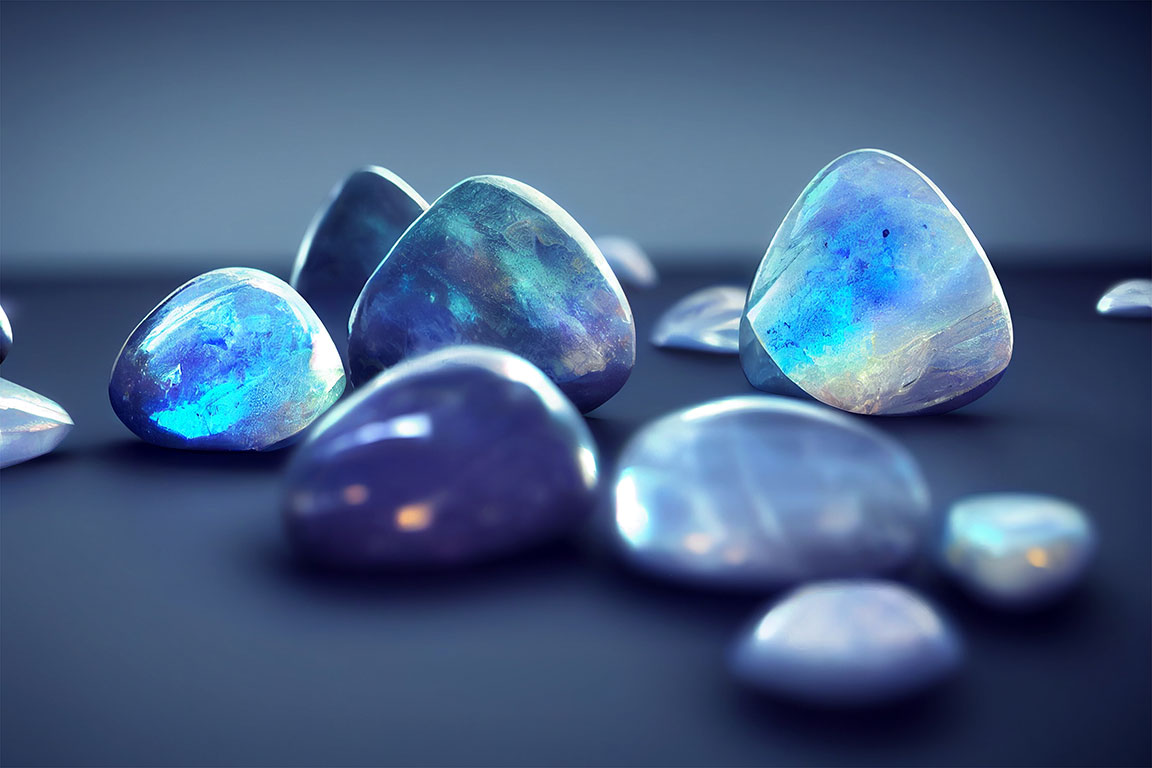
Moonstone
| Property | Details |
|---|
| Mineral | Feldspar (orthoclase) |
| Mohs Hardness | 6 – 6.5 |
| Refractive Index | 1.518 – 1.526 |
| Birthstone | June (alternative) |
| Major Sources | Sri Lanka, India, Myanmar, Madagascar |
| Treatments | Rarely treated |
Overview
Moonstone is a variety of feldspar that displays a beautiful floating glow called adularescence—a soft, billowing light that moves across the surface as the stone is tilted, reminiscent of moonlight glowing through thin clouds. The finest moonstones are colorless with a blue adularescence, though the gemstone also occurs in peach, gray, and rainbow varieties.
Varieties
Blue moonstone: The most valued variety, with a transparent body and strong blue adularescence. Rainbow moonstone: Technically a variety of labradorite, displays multicolored flashes of blue, purple, and gold. Peach moonstone: Warm, peachy-pink body color with soft adularescence, popular in bohemian jewelry. Moonstone has been used in jewelry since ancient Rome and is especially popular in Art Nouveau-inspired and bohemian designs.
Care & Cleaning
Moonstone ranks 6 to 6.5 on the Mohs scale and has cleavage planes, making it best used in earrings, pendants, and protected ring settings. Clean with warm soapy water only. Avoid ultrasonic cleaners and hard impacts.
Frequently Asked Questions
What is adularescence?
Adularescence is the soft, glowing light that appears to float just below the surface of a moonstone, moving as the stone is tilted. This phenomenon is caused by light scattering between microscopic layers of two different feldspar minerals (orthoclase and albite) within the stone. The thinner and more regular these layers, the bluer and more vivid the adularescence. The effect is named after Mount Adular in Switzerland, an early source of fine moonstone.
What is the difference between moonstone and rainbow moonstone?
True moonstone is a variety of orthoclase feldspar that displays a soft, floating glow (adularescence). Rainbow moonstone is technically a variety of labradorite (a different feldspar mineral) that displays multicolored flashes of blue, purple, gold, and green. Both are sold commercially under the moonstone name, but gemologically they are different minerals. Traditional blue moonstone from Sri Lanka is generally more valued by collectors.
Is moonstone durable enough for rings?
Moonstone ranks 6 to 6.5 on the Mohs scale, which is softer than many popular gemstones. It also has two cleavage directions that can make it susceptible to breaking if struck sharply. Moonstone can be used in rings with protective settings (bezel or halo) but is not ideal for engagement rings or heavy daily wear. Earrings and pendants are the safest jewelry choices for moonstone.
Where does the best moonstone come from?
Sri Lanka produces the finest moonstone, particularly the prized blue moonstone with a transparent body and vivid blue adularescence. India is a major source of rainbow moonstone and other varieties. Myanmar produces some fine blue moonstone as well. Madagascar has become an increasingly important source. The origin significantly affects quality and value, with Sri Lankan blue moonstone commanding the highest prices.
Is moonstone treated or enhanced?
Moonstone is almost never treated or enhanced. The adularescence effect is entirely natural and cannot be created or improved through treatment. What you see in a moonstone is what nature produced. This makes moonstone one of the most honest gemstones on the market. The only concern is that some low-quality material may be coated to improve surface appearance, but this is uncommon in reputable jewelry.
Specialty & Collector Gemstones