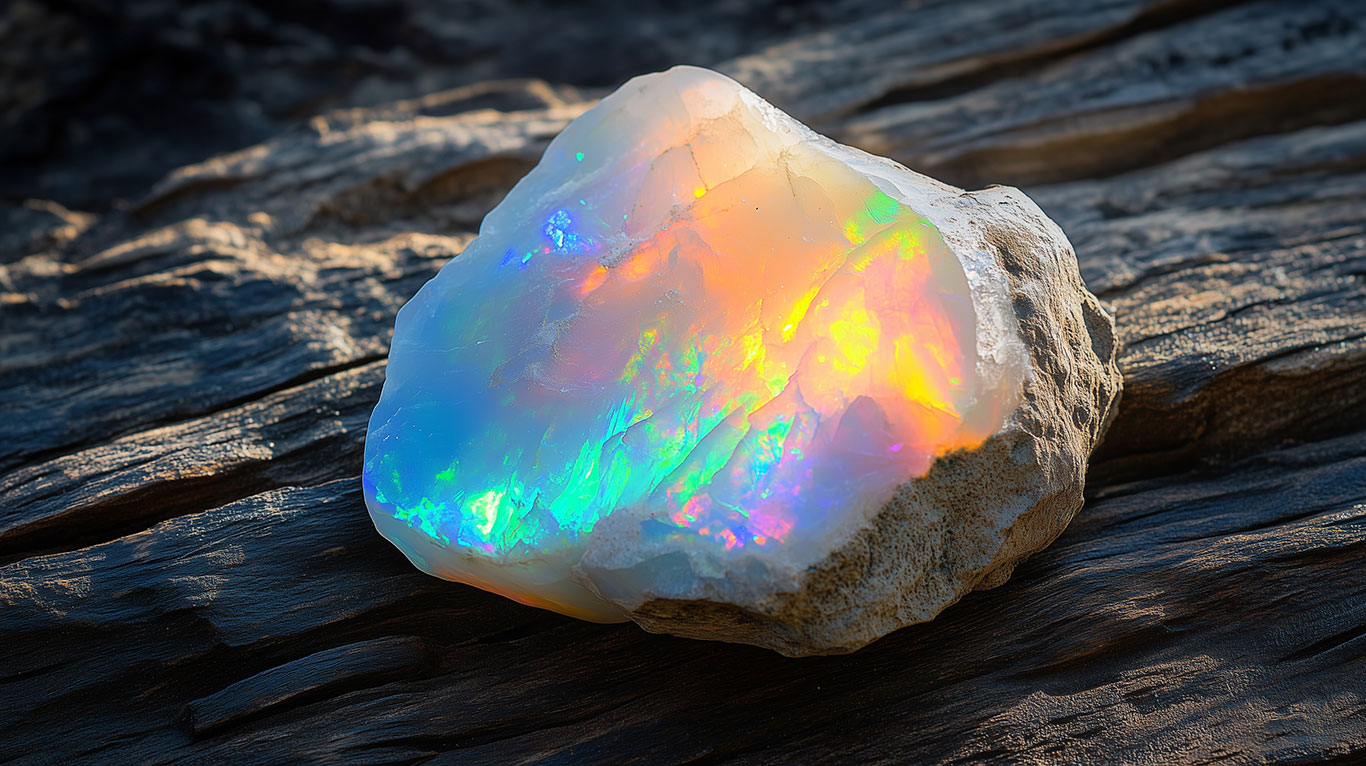
Opal
| Property | Details |
|---|
| Mineral | Hydrated silica |
| Mohs Hardness | 5.5 – 6.5 |
| Refractive Index | 1.450 (approximate) |
| Birthstone | October |
| Anniversary | 14th |
| Major Sources | Australia (95%), Ethiopia, Mexico, Brazil |
| Treatments | Smoke treatment, sugar/acid treatment, polymer impregnation |
Overview
Opal is one of the most visually spectacular gemstones, renowned for its play of color—a shifting display of rainbow hues caused by the diffraction of light through microscopic silica spheres within the stone. No two opals are alike, making each stone truly one-of-a-kind.
Varieties
Black opal: From Lightning Ridge, Australia. The rarest and most valuable, with dark body colors that dramatically showcase the play of color. White opal: Light body color with play of color; the most common precious opal. Fire opal: From Mexico, displaying vivid orange to red body colors, often faceted. Boulder opal: From Queensland, Australia, formed naturally on ironstone host rock. Crystal opal: Transparent to semi-transparent, allowing light to pass through and enhance the play of color. Ethiopian opal: A newer source producing vivid play-of-color material, sometimes hydrophane (absorbs water).
Quality & Value Factors
The most important value factor is the play of color—its intensity, range, and pattern. Red play of color against a black body is the most valuable combination. Pattern types include harlequin (large, angular patches), pinfire (tiny points), broadflash (large sweeping flashes), and rolling flash. Body tone, brightness of the play of color, and the range of colors displayed all contribute to value. Black opals command the highest prices, followed by boulder opals and crystal opals.
Care & Cleaning
Opal ranks 5.5 to 6.5 on the Mohs scale and contains 5–10% water, making it sensitive to heat, dryness, and chemicals. Store opals in a cool place and consider placing a damp cloth nearby in very dry climates. Clean only with mild soap and room-temperature water. Never use ultrasonic cleaners, steam cleaners, or chemicals. Opal is best suited for earrings, pendants, and carefully worn rings with protective settings.
Frequently Asked Questions
What causes the play of color in opal?
Opal's play of color is caused by the diffraction of light through a regular arrangement of microscopic silica spheres within the stone. When these spheres are uniform in size and stacked in an orderly pattern, they diffract white light into its spectral colors, creating the rainbow effect. The size of the spheres determines which colors are produced: smaller spheres create blues and greens, while larger spheres produce the rarer and more valuable reds and oranges.
What is a black opal?
Black opal is the rarest and most valuable type of opal, characterized by a dark body color (black, dark gray, or dark blue) that dramatically enhances the play of color. Nearly all fine black opal comes from Lightning Ridge, New South Wales, Australia. A black opal with vivid red play of color against a black body is the most prized combination and can sell for tens of thousands of dollars per carat. The dark background makes the spectral colors appear more vivid and dramatic.
Do opals crack or craze?
Some opals can develop fine cracks called crazing when they lose moisture or experience rapid temperature changes. This is more common in Ethiopian opals (which are hydrophane and absorb water) and thin opals. Australian opals from established mines are generally more stable. To prevent crazing, store opals in moderate humidity, avoid extreme heat and cold, never use ultrasonic or steam cleaners, and keep opals away from prolonged direct sunlight and heating vents.
Can opals be worn in rings?
Opals can be worn in rings but require protective settings and careful handling. At 5.5 to 6.5 on the Mohs scale, opal is softer than many gemstones and can scratch with everyday wear. Choose a bezel setting or a design with protective prongs, avoid wearing opal rings during physical activities, and remove them before washing hands with soap. Many opal enthusiasts prefer earrings and pendants for everyday wear and save opal rings for special occasions.
What is the difference between Australian and Ethiopian opal?
Australian opal, from deposits in New South Wales, Queensland, and South Australia, is the world standard for quality and stability. It tends to be more stable and less prone to crazing. Ethiopian opal, discovered commercially in 2008, produces vivid play-of-color material but is often hydrophane, meaning it absorbs water and temporarily becomes transparent when wet. Ethiopian opal is generally more affordable and can be more prone to crazing if not properly cared for.
Specialty & Collector Gemstones