$3,000–$7,000 Engagement Rings for U.S. Buyers: Skip Retail Markup, Buy Smarter
Most couples spend a few thousand dollars on an engagement ring, with the center diamond accounting for the majority of the total cost. The old “three months’ salary” rule is marketing, not math. Budget with cash on hand, not credit, and know that lab-grown diamonds and smarter settings can significantly reduce the cost without shrinking the ring.
TL;DR:
- Choosing a ring under $3,000 to $4,000 typically yields a high-quality, well-cut diamond or a larger lab-grown stone, especially with a smaller carat weight.
- Opting for elongated shapes like oval or marquise and using halo settings can significantly increase perceived size without adding cost.
- Avoid paying a premium for round diamonds over 1 carat by purchasing just under popular “magic” carat thresholds, which offer better value.
- In-house manufacturing and direct-to-consumer models eliminate intermediate markups, making higher-quality options more accessible within your budget.
- Remember to include costs for insurance, resizing, taxes, and potential rush fees in your final budget to prevent unexpected expenses.
Table of Contents
- How Much Does the Average Engagement Ring Cost?
- What Drives the Price: The 4Cs, Shape, Setting, and Metal
- Budgeting by Income: Smarter Than the Old Salary Rule
- How to Get a Bigger Look for a Smaller Budget
- The Hidden Costs Nobody Budgets For
- Your Step-by-Step Ring Budgeting Checklist
- Why In-House Manufacturing Changes the Math
- What I’d Tell a Friend Buying Their First Ring
- Ready to Design a Ring That Fits Your Budget?
- Sources
- FAQ
How Much Does the Average Engagement Ring Cost?
The number you see quoted depends entirely on whether you’re looking at an average or a median, and that distinction matters more than most shoppers realize. Averages get pulled upward by a small number of very expensive purchases, the same way one $50,000 custom ring can drag a whole dataset off course.
Recent industry data put the average engagement ring cost in the mid-thousands, with the center diamond typically representing the majority of that figure, according to pricing data from The Diamond Price. But the median tells a different story. Because a relatively small share of high-end purchases inflates the mean, the median (the true “middle” purchase) runs noticeably lower.
Survey data backs this up directly. A substantial portion of buyers spend a few thousand dollars or less, according to The Knot’s survey of real couples. That means the “average” figure you keep seeing quoted online represents a minority, not the typical buyer.
Where you live matters too.
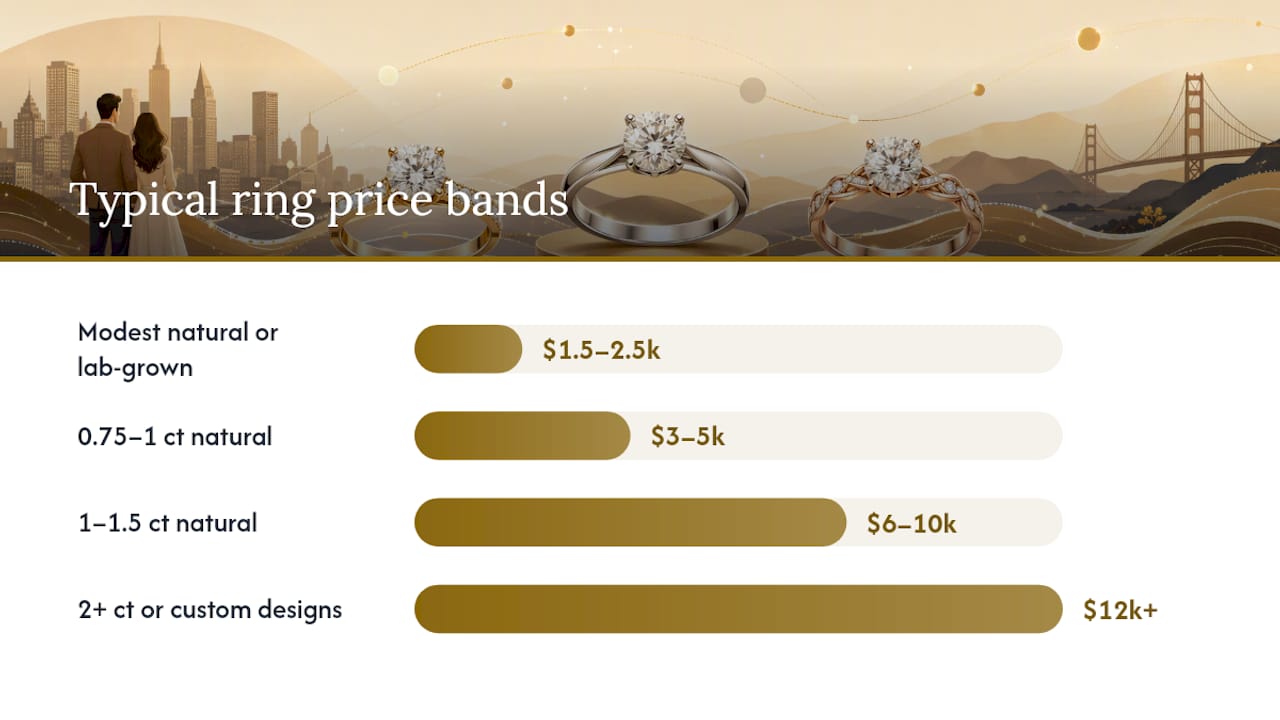
Here’s roughly what that spread buys, based on typical market pricing for a well-cut center stone with a simple setting:
- $1,500 to $2,500: A modest natural diamond (0.3 to 0.5 carat) or a larger lab-grown stone in a simple solitaire setting.
- $3,000 to $5,000: A 0.75 to 1 carat natural diamond with solid clarity and color, or a 1.5+ carat lab-grown diamond with room to spare for a nicer setting.
- $6,000 to $10,000: A full 1 to 1.5 carat natural diamond with excellent cut grade, often paired with platinum or 18K gold.
- $12,000 and up: Larger stones (2+ carats), fancy colored diamonds, or elaborate custom designs with significant metal work.
None of these numbers are prescriptive. They’re a map, not a rulebook, and where you land on it should depend on your own finances, not a survey average.
What Drives the Price: The 4Cs, Shape, Setting, and Metal
The center stone is the single biggest lever in your budget, and understanding why lets you spend intentionally instead of guessing.
Carat weight moves the needle hardest, but not in a straight line. Diamond pricing jumps at what the trade calls “magic sizes,” round numbers like 1.00, 1.50, and 2.00 carats where demand (and therefore price per carat) spikes. A stone at 0.97 carats can look nearly identical to a full carat but cost noticeably less. Buying just under these thresholds is one of the easiest ways to stretch a budget without a visible tradeoff.
The math behind the 4Cs: GIA’s own guidance recommends prioritizing cut above color and clarity, since cut quality controls brilliance and sparkle more than any other factor. A well-cut diamond in the VS2 to SI1 clarity range, with G to H color, often looks just as bright as a flawless, colorless stone, at a fraction of the cost.
Shape changes the math too. A round brilliant carries the highest price per carat of any shape because it demands the most rough diamond material and cutting precision. Fancy shapes like oval, pear, and cushion cost less per carat and, in the case of elongated cuts, often appear larger on the finger than a round stone of identical weight. Our round brilliant guide breaks down exactly what you’re paying for with that shape if it’s still your preference.
Setting and metal round out the equation:
- Solitaire settings cost less than halo or pavé designs since they use less metal and fewer accent stones.
- 14K gold runs less expensive than 18K gold or platinum, with minimal visible difference to most eyes.
- Platinum costs more upfront but resists wear better over decades, a tradeoff worth weighing against gold alternatives if longevity matters to you.
- Halo settings add cost but also add perceived size, often making a smaller center stone look considerably bigger.
Budgeting by Income: Smarter Than the Old Salary Rule
Forget the three-month salary formula. It originated as a diamond industry marketing slogan, not a financial guideline, and GIA itself says as much. A far better approach starts with your actual disposable income, not a percentage pulled from an old ad campaign.
Here’s a practical way to think through it:
- Calculate your monthly disposable income after rent, debt payments, and essential expenses. This is the number that should drive your decision, not your gross salary.
- Set a conservative band if you’re also saving for a house, paying down debt, or planning a wedding simultaneously. That typically means keeping the ring under $3,000 to $4,000, which still gets you a genuinely beautiful stone in the 0.5 to 0.75 carat range or a larger lab-grown diamond.
- Set a moderate band if you have steady income and modest other financial obligations. A $5,000 to $7,000 budget lands you in the sweet spot most American couples actually choose, per The Knot’s survey data.
- Set a generous band only if you have minimal debt and healthy savings already in place. Budgets of $10,000 and above open the door to larger natural stones, platinum settings, and custom design work.
- Build a savings timeline rather than financing the purchase. If a jeweler offers in-house financing, read every term before committing, and avoid high-interest store credit cards that can quietly double your real cost.
The honest rule of thumb is this: spend what you can pay off within a few months without touching your emergency fund. A ring bought under financial stress rarely feels as good as one bought free and clear.
How to Get a Bigger Look for a Smaller Budget
Getting real visual impact without inflating your budget comes down to a handful of specific tactics, not luck.
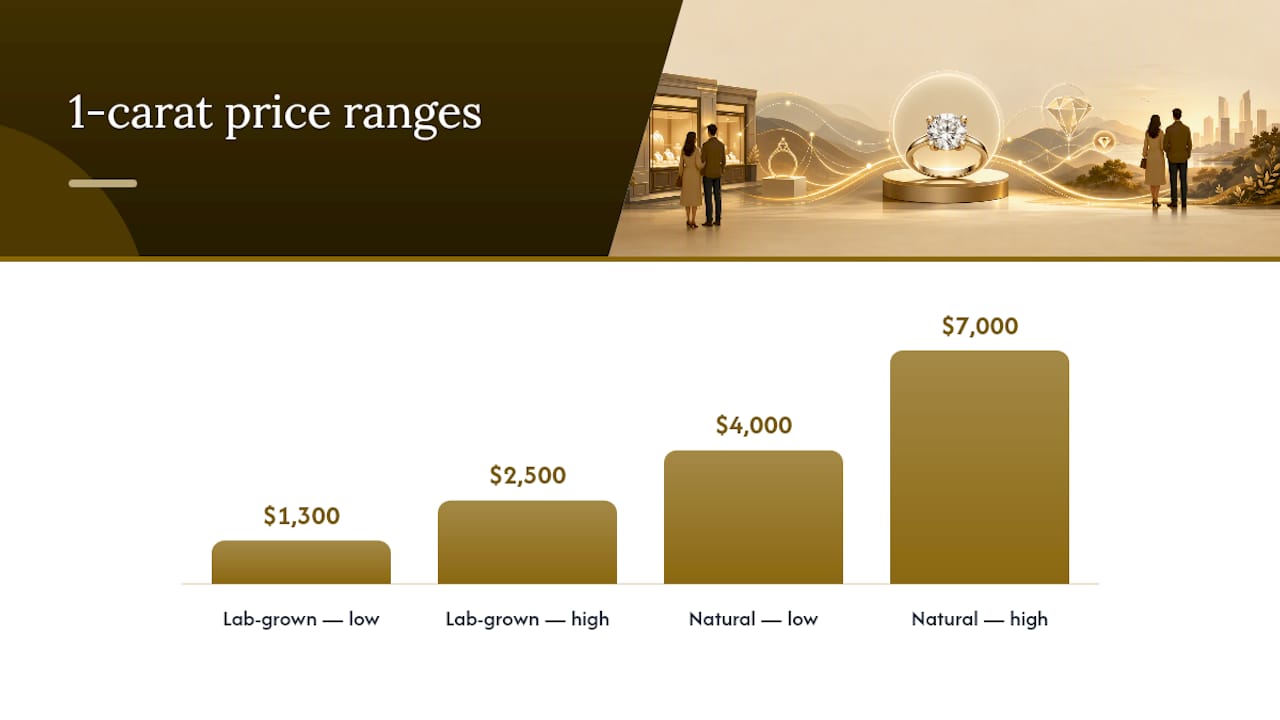
Lab-grown diamonds deliver the clearest savings. A comparable 1-carat lab-grown diamond often costs 50% to 70% less than its natural counterpart, according to pricing analysis from The Diamond Price, which can put a 1-carat lab-grown stone in the $1,300 to $2,500 range versus $4,000 to $7,000 for a similar natural diamond. The tradeoff is resale value, since lab-grown diamonds currently hold less resale premium than natural stones, though most couples never plan to resell an engagement ring anyway.
Beyond stone origin, a few setting choices consistently punch above their price:
- Elongated shapes like oval, pear, and marquise create more surface-area coverage per carat than round or cushion cuts.
- Halo settings surround the center stone with small diamonds, adding visual size for a fraction of what a larger center stone would cost.
- Yellow or rose gold bands make a diamond’s color grade appear whiter by contrast, letting you save on color grade without a visible tradeoff.
- Pavé bands extend sparkle down the shank, drawing the eye across the whole ring instead of just the center stone.
Pro Tip: Ask to see the same carat weight in two different shapes side by side before you decide. An oval and a round diamond of identical weight can look meaningfully different in size on the hand, and that comparison is impossible to judge from photos alone.
The Hidden Costs Nobody Budgets For
The ring price tag is rarely the final number. Insurance, resizing, and rush production fees show up after the purchase, and skipping them in your planning is how budgets blow past their limit.
- Insurance typically runs 1% to 2% of the ring’s appraised value per year, covering loss, theft, and accidental damage.
- Resizing costs vary by design complexity. A simple solitaire band resizes cheaply, but continuous pavé or hidden halo settings require far more labor since the stones wrap around the band itself.
- Rush and custom fees apply when you need a ring faster than standard production allows.
- Sales tax applies in most states and adds a real percentage to your final total, so factor your state’s rate into your top-line number before you shop.
Industry guidance commonly recommends setting aside an extra $400 to $600 as a buffer for rush charges or last-minute production adjustments, according to engagement ring cost data from The Diamond Price. Ready-to-ship rings ship in days; fully custom designs typically take several weeks from design approval to delivery, so if you’re working toward a specific proposal date, start the process well ahead of it.
Your Step-by-Step Ring Budgeting Checklist
Turning everything above into an actual purchase decision comes down to a short sequence of steps and a handful of direct questions for whichever jeweler you choose.
- Assess your disposable income honestly, factoring in existing debt, savings goals, and upcoming expenses.
- Set a target range, not a single number, so you have flexibility once you start comparing real stones.
- Rank your priorities: cut quality first for sparkle, then carat weight, then color and clarity where a jeweler can show you the difference is invisible to the naked eye.
- Compare shapes and settings within your range before locking in a stone, since the same budget can look dramatically different depending on those two choices.
- Confirm every hidden cost (insurance, resizing, taxes) before you finalize the number in your head.
Before you commit, ask any jeweler these questions directly:
- Is the diamond certified, and by which grading lab?
- What’s the return policy if the ring doesn’t fit the proposal or the recipient’s taste?
- What does the warranty actually cover, and for how long?
- What does resizing cost after purchase, and is a first resize included?
- How are the diamonds sourced, and can that be verified?
- What’s the realistic production and shipping timeline?
- Is there an upgrade program if you want a larger stone later?
Treat vague answers as a warning sign. A jeweler unwilling to name a certification lab, put a warranty in writing, or give you a clear return window is not one you want holding your money.
Why In-House Manufacturing Changes the Math
Retail markup is the invisible line item in every ring price. Direct-to-consumer and in-house manufacturing models cut out that middleman layer, letting more of your dollar go toward the actual diamond, according to Vogue’s reporting on engagement ring pricing.
Usajewels builds on that model directly:
- Family-owned and operating since 1999, with in-house manufacturing that removes the traditional wholesale-to-retail markup chain.
- A lifetime diamond upgrade program, so your first purchase isn’t your last if your budget grows later.
- Over 222 Google reviews reflecting a track record built on repeat trust, not one-time transactions.
- A design-your-own process where you choose diamond shape, quality, and metal type directly, putting the budgeting priorities from this guide into your own hands.
That last point is the real advantage: instead of choosing from a fixed inventory, you allocate your exact budget toward whichever factor, cut, carat, or metal, matters most to you.
What I’d Tell a Friend Buying Their First Ring
Buy within your means, and build in the timeline for insurance and any resizing before the proposal, not after. Sparkle and durability matter more in daily life than carat size ever will; a well-cut, well-set diamond you can wear without worry beats a bigger stone you’re afraid to bump against a doorframe.
My one practical tip: before you commit to a setting, ask to see your chosen stone in at least two different mounts, ideally under different lighting. A halo that looks stunning under jewelry-store spotlights can read differently in daylight, and you want to fall in love with the ring you’ll actually see every morning, not just the one under the display case lights.
— Joseph
Ready to Design a Ring That Fits Your Budget?
Skipping the traditional markup is exactly how Usajewels lets you put more of your budget into the diamond itself instead of retail overhead. Because everything is manufactured in-house, you can choose your diamond shape, quality, and metal directly, then see real pricing before committing to anything.
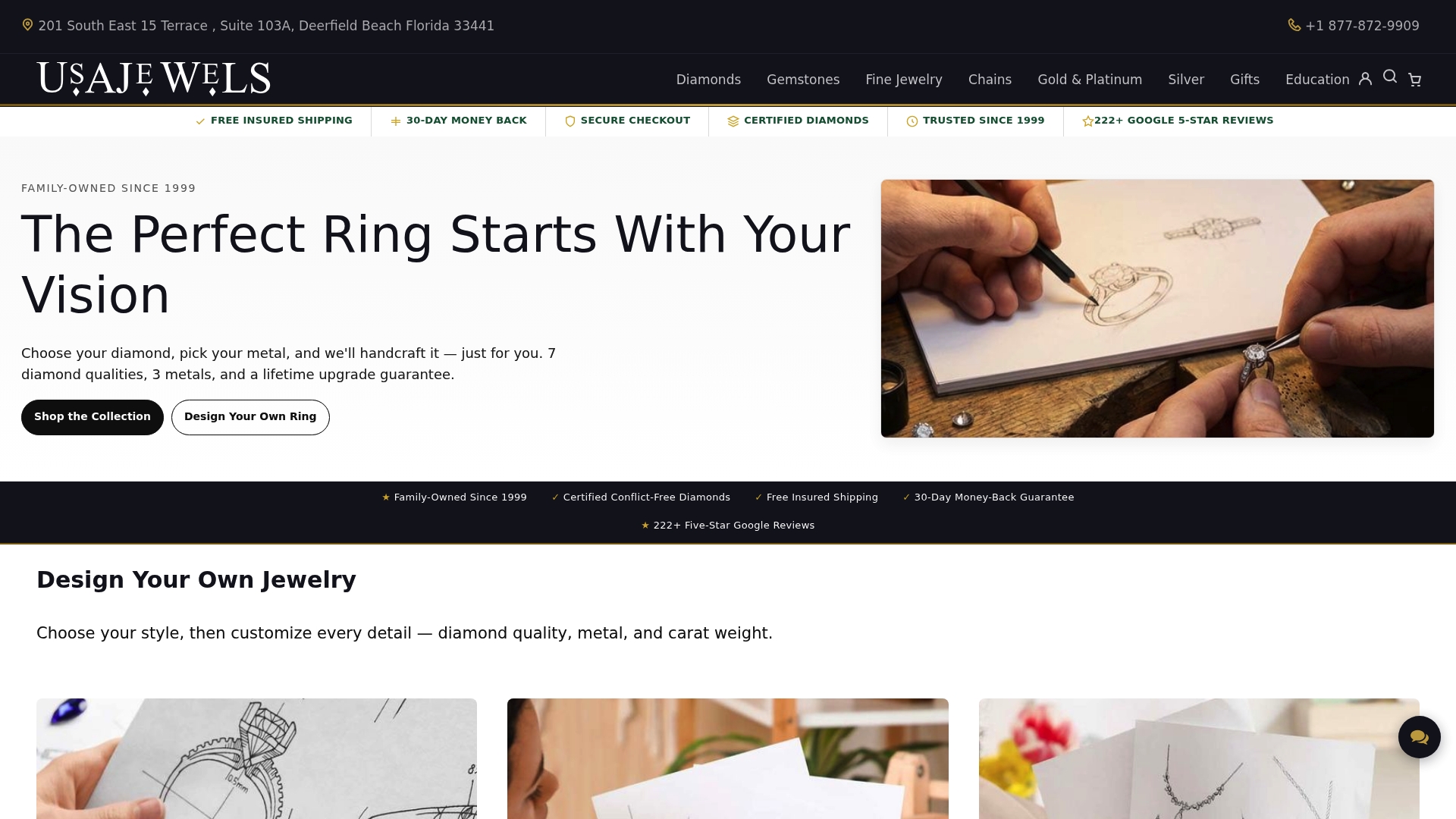
If you already have a budget number in mind from this guide, the fastest next step is browsing engagement rings built around real pricing transparency, where you can compare settings and stone options against the exact range you’ve set for yourself. Prefer something outside a traditional white diamond, or planning the proposal itself with a photographer’s help via resources like creative engagement photo ideas? Our fine jewelry collection covers colored stones and complementary pieces worth considering as you finalize the full picture. Reach out for a direct pricing quote and realistic timeline before you set a final number.
Sources
- How Much Does a Diamond Engagement Ring Cost in 2026?
- How Much Should a Diamond Engagement Ring Cost | GIA 4Cs
- The Average Engagement Ring Cost, According to Real Couples
- How much should I spend on an engagement ring? | Vogue
FAQ
How much are you supposed to spend on an engagement ring?
There’s no fixed rule. Most buyers spend between $3,000 and $7,000, but the right number depends on your disposable income and financial obligations, not a percentage of salary.
How much should I spend on an engagement ring if I make $100,000 a year?
A moderate approach for that income level typically lands between $5,000 and $7,000, assuming manageable debt and stable savings, though a conservative budget of $3,000 to $4,000 works just as well if you’re saving for other goals simultaneously.
Is $10,000 enough for an engagement ring?
Yes, $10,000 comfortably buys a 1.5 to 2 carat natural diamond with strong cut quality, or a significantly larger lab-grown stone, often paired with platinum or 18K gold.
Is $1,500 too cheap for an engagement ring?
No. A $1,500 budget can buy a genuinely beautiful ring, particularly with a lab-grown diamond or a smaller natural stone in a well-designed setting, and it falls within what a meaningful share of real buyers actually spend, according to The Knot’s survey data.
Recommended
- Engagement Ring Budget Guide
- Ring Guide: Engagement Settings & Styles
- Engagement Ring Buying Guide: How to Choose the Perfect Ring
- Diamond Pricing Guide: What Diamonds Cost

Deep Mehta is the Co-Owner of USA Jewels, a family-owned jewelry business she has led since 2013 in Deerfield Beach, Florida. With over 13 years of hands-on experience in fine jewelry retail, manufacturing, and diamond importing, Deep specializes in engagement rings, wedding bands, and custom jewelry design. She also co-manages Kaash Group Talent Acquisition. Deep is a University of Florida graduate and oversees every aspect of USA Jewels’ operations, from product development to marketing.
Fine Jewelry Collection


You May Also Like
Handcrafted vs. Mass-Produced Children’s Jewelry Guide
Monogram Jewelry Design: What It Means and How It Works