Which Gold Chain Fits You: 1.5–3mm Rules, Purity, Custom Orders
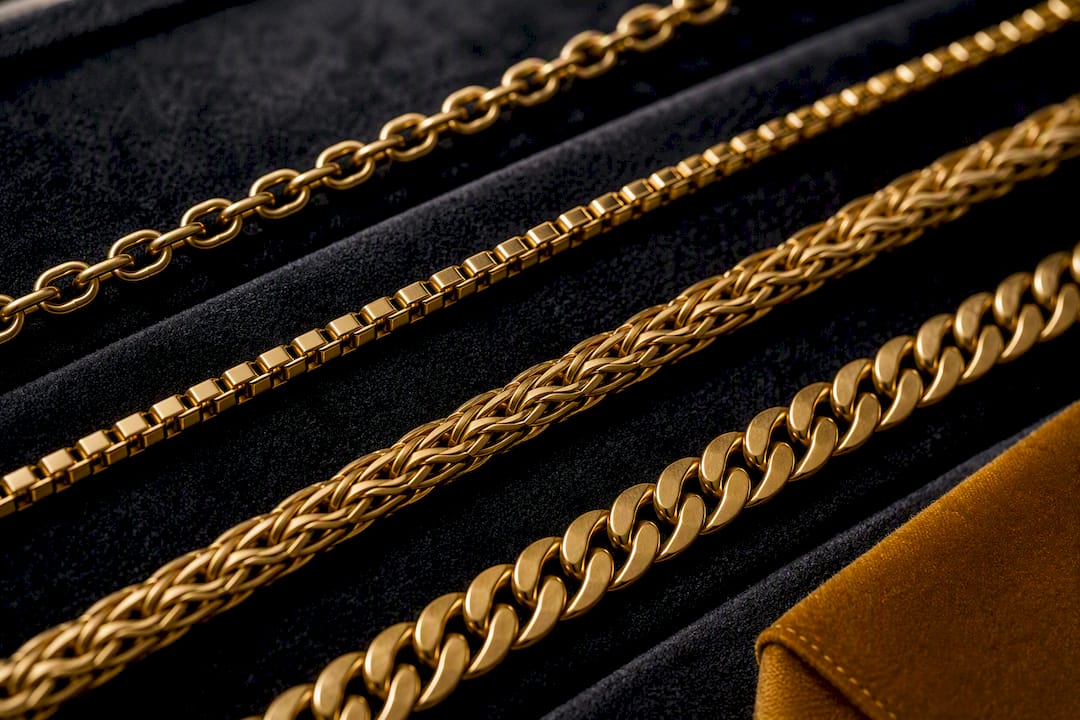
For pendant-ready durability, choose box, cable, wheat, or Franco chains. For bold standalone looks, reach for Cuban curb, rope, or herringbone. Whatever style catches your eye, prioritize solid construction over hollow if you plan to wear it daily. That single choice affects strength, weight, and how easily a jeweler can repair it down the road.
TL;DR:
- Solid construction is essential for daily wear chains to ensure they can be repaired and resist bending or breaking over time.
- 18K gold offers a better balance of durability and richness for chains that will be worn frequently, compared to the softer 22K variant.
- Thick chains of 2.5 to 3mm support medium pendants well, while heavier chains of 3 to 5mm are better for larger, heavier pendants.
- Chains like box, cable, wheat, and Franco are the best choices for carrying pendants securely due to their tight and uniform link structure.
- Avoid thin, flat, or hollow chains for everyday use, as they are more prone to kinks, stretch, or damage, especially if worn constantly.
Table of Contents
- Gold Chain Types at a Glance
- What Makes Each Gold Chain Style Different
- How to Choose the Right Gold Chain
- Caring for Your Gold Chain
- Why This Guide Reflects How We Build Chains
- Ready to Build Your Own Gold Chain
- Sources
- FAQ
Gold Chain Types at a Glance
We’ve spent years watching customers walk into our showroom convinced they want a “rope chain” when what they’re picturing is actually a Cuban link, or asking for a “Belcher” without realizing it’s the same chain sold elsewhere as a rolo. The names get tangled fast. Here’s a quick reference for the major gold chain styles, what they’re good for, and the alternate names you’ll see on other sites.
- Cable (Anchor): Uniform oval links joined at right angles; sturdy, classic, and a dependable pendant carrier.
- Rolo (Belcher): Rounded, evenly sized links with a smooth profile; the same style, two names, great for charms.
- Box (Venetian): Square-cut links that lie flat and catch light beautifully; excellent for medium pendants.
- Rope: Twisted links that mimic braided cord; eye-catching as a standalone statement piece.
- Figaro: Alternating pattern of one long link and several short ones; a European staple for daily wear.
- Curb (Cuban): Flattened, interlocking links that lie close together; the go-to for bold, heavy-set looks.
- Franco: Tightly woven square links with a subtle diamond texture; flexible and pendant-friendly.
- Singapore: Twisted rope-like pattern with a diamond-cut sparkle; delicate, best for light layering.
- Wheat (Spiga): Multiple strands braided into a rounded rope look; deceptively strong for its slim profile.
- Byzantine: Intricate interlocking rings that create a woven, textured surface; a statement piece, not a pendant carrier.
- Snake: Smooth, scale-like links forming a flexible tube; sleek but prone to permanent kinks.
- Herringbone: Flat, tightly angled links producing a ribbon-like sheen; gorgeous but fragile if bent.
- Omega: A rigid, plate-based design (not a true link chain) built specifically to let slide pendants glide smoothly.
What Makes Each Gold Chain Style Different
Knowing the names is one thing. Knowing which chain actually holds up to your lifestyle, or your pendant, is what saves you from a returned order or a snapped clasp six months in. Here’s what you’re actually buying with each style.
Cable (Anchor) Chain
Cable chains, sometimes called anchor chains, are built from uniform oval links connected at alternating angles, the same basic structure used in ship anchor chains, just scaled down and polished. That construction is precisely why it’s considered one of the more durable everyday weaves alongside box, curb, and wheat designs, according to Wikipedia’s overview of jewelry chain construction. Failure modes are rare, mostly limited to a stretched link after years of heavy tension.
For pendants, cable in the 1.5 to 2.5mm range comfortably supports small to medium charms without looking flimsy. It’s a strong first chain if you’re building a layered look, since its simple profile doesn’t compete visually with more textured neighbors.
Rolo (Belcher) Chain
Rolo and Belcher are the same chain wearing two different name tags, depending on which retailer you’re browsing. The rounded, uniform links create a smooth, almost bead-like texture that reads as understated rather than flashy.
It handles small to medium pendants well, particularly birthstone charms and religious medals, because the round profile doesn’t twist or catch on fabric the way angular links can. Durability sits in the middle of the pack: solid rolo in 14K holds up fine for daily wear, but very thin versions (under 1mm) can stretch over time under a heavier pendant.
Box (Venetian) Chain
Box chains, also marketed as Venetian, use square-cut links that interlock to form a nearly seamless, flat surface. That flat geometry is part of why box shows up repeatedly on lists of the most durable everyday weaves, since the tight linking resists the kind of snagging that plagues flatter, more delicate designs, per BlueStone’s long chain durability guide.
A 2 to 3mm solid box chain at 18 to 20 inches is a near-universal recommendation for medium pendants, from small diamond solitaires to modest gold charms. It resists kinking better than herringbone or snake, and if a link does wear thin, a jeweler can usually cut and resolder a solid box chain without disturbing the rest of the piece.
Rope Chain
Rope chains twist multiple strands of gold into a pattern that mimics braided cord, and they’re one of the most recognizable statement styles in fine jewelry. The twisted structure gives rope chains real heft and visual presence, which is exactly why they’re worn standalone more often than as pendant carriers.
Thicker rope (4mm and up) can technically hold a pendant, but the twisting motion tends to spin lighter charms around so the front design ends up facing sideways. If you love the rope look and still want a pendant, consider a thicker gauge and a bail designed to resist rotation, or simply let the chain be the statement.
Figaro Chain
Figaro chains alternate one elongated oval link with a small cluster of shorter round links, a pattern borrowed from Italian design traditions and still associated with that heritage today. It’s flexible enough for comfortable daily wear and structurally sound thanks to the varied link sizes distributing tension differently than a uniform chain.
Figaro in 2 to 3mm works well for medium pendants and also stands on its own as a men’s chain in heavier 4 to 6mm widths. It’s a practical middle ground for someone who wants more visual interest than a plain cable chain but doesn’t want the bulk of a full curb link.
Curb (Cuban) Chain
Curb chains, and their heavier cousin the Cuban link, use flattened links that twist and interlock so tightly they lie almost flush against each other. This is the chain most associated with bold, statement-driven style, largely worn on its own rather than as a pendant support.
Cuban curb ranks among the sturdiest weaves for daily wear specifically because of how densely those links pack together, a point BlueStone’s guide to durable chain construction backs up directly. If you do want to hang a pendant from a curb chain, go thick (5mm or more) so the bail has enough surface to grip without sliding.
Franco Chain
Franco chains weave square links into a tight, faceted pattern that produces a subtle diamond-cut shimmer down the length of the piece. That woven construction gives Franco a flexibility that reduces the twisting and friction responsible for shortening the life of stiffer chains, an advantage noted in BlueStone’s analysis of long chain designs.
Franco chains in moderate medium widths and typical pendant lengths are a frequently recommended combination for medium to heavy pendants, a pairing echoed in Jewelryshopping. It’s one of the better all-around choices if you want one chain that can carry a pendant today and stand alone tomorrow.
Singapore Chain
Singapore chains twist thin strands into a rope-like pattern, then add diamond-cut faceting that throws light in a way heavier chains simply can’t match. The tradeoff is durability. This is a delicate style meant for light layering, not for supporting anything beyond a tiny charm or a few grams of pendant weight.
Because the links are thin by design, Singapore chains are more prone to stretching and snapping under strain than cable, box, or curb. Treat it as a decorative layering piece rather than your primary pendant chain.
Wheat (Spiga) Chain
Wheat chains, called Spiga in Italian design circles, braid several small strands together into a rounded, rope-like texture that looks far more delicate than it behaves. The braided construction spreads tension across multiple strands instead of a single link, which is why wheat consistently appears alongside box, cable, and curb on lists of the most durable everyday weaves.
That same flexible, woven structure reduces the friction and twisting that shortens the life of stiffer designs, an advantage shared with Franco chains. A 2 to 3mm wheat chain handles medium pendants confidently, and its slim profile makes it one of the more comfortable heavy-use options for daily wear.
Byzantine Chain
Byzantine chains interlock multiple small rings into a dense, woven texture that catches light from every angle, making it one of the most visually complex styles on this list. It’s built for presence, not for practicality as a pendant carrier. The intricate ring structure doesn’t offer a natural, stable point for a bail to sit without shifting the whole pattern out of alignment.
Wear Byzantine as a standalone piece. Its texture alone carries the outfit, and adding a pendant tends to fight with the design rather than complement it.
Snake Chain
Snake chains form a smooth, scale-like tube that flexes fluidly, giving them a sleek, almost liquid drape against the skin. That same flexibility is a liability. Snake chains are prone to permanent kinking if bent sharply or snagged on clothing, and once a kink sets in, it’s often visible for good.
Keep snake chains for occasional wear rather than daily rotation, and skip them entirely if you’re hoping to hang a pendant, since the tube structure isn’t designed to anchor a bail securely.
Herringbone Chain
Herringbone chains use flat, tightly angled links to create a ribbon-like sheen that looks stunning under direct light. Like snake chains, that flat profile comes at a durability cost. Herringbone kinks easily and, once bent, rarely goes back to its original shape, which is why most buying guides flag it as a standalone style rather than a pendant carrier.
If herringbone catches your eye, buy it to wear on its own, store it flat, and handle it gently. It rewards care and punishes rough treatment more than almost any other style here.
Omega Chain
Omega chains aren’t technically a linked chain at all. They’re built from rigid, interlocking plates that form a smooth, solid-looking band, a structural difference from every other style on this list, as JewelryShopping.com’s complete buying guide explains. That rigidity is exactly what makes omega chains the right choice for slide pendants, since the flat surface lets a pendant glide and sit flush without a bail.
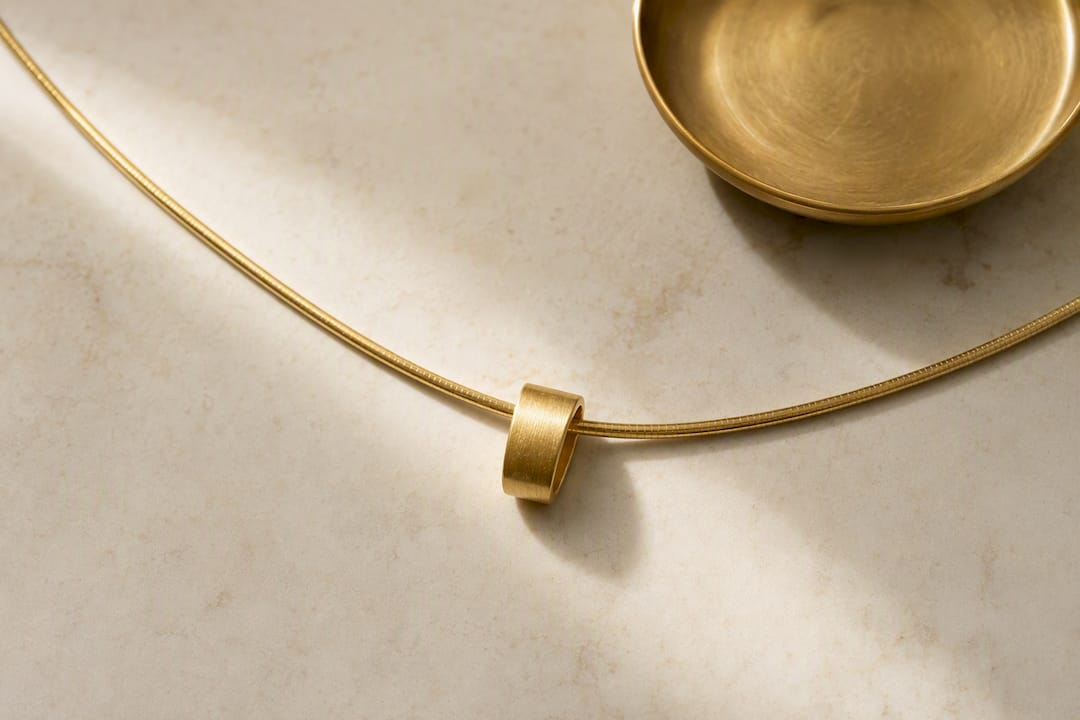
Skip omega if you want a chain that layers or drapes naturally. It’s a specialist’s choice, built for one job: showcasing a slide pendant cleanly.
How to Choose the Right Gold Chain
Picking a chain isn’t just about the pattern you like best. Construction, purity, width, and length all interact, and getting one wrong undercuts the others. Here’s the practical checklist we walk customers through.
Solid versus hollow is the single biggest durability decision you’ll make. Solid chains cost more because they use more gold, but they hold their shape under daily stress and, critically, a jeweler can reshape and resolder a dented or bent link. Hollow chains look bigger for less money, but a crushed link often can’t be restored because there’s no core metal left to work with. Reserve hollow construction for occasional statement pieces you’ll handle carefully, not for a chain you’re wearing every day.
Gold purity matters more than most shoppers expect. BlueStone’s chain guide recommends 18K over 22K for chains that see daily wear or carry diamonds, since 18K offers better tensile strength than the softer, higher-purity 22K alloy. If you’re set on a warmer, richer tone and don’t mind extra care, 22K is workable for lighter, occasional pieces. Our 18K gold chain collection balances that strength with a rich color, while 14K options trade a shade of warmth for even greater everyday durability and a lower price point.
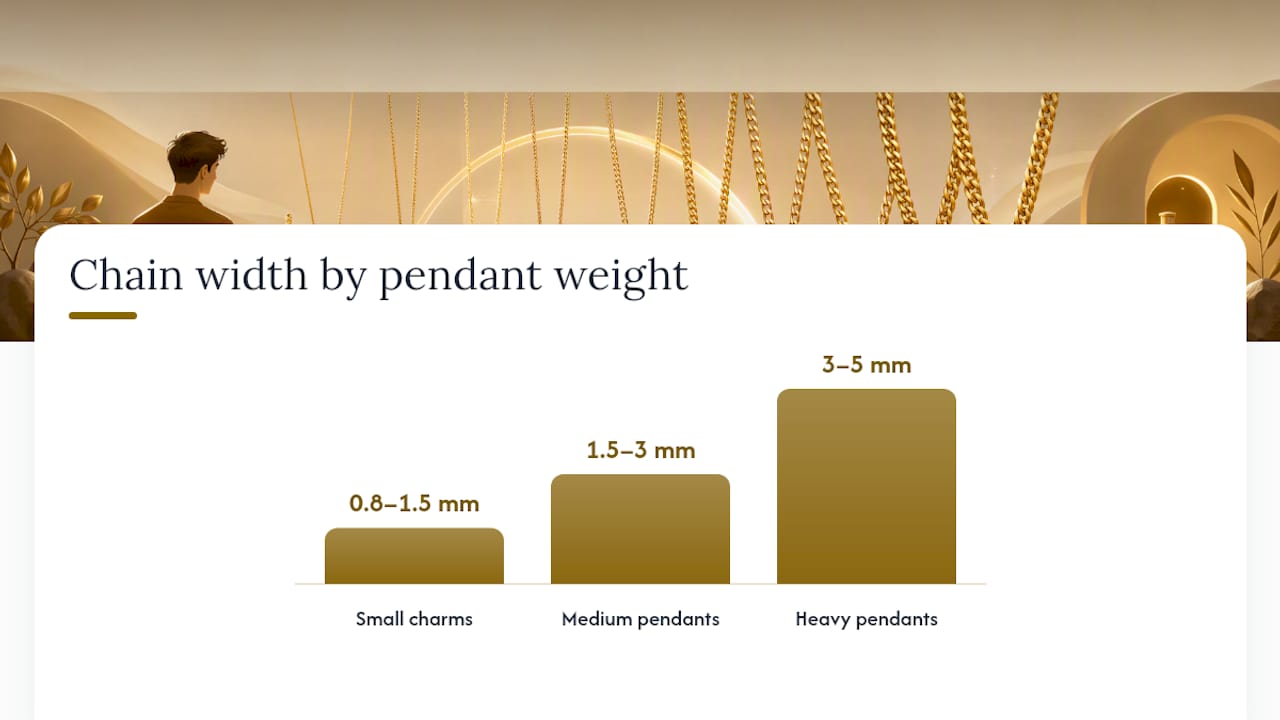
Width and length follow fairly consistent rules across the trade. Small charms pair well with 0.8 to 1.5mm chains; medium pendants call for 1.5 to 3mm; heavy pendants need 3 to 5mm to avoid looking overwhelmed or straining the links, guidance detailed in JewelryShopping.com’s 14K buying guide. For length, 16 to 18 inches sits at the collarbone, 20 inches is the standard pendant length that works for most body types, and 24 inches or longer reads as a layering or statement length.
Here’s the shortlist to run through before you buy:
- Confirm solid versus hollow construction in the product description, not just the photo.
- Match the width to your pendant’s weight, not just its visual size.
- Choose 18K if the chain will see daily wear or carry diamonds; consider 14K for durability on a budget.
- Pick a lobster clasp for anything heavier than a light layering chain; it holds up better under repeated use than a spring ring.
- Ask directly whether the chain is machine-made or hand-finished, since hand-finished links often resist wear better at the same gauge.
Pro Tip: If a listing doesn’t specify link construction, ask the seller directly whether the chain is solid or hollow before you buy. “Making charges” and gauge descriptions can obscure this detail, and it’s the one factor that determines whether your chain can be repaired later.
Caring for Your Gold Chain
A little routine care extends any chain’s life by years. Store chains flat or hanging separately, since tangling in a jewelry box is how most kinks happen in the first place. Remove your chain before swimming, showering, or sleeping, and wipe it down with a soft cloth after wear to keep body oils from dulling the shine.
Check periodically for worn or stretched links, especially near the clasp, which takes the most daily stress.
- Solid chains with worn or bent links can usually be repaired by resoldering.
- Hollow chains with crushed or dented links often can’t be restored to their original shape.
- Herringbone and snake chains that kink sharply are frequently beyond repair, given their flat or tube construction.
If you spot damage, take the chain to a jeweler and ask three questions: is this link solid or hollow, can it be resoldered without weakening the surrounding links, and will the repair affect the chain’s overall shape. Pro Tip: A jeweler who can answer all three without hesitation is one you can trust with the repair.
Why This Guide Reflects How We Build Chains
We’ve built chains in-house since 1999, which means we’ve seen firsthand which weaves actually hold up and which ones look better in a display case than on a wrist. Our Design Your Own Chain option lets you pick solid 14K or 18K gold, the exact width and length this guide recommends, and a clasp built for how you’ll actually wear it. Every chain we make uses ethically sourced gold, and it’s backed by the same trust that’s earned us more than 222 five-star Google reviews. If you’re ready to apply what you just learned, ordering a custom solid Franco or box chain at 2.5 to 3mm is a great place to start.
— Joseph
Ready to Build Your Own Gold Chain
Choosing between box, Franco, curb, and wheat is a lot easier when you’re not stuck picking from whatever a display case happens to have in stock that day. Usajewels lets you design your own chain from scratch, choosing solid 14K or 18K gold, the exact width and length this guide recommends, and a clasp rated for how you’ll actually wear it, all made in-house without a retail markup driving up the price.

Some sellers offer a 30-day money-back guarantee and have experience building chains refined over years, supported by customer reviews. Whether you want a solid 18K Franco for daily wear or a heavier Cuban curb as a standalone statement, our gold chain collection is where to start browsing, or you can jump straight into building your own from the Design Your Own Chain page and specify the exact construction, width, and length this guide recommends.
Sources
- Jewellery chain — Wikipedia
- Long Chain Designs 2026: 15 Trending Gold Styles & Length Guide | BlueStone
FAQ
What are different types of chains called?
The major gold chain types include cable, rolo (also called Belcher), box (also called Venetian), rope, figaro, curb (also called Cuban), franco, Singapore, wheat (also called Spiga), byzantine, snake, herringbone, and omega. Each name describes a distinct link pattern, and several styles go by two common names depending on the retailer, according to Wikipedia’s jewelry chain reference.
What is the best type of gold for a chain?
For daily wear or chains that carry diamonds, 18K gold offers a stronger balance of durability and richness than 22K, which is softer and more prone to bending, per BlueStone’s chain durability analysis. 14K is a durable, budget-friendly alternative if you’re prioritizing everyday toughness over deeper color, and you can compare both in our 14K and 18K chain collections.
What are 10 different types of necklaces?
Common gold chain necklace styles include cable, rolo, box, rope, figaro, curb (Cuban), franco, Singapore, wheat (Spiga), and byzantine, with snake, herringbone, and omega as additional flat or specialty options. Each style varies in durability and pendant suitability, so the right pick depends on whether you’re wearing it standalone or with a charm.
What is the most popular gold chain style?
Curb (Cuban link) and box chains rank among the most consistently popular styles, prized for their durability and versatility across both standalone wear and pendant support. Franco and wheat chains have also grown in popularity for their flexibility and pendant-friendly profiles, a trend reflected in BlueStone’s roundup of trending chain styles.
Which gold chain is best for holding a pendant?
Box, cable, wheat, and franco chains are generally the best pendant carriers because their tight, uniform links keep a bail secure without twisting the pendant out of place. A 2.5 to 4mm width at 20 inches is a commonly recommended pairing for medium to heavy pendants, according to JewelryShopping.com’s buying guide.
Recommended
- Chain Buyers Guide | How to Choose Gold Chains
- Gold Chains | 14K & 18K Necklace Chains
- 18K White Gold Chains, Inspired by Beauty
- Men’s Gold Chains | 14K & 18K Solid Gold

Deep Mehta is the Co-Owner of USA Jewels, a family-owned jewelry business she has led since 2013 in Deerfield Beach, Florida. With over 13 years of hands-on experience in fine jewelry retail, manufacturing, and diamond importing, Deep specializes in engagement rings, wedding bands, and custom jewelry design. She also co-manages Kaash Group Talent Acquisition. Deep is a University of Florida graduate and oversees every aspect of USA Jewels’ operations, from product development to marketing.
Fine Jewelry Collection

You May Also Like

How Jewelry Personalization Options Work for Gifts

Anniversary Jewelry Milestone Gifts That Last a Lifetime