Lab Diamond Sustainability: What the Evidence Shows
A lab-grown diamond can be a lower-impact choice, but how much lower depends mostly on the electricity that powered the lab and on the proof behind the claim. Lab growing avoids digging up land and moving tons of rock. It still uses a lot of energy. So the honest answer to “is it sustainable?” is: often, when the grower can show you where the power came from. Below, we walk through what the research says, where the numbers disagree, and what to ask for at checkout.
TL;DR
- Lab growing produces very little mineral waste, while mining moves a great deal of earth. One industry report estimates 2.63 tonnes of mineral waste per carat for mining.
- The big variable for lab diamonds is electricity. Coal-heavy grid power and clean power produce very different footprints.
- Carbon figures differ widely between studies, and many are commissioned by one side of the industry. Treat a single number with care.
- Ask for specifics: the energy source, the growth method, an independent grading report, and the full scope of any emissions claim.
- Sustainability and ethics are related but not the same. Conflict-free sourcing and low emissions are two separate questions.
Table of Contents
- How a lab-grown diamond is made, and where the impact comes from
- Lab-grown vs. mined: the comparison, point by point
- Why the power source matters more than the label
- How to read a sustainability claim
- Sustainable is not the same as ethical
- Beyond the stone: the rest of the ring
- Perspective: how we think about it
- Design a piece you will keep
- What this means for your budget
- FAQ
- Sources
How a lab-grown diamond is made, and where the impact comes from
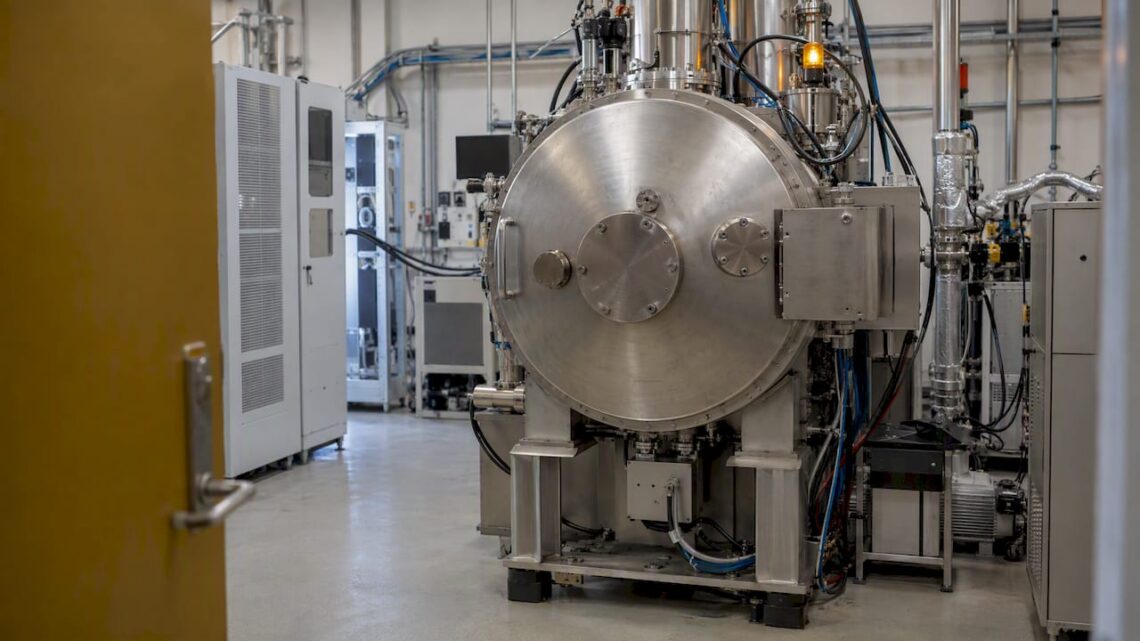
A lab-grown diamond is real diamond: carbon arranged in the same crystal structure as a mined stone. It is grown in one of two ways. High pressure, high temperature (HPHT) mimics the squeeze of the earth. Chemical vapor deposition (CVD) builds the crystal layer by layer from a carbon-rich gas. If you want the full walkthrough, our guide to how synthetic diamond creation works covers both.
The environmental footprint comes from three places:
- Energy. Reactors run hot for days or weeks. This is the largest factor and the reason the debate exists.
- Materials. An industry fact sheet notes that production needs high-grade steel for reactors, graphite and metals for HPHT, and methane and hydrogen for CVD, with methane generally sourced from fossil fuels. That report comes from the natural diamond trade, so read it as one perspective, but the inputs it lists are the ones to ask a grower about.
- Cutting and polishing. Both lab and mined stones are cut and polished, so this step is a wash between them.
Mining has its own list: land disturbance, water use, waste rock, fuel for heavy equipment and, in some regions, community and labor concerns.
Lab-grown vs. mined: the comparison, point by point
No single number settles this. Here is how the main categories line up.
| Factor | Mined diamond | Lab-grown diamond |
|---|---|---|
| Land disturbance | Open pits and large footprints | Small facility footprint |
| Mineral waste | Estimated at 2.63 tonnes per carat in one industry report | Minimal mineral waste |
| Water | Varies by mine and has improved at some operators | Used for cooling and cutting; varies by facility |
| Energy and carbon | Diesel, machinery and processing | Depends heavily on the grid or power source |
| Traceability | Depends on the supply chain | Can be documented from one facility |
Land and waste
This is where lab growing has the clearest advantage. Imperial College London’s Gbemi Oluleye describes substantial land and water impacts from mining and suspects mined diamonds are losing the greenhouse-gas comparison too. A lab facility sits on a small plot, and it does not leave behind tailings or open pits.
Water
Water is less one-sided than you may expect. Mining has been improving. A peer-reviewed analysis found that one major producer’s reported water intake fell more than fivefold, from 0.676 to 0.125 cubic meters per carat over seven years. That is a single operator, so it does not describe every mine. It does show that a claim about water needs the operator’s name and the year attached.
Carbon
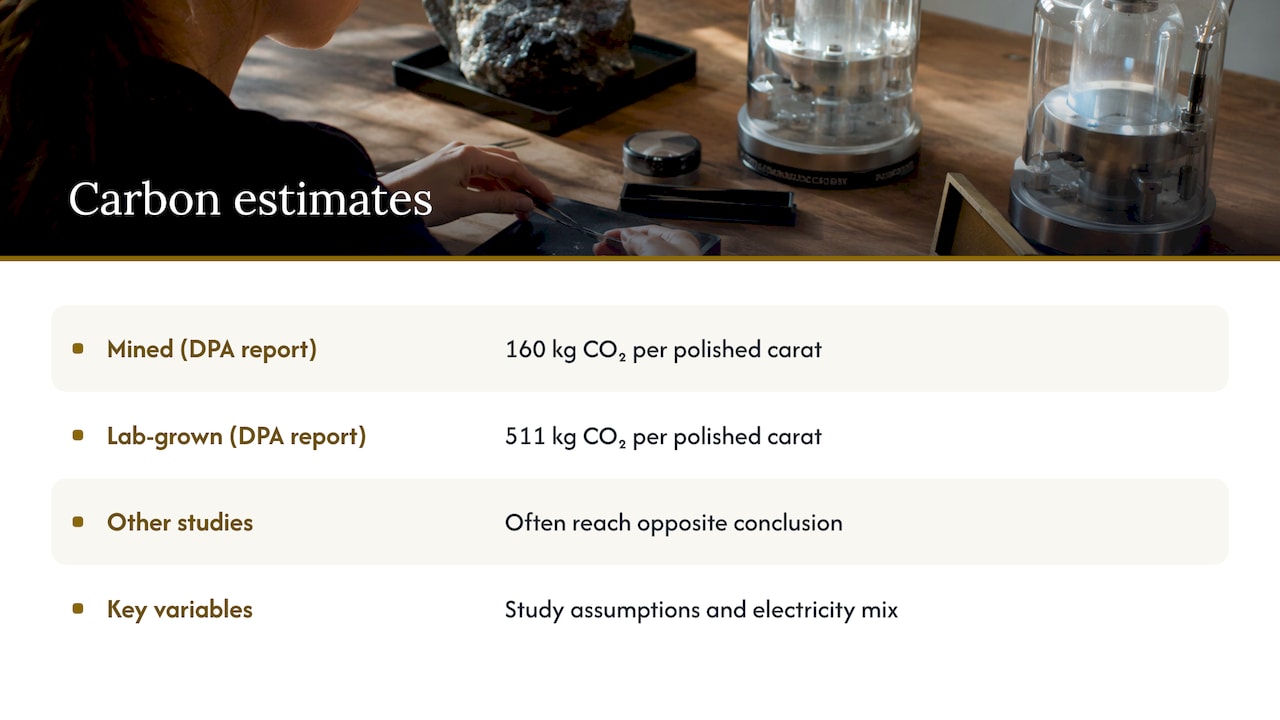
This is the most contested number. A report commissioned by the Diamond Producers Association, a mined-diamond trade group, put mined diamonds at 160 kg of CO2 per polished carat and lab-grown at 511 kg. Other studies, often funded by lab-grown producers, reach the opposite conclusion. When each side funds its own research, the fair reading is that the answer depends on assumptions: which mines, which labs, which grid.
The assumption that moves the result most is electricity. A lab running on coal-heavy grid power and a lab running on hydro, solar or wind are not the same product environmentally, even if the stones look identical under a loupe.
Why the power source matters more than the label
Because growing is energy-intensive, two lab diamonds can have very different footprints. Three things shape the result:
- Where the lab is. Grids differ a great deal from region to region.
- Whether the lab buys or generates clean power. A facility with its own renewable supply, or a long-term clean power contract, changes the math.
- The growth method. HPHT and CVD use energy differently, and growers keep improving. Researchers note that advances in diamond synthesis can reduce production costs and increase output, and efficiency gains often cut energy per carat along the way.
It is the same logic you would use for any product. A claim is only as strong as the material and energy behind it. The question applies to a pair of jeans just as it does to a ring: this look at sustainable jeans materials shows how much the details behind the word “sustainable” matter.
How to read a sustainability claim
There is no single rulebook for the word. The Association for Intelligent Diamond International notes that sustainability claims in jewelry lack a common standard, much like the early days of organic food labeling, so terms like “sustainable” and “ethical” get used inconsistently. In the EU, the CSRD requires companies that meet its criteria to disclose sustainability data, including auditable Scope 1, 2 and 3 emissions, per the same report. The US has no equivalent jewelry-specific disclosure rule that we know of, which leaves it to you to ask good questions.
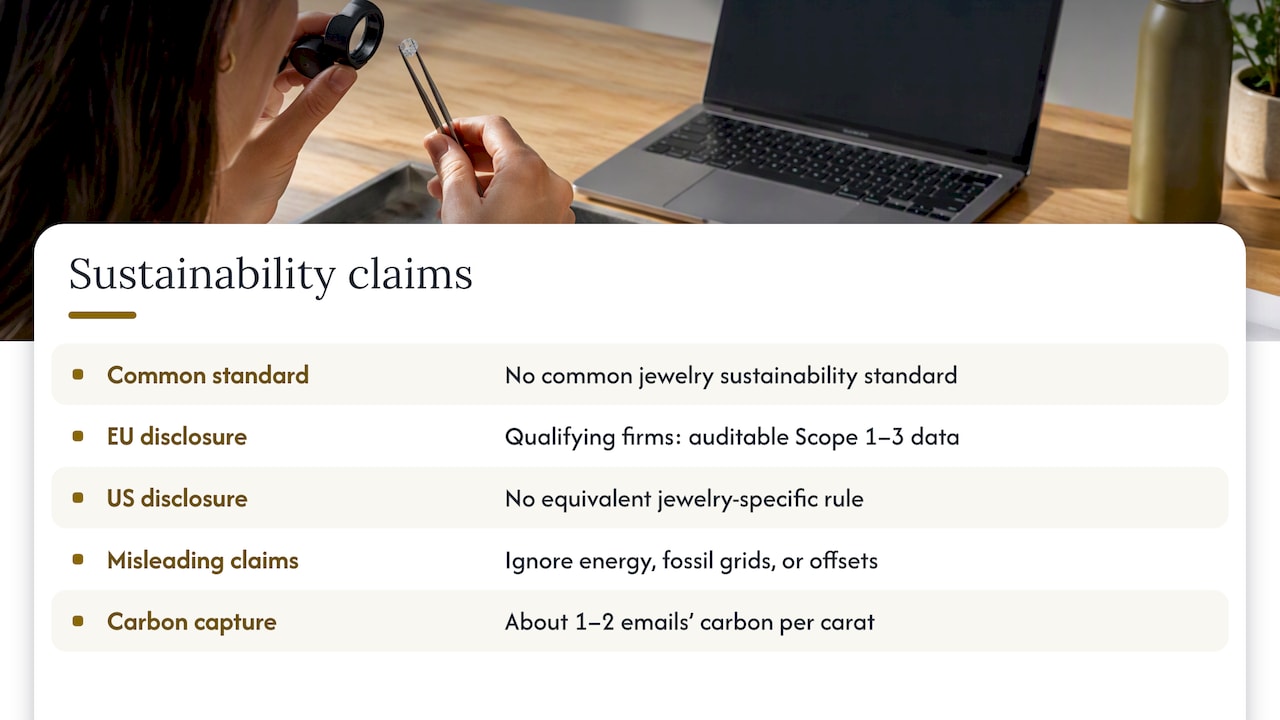
A trade report on lab-grown diamonds warns that claims can mislead if they ignore energy-intensive manufacturing, rely on fossil-fuel grid electricity, or lean only on carbon offsets instead of cutting emissions at the source. The same report says the carbon captured in some lab-grown processes is tiny next to the emissions, about the carbon in sending one or two emails per carat. A claim that leans on that kind of capture is not telling you much.
Five questions to ask any jeweler
- What powered the growth? A named source (hydro, solar, grid) is a better answer than “eco-friendly.”
- Which method was used, HPHT or CVD? A seller who knows its stones can tell you.
- What does the claim cover? Is it about the growing only, or the whole path from reactor to your door?
- Are offsets doing the work? Offsets are not the same as using less energy.
- Is the stone graded independently? A grading report tells you what the stone is, so you are not buying on adjectives. Our diamond certification guide explains how the major labs compare.
A note on wording
In the US, the FTC’s Jewelry Guides let sellers describe these stones as laboratory-grown, laboratory-created or by the manufacturer’s name followed by “created”. The revised Guides also dropped the word “natural” from the definition of a diamond, since a diamond can now be made in more than one way. If a seller avoids the plain term “lab-grown,” ask why.
Sustainable is not the same as ethical
Many shoppers use the two words as if they were one. They are different questions.
- Sustainability asks about environmental impact: energy, land, water, waste.
- Ethics asks about people and sourcing: working conditions, conflict, traceability.
A stone can do well on one and say nothing about the other. If conflict-free sourcing matters to you, our buyer’s guide to conflict-free vs. lab-grown diamonds separates the two. For how we think about production standards, read how lab-grown diamonds are ethically produced. And if you are still weighing the choice itself, the lab-grown vs. natural diamonds guide lays the two out side by side.
Beyond the stone: the rest of the ring
A diamond is only part of a piece of jewelry. The metal, the setting and how long the piece lasts all count too.
- Durability. A piece you wear for decades and never replace has a smaller footprint over time than one you swap out. Solid construction, rather than hollow or plated, is part of why we build the way we do.
- Metal. Gold and platinum can be recycled and reworked. If you have an old family piece, ask your jeweler whether the metal can be reused in a new design.
- Upgrades. Rather than discarding a ring when tastes or budgets change, a lifetime diamond upgrade program lets you step up the stone without starting from scratch.
Those are choices about how much you buy over a lifetime, and they matter as much as any single carbon figure.
Perspective: how we think about it
We have made jewelry since 1999, and the question we hear most from couples today is, “Which one is better for the planet?” We would rather give you a straight answer than a slogan.
Here is ours. A lab-grown diamond leaves behind far less disturbed land and waste rock, and for many buyers that is reason enough to choose one. Growing a diamond takes real energy, though, so the best question is not “is it green?” but “how was it made, and can you show me?” That is the kind of question we welcome.
Because we manufacture in-house as a family business, we can speak plainly about how our pieces are built: solid, never hollow or plated, with certified diamonds, whether natural or lab-grown, that we select with care. Our diamonds are ethically sourced and conflict-free, and every stone comes with a lifetime upgrade option, so the ring you buy now can grow with you instead of being replaced.
Choosing a piece you will wear for life is one of the most sustainable decisions in jewelry. We would be glad to help you make it.
Joseph
Design a piece you will keep
If you want to put these ideas into practice, you can see certified natural and lab-grown stones side by side. Our certified loose diamonds start at $142, and you can pair one with the metal and setting you prefer.

Prefer to build the whole piece? Our design-your-own tools let you choose the diamond shape, quality and metal, with rings starting at $399. Shipping is free and insured, and every order has a 30-day money-back guarantee. For help with the steps, see our design-your-own engagement ring guide, or browse engagement rings starting at $346.
What this means for your budget
Sustainability and price are linked in a way many buyers find helpful. Lab-grown stones usually cost less than natural ones of similar size and quality, so the same budget can buy more carat weight or a better-graded stone. Our price guide on why lab-grown diamonds cost less explains the reasons. If you want to compare value more broadly, see whether lab-grown diamonds are worth it.
A practical way to decide:
- Set your total budget first.
- Decide which matters most: size, grade, origin or environmental impact.
- Ask for the grading report and the origin details before you pay.
- Choose a metal and setting built to last, so you are not rebuying in ten years.
If you want to check who you are buying from, our guide on how to choose a certified ethical diamond jeweler gives a checklist, and our overview of three ways to an ethical engagement ring you can verify walks through the options.
FAQ
Are lab-grown diamonds better for the environment than mined diamonds?
In land use and waste, yes: lab growing avoids open pits and large volumes of waste rock. On carbon, it depends on the electricity that powers the lab, and studies disagree. The best choice is a stone whose seller can tell you how it was grown.
Do lab-grown diamonds use a lot of energy?
Growing a diamond takes sustained heat and pressure or a controlled gas chamber, so energy use is real. Its carbon impact depends on whether that power comes from fossil fuels or renewable sources. Ask the seller what the source was.
Is “sustainable” a regulated term for diamonds?
Not as a single standard. Industry groups point out that sustainability claims in jewelry lack a common standard, so the word can mean different things from seller to seller. Look for specific, checkable details rather than the word alone.
Are lab-grown diamonds conflict-free?
Lab-grown stones are made in a facility, so they do not come from a mine. Conflict-free is a sourcing question, and it is still worth asking any seller to explain its policy. We provide ethically sourced, certified stones, natural and lab-grown, and we are happy to talk through how we select them.
Can I upgrade my diamond later?
With us, yes. Our lifetime diamond upgrade program lets you trade up to a larger or higher-grade stone later. It also means you keep wearing and building on one piece instead of replacing it.
Sources
- Diamond Facts report (Natural Diamond Council)
- Are synthetic diamonds really better for the planet? (National Geographic)
- A Comparative Analysis of Energy and Water Consumption (MDPI Energies)
- Report reveals lab-grown diamonds’ carbon footprint (The Jewellery Editor)
- Comparative analysis: CapEx in diamond mining versus lab-grown (PMC)
- AIDI annual report
- Laboratory-Grown Diamond Facts report
- New FTC Jewelry Guidelines Made Simple (National Jeweler)
- Sustainable jeans materials (NYDJ)
Recommended
- How Lab-Grown Diamonds Are Ethically Produced
- Conflict-Free Diamond vs Lab Grown: Buyer’s Guide
- Lab-Grown vs Natural Diamonds Guide
- Pick One of 3 Paths to an Ethical Engagement Ring You Can Verify

Deep Mehta is the Co-Owner of USA Jewels, a family-owned jewelry business she has led since 2013 in Deerfield Beach, Florida. With over 13 years of hands-on experience in fine jewelry retail, manufacturing, and diamond importing, Deep specializes in engagement rings, wedding bands, and custom jewelry design. She also co-manages Kaash Group Talent Acquisition. Deep is a University of Florida graduate and oversees every aspect of USA Jewels’ operations, from product development to marketing.
Fine Jewelry Collection

You May Also Like

Why 14K Gold Is Popular for Kids’ Jewelry
Safety Clasps for Children’s Fine Jewelry: A Parent’s Guide