Crown Angle vs Pavilion Angle: What Each Does for a Diamond
The crown angle is the slope of the top of a diamond, and it mostly shapes fire and the face-up look. The pavilion angle is the slope of the bottom, and it mostly decides how much light returns to your eye instead of leaking out. Neither works alone. A diamond sparkles when the two are matched, which is why a strong cut grade matters more than any single number.
We have been hand-selecting diamonds for families since 1999, and these two angles come up in almost every conversation with a couple choosing a stone. Here is what they mean, how they are measured, and how to use them without needing a trigonometry degree.
TL;DR
- The crown angle is the angle between the crown’s bezel facets and the table plane. The pavilion angle is the angle between the pavilion main facets and the table plane.
- Crown angle has a large effect on a round brilliant’s face-up appearance and its fire. Pavilion angle controls brightness and light leakage.
- For round brilliants, GIA says crown angles of 32 to 36 degrees look bright and fiery when paired with the right table and pavilion angle.
- Always judge the two angles together, with table size, depth and the overall cut grade on a lab report.
Table of Contents
- What the two angles actually are
- How each angle is measured
- What the crown angle does
- What the pavilion angle does
- Crown angle vs pavilion angle at a glance
- Ideal crown and pavilion angles for a round brilliant
- Why you should read them together with table and cut grade
- How to use this when you shop
- Natural or lab-grown: do the angles change?
- Our perspective
- Find a well-cut diamond with us
- FAQ
- Sources
What the two angles actually are
Picture a round brilliant diamond from the side. The flat top is the table. Above the widest edge (the girdle) sits the crown, the upper section with its sloping facets. Below the girdle sits the pavilion, the deeper section that tapers to a point at the bottom.
Per GIA’s anatomy of a round brilliant, the crown angle is measured between the bezel facet and the plane of the table. The pavilion angle is measured between the pavilion main facet and that same table plane. Both are measured in degrees, so they are true angles, not percentages like table size or depth.
A quick way to remember it:
- Crown angle: the top slope. It affects how light enters and how it breaks into color on the way out.
- Pavilion angle: the bottom slope. It affects whether light bounces back up toward you or escapes through the sides and bottom.
How each angle is measured
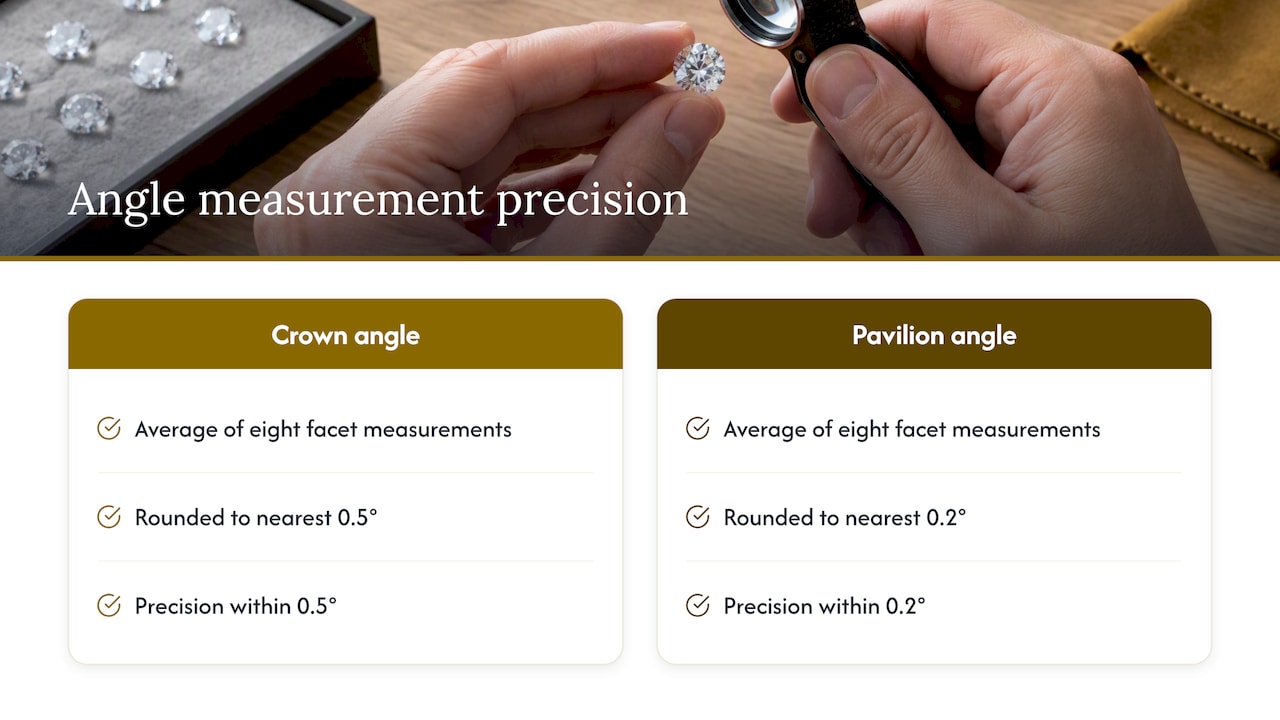
No diamond has a perfectly uniform angle all the way around. A round brilliant has eight bezel facets and eight pavilion main facets, so graders average them. GIA reports each angle as the average of eight individual facet measurements, with the crown angle rounded to the nearest 0.5 degrees and the pavilion angle to the nearest 0.2 degrees.
That difference in rounding is telling. The pavilion angle is reported more finely because small changes there matter more. Professional cut grading calls for high-precision readings, within 0.5 degrees for the crown and 0.2 degrees for the pavilion.
You do not need to measure anything yourself. Reputable labs and sellers publish proportion data for each stone. If you are curious about the math, one trade magazine explains how angles can be derived from depth and percentage figures with a scientific calculator, which is a handy consistency check, not a shopping requirement.
What the crown angle does
The crown is the first thing light meets. According to GIA’s diamond anatomy overview, crown angle has a large effect on a round brilliant’s face-up appearance. It gives light a route to leave the stone as dispersion and offers additional contrasting directions for entering light.
In plain terms, the crown facets act like small prisms. They split white light into spectral colors that flash in all directions, which is the fire you see as flashes of red, blue and orange.
Lower vs higher crown angles
- A shallower crown spreads the top out and often shows a larger-looking table. Light can look broader and softer, with less colored flash.
- A steeper crown tends to push more light into colorful, scattered flashes, but pushed too far it can make a stone look smaller across the top.
Fire is not produced by one number. Optics research from GIA’s materials explains that fire depends on exit angle, entry angle, the number of internal facet interactions and dispersion across facet junctions. The same source notes that the surrounding lighting matters too. This is why a diamond can look livelier in a jeweler’s spotlights than in a dim restaurant.
What the pavilion angle does
The pavilion works like a mirror system. Light that enters through the crown travels down and should reflect off the pavilion facets and back up through the table. If the angle is off, light exits through the bottom or sides instead.
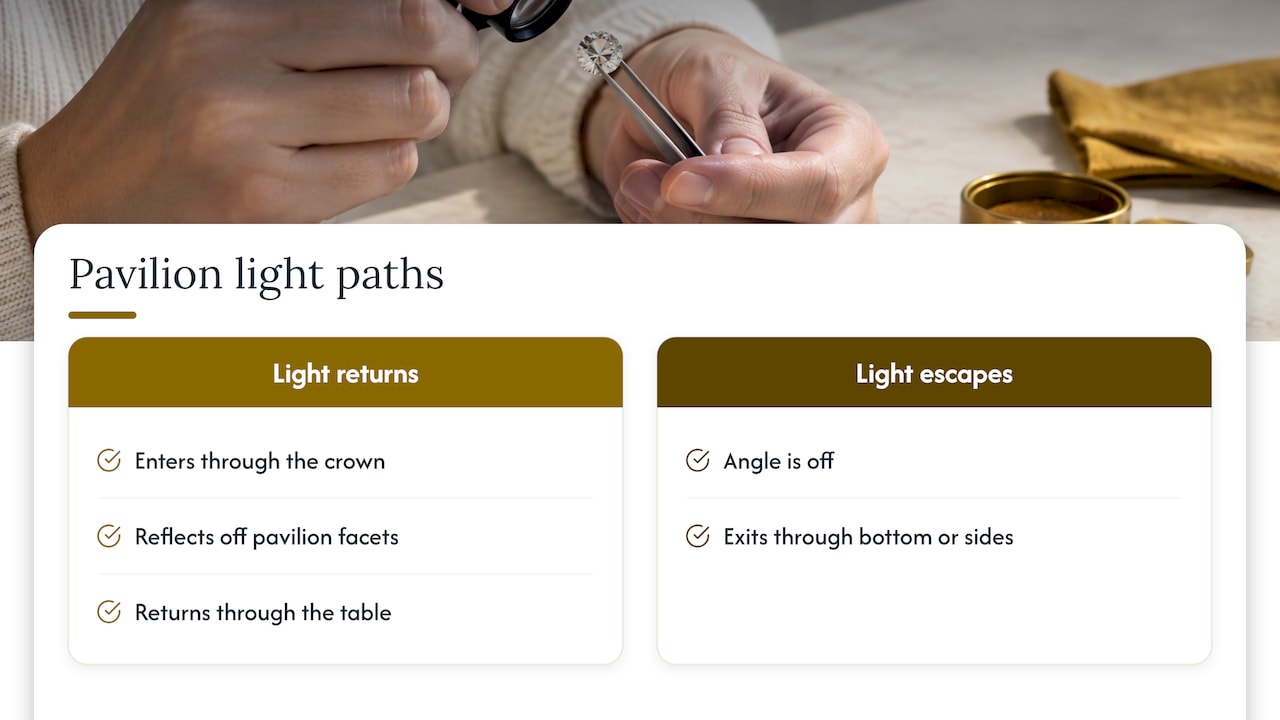
GIA notes that subtle pavilion angle differences can significantly change a diamond’s face-up appearance, and steep pavilion angles can produce dark areas under the table. That dark center is sometimes called a “nailhead” effect, and it is one of the main reasons two diamonds with the same carat weight and color can look so different.
Why small differences count
The tolerance on this angle is tight. Within GIA’s cut grading system, the highest grade a round brilliant can reach with a 40.4 degree pavilion angle is Very Good. A difference of a fraction of a degree can separate tiers. That is why the pavilion is often called the engine of light return.
Crown angle vs pavilion angle at a glance
| Crown angle | Pavilion angle | |
|---|---|---|
| Location | Above the girdle | Below the girdle |
| Measured against | The table plane | The table plane |
| Reported to the nearest | 0.5 degrees | 0.2 degrees |
| Main visual role | Fire and face-up character | Brightness and light return |
| Risk when off | Less colorful flash, odd proportions | Dark areas, light leakage |
| Sensitivity | Large effect, wider tolerance | Small shifts matter a lot |
The row on sensitivity is a practical reading of the figures above, not a rule: the pavilion is reported more finely and caps grades at tight values, so it deserves close attention.
Ideal crown and pavilion angles for a round brilliant
For the crown, GIA’s guidance is that angles from 32 to 36 degrees produce attractive, bright and fiery diamonds, as long as they are combined with the right table percentage and pavilion angle. That last clause is the key. There is no single magic crown angle.
You will find forum posts and cut-focused sites quoting much narrower “ideal” windows, such as a crown in the mid-30s paired with a pavilion near 41 degrees. Those are useful starting points for hunting, but they are community conventions, not a rule every beautiful stone must meet. A stone slightly outside them can still be lovely when the other proportions compensate.
The reason is that the angles interact. Roughly speaking:
- A steeper crown can be balanced by a slightly shallower pavilion, and the reverse.
- A larger table usually pairs with a different crown angle than a smaller one.
- Depth changes with both angles, so a depth figure can flag a mismatch quickly. Our guide to verifying table and depth before you buy walks through the ranges.
The optics research agrees that specific combinations of crown and pavilion angles are optimized for the best sparkle, and that a precise crown, a mid-range pavilion and a small culet go together in high-quality sparkle.
Why you should read them together with table and cut grade
The GIA cut grading system for round brilliants uses a combination of proportion parameters, crown and pavilion angles among them, to produce an overall grade. GIA also publishes an estimating chart showing how cut grade depends on table size, crown angle and pavilion angle.
That chart shows what happens with a poor match. A stone with a shallow crown and pavilion looks dark and flat, which is why GIA’s example for a Fair grade pairs a low crown angle with a shallow pavilion. It is the combination that fails, not one angle in isolation.
A worked example
Imagine two round diamonds, both one carat, both the same color and clarity.
- Stone A: crown angle in the mid-30s, pavilion angle in the low 40s, table in a moderate range. The report shows an Excellent cut grade. It looks bright in the center, with lively flashes at the edges.
- Stone B: a shallower crown and a steeper pavilion. The report shows a lower cut grade. Under the table, it can show a darker core, and the stone may look dull next to Stone A.
On paper they match on three of the four Cs. In person, Stone A looks like the more valuable stone. Cut is the C that creates the sparkle, and these two angles are most of the story.
How to use this when you shop
You do not need to chase decimals. Use the angles as a filter, not a goal.
- Start with the overall cut grade. For a round brilliant, stay in the top grades. Our diamond cut guide explains each tier.
- Open the report and check the crown and pavilion angles. Look for a crown inside the 32 to 36 degree zone and a pavilion that is not noticeably steep.
- Check table and depth. If the angles look fine but the depth is far off, ask why.
- Choose a reputable lab report. Our certification comparison covers how the major labs differ.
- Look at the stone, or ask for close images and video. Numbers narrow the field. Your eyes make the final call.
If you are choosing between shapes, remember that these angle conventions are written for the round brilliant. Fancy shapes such as princess, oval and emerald cuts follow different rules. Our diamond shapes guide and round brilliant guide cover what to look for in each, and the cut comparison for engagement rings puts them side by side.
Natural or lab-grown: do the angles change?
No. The geometry is the same. A natural stone and a lab-grown stone of the same shape are cut with the same facets, and the same angle logic applies to both. What differs is origin and price, which our lab-created diamonds guide explains. If you are buying lab-grown, it is smart to be even more particular about cut, because it is the one factor you control completely.
Our perspective
We are a family-owned jeweler, and we make our pieces in-house. That means we handle a lot of diamonds, and we have learned that the numbers on a report only tell part of the story. A stone can sit inside every recommended range and still not be the one that makes a person smile when it catches the light.
Here is how we advise couples:
- Treat the cut grade as your first screen, then use crown and pavilion angles to compare finalists. Do not pay extra for decimals when your eye cannot see them.
- Spend on cut before you spend on size. A slightly smaller stone with a well-matched crown and pavilion often looks bigger and brighter than a larger one that leaks light.
- Ask us. We hand-select our stones and will tell you honestly if one on your shortlist is a better candidate than another.
- Design it around the stone. The setting should show off the diamond, not hide a weak cut. Solid construction, not hollow or plated, is how we build every piece.
A diamond ring is often the first piece of jewelry that tells a couple’s story. We want the stone at the center to be one you can trust for decades, and our lifetime diamond upgrade program means you are not locked into your first choice forever.
— Joseph
Find a well-cut diamond with us
When you are ready to put this into practice, you can browse certified loose diamonds, with prices from $142, and compare certified natural and lab-grown options by shape, color, clarity and cut. Prefer to build the whole ring? Our design-your-own diamond ring tool starts at $399 and lets you choose the diamond shape, quality and metal. Ready-made engagement rings start at $346.

Every order ships free and insured, and our 30-day money-back guarantee lets you see the diamond in person before you commit. If you want a walkthrough first, our design your own engagement ring guide takes you step by step.
FAQ
Which matters more, crown angle or pavilion angle?
The pavilion angle is usually the more sensitive of the two, because small changes there can cause light leakage or dark areas under the table. The crown angle strongly shapes fire and face-up appearance. Neither wins on its own, so judge them as a pair along with table size and the overall cut grade.
What is the ideal crown angle for a round diamond?
GIA says crown angles from 32 to 36 degrees produce attractive, bright and fiery round brilliants when combined with the right table percentage and pavilion angle. Within that zone, the best figure depends on the rest of the proportions. Look at the whole report, not one number.
Can a diamond have an Excellent cut grade with different angles?
Yes. Several combinations of crown angle, pavilion angle and table size can earn a top grade, because the angles balance each other. That is why two Excellent stones can look slightly different, and why it helps to view images or the stone itself before choosing.
Do crown and pavilion angles apply to princess or emerald cuts?
The ranges quoted here are for the round brilliant. Other shapes have their own facet patterns and proportion rules. For those, start with the shape guides for princess and emerald cuts.
Where do I find these angles for a specific diamond?
They appear in the proportions section of a grading report, or in the stone’s listing data. If a listing does not show them, ask the seller to provide them before you buy.
Sources
- Diamond Cut: Anatomy of a Round Brilliant (GIA)
- Diamond Anatomy, Explained (GIA 4Cs)
- Modern Diamond Cut Grading Methods (International Gem Society)
- Diamond Math for the Trig Challenged (JCK)
- Diamond Optics Part 2: Light Dispersion (GIA)
- Maximizing the Sparkle of a Diamond (Illinois Science Council)
- GIA Diamond Cut Grading System cover letter
- Estimating Cut Grade chart (GIA)
Recommended
- Diamond Cut Comparison Guide for Engagement Rings
- Diamond Shapes Guide: Every Shape Compared
- 59–62.6% Depth: Verify Diamond Table and Depth Before You Buy
- Princess Cut Diamond Guide: Modern Square Brilliance

Deep Mehta is the Co-Owner of USA Jewels, a family-owned jewelry business she has led since 2013 in Deerfield Beach, Florida. With over 13 years of hands-on experience in fine jewelry retail, manufacturing, and diamond importing, Deep specializes in engagement rings, wedding bands, and custom jewelry design. She also co-manages Kaash Group Talent Acquisition. Deep is a University of Florida graduate and oversees every aspect of USA Jewels’ operations, from product development to marketing.
Fine Jewelry Collection

You May Also Like
Hypoallergenic Jewelry Metals: Why Nickel Release Beats Labels
How Lab-Grown Diamonds Are Ethically Produced