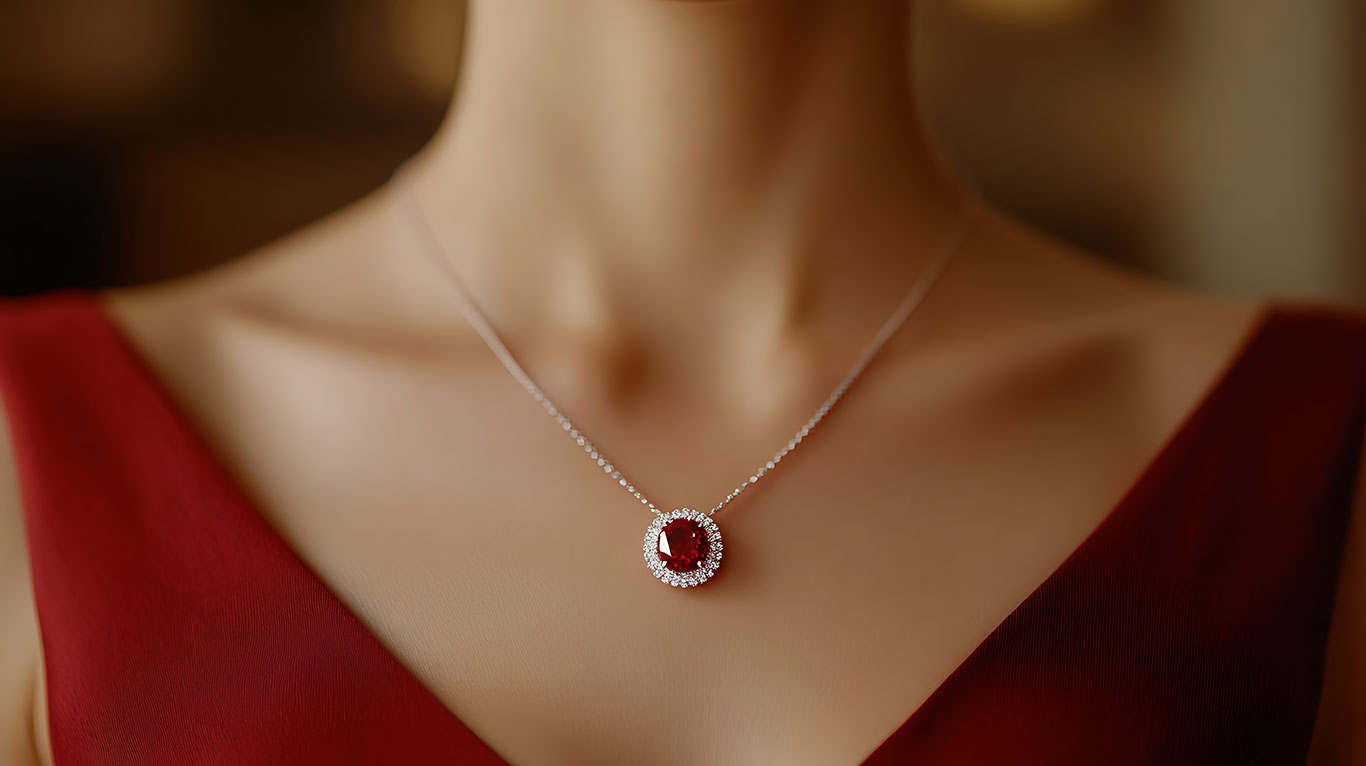
Ruby
| Property | Details |
|---|
| Mineral | Corundum |
| Mohs Hardness | 9 |
| Refractive Index | 1.762 – 1.770 |
| Birthstone | July |
| Anniversary | 15th & 40th |
| Major Sources | Myanmar (Burma), Mozambique, Madagascar, Sri Lanka |
| Treatments | Heat treatment (standard, widely accepted) |
Overview
Ruby is the red variety of the mineral corundum and one of the four precious gemstones. Its intense red color, caused by traces of chromium, has made it a symbol of passion, power, and love throughout history. The most prized color is a vivid, medium-dark red with a slight purplish hue, known in the trade as pigeon blood red. Fine rubies from Myanmar (Burma) and Mozambique are among the most valuable colored gemstones in the world, sometimes exceeding diamonds of equal size in price.
History & Lore
The word ruby comes from the Latin rubeus, meaning red. In ancient Sanskrit, ruby was called ratnaraj, meaning king of precious stones. Ancient Hindus offered rubies to the god Krishna in the hope of being reborn as emperors. Warriors in Myanmar implanted rubies under their skin before battle, believing the stones made them invincible. In medieval Europe, rubies were believed to guarantee health, wealth, wisdom, and success in love. The legendary rubies of the Mogok Valley in Myanmar have set the standard for quality for centuries.
Color & Varieties
Ruby color ranges from pinkish-red to a deep, vivid crimson. The most valued shade is pigeon blood red—a pure red with a slight hint of blue that seems to glow from within. Rubies that are too pink may be classified as pink sapphires, while those that are too dark can appear almost black. The finest rubies combine excellent color saturation with good transparency. Star rubies display a six-pointed star effect called asterism, caused by needle-like inclusions of rutile within the stone, and are prized for their rarity and mystique.
Quality & Value Factors
Color is by far the most important value factor for rubies, accounting for roughly 60% of the stone's value. After color, clarity and transparency matter most. Unlike emeralds, where inclusions are broadly accepted, the most valuable rubies are those that combine vivid color with good transparency. However, some inclusions are expected in natural rubies—they are part of what distinguishes natural rubies from synthetics. Cut quality affects how well the ruby displays its color and brilliance. Carat weight increases value exponentially: fine rubies over 3 carats are extremely rare and command premium prices.
Treatments
The vast majority of rubies on the market have been heat-treated to improve color and clarity. This is a standard, permanent, and widely accepted practice. Some rubies are treated with lead glass filling to improve clarity, which is a less stable treatment that requires disclosure and careful handling. USA Jewels discloses all known treatments.
Care & Cleaning
Ruby ranks 9 on the Mohs hardness scale, making it exceptionally durable for all types of jewelry, including engagement rings worn daily. Rubies can be safely cleaned with warm soapy water, an ultrasonic cleaner, or a steam cleaner (unless the stone has been fracture-filled). Ruby is one of the best gemstones for active lifestyles.
Shop Ruby Jewelry
Browse our collection of ruby jewelry including rings, earrings, pendants, and bracelets featuring natural rubies set in gold and platinum.