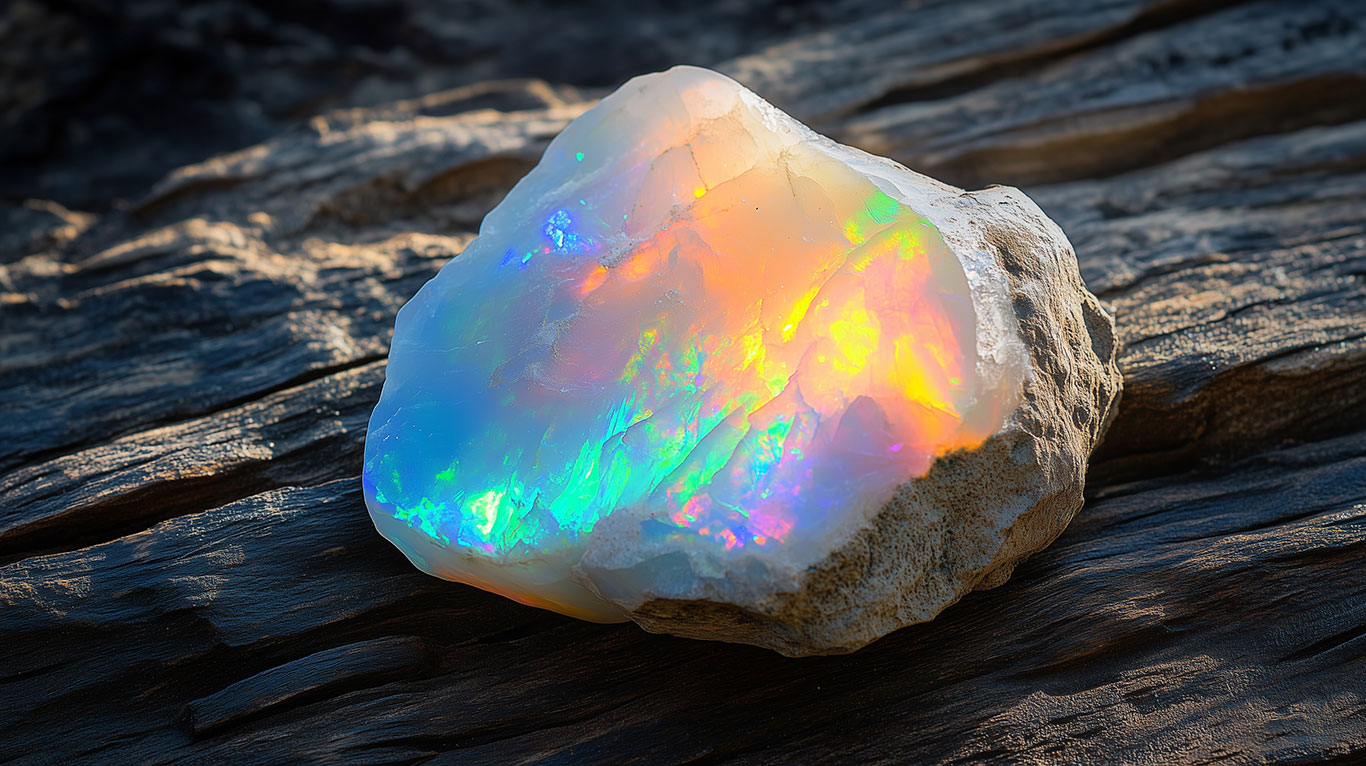
Opal
| Property | Details |
|---|
| Mineral | Hydrated silica |
| Mohs Hardness | 5.5 – 6.5 |
| Refractive Index | 1.450 (approximate) |
| Birthstone | October |
| Anniversary | 14th |
| Major Sources | Australia (95%), Ethiopia, Mexico, Brazil |
| Treatments | Smoke treatment, sugar/acid treatment, polymer impregnation |
Overview
Opal is one of the most visually spectacular gemstones, renowned for its play of color—a shifting display of rainbow hues caused by the diffraction of light through microscopic silica spheres within the stone. No two opals are alike, making each stone truly one-of-a-kind.
Varieties
Black opal: From Lightning Ridge, Australia. The rarest and most valuable, with dark body colors that dramatically showcase the play of color. White opal: Light body color with play of color; the most common precious opal. Fire opal: From Mexico, displaying vivid orange to red body colors, often faceted. Boulder opal: From Queensland, Australia, formed naturally on ironstone host rock. Crystal opal: Transparent to semi-transparent, allowing light to pass through and enhance the play of color. Ethiopian opal: A newer source producing vivid play-of-color material, sometimes hydrophane (absorbs water).
Quality & Value Factors
The most important value factor is the play of color—its intensity, range, and pattern. Red play of color against a black body is the most valuable combination. Pattern types include harlequin (large, angular patches), pinfire (tiny points), broadflash (large sweeping flashes), and rolling flash. Body tone, brightness of the play of color, and the range of colors displayed all contribute to value. Black opals command the highest prices, followed by boulder opals and crystal opals.
Care & Cleaning
Opal ranks 5.5 to 6.5 on the Mohs scale and contains 5–10% water, making it sensitive to heat, dryness, and chemicals. Store opals in a cool place and consider placing a damp cloth nearby in very dry climates. Clean only with mild soap and room-temperature water. Never use ultrasonic cleaners, steam cleaners, or chemicals. Opal is best suited for earrings, pendants, and carefully worn rings with protective settings.