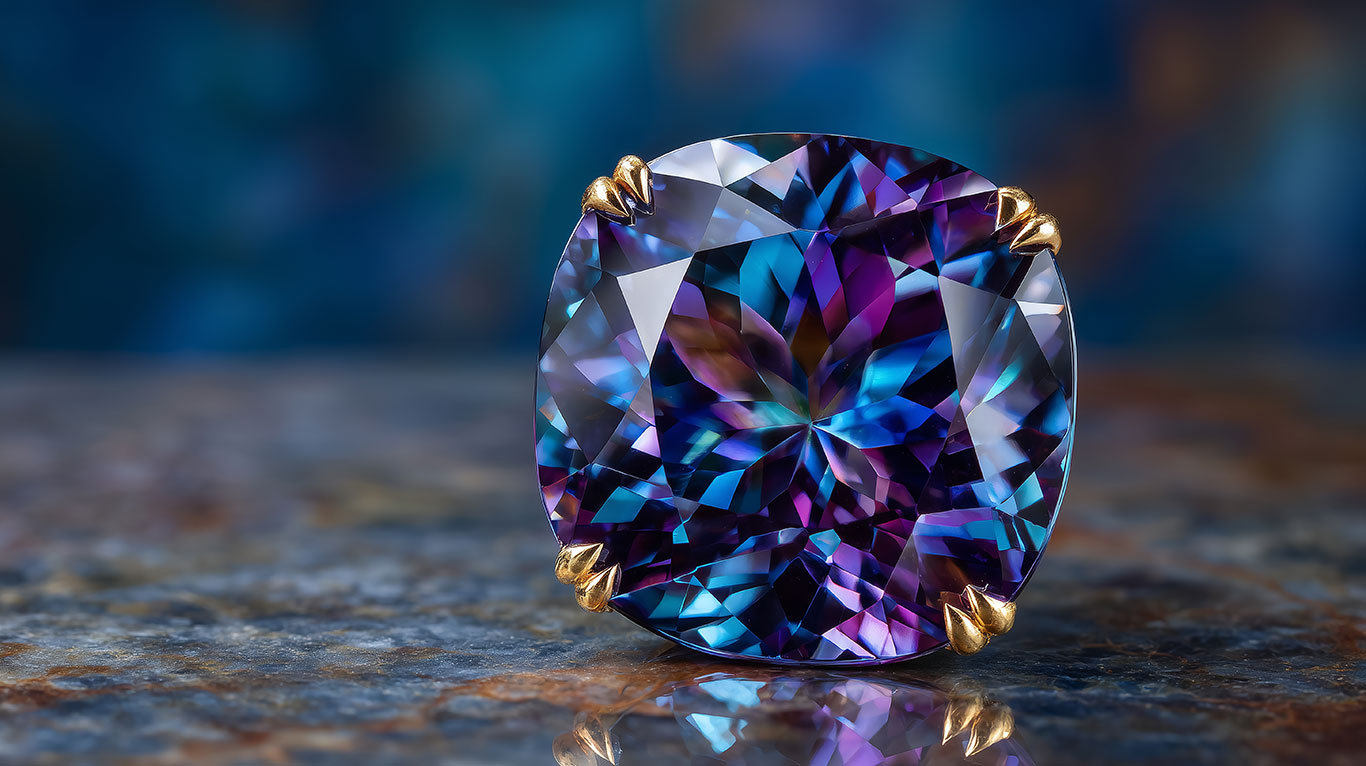
Alexandrite
| Property | Details |
|---|
| Mineral | Chrysoberyl |
| Mohs Hardness | 8.5 |
| Refractive Index | 1.746 – 1.755 |
| Birthstone | June (alternative) |
| Anniversary | 55th |
| Major Sources | Brazil, Sri Lanka, East Africa, Russia (historic) |
| Treatments | Rarely treated |
Overview
Alexandrite is one of the rarest and most fascinating gemstones, prized for its remarkable color-change property. In daylight or fluorescent light it appears green to bluish-green; under incandescent light it shifts to red, purplish-red, or raspberry. The more dramatic the color change, the more valuable the stone.
History & Lore
First discovered in Russia's Ural Mountains in the 1830s, alexandrite was named after Czar Alexander II because it displayed the national military colors of imperial Russia: green and red. The original Russian deposits are now essentially depleted, making old Russian alexandrites extremely collectible. Today, fine alexandrite primarily comes from Brazil, Sri Lanka, and East Africa.
Quality & Value Factors
The strength and completeness of the color change is the primary value driver. An alexandrite that shifts from a vivid green to a vivid red is dramatically more valuable than one showing only a slight shift between muddy colors. Natural alexandrite is extremely rare and expensive—fine stones can exceed the price of rubies and sapphires per carat.
Care & Cleaning
Alexandrite ranks 8.5 on the Mohs scale, making it very durable for all types of jewelry. It can be cleaned safely with warm soapy water or ultrasonic cleaners. Its outstanding hardness and rarity make it an exceptional collector's gemstone and an unconventional but stunning choice for engagement rings.