GIA Certification Diamonds: What Buyers Need to Know
GIA certification diamonds are diamonds accompanied by an independent grading report from the Gemological Institute of America, the global benchmark for diamond quality assessment. The GIA does not certify diamonds in the legal sense. It grades them using the standardized 4Cs system: cut, color, clarity, and carat weight. As a nonprofit organization, GIA has graded over 50 million diamonds since its founding in 1931, making its reports the most trusted documentation in the industry. When you buy a diamond with a GIA grading report, you get an unbiased, third-party assessment that no seller can alter or inflate.
What is GIA certification for diamonds, and what does the report include?
A GIA diamond grading report is a detailed document that records every measurable quality characteristic of a diamond. Understanding what is GIA certification means understanding what that document actually tells you.
The report covers:
- Carat weight: Measured to the hundredth of a carat for accuracy.
- Color grade: Rated on the D-to-Z scale, from colorless to light yellow or brown.
- Clarity grade: Ranges from Flawless to Included, with a plotted diagram showing inclusion locations.
- Cut grade: Applies to round brilliant diamonds and uses seven factors including brightness, fire, and scintillation on a five-point scale.
- Fluorescence: Describes how the diamond reacts under ultraviolet light.
- Polish and symmetry: Rated separately to reflect surface finish and facet alignment.
- Measurements and proportions: Exact dimensions in millimeters.
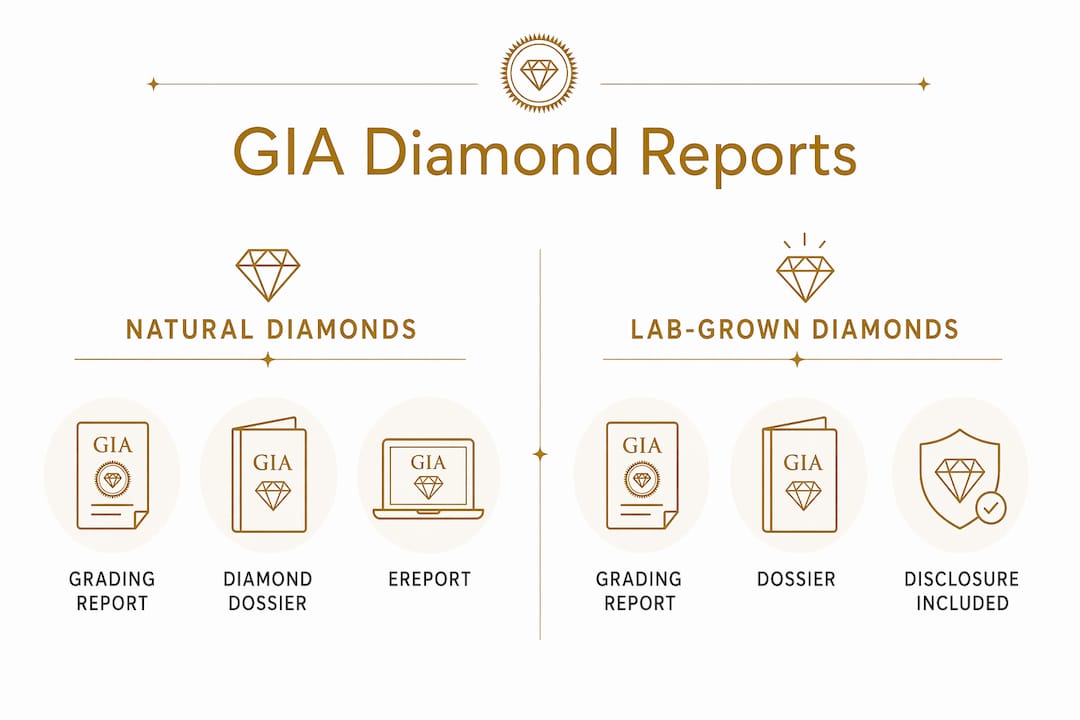
GIA offers three main report types for diamonds: the Diamond Grading Report, the Diamond Dossier, and the eReport. The full Diamond Grading Report includes a plotted clarity diagram and is best suited for larger or higher-value stones. The Dossier is more compact and typically used for diamonds under one carat. The eReport is a digital-only version accessible online.
Every report carries a unique report number. For diamonds over 0.30 carats, GIA laser-inscribes that number on the diamond’s girdle. The inscription is invisible to the naked eye but visible at 10x magnification. This physical link between the stone and the report is one of the most reliable authenticity checks available.

Pro Tip: Always ask to see the laser inscription under magnification before you buy. If the number on the girdle does not match the report, walk away.
| Report Type | Best For | Key Feature |
|---|---|---|
| Diamond Grading Report | Larger or high-value stones | Full plotted clarity diagram |
| Diamond Dossier | Diamonds under 1 carat | Compact format, laser inscription |
| eReport | Online purchases | Digital access via report number |
Why is GIA grading considered the gold standard?
GIA grading carries the most weight in the diamond industry because it is built on science, not sales. GIA developed the 4Cs framework that the entire industry now uses. That origin matters because it means GIA set the rules and continues to apply them with the most consistency.
Several factors explain GIA’s authority:
- Nonprofit status: GIA has no financial interest in selling diamonds. Its income comes from grading fees, not commissions. That structure removes commercial bias entirely.
- Standardized criteria: Every grader at GIA follows the same protocols. A diamond graded in New York receives the same evaluation as one graded in Carlsbad or Antwerp.
- Cut grading depth: GIA’s cut grade uses seven factors including brightness, fire, and scintillation. Most other labs use fewer criteria, which produces less consistent results.
- Consumer protection: A GIA report separates quality measurement from the seller’s pitch. You can compare two diamonds fairly because both are measured by the same independent standard.
“GIA grading is considered the gold standard, especially for natural diamonds above 0.70 carats or valued above $3,000, due to its standardized criteria and consistent consumer protection.”
The benefits of GIA certified diamonds extend directly to resale. Buyers in the secondary market pay more for GIA-graded stones because the documentation is trusted and verifiable. A diamond without a GIA report requires a new appraisal, which costs time and money and introduces uncertainty.
What are the benefits and limitations of GIA graded diamonds?
GIA grading gives you real, measurable advantages when buying a diamond. It also has limits you should understand before relying on the report alone.
Benefits of buying a GIA graded diamond:
- Unbiased quality information. The report reflects what the diamond actually is, not what a seller wants you to believe.
- Stronger resale value. GIA reports provide resale liquidity because buyers and dealers worldwide recognize and trust them.
- Ethical sourcing transparency. GIA grading supports traceability. Knowing a diamond’s origin and characteristics helps confirm it was sourced responsibly.
- Fair price comparison. You can compare two diamonds with identical grades across different sellers and know you are comparing equivalent quality.
- Fraud protection. A verified GIA report makes it much harder for a seller to misrepresent a diamond’s quality.
Limitations to keep in mind:
GIA grading does not guarantee beauty. Two diamonds with identical GIA grades can look noticeably different to the naked eye. Inclusion placement, light performance, and subtle cut differences all affect how a diamond appears in real life. A VS1 clarity diamond with inclusions near the center looks different from one with inclusions near the edge, even though both carry the same grade.
The report is a technical document, not a visual assessment. You still need to see the diamond in person or request a high-quality video before buying, especially for stones above one carat.
Pro Tip: Use the GIA report to narrow your search, then inspect the actual diamond. The report tells you what a diamond is. Your eyes tell you whether you love it.
For a deeper look at how the 4Cs interact, the diamond quality guide at Usajewels walks through each factor with practical examples.
How to verify a GIA report and confirm authenticity
Report fraud exists in the diamond market. Verifying a GIA report before purchase is a non-negotiable step, especially for high-value stones.
Follow these steps:
- Use GIA Report Check. Visit the GIA Report Check database online and enter the report number. Matching the report number in the certificate, the laser inscription, and the online database is the most reliable verification method available.
- Check the laser inscription. Ask the seller to show you the girdle inscription under 10x magnification. The number must match the report exactly.
- Request a magnified video. For online purchases, ask for a loupe-quality video that shows the inscription clearly. Reputable sellers provide this without hesitation.
- Watch for outdated reports. A report issued years ago for a different stone can be fraudulently paired with a new diamond. Always confirm the physical diamond matches the report’s measurements and weight.
Discrepancies between the report, the inscription, and the GIA database indicate a fraudulent or mismatched report and should never be accepted. If a seller resists verification, that resistance is itself a warning sign.
Pro Tip: The GIA Report Check tool is free and takes under two minutes. Use it every time, without exception.
For a full breakdown of how different certification labs compare, the diamond certification guide at Usajewels covers GIA alongside other major grading authorities.
What is the difference between GIA reports for natural vs. lab-grown diamonds?
GIA grades both natural and lab-grown diamonds using the same 4Cs criteria. The key difference is disclosure. GIA explicitly identifies lab-grown diamonds on their reports, so there is no ambiguity about origin.
| Feature | Natural Diamond Report | Lab-Grown Diamond Report |
|---|---|---|
| Grading criteria | 4Cs: cut, color, clarity, carat | 4Cs: cut, color, clarity, carat |
| Origin disclosure | Identified as natural | Explicitly labeled as lab-grown |
| Resale market | Stronger secondary market demand | Lower resale value currently |
| Report trust level | Universally accepted | Trusted but market still maturing |
Lab-grown diamonds with GIA reports carry the same grading credibility as natural stones. The grades mean the same thing. What differs is market perception and resale value. Natural diamonds hold stronger resale prices in the current market, while lab-grown diamonds offer a lower entry cost for the same visual quality.
GIA’s decision to grade lab-grown diamonds with the same rigor it applies to natural stones reinforces its position as the trusted authority for both categories. Buyers who want full transparency on origin and quality get that from a GIA report regardless of which type they choose. The lab-created diamond guide at Usajewels explains the practical differences in more detail.
Key Takeaways
A GIA grading report is the most reliable independent document available for assessing diamond quality, but it must be paired with visual inspection and verified against the GIA Report Check database before any purchase.
| Point | Details |
|---|---|
| GIA grades, not certifies | GIA provides independent grading reports, not legal certifications, based on the 4Cs. |
| Report verification is mandatory | Always match the report number, laser inscription, and GIA Report Check database before buying. |
| Grades do not guarantee beauty | Two diamonds with identical grades can look different; always inspect the stone visually. |
| Lab-grown diamonds are graded equally | GIA applies the same 4Cs standards to lab-grown diamonds and explicitly discloses their origin. |
| GIA reports protect resale value | GIA-graded diamonds command stronger secondary market prices due to universal trust in the reports. |
Why I trust GIA reports but never rely on them alone
After years of working with diamonds and helping customers find the right stone for some of the most meaningful moments of their lives, I have a clear view on GIA reports. They are necessary. They are not sufficient.
The report tells you what a diamond is on paper. It does not tell you whether that diamond will take your breath away when light hits it across a dinner table. Cut nuances that fall within the same grade category can produce wildly different visual results. A diamond graded “Very Good” cut can outperform an “Excellent” cut stone if the proportions happen to interact with light more favorably for that specific shape.
What I always tell buyers is this: use the GIA report to eliminate bad options fast. A diamond without a GIA report from a reputable seller is a diamond you cannot fully trust. But once you have a shortlist of GIA-graded stones that meet your quality criteria, go look at them. Or at minimum, watch high-quality video of each one. The report narrows the field. Your eyes make the final call.
The ethical sourcing piece matters too. GIA grading supports traceability in a way that ungraded diamonds simply cannot match. When you buy a GIA-graded stone from a seller who prioritizes conflict-free sourcing, you have documentation that backs up the claim. That peace of mind is real, and it lasts as long as the diamond does.
Work with sellers who provide full GIA documentation without being asked. That transparency is a signal of how they do business across the board.
— Joseph
Usajewels’ GIA graded diamonds for engagement rings and fine jewelry
At Usajewels, every diamond we offer comes with full transparency on quality and sourcing. Our family has been hand-selecting conflict-free, certified diamonds since 1999, and we believe you deserve to know exactly what you are buying before you commit.
Our fine diamond jewelry collection features GIA-graded stones set in rings, earrings, and pendants crafted in-house. Because we manufacture directly, you get honest pricing without the markups that come from middlemen. You can also explore our diamond and gold collections to find pieces that match your style and budget. Whether you are choosing an engagement ring or a meaningful gift, our team is here to walk you through every grade, every report, and every option with care.
FAQ
What does GIA certification mean for a diamond?
GIA certification refers to an independent grading report issued by the Gemological Institute of America. The report documents a diamond’s cut, color, clarity, and carat weight using standardized, unbiased criteria.
How do I read a GIA diamond grading report?
The report lists the 4Cs grades, measurements, fluorescence, polish, symmetry, and a clarity plot. Match the report number to the laser inscription on the diamond’s girdle and verify both against the GIA Report Check database online.
Is a GIA report the same as a diamond appraisal?
No. A GIA report is a quality grading document, not a monetary appraisal. An appraisal assigns a dollar value based on market conditions, while a GIA report measures physical and optical characteristics only.
Do lab-grown diamonds get GIA reports?
Yes. GIA grades lab-grown diamonds using the same 4Cs standards applied to natural diamonds. The report explicitly identifies the stone as lab-grown, so origin is always clearly disclosed.
Does a GIA report guarantee a diamond looks beautiful?
No. Two diamonds with identical GIA grades can look different to the naked eye due to inclusion placement and subtle cut differences. Always inspect the diamond visually alongside the report before purchasing.
Recommended
- Diamond Clarity Chart — FL to I3 Grades Explained | USA Jewels
- Diamond Certification Guide: GIA vs AGS vs IGI Compared | USA Jewels
- Gemstone Grading Guide: How Colored Gems Are Evaluated | USA Jewels
- Diamond Cut Guide — How Cut Grades Affect Brilliance | USA Jewels

Deep Mehta is the Co-Owner of USA Jewels, a family-owned jewelry business she has led since 2013 in Deerfield Beach, Florida. With over 13 years of hands-on experience in fine jewelry retail, manufacturing, and diamond importing, Deep specializes in engagement rings, wedding bands, and custom jewelry design. She also co-manages Kaash Group Talent Acquisition. Deep is a University of Florida graduate and oversees every aspect of USA Jewels’ operations, from product development to marketing.
Frequently Asked Questions
Does a GIA report guarantee that a diamond is real?
How much more expensive is a GIA certified diamond compared to an uncertified one?
Can I use a GIA Diamond Dossier report for a diamond larger than one carat?
What's the difference between GIA fluorescence grades and how do they affect a diamond's value?
Why would a diamond have a GIA eReport instead of a physical report?
Fine Jewelry Collection


You May Also Like
Bar Setting Rings: How to Balance Sparkle and Resizing With USA Jewels

What Is Certified Pre-Owned Jewelry: A Buyer’s Guide