In-House Jewelry Manufacturing: What It Is and Why It Matters
In-house jewelry manufacturing is defined as the practice of managing every production stage, from CAD design and casting through stone setting and finishing, inside a single company-owned facility. This model gives brands direct control over quality, speed, and design at every step. Integrated production supports single-piece minimums and turnaround times as fast as 7–10 days, a capability that outsourced models rarely match. For anyone exploring custom jewelry creation or building a jewelry line from scratch, understanding this production approach is the clearest path to making informed decisions about quality, cost, and brand identity.
What is in-house jewelry manufacturing, and how does it work?
In-house jewelry manufacturing is the industry’s term for vertically integrated production, where a brand owns and operates each stage of the jewelry manufacturing process under one roof. The alternative terms you will encounter, such as “studio manufacturing” or “direct production,” all describe the same core concept: no third-party factories, no outsourced casting, no external stone setters.
The process follows a defined sequence. Each stage builds on the last, and owning every step is what separates this model from OEM or contract manufacturing.
-
CAD design and prototyping. A designer creates a digital 3D model using CAD software such as Rhino or Matrix. The model is then printed as a wax or resin prototype using a 3D printer. This stage allows rapid iteration because changes cost almost nothing compared to reworking a cast piece.
-
Casting. The prototype is used to create a mold. Molten metal, typically gold, platinum, or silver, is poured or injected into the mold through a process called lost-wax casting. The raw casting is then cleaned and inspected before moving forward.
-
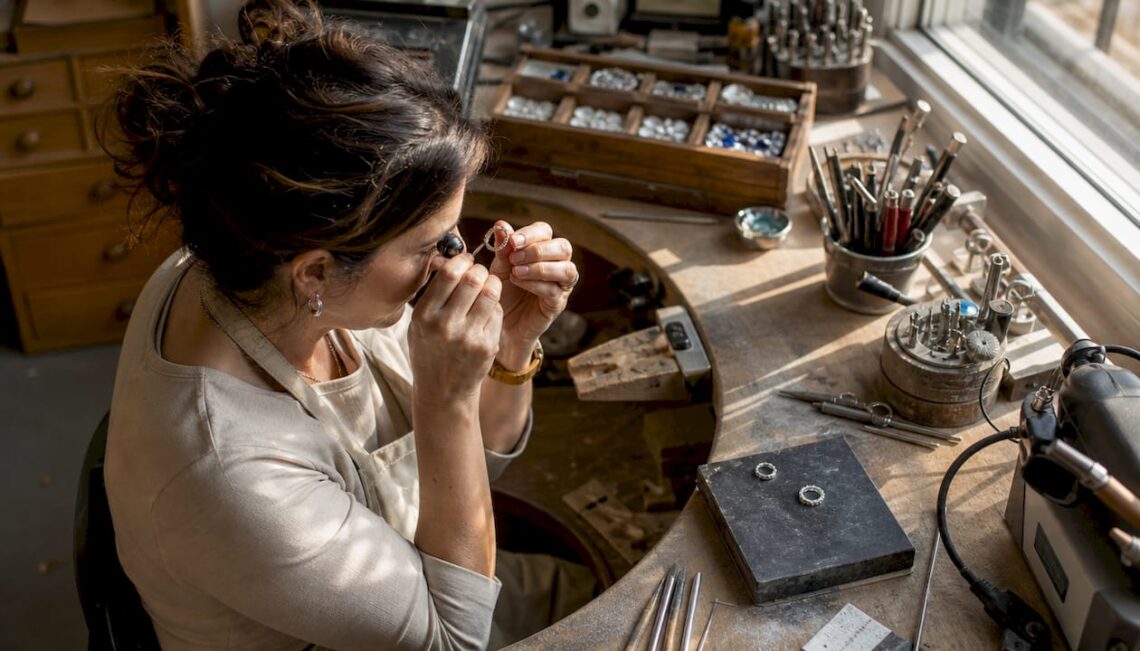
Stone setting. Skilled setters place diamonds or gemstones by hand. Common setting techniques include prong, bezel, pavé, and channel settings. This stage requires the most craft skill and is where quality differences between producers become most visible.
-
Finishing. Pieces are polished, plated if required, and inspected against quality standards. Finishing also includes any engraving, rhodium plating on white gold, or surface texturing.
-
Quality control and packaging. A final inspection checks dimensions, stone security, and surface quality before the piece is packaged and shipped.
Brands that own in-house facilities can iterate on designs and run R&D cycles far faster than those tied to vendor catalogs and external lead times. That speed is a real competitive advantage, not a marketing claim.
Pro Tip: If you are evaluating a jewelry producer, ask specifically which stages they perform in-house. A producer who outsources casting or stone setting is not truly vertically integrated, and your quality control will reflect that gap.

What are the key benefits and challenges of in-house jewelry production?
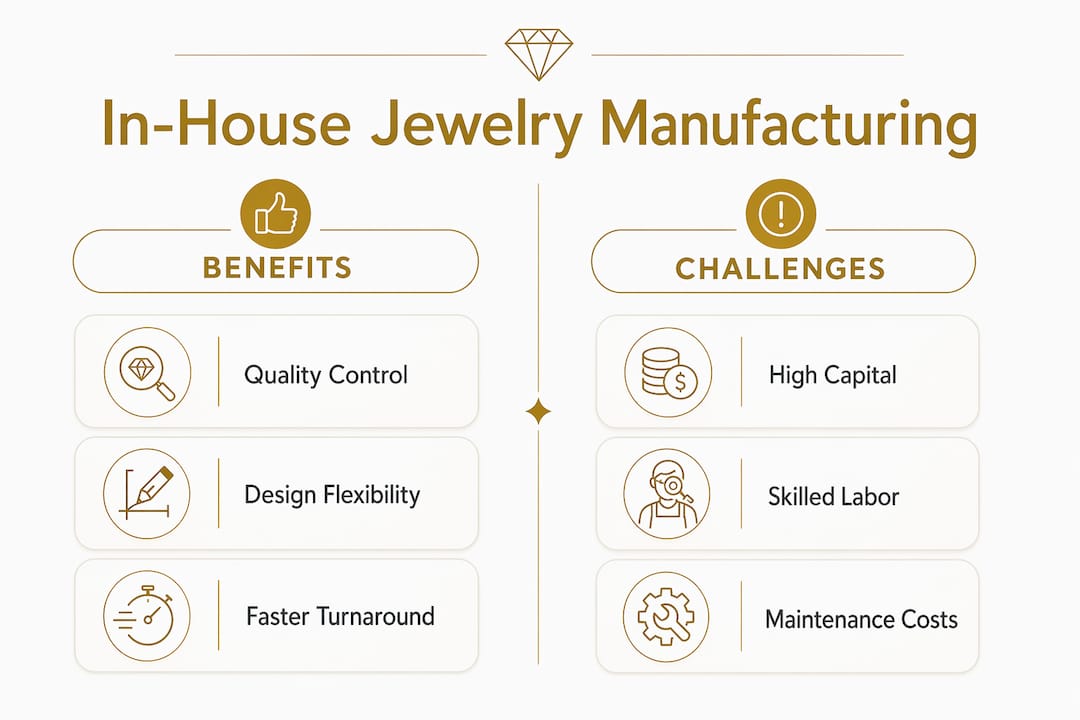
In-house production delivers advantages that outsourced models structurally cannot replicate. The most significant is quality oversight. When casting, setting, and finishing all happen in one facility, defects are caught and corrected before they compound across stages.
Core benefits:
- Proprietary design protection. Your designs stay inside your facility. No vendor copies, no catalog leakage.
- Flexible order sizes. Single-piece minimums become practical, which is critical for custom jewelry creation and made-to-order businesses.
- Faster turnaround. Without shipping between vendors, production cycles shrink from weeks to days.
- Consistent quality systems. Proprietary QA standards can be applied and adjusted without negotiating with external suppliers.
- Lower total cost of ownership. OEM manufacturers offer lower unit costs, but in-house production cuts hidden costs tied to rework, shipping delays, and communication failures that can add 10–20% in losses.
Real challenges to plan for:
- High upfront capital investment in equipment, space, and tooling.
- Fixed labor costs that continue even during slow production periods.
- Skilled labor is scarce. Experienced stone setters and casters are not easy to hire or replace.
- Scaling output requires proportional investment in people and equipment.
The financial picture is more nuanced than it first appears. In-house manufacturing requires high upfront capital, but it removes supplier margins and currency risks that add unpredictability to long-term costs. The unit cost may look higher on a spreadsheet, yet the total cost of ownership often favors in-house production for specialty, custom, or high-margin low-volume lines.
Pro Tip: Before committing to full in-house production, calculate your break-even volume. If your projected annual output cannot absorb fixed facility and labor costs, a hybrid model may serve you better in the short term.
How does in-house production compare to OEM or hybrid models?
Three production models define the jewelry industry: in-house, OEM (original equipment manufacturer), and hybrid. Each suits a different business profile.
OEM manufacturing means contracting a third-party factory to produce pieces to your specifications. The factory owns the equipment, employs the workers, and manages production. You pay per unit. OEM works well for high-volume, standardized SKUs where design complexity is low and price per piece is the primary concern.
Hybrid manufacturing combines in-house design and prototyping with outsourced production of standardized pieces. Hybrid models balance cost, control, and scalability by keeping proprietary, high-precision designs in-house while routing commodity SKUs to external factories.
| Factor | In-house | OEM | Hybrid |
|---|---|---|---|
| Quality control | Full direct control | Dependent on vendor | Partial, varies by stage |
| Unit cost | Higher | Lower | Mixed |
| Design protection | Strong | Weak | Moderate |
| Minimum order | 1 piece | Often 50–500 pieces | Varies |
| Scalability | Limited by facility | High | Moderate to high |
| Turnaround speed | Fastest | Slowest | Moderate |
The right model depends on three factors: production volume, design complexity, and how much your brand identity depends on proprietary craftsmanship. A brand built on custom engagement ring design needs in-house control. A brand selling standardized fashion jewelry at scale may find OEM more practical.
- High IP value and custom work: choose in-house.
- High volume, low complexity: OEM is cost-effective.
- Growing brand with mixed catalog: hybrid offers the best path forward.
Hybrid manufacturing effectively manages complexity by allocating proprietary, high-precision designs to in-house production and routing standardized SKUs outward. Many established jewelry brands use this approach as they scale.
What practical steps should businesses take to start in-house jewelry manufacturing?
Starting in-house jewelry production requires a clear sequence of decisions. Skipping steps creates expensive problems later.
-
Define your production scope. Decide which stages you will manage in-house from day one. Most new operations start with design and prototyping, then add casting and finishing as volume grows.
-
Invest in the right equipment. A professional CAD workstation, 3D printer, casting kiln, and polishing setup form the core toolkit. Do not cut corners on casting equipment. Inconsistent casting creates defects that no amount of finishing can fix.
-
Hire skilled personnel. Jewelry businesses starting in-house manufacturing need skilled staff, modern CAD tools, and quality systems to maximize benefits. A single experienced stone setter or caster is worth more than three untrained workers.
-
Build a quality assurance system. Document your standards for every stage before you produce your first piece. Define acceptable tolerances for stone setting, surface finish, and metal weight. This system becomes your brand’s quality signature.
-
Manage your supply chain internally. Source metals and stones directly from certified suppliers. Ethical sourcing, including conflict-free diamonds, is not just a moral choice. It protects your brand reputation and satisfies customer expectations in 2026.
-
Plan for R&D cycles. In-house operations excel at rapid design iteration, which is critical for specialty and custom lines. Build time for prototyping and testing into your production calendar.
Understanding how jewelry quality is verified at each stage will sharpen your QA process and reduce costly rework from the start.
Pro Tip: Start with a small, defined product line rather than trying to produce everything in-house immediately. Mastering three or four pieces deeply teaches you more about your production system than spreading thin across twenty designs.
Key Takeaways
In-house jewelry manufacturing delivers the strongest quality control and design protection of any production model, but it requires deliberate investment in people, equipment, and systems to work.
| Point | Details |
|---|---|
| Core definition | In-house manufacturing means owning every production stage, from CAD design to finishing, inside one facility. |
| Quality advantage | Direct control over casting, setting, and finishing catches defects before they compound across stages. |
| True cost picture | Unit costs run higher in-house, but total ownership costs are often lower due to less rework and fewer delays. |
| Model selection | Choose in-house for custom or high-IP work; consider hybrid models when scaling standardized SKUs. |
| Starting right | Invest in skilled staff and a documented QA system before scaling production volume. |
Why the “cost per unit” comparison misses the point
I have spent years watching businesses make the same mistake: they compare in-house unit costs to OEM quotes and conclude that outsourcing wins. That math is incomplete, and it leads brands into a cycle of rework, delays, and quality complaints they never fully trace back to the original decision.
The real calculation includes the cost of a shipment that arrives with 15% of pieces needing rework. It includes the two weeks lost waiting for a vendor to respond to a quality issue. It includes the design that leaked to a competitor because a factory in another country had no reason to protect it. None of those costs appear on a quote sheet.
What I have found is that in-house production pays for itself most clearly in the custom segment. When a customer orders a piece that tells their story, a one-of-a-kind engagement ring or a family heirloom redesigned, the margin for error is zero. You cannot outsource that responsibility and expect consistent results. The families and individuals who care most about what they are buying can tell the difference.
The brands I respect most treat their production facility as a core asset, not a cost center. They invest in their craftspeople, protect their designs, and build quality systems that compound over time. That is not a financial strategy. It is a commitment to the customer. And in my experience, customers remember it.
— Joseph
Usajewels and the craft behind every piece
Usajewels has operated as a family-owned, in-house jewelry manufacturer since 1999, building fine diamond jewelry from design through finishing without middlemen. Every piece reflects direct craftsmanship, ethical sourcing, and a commitment to conflict-free diamonds that customers can trust.
With over 222 Google reviews and more than two decades of experience, Usajewels offers custom jewelry creation with your choice of diamond quality and metal type, all at direct pricing. Whether you are designing an engagement ring or selecting a gift for a milestone occasion, the Usajewels team works with you from concept to finished piece. Explore the full jewelry collections and see what in-house craftsmanship looks like when it is done right.
FAQ
What is in-house jewelry manufacturing?
In-house jewelry manufacturing is the practice of managing all production stages, including CAD design, casting, stone setting, and finishing, inside a single company-owned facility. This model gives brands direct control over quality, speed, and design protection.
How does in-house production differ from OEM manufacturing?
OEM manufacturing uses a third-party factory to produce pieces to your specifications, typically at lower unit costs but with less quality control and design protection. In-house production keeps every stage internal, which reduces rework and protects proprietary designs.
What are the biggest benefits of in-house jewelry production?
The primary benefits are direct quality oversight, faster turnaround times, flexible order sizes down to a single piece, and protection of proprietary designs. In-house operations also reduce hidden costs tied to rework and supplier delays.
Is in-house manufacturing more expensive than outsourcing?
The unit cost is typically higher in-house, but the total cost of ownership is often lower. Fewer quality failures, no shipping delays between vendors, and no supplier margins add up to better financial outcomes for custom and specialty jewelry lines.
When should a jewelry brand consider a hybrid manufacturing model?
A hybrid model makes sense when a brand produces both custom, high-IP pieces and standardized catalog items. Hybrid manufacturing keeps proprietary designs in-house while routing high-volume, low-complexity SKUs to external factories for cost efficiency.
Recommended
- Why Custom Jewelry Beats Store-Bought: Quality and Value
- How Jewelry Quality Is Verified in Manufacturing
- How to Spot Quality Jewelry Craftsmanship Like a Pro
- Monogram Jewelry Design: What It Means and How It Works

Deep Mehta is the Co-Owner of USA Jewels, a family-owned jewelry business she has led since 2013 in Deerfield Beach, Florida. With over 13 years of hands-on experience in fine jewelry retail, manufacturing, and diamond importing, Deep specializes in engagement rings, wedding bands, and custom jewelry design. She also co-manages Kaash Group Talent Acquisition. Deep is a University of Florida graduate and oversees every aspect of USA Jewels’ operations, from product development to marketing.
Frequently Asked Questions
How does in-house manufacturing affect the timeline for a custom engagement ring?
What quality control advantages does in-house manufacturing provide for diamond settings?
Can in-house manufacturers accommodate single custom pieces or small orders?
Why does in-house manufacturing matter when choosing between white gold and platinum?
How should I verify that a jewelry maker actually manufactures in-house versus outsourcing?
Fine Jewelry Collection


You May Also Like
Promise Ring vs Engagement Ring: What’s the Real Difference?

Insist on a GIA Report: Color Treated Diamonds for U.S. Buyers