Why Diamond Certifications Differ Globally: 2026 Guide
Diamond certification is the formal process by which an independent laboratory grades a polished stone on cut, color, clarity, and carat weight. The reason why diamond certifications differ globally comes down to one core fact: no single authority controls how every lab trains its graders, calibrates its master stones, or draws the line between adjacent grades. Bodies like the GIA, IGI, and CIBJO each operate under their own methodologies, and the resulting grades can shift a stone’s perceived value by thousands of dollars. For buyers, understanding these differences is not optional. It is the foundation of every smart diamond purchase.
Why diamond certifications differ globally: the core reasons
Diamond grading is a semi-subjective expert opinion, not a measurement like weight or length. Two trained gemologists examining the same stone can reach different conclusions on color or clarity, and that gap widens when they work under different lab protocols. Grading remains an expert evaluation affected by lab tolerance and methodology differences, even when international standards exist.
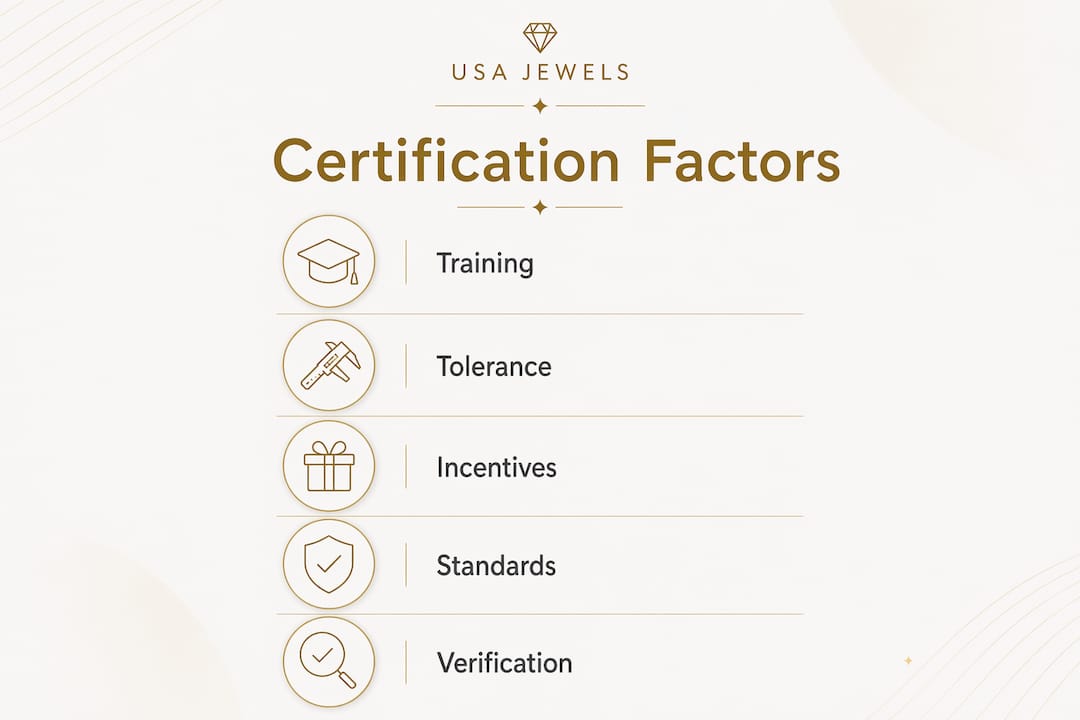
Three structural factors drive most of the variation buyers encounter.
Grading tolerance levels. Each lab sets internal tolerance ranges for borderline stones. A stone sitting between G and H color may land on G at one lab and H at another. Neither grade is wrong within that lab’s system. The difference is simply where the tolerance boundary falls.
Training and calibration methods. Labs that use unified master stone sets and centralized training produce more consistent results across locations. Labs with decentralized branches historically show wider grade spreads. Branch inconsistency has damaged the reputation of some lab networks over time, and buyers pay the price through unreliable certificates.
Commercial incentives. Non-profit labs with no financial stake in inflating grades tend to grade more conservatively. Labs that compete for volume business face different pressures. GIA’s non-profit status and strict calibration policies are a direct reason why its certificates carry the most universal market trust.
What grading criteria do labs assess, and how do interpretations differ?
The four Cs form the backbone of every diamond certificate. Understanding how diamond quality is measured across each criterion reveals exactly where lab differences create real price gaps.
- Carat weight is the one objective measure. All labs weigh stones on calibrated scales, so carat grades are consistent across the industry.
- Color is graded on a D-to-Z scale, with D being colorless. This is where lab tolerance has the biggest impact. A stone graded G by one lab may receive an H from a stricter lab. That single grade difference can reduce a stone’s retail price noticeably.
- Clarity evaluates internal inclusions and surface blemishes on a scale from Flawless to I3. Graders must decide whether an inclusion is significant enough to move a stone down a grade. The FL to I3 clarity scale involves judgment calls that vary by lab protocol.
- Cut is the most complex grade to standardize. It combines proportions, symmetry, and polish into a single quality tier. Cut grading systems differ between labs, and some labs do not grade cut at all for certain shapes.
Beyond the four Cs, labs also assess fluorescence, treatment disclosure, and, for some reports, light performance. Each of these adds another layer where methodology differences produce different outcomes.
Pro Tip: Cut grade matters more than most buyers realize. A well-cut stone reflects light beautifully even at a lower color or clarity grade. When comparing certificates, prioritize cut grade consistency and verify that both stones were graded by the same lab before drawing conclusions.
How do international grading labs compare in standards and reputation?
The global diamond grading system is not a single unified network. It is a collection of independent labs, each with its own history, market focus, and grading philosophy.
| Lab | Grading strictness | Primary market | Known for |
|---|---|---|---|
| GIA | Highest | Global | Invented the 4 Cs; non-profit; gold standard |
| AGS | Very high | North America | Rigorous cut grading system |
| IGI | Moderate | Global; lab-grown | High volume; accessible pricing |
| HRD | Moderate to high | Europe (Belgium) | Strong in Antwerp trade |
| EGL | Variable | Regional | Inconsistent across branches |
GIA is the gold standard in diamond certification because it operates without commercial incentives to inflate grades. Its certificates are accepted in every major market, from New York to Hong Kong to Mumbai.
IGI occupies a different position. It dominates lab-grown diamond certification and offers more accessible pricing for natural diamonds, but its grades for natural stones run moderately more lenient on average. IGI-graded natural diamonds trade at roughly 75–82% of GIA-equivalent prices in the secondary market. That discount exists because experienced buyers mentally adjust IGI grades downward. An IGI G/VS2 is treated as approximately equivalent to a GIA H/SI1 by professional traders.
EGL presents the most cautionary example. Its franchise model allowed individual branches to operate with significantly different standards. That inconsistency made EGL certificates unreliable as a class, regardless of the quality of any individual branch. The lesson is clear: lab brand alone does not guarantee consistency. Branch location and operational structure matter too.
Regional preferences also shape which certificates buyers encounter. European buyers often see HRD certificates from the Antwerp trade. Indian market buyers frequently encounter IGI certificates. American buyers are most familiar with GIA. Knowing the regional context of a certificate helps you interpret it correctly.
What role do global standards play in harmonizing diamond certification?
International standardization is real and growing, but it has not eliminated grading variation. EN ISO 24016:2026 defines international procedures for grading natural, polished diamonds. It applies globally to unmounted natural diamonds over 0.25 carats, excluding fancy colored and synthetic stones.
| Standard | Scope | Limitation |
|---|---|---|
| EN ISO 24016:2026 | Natural polished diamonds over 0.25 ct | Does not eliminate expert judgment variability |
| CIBJO standards | Nomenclature and disclosure | Voluntary adoption by labs |
| Regional regulations | Market-specific disclosure rules | Vary by country |
The standard sets procedures, not outcomes. Final grades still reflect the expert judgment of the grader, the calibration of the master stones used, and the tolerance policies of the lab. ISO compliance means a lab follows a defined process. It does not mean two ISO-compliant labs will always reach the same grade on the same stone.
Global harmonization efforts led by forums including those in Taipei aim to standardize cut nomenclature and treatment disclosure language. The goal is to let buyers compare diamonds across certificates more fairly over time. Progress is real, but the industry is not there yet. Buyers who understand this reality make better decisions than those who assume all certificates are equal.
CIBJO, the World Jewellery Confederation, publishes voluntary standards that many labs reference for nomenclature. These standards cover terms like “natural,” “treated,” and “synthetic” to reduce consumer confusion. Adoption is voluntary, which means compliance varies by lab and region.
How can buyers navigate differing certifications confidently?
Reading a certificate correctly requires more than checking the grade boxes. The originating lab, the branch that issued the report, and the current market price all carry information that the grade alone does not.
- Verify the certificate directly. Every major lab maintains an online verification tool. Enter the report number on the GIA, IGI, or AGS website to confirm the certificate is genuine and matches the stone.
- Use price as a quality signal. Market price reflects lab reputation more accurately than the certificate grade alone. A stone priced well below market for its stated grade is often from a more lenient lab.
- Apply shadow grading when comparing across labs. Professional buyers mentally translate grades from less strict labs to GIA equivalents before pricing. If you are comparing an IGI stone to a GIA stone, adjust the IGI grade down by roughly one grade on color and clarity before comparing prices.
- Ask about the specific branch. For labs with multiple locations, the issuing branch matters. Centralized labs with unified training produce more consistent results than decentralized franchise networks.
- Prioritize the 4 Cs explained in context. A certificate from a reputable lab is a starting point, not a final verdict. Always view the stone in person or request high-resolution imagery before purchasing.
Pro Tip: When buying online, always request the certificate number and verify it on the issuing lab’s website before completing a purchase. A certificate that cannot be verified is a red flag regardless of how official it looks.
Understanding how diamond quality tiers affect pricing helps you read the market signals that experienced buyers use every day.
Key takeaways
Diamond certifications differ globally because grading is a semi-subjective expert process shaped by each lab’s tolerance levels, training methods, and commercial structure, not by a single universal standard.
| Point | Details |
|---|---|
| Grading is not objective | Final grades reflect expert judgment and lab tolerance, not a fixed measurement. |
| GIA sets the market benchmark | GIA certificates carry the highest market trust due to non-profit status and strict calibration. |
| IGI grades run more lenient | IGI natural diamond grades trade at 75–82% of GIA-equivalent prices in the secondary market. |
| ISO standards help but do not unify | EN ISO 24016:2026 standardizes procedures, not outcomes, so variability remains. |
| Price signals lab strictness | A stone priced below market for its grade often reflects a more lenient issuing lab. |
The certificate tells part of the story
After more than two decades in the jewelry business, I have watched buyers make the same mistake repeatedly. They treat a certificate grade as an absolute truth and ignore the market price sitting right next to it. The price is telling you something the certificate cannot. If a G/VS2 is priced like an H/SI1, the market has already done the translation for you.
The rollout of EN ISO 24016:2026 is genuinely meaningful. It gives labs a shared procedural framework, and that matters for long-term buyer confidence. But I would caution anyone from assuming that ISO compliance means two labs will grade identically. The standard governs process, not perception. A grader’s eye and a lab’s master stones still determine where a borderline stone lands.
The most common misconception I encounter is that a higher-grade certificate always means a better stone. It does not. It means a lab assigned that grade under its specific methodology. The stone’s actual light performance, its face-up appearance, and its price relative to the market are the real measures of value. Certificates are tools. Use them as one input among several, not as the final word.
The buyers who get the best value are the ones who learn to read both the certificate and the market together. That skill is worth more than any single grade on any single report.
— Joseph
Certified diamonds you can trust at Usajewels
Choosing a certified diamond is easier when you work with a jeweler who understands what the certificate actually means.

Usajewels has been a family-owned, trusted source for certified diamond jewelry since 1999. Every piece is manufactured in-house, which means direct pricing without middlemen and full transparency on the diamonds we select. Our collection of fine diamond jewelry includes stones certified by recognized laboratories, so you always know exactly what you are buying. Whether you are selecting an engagement ring or a meaningful gift, our team is here to help you read the certificate, understand the market, and find a stone that delivers real beauty at a fair price.
FAQ
Why do diamond grades vary between labs?
Diamond grading is a semi-subjective expert process. Each lab sets its own tolerance levels and calibration standards, so the same stone can receive different grades from different labs.
Is a GIA certificate better than an IGI certificate?
GIA certificates carry higher market trust and command higher resale prices. IGI-graded natural diamonds trade at roughly 75–82% of GIA-equivalent prices, reflecting the difference in grading strictness.
What is EN ISO 24016:2026?
EN ISO 24016:2026 is an international standard that defines grading procedures for natural polished diamonds over 0.25 carats. It standardizes the process but does not eliminate variability in final expert grades.
How can I verify a diamond certificate is genuine?
Enter the certificate report number directly on the issuing lab’s official website. GIA, IGI, and AGS all offer free online verification tools that confirm the certificate matches the stone on record.
Does a higher certificate grade always mean a better diamond?
Not necessarily. A higher grade reflects one lab’s assessment under its specific methodology. Market price, cut quality, and the stone’s actual visual performance are equally important indicators of real value.
Recommended
- Gemstone Grading Guide: How Colored Gems Are Evaluated | USA Jewels
- Conflict-Free Diamond vs Lab Grown: Buyer’s Guide
- Natural Diamonds: Quality, Value & Origin | USA Jewels
- How to Choose a Certified Ethical Diamond Jeweler

Deep Mehta is the Co-Owner of USA Jewels, a family-owned jewelry business she has led since 2013 in Deerfield Beach, Florida. With over 13 years of hands-on experience in fine jewelry retail, manufacturing, and diamond importing, Deep specializes in engagement rings, wedding bands, and custom jewelry design. She also co-manages Kaash Group Talent Acquisition. Deep is a University of Florida graduate and oversees every aspect of USA Jewels’ operations, from product development to marketing.
Frequently Asked Questions
If the same diamond gets graded as H color at one lab and G color at another, which grade is correct?
Why does the GIA certificate seem more valuable than certificates from other labs?
Can a diamond's price change significantly if I get it re-certified by a different lab?
What's the difference between how labs train their graders, and why does it matter to me?
Since carat weight is objective, why do labs still differ on the other three Cs?
Fine Jewelry Collection


You May Also Like

Design a Custom Wedding Ring Set That’s Truly Yours

The Best Push Present Jewelry Ideas for New Moms