Diamond Fluorescence: Does It Actually Matter to You?
For most buyers, diamond fluorescence is not something to worry about. In fact, faint or medium blue fluorescence often makes no visible difference, and in warmer color grades, it can even help. About 35 to 50% of natural diamonds show some fluorescence, and roughly 97% of those fluorescent stones glow blue under ultraviolet light. That is not a rare quirk. It is closer to a coin flip.
Here is the quick version before we get into the full picture:
- Who benefits: Buyers eyeing I through M color grades, where blue fluorescence can neutralize a warm, yellowish tint and make the stone look whiter face-up.
- Who should be cautious: Buyers considering a D to F colorless stone with Strong or Very Strong fluorescence, since a small number of these show a hazy or milky look.
- The fastest decision rule: Never buy a fluorescent diamond sight-unseen. Ask for a video under multiple lighting conditions, and check the GIA or IGI report’s comments section for any note about transparency.
We will walk through what causes fluorescence, how labs grade it, when it helps or hurts, and exactly how to check a specific stone before you commit.
Key Takeaways
Diamond fluorescence rarely hurts a diamond’s appearance, and on I through M color grades, blue fluorescence often improves how white the stone looks face-up.
| Point | Details |
|---|---|
| None to Medium is safe | These intensities show negligible visual change in almost any lighting, per GIA research. |
| Strong fluorescence needs a look | Request video under sunlight and indoor light before buying a colorless stone with Strong or Very Strong fluorescence. |
| Warmer grades can benefit | Blue fluorescence on I to M color diamonds can visually neutralize yellow tint. |
| Discounts are common | Medium to Strong fluorescence on colorless stones often sells for less despite little visual difference. |
| Usajewels documents everything | Every certified stone ships with a lab report and available video showing fluorescence under multiple lighting conditions. |
Table of Contents
- What Is Diamond Fluorescence and How Common Is It?
- How Diamond Grading Reports Record Fluorescence
- How Fluorescence Changes a Diamond’s Appearance
- Does Fluorescence Change a Diamond’s Price?
- How to Evaluate Fluorescence in a Specific Diamond
- Phosphorescence, Lab-Grown Diamonds, and Rare Fluorescence Colors
- What We See in the Showroom
- Shop Fluorescence-Graded Diamonds With Confidence
- Sources
- FAQ
What Is Diamond Fluorescence and How Common Is It?
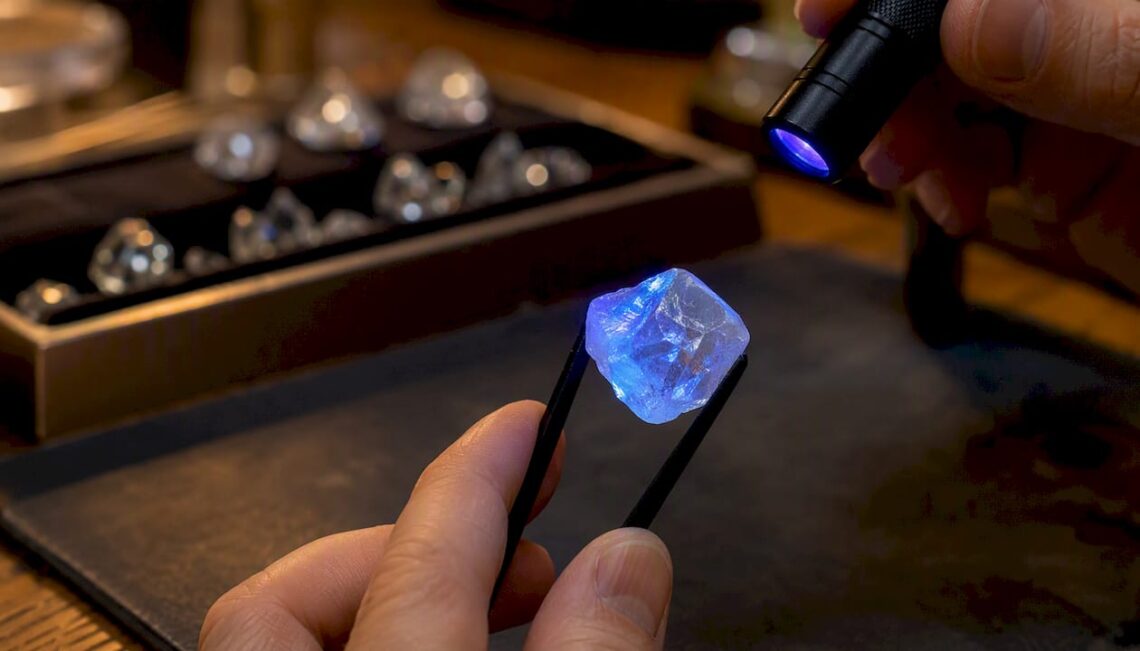
Diamond fluorescence happens when a stone absorbs invisible ultraviolet light and re-emits it as visible light, most often a soft blue glow. It is a physical reaction, not a defect and not a treatment. You are seeing trace structural elements inside the crystal doing something interesting when hit with the right wavelength.
The cause traces back to nitrogen related defects in the crystal lattice, commonly linked to what gemologists call the N3 center, along with occasional trace boron. These microscopic features absorb UV energy and release it as light in the visible spectrum. Because the emitted light usually falls in the blue range, blue is by far the dominant fluorescence color you will encounter while shopping.
Fluorescence is far from a fringe phenomenon. Roughly 35 to 50% of natural diamonds fluoresce at some intensity, and blue accounts for about 97% of those cases. The remaining sliver includes yellow, orange, and green fluorescence, which we will cover later since they behave differently in the market.
| Fluorescence Trait | What It Means |
|---|---|
| Cause | UV light exciting nitrogen-related defects (N3 center) in the crystal structure |
| Typical color | Blue, in about 97% of fluorescent diamonds |
| Prevalence | An estimated 35 to 50% of natural diamonds show some fluorescence |
| Visibility trigger | Requires ultraviolet light, such as sunlight or blacklight, not standard indoor bulbs |
A few things worth remembering as you shop:
- Fluorescence is a natural property of the crystal, not a sign of poor quality or damage.
- It only becomes visible under UV-rich light, so a stone can look completely normal indoors and glow outside.
- The intensity of the reaction, not just its presence, is what determines whether it affects appearance at all.
How Diamond Grading Reports Record Fluorescence
Every diamond fluorescence grading system used by major labs follows a similar five-tier intensity scale: None, Faint, Medium, Strong, and Very Strong. This single field on your report tells you how reactive the stone is under long-wave ultraviolet light, which is the standard testing method labs use to evaluate it.
You will find this listed clearly on both GIA and IGI reports, usually right below the clarity and color grades. A stone graded “None” or “Faint” will rarely draw any comment. Once you hit Medium and above, pay closer attention to the report’s comments section, since that is where a lab will flag anything unusual, such as a note about the fluorescence color if it is not blue, or a rare mention of an effect on transparency.
A few practical notes on reading the field:
- None or Faint: No practical visual effect in almost any lighting condition.
- Medium: Occasionally visible in strong UV settings, but usually not a concern.
- Strong to Very Strong: Worth a closer look, particularly on colorless stones, though most still show no visible issue.
- Color notation: Labs will specify if the fluorescence is anything other than blue, since off-color fluorescence gets flagged differently.
Pro Tip: Always scroll to the comments section on a GIA or IGI report before assuming a fluorescence grade tells the whole story. That’s where a lab notes anything specific enough to affect the stone’s face-up look.
How Fluorescence Changes a Diamond’s Appearance
The visual impact of fluorescence depends almost entirely on two things: how much ultraviolet light is present, and what color grade the diamond already carries. Indoor lighting, LED bulbs, and most office environments contain very little UV, so fluorescence rarely shows up there at all. Direct sunlight and blacklights are a different story, since both are UV-rich enough to trigger a visible reaction.
GIA’s own research backs this up directly. Using a standardized lighting setup called the DiamondDock, calibrated to roughly 2% UV content, researchers found that Strong and Very Strong blue fluorescence can noticeably shift face-up color and brightness, while None, Faint, and Medium fluorescence produced negligible changes. That distinction is the entire reason a blanket “fluorescence is bad” rule falls apart under scrutiny.
Color grade matters just as much as intensity. On a diamond graded D through F, blue fluorescence has nothing to counteract since the stone is already colorless, so any visible shift tends to read as a downside. On a diamond graded I through M, the story flips. Those grades carry a faint yellow body color, and blue light sitting on the opposite side of the color wheel can visually cancel some of that tint. IGI notes that blue fluorescence can genuinely improve the look of lower color diamonds in the H to K range, sometimes making a warmer stone appear a full grade or so whiter face-up.
| Factor | Effect |
|---|---|
| Sunlight / blacklight | UV-rich; fluorescence most visible here |
| Office / LED lighting | Low UV; fluorescence usually invisible |
| D to H color grade | Fluorescence adds no benefit, occasional risk on Strong+ |
| I to M color grade | Fluorescence can neutralize yellow tint, often a visual improvement |
| None to Medium intensity | Negligible visual change in virtually any lighting |
| Strong to Very Strong intensity | Most likely tier to show visible effects, positive or negative |
What about the “milky” or hazy diamonds you may have read about? Jewelry transparency explains that true haziness is almost always caused by light-scattering structural defects inside the stone, not by fluorescence itself. Very Strong fluorescence can occasionally make an already hazy stone look worse, but fluorescence alone, in a structurally clean diamond, essentially never produces that effect. The milky-diamond scare that circulates online overstates a genuinely rare combination of factors.
Does Fluorescence Change a Diamond’s Price?
Yes, fluorescence often affects price, and usually in the buyer’s favor. Medium to Strong blue fluorescence on colorless and near-colorless stones (D through H) frequently sells at a measurable discount compared to equivalent non-fluorescent diamonds, even though the visual difference in typical lighting is often impossible to spot. The market has, for decades, penalized fluorescence more than the science actually justifies.
That gap between perception and reality is where smart buyers find value. If you’re comparing two D-color diamonds with identical cut, clarity, and carat weight, and the only difference is that one carries Strong blue fluorescence, that stone will often cost noticeably less while looking nearly identical face-up in normal indoor conditions.
The relationship flips for warmer color grades. On an I, J, or K color diamond, blue fluorescence that visibly whitens the stone’s appearance can actually support the price rather than dragging it down, since the buyer is getting a stone that looks better than its color grade suggests.
- Request a video of the exact stone under indoor light, direct sunlight, and if possible, blacklight, before finalizing any purchase with fluorescence above Faint.
- Compare the fluorescent stone side by side with a non-fluorescent option of the same grade to judge whether any price difference reflects a real visual gap or just trade caution.
- Treat a Strong fluorescence discount on a colorless stone as a genuine opportunity once you have confirmed there’s no haze, not as a red flag on its own.
How to Evaluate Fluorescence in a Specific Diamond
Judging fluorescence on paper only gets you halfway. The real test is seeing how a specific stone behaves, and that takes a short, repeatable process whether you are standing in a showroom or shopping from your couch.
- Read the lab report first. Locate the fluorescence field and check the comments section for anything unusual, particularly a non-blue color notation or a transparency remark.
- Request a 360 degree video of the actual stone, not a stock photo, filmed under at least two lighting conditions: typical indoor light and something UV-rich like sunlight or a blacklight.
- View the stone outdoors on a sunny day if you can, since that is the single most realistic worst-case (or best-case) scenario for fluorescence to show itself.
- Compare against a non-fluorescent stone of the same color and clarity grade side by side. If you can’t tell them apart, the fluorescence isn’t costing you anything visually.
- Ask the seller directly whether the lab report notes any effect on transparency, and request that they point out the exact language if so.
- Check for phosphorescence, the lingering glow after UV light is removed, since a report flagging this deserves a closer follow-up conversation with the seller or lab.
For anyone shopping sight-unseen, a few extra safeguards go a long way. Insist on long-wave UV video specifically, since that is the standard test condition labs use. Confirm the return policy before buying anything above Medium fluorescence on a colorless stone, and ask the seller to state the fluorescence color and intensity explicitly in the product listing rather than burying it in a spec sheet.
Pro Tip: If a seller hesitates to send video under multiple lighting conditions, treat that as a signal, not the fluorescence grade itself. A stone with nothing to hide is easy to document.
For a broader look at how fluorescence fits alongside color and clarity, our guide to diamond color and clarity walks through how these grades interact on a real report.
Phosphorescence, Lab-Grown Diamonds, and Rare Fluorescence Colors
Phosphorescence gets confused with fluorescence constantly, but they are not the same reaction. Fluorescence stops the instant the UV source is removed. Phosphorescence lingers, sometimes for several seconds or longer, glowing after the light source is gone. It shows up far less often than fluorescence and, when a lab report flags it, that is worth a direct conversation with the seller about what testing was done.
Lab-grown diamonds add another layer to this picture. Testing guides show that natural diamonds typically glow brighter under long-wave UV, while some lab-grown stones respond more under short-wave UV instead, and phosphorescence appears more frequently in HPHT lab-grown material specifically. This makes fluorescence testing a useful screening tool, though GIA is clear that it is not a substitute for full laboratory analysis when origin needs to be confirmed. If you’re weighing natural against lab-created options, fluorescence behavior is one more data point, not the deciding factor.
Non-blue fluorescence colors deserve a mention too, even though they are uncommon. Yellow, orange, and green fluorescence occasionally appear, and the market treats them differently than blue. These colors don’t offer the same tint-neutralizing effect on warmer stones, and labs will note them specifically in the report rather than leaving fluorescence color unstated, which typically implies blue by default.
What We See in the Showroom
Most customers who ask about fluorescence have read something alarming online and walk in expecting bad news. Almost every time, once we pull up the actual lab report and put the stone under a few different lights, the concern disappears. The gap between the internet’s reputation for fluorescence and what a jeweler actually sees day to day is significant.
Here’s how we handle it when a customer raises the question:
- We disclose every fluorescence grade upfront, on the report and in conversation, before you ever ask.
- We offer in-house inspection under multiple lighting setups so you can see the stone the way it will actually look in daily life.
- Every diamond we sell comes with a lifetime upgrade option, so a decision today isn’t a decision forever.
- Our video documentation shows the stone as it is, not a filtered or staged version.
If a stone doesn’t look the way you expected once you see it under real light, our return and inspection policies exist for exactly that reason. We would rather you feel confident before you buy than surprised after.
Shop Fluorescence-Graded Diamonds With Confidence
Usajewels gives you something a lot of online diamond marketplaces don’t: the ability to see the actual stone, from every angle, under real lighting, before you commit. Every diamond in our certified inventory carries a full GIA or IGI report, and if fluorescence shows up as Medium or higher, we’ll walk you through exactly what it means for that specific stone rather than leaving you to guess from a spec sheet.

If you’re drawn to the way blue fluorescence plays against a warmer diamond, our blue diamond jewelry collection is worth a look, and it pairs naturally with the fluorescence effects we covered above. For a broader shopping experience, our fine jewelry collection includes certified stones across every color and clarity range, each ready for a request-a-video or in-showroom appointment before you buy. Reach out for a 360 degree video of any stone that catches your eye, and see it under multiple lights before you make a decision you’ll wear for a lifetime.
Sources
- GIA — Fluorescence and phosphorescence (Winter 2024)
- IGI: Diamond fluorescence — The bad and the beautiful (2023)
- TheDiamondPrice: Diamond fluorescence — Good, bad, or worth the discount? (2026)
FAQ
Is a diamond with fluorescence good or bad?
Neither by default. Fluorescence’s effect depends on intensity and color grade. Faint to Medium is typically invisible, while blue fluorescence on I to M color stones can visually improve the diamond by softening yellow tint.
Are diamonds with fluorescence cheaper?
Often, yes. Medium to Strong blue fluorescence on colorless diamonds frequently sells at a discount compared to identical non-fluorescent stones, even when the visual difference is minimal.
Are diamonds supposed to glow under a blacklight?
Only some do. Roughly 35 to 50% of natural diamonds fluoresce under UV light, so a stone that doesn’t react is completely normal, not defective.
What does it mean if a diamond has no fluorescence?
A “None” fluorescence grade simply means the stone doesn’t react to UV light at all. It carries no downside and no missed benefit, since fluorescence only matters visually in Strong to Very Strong intensities to begin with.
Recommended
- Diamond Color & Clarity Explained: What to Buy | USA Jewels
- Colored Diamond Jewelry, Fine Jewelry Artistry | USA Jewels
- Emerald Cut Diamond Guide: Sophisticated Step-Cut Beauty | USA Jewels
- Diamond Color Chart — D-to-Z Color Scale Explained | USA Jewels

Deep Mehta is the Co-Owner of USA Jewels, a family-owned jewelry business she has led since 2013 in Deerfield Beach, Florida. With over 13 years of hands-on experience in fine jewelry retail, manufacturing, and diamond importing, Deep specializes in engagement rings, wedding bands, and custom jewelry design. She also co-manages Kaash Group Talent Acquisition. Deep is a University of Florida graduate and oversees every aspect of USA Jewels’ operations, from product development to marketing.
Fine Jewelry Collection


You May Also Like
Diamond Carat Weight: What It Means and Why It Matters
Buy With Confidence: When Laser-Drilled Diamonds Make Sense