Cut vs Carat: Which Matters More for Your Diamond?
For most buyers, cut matters more than carat. Carat tells you what a diamond weighs. Cut tells you how well it turns light into sparkle, and it decides whether that weight looks like a big, lively stone or a flat, glassy one. Put your budget into a well-cut diamond first, then choose the carat weight that fits what is left. That is how we guide couples who design a ring with us, and the rest of this guide shows the reasoning so you can make the call yourself.
TL;DR
- Carat is weight, not size. One carat equals 200 milligrams, and two stones of the same carat weight can look noticeably different on the hand.
- Cut drives beauty. It controls brightness, fire and sparkle, and a well-cut stone often looks larger than its weight suggests.
- Price climbs fast with carat. Cost rises steeply, with jumps at round numbers like 0.50, 0.75 and 1.00 carat.
- The smart order: choose an Excellent or Very Good cut first, then pick the largest carat weight your budget allows, ideally just under a round-number threshold.
- You can see both choices before you buy when you design your own ring or browse certified loose diamonds with us.
Table of Contents
- What cut and carat actually mean
- Why a carat is not a size
- How cut shapes sparkle
- Cut vs carat: a side-by-side view
- How each one affects price
- How to balance cut and carat
- Questions about budget and size
- Our perspective
- Choose your diamond with us
- Related reading
- FAQ
- Sources
What cut and carat actually mean
These two words sit side by side in every diamond guide, but they describe very different things.
Carat is a measurement of weight. According to the American Gem Society, one carat is one fifth of a gram (200 milligrams), and it is divided into 100 points. A diamond of 0.75 carat is also called a 75-pointer. Carat is the most objective of the 4Cs (cut, color, clarity and carat) because a scale gives the same answer every time.
Cut is not the shape. Shape is the outline you see from above: round, oval, pear, emerald and so on. Cut is the quality of the craftsmanship: the proportions, the angles of the facets (the small flat surfaces) and the finish. The American Gem Society describes it as the grader’s evaluation of the cutter’s skill, and says it has the greatest effect on a diamond’s beauty. If you want to compare outlines, our diamond shapes guide covers each one.
A quick way to remember it: carat is how much diamond you are buying, and cut is how well that diamond has been made to perform.
Why a carat is not a size
It is natural to think a bigger carat number means a bigger-looking stone. Often it does, but not always, because carat measures mass, not the width you see from above.
GIA, the Gemological Institute of America, explains that a poorly cut round diamond can be too deep or have a very thick edge (the girdle), which hides weight below the surface where you cannot see it. As GIA’s guide to carat weight puts it, a poorly cut 1.20 carat diamond may appear the same size as a well-cut 1.00 carat diamond. In that case you pay for 0.20 carat that never shows.
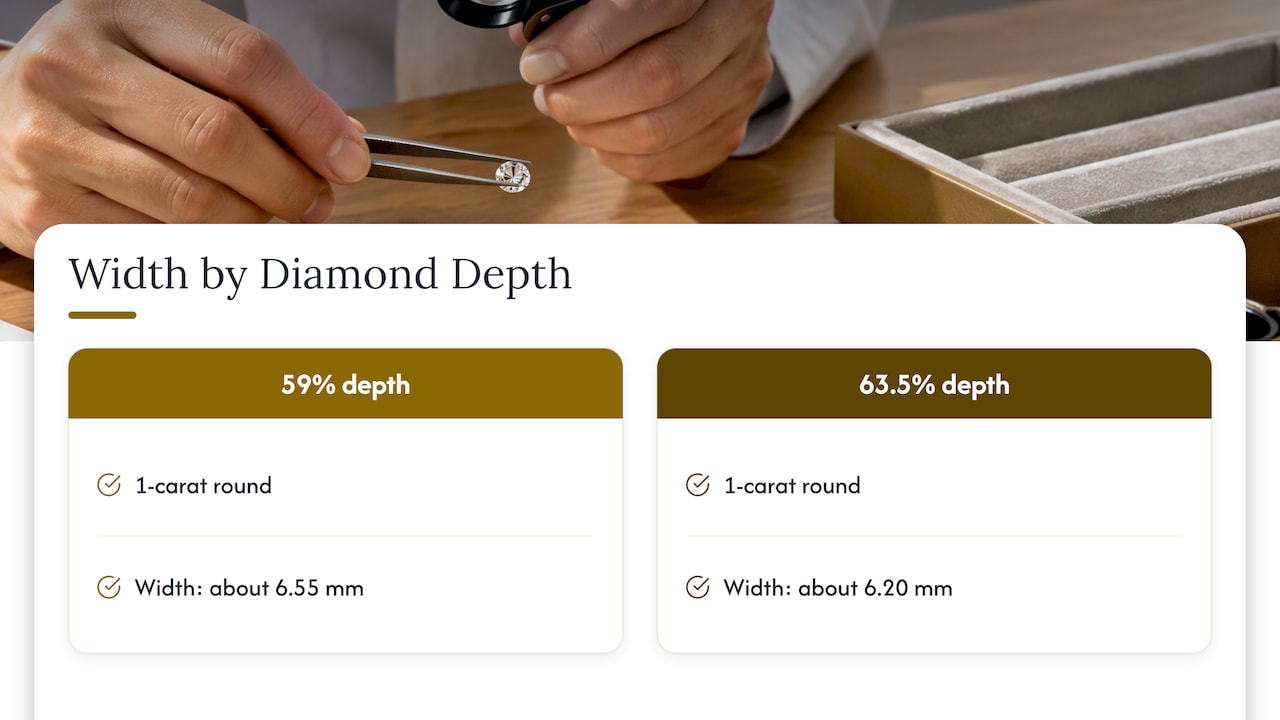
The measurements bear this out. A 2026 face-up size chart from Diamond Critics shows a 1-carat round at 59% depth measuring about 6.55 mm across, against about 6.20 mm for the same weight at 63.5% depth. Depth percentage is the stone’s height divided by its width. Same carat weight, a third of a millimeter apart, and your eye can pick that up.
This is why we publish depth guidance in our article on verifying table and depth before you buy. It is a quick check that tells you whether the weight sits where you can see it.
What a one-carat diamond looks like on a hand
A round one-carat diamond typically measures between roughly 6.3 and 6.6 mm across, according to the diamond size simulator at DiamDB, which puts that at around 39% finger coverage on a size 6.5 finger. On a slim finger it reads as a clear, confident stone. On a wider finger it reads as classic and modest. Setting matters too: a thin band and a low setting let the diamond take center stage, while a wide band makes it look smaller.
Shape changes the picture as well. Oval, pear and marquise cuts carry their weight across a longer outline, so they often look larger than a round of the same carat weight. Emerald cuts look elegant but show less hidden sparkle, so clarity and color matter more with them, as GIA notes in the carat weight guide above.
How cut shapes sparkle
When light enters a diamond through the top (the crown), it should bounce between the facets and return through the top to your eye. GIA’s Diamond Quality Factors page explains that if light leaks out through the bottom (the pavilion), the stone looks dark in places. A well-cut diamond shows three things:
- Brightness: white light reflected back to your eye.
- Fire: flashes of color.
- Scintillation: the play of light and dark patterns as the stone or the light moves.
GIA says cut has the greatest impact on a stone’s beauty. According to GIA’s six things to know about cut grade, an expertly cut diamond appears brilliant even with lower color and clarity grades, while a poorly cut diamond with top color and clarity can look dull.
GIA grades cut for standard round brilliant diamonds only, because round is the shape with standardized facets. Every round brilliant has 57 or 58 facets, depending on whether the tiny bottom point, the culet, counts as one, according to GIA’s cut scale page. The scale runs from Excellent down to Poor. Fancy shapes such as oval or cushion are not given a GIA cut grade, so for those you rely on the proportions, the symmetry and polish grades, and your own eyes.
We go deeper on each level in our guides to GIA’s five cut grades and how cut grades affect brilliance.
Cut vs carat: a side-by-side view
| Cut | Carat | |
|---|---|---|
| What it is | Quality of proportions, facets and finish | Weight: 1 carat = 200 mg |
| What you notice | Sparkle, brightness, liveliness | Potential size and presence |
| Can you judge it from a number? | Only with a grade or a view of the stone | Yes, it is measured on a scale |
| Effect on price | Better cut costs more, but pays off in beauty | Rises steeply, with jumps at round numbers |
| Can it be “made up” later? | No, it is fixed when the stone is cut | You can choose a size to suit the budget |
| Risk if you ignore it | A big stone that looks dull | Overspending on weight that adds little |
The last row is the heart of it. A well-cut diamond can lose a little carat weight and still look stunning. A large, poorly cut diamond cannot be fixed by anything else about the ring.
How each one affects price
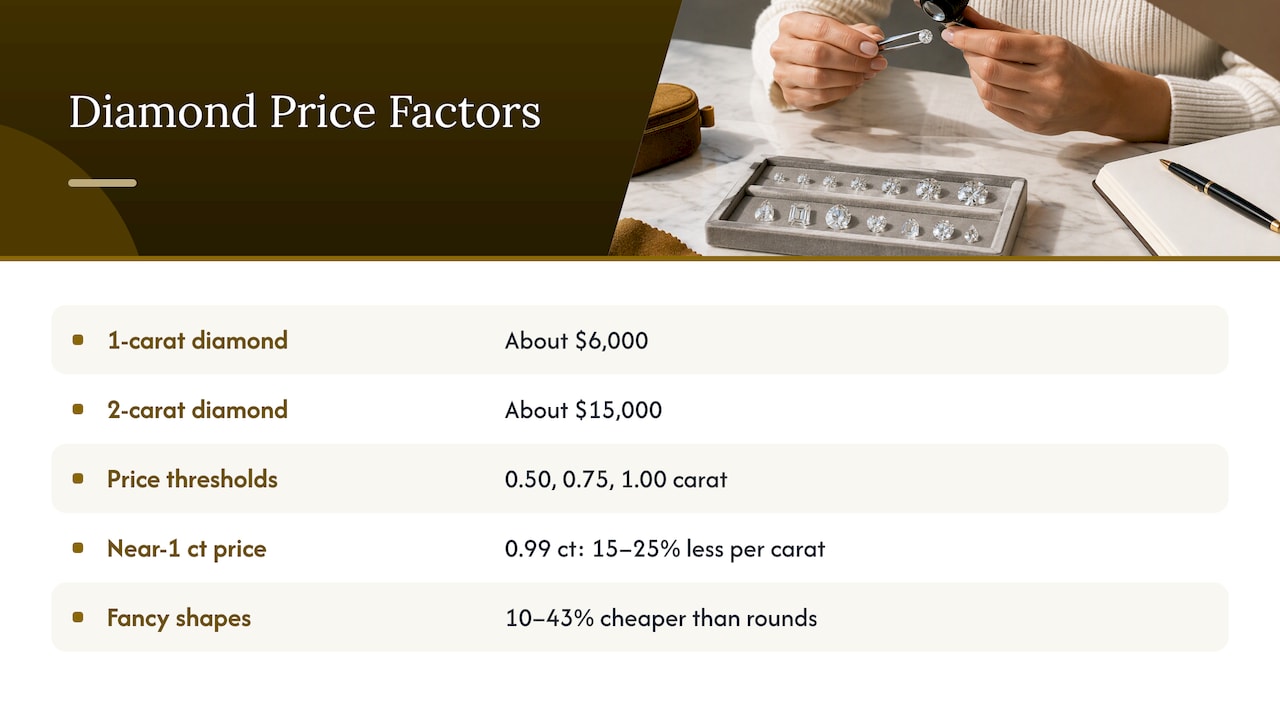
Carat weight is the biggest driver of the sticker price, and the climb is not gentle. GIA gives an example on its Diamond Quality Factors page: a 1-carat diamond might be worth about $6,000, while a 2-carat diamond of similar quality might be worth about $15,000. Large stones are rarer, so they cost more per carat as well as in total.
Prices also jump at round numbers. GIA’s tips for saving money on diamonds point out that prices step up at thresholds like 0.50, 0.75 and 1.00 carat, and that a 0.98 carat and a 1.10 carat diamond look nearly the same size. A 2026 market analysis by Stone Insights found a 0.99 carat G VS1 Excellent round on GIA paper trading at a per-carat price 15 to 25% below an identical 1.00 carat stone. The difference you can see between the two is tiny. The difference in your budget is not.
Cut affects price differently. A higher cut grade costs more than a lower one at the same weight, because the cutter gave up some weight to get better proportions. The International Gem Society describes cutting as a balance between saving weight and keeping brightness, pattern and symmetry. A lower grade often means more weight is kept but less of it shows face-up.
Shape plays a part too. In the International Gem Society’s shape and price comparison, fancy shapes were 10 to 43% cheaper than rounds, depending on carat weight. If you love the look of an oval or a pear, you may get more face-up size for your money.
A worked example
Say you have a fixed budget and are choosing between two round diamonds:
- Stone A: 1.10 carat, a lower cut grade, with a deeper body.
- Stone B: 0.98 carat, an Excellent cut, just under the 1.00 carat threshold.
Stone A sounds bigger on paper. But because of its proportions, more of its weight sits below the girdle, so its face-up width may match or trail Stone B. Stone B also sits below the 1.00 carat step, which tends to lower the price per carat. With the money you save, you could choose a better color grade, a more refined setting or a gold or platinum band you will love for decades. That trade is exactly what GIA recommends: spend on cut first, because a well-cut stone forgives compromises elsewhere.
How to balance cut and carat
Here is the order we suggest for a first-time buyer.
- Set a total budget for the ring, not just the diamond. The setting and metal are part of the cost.
- Lock in cut quality first. For a round diamond, look for an Excellent or Very Good grade. GIA’s advice is that either is often wiser than a larger stone with a lower grade.
- Choose your shape. If you want maximum finger presence for the weight, look at elongated shapes. If you want classic fire, round is the most traditional.
- Pick a carat weight, then look just below it. If you are dreaming of 1 carat, compare stones at 0.90 to 0.99 carat. The gap in size is hard to see, and the gap in price is not.
- Match color and clarity to the shape. Step-cut shapes like emerald show inclusions more readily, so they reward a higher clarity grade.
- Check the certificate. A grading report from a recognized laboratory confirms the cut, carat, color and clarity. Our guide to GIA certification and our comparison of GIA, AGS and IGI reports explain what each report tells you.
What if the ring is a gift?
If you are buying for a partner, a child or a graduate, the same logic holds, and it is even more useful. A smaller, beautifully cut diamond in a well-made setting often delights more than a bigger stone that looks flat. For a younger wearer, a modest carat weight with excellent sparkle is a gift that will still feel right in ten years.
Questions about budget and size
Searchers often ask how many carats a $10,000 ring buys. There is no single answer, because the result depends on cut, color, clarity, shape and whether the diamond is natural or lab-grown. Lab-grown and natural diamonds are both real diamonds, but they are priced differently, and a lab-grown stone will usually give you more carat weight for the same money. What stays true in every case is that a well-cut stone just under a round-number threshold gives you the most visible size and sparkle for your budget.
Another common worry is whether two carats is too flashy. That is a matter of taste and of the hand wearing it. A slim finger can carry a large stone beautifully, and a smaller diamond in a delicate setting suits someone who wants a quiet, everyday ring. Try a few sizes in the ring designer and see what feels like you.
Our perspective
We have been a family-owned jeweler since 1999, and the question we hear most is the one in this article: should I go bigger, or should I go better? Our answer is almost always better.
Because we manufacture in-house and sell direct, there are no middlemen adding to the price. That means your budget goes into the diamond and the metal, not into markup. We think that is the right way to put cut first: you can afford the quality that makes the stone shine, and still choose a carat weight you are proud of.
Our rings are solid, not hollow or plated, and our diamonds are certified and conflict-free. If your tastes or your family grow, our lifetime diamond upgrade program lets you step up to a larger stone later, so you never have to feel that today’s carat weight is the last word. A ring should tell your story, and stories grow.
Joseph
Choose your diamond with us
When you are ready to see the difference between a well-cut stone and a bigger number, start with our certified loose diamonds, available from $142. You can browse natural and lab-grown stones, compare weights and read each certificate. Or build the whole ring yourself with our design tools: Design Your Own Diamond Ring starts from $399, and you choose the diamond shape, quality and metal type.

If you would rather start from finished designs, our engagement rings start from $346. Every order ships free and insured, and comes with a 30-day money-back guarantee. For a walk through the process, our step-by-step design guide takes you from first idea to finished ring.
Related reading
If you want to go further on either topic, these guides cover the details: diamond carat weight and why it matters, our carat weight guide for size, price and value, the diamond cut comparison for engagement rings and the full 4Cs buying guide.
FAQ
Is cut more important than carat?
For beauty, yes. GIA says cut has the greatest impact on how a diamond looks, and a well-cut stone can appear larger and brighter than a heavier one with poor proportions. Carat still matters for the size you want and for price, so the best approach is to choose the cut first and then the largest carat weight your budget allows.
Does a higher carat always look bigger?
Not always. Carat measures weight, not width. A deep or thick-edged stone hides weight below the surface, so a poorly cut 1.20 carat diamond can look the same size as a well-cut 1.00 carat one. Shape matters as well, since elongated shapes often spread their weight over a larger face-up area.
Which cut diamond is more expensive?
Round diamonds usually command the highest price at all sizes. In one 2023 comparison, fancy shapes were 10 to 43% cheaper, depending on the carat weight. Within any shape, a higher cut grade and a weight just over a round-number threshold, such as 1.00 carat, both raise the price.
Is it better to buy a 0.99 carat diamond instead of 1 carat?
Often, yes. The size difference is too small to see, but the price can differ noticeably. A 2026 market analysis found the per-carat price of a 0.99 carat stone to be 15 to 25% lower than an identical 1.00 carat. The key is that the 0.99 carat diamond should still have an Excellent or Very Good cut.
How big is a one-carat diamond on a finger?
A round one-carat diamond measures roughly 6.3 to 6.6 mm across. How large it appears depends on your finger width, the band and the setting. A slim band and a low setting make the stone look larger, and an oval or pear of the same weight usually looks bigger than a round.
Sources
- What Are the 4Cs of Diamonds? American Gem Society
- Nine Things About Diamond Carat Weight You Need to Know, GIA 4Cs
- Round Diamond Face-Up Size Chart 2026, Diamond Critics
- 1 Carat Diamond (Round, 6.5mm) Size Simulator, DiamDB
- Diamond Quality Factors, GIA
- GIA Diamond Cut Grade: 6 Things to Know, GIA 4Cs
- Diamond Cut: Understanding the Cut Scale, GIA 4Cs
- Top Tips to Save Money on Diamonds, GIA 4Cs
- The 0.99 vs 1.00ct Jump, Stone Insights
- Diamond Cut Quality: Ultimate Guide, International Gem Society
- Different Diamond Shapes: Size and Price, International Gem Society
Recommended
- Diamond Carat Weight: What It Means and Why It Matters
- Diamond Quality 4Cs Breakdown: Your Buying Guide
- Diamond Cut Comparison Guide for Engagement Rings
- The 4Cs of Diamonds: Cut, Color, Clarity & Carat Guide

Deep Mehta is the Co-Owner of USA Jewels, a family-owned jewelry business she has led since 2013 in Deerfield Beach, Florida. With over 13 years of hands-on experience in fine jewelry retail, manufacturing, and diamond importing, Deep specializes in engagement rings, wedding bands, and custom jewelry design. She also co-manages Kaash Group Talent Acquisition. Deep is a University of Florida graduate and oversees every aspect of USA Jewels’ operations, from product development to marketing.
Fine Jewelry Collection

You May Also Like
Tennis Bracelet vs. Rivière: What’s the Real Difference?
Split Shank Ring: 5 Buyer Priorities to Boost Center Stone Presence