Hollow vs Solid Gold Chain: Which Should You Buy?
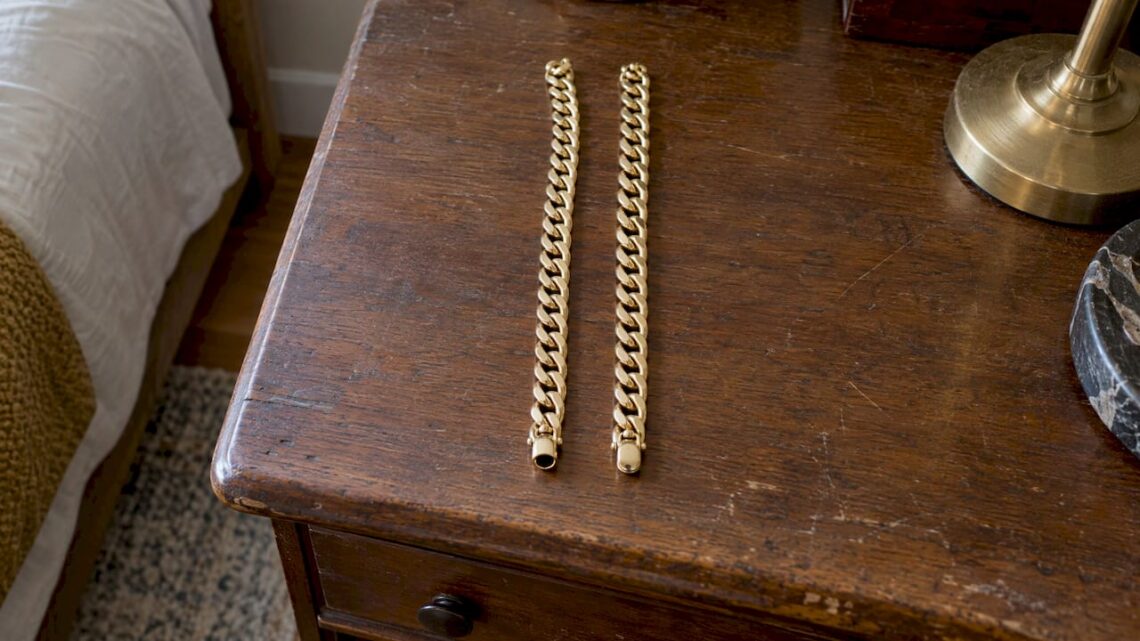
A solid gold chain is gold from the surface to the center of every link. A hollow chain is a thin tube of gold wrapped around an empty core. Side by side on a table they can look the same. On your neck for years, they behave very differently. If you want a chain to wear every day, hold a pendant, or hand down someday, solid is the choice that keeps its shape, its weight and its value. That is why every chain we build is solid, not hollow or plated.
This guide explains the difference in plain terms, shows what each costs you over time, and gives you a short checklist for telling them apart before you pay.
TL;DR
- Solid chains are one continuous gold alloy through every link. They are heavier, stronger, easier to repair and hold more value.
- Hollow chains use far less gold, so they cost less up front and feel lighter, but they dent more easily and are hard to repair.
- Semi-solid chains sit in between: thick gold walls around a smaller hollow core.
- Ask for the weight in grams and get “solid” in writing. Width and length alone tell you very little.
- For a gift, a pendant chain, or a piece meant to last, choose solid. We make ours solid, and you can design your own.
Table of Contents
- What the words actually mean
- How hollow and solid chains compare
- Why hollow chains cost less
- Wear and durability
- Hollow vs solid rope chains
- Repair and long-term value
- Is a hollow chain ever the right choice?
- How to tell if a chain is hollow or solid
- Choosing by who it is for
- Perspective
- Design a solid chain of your own
- FAQ
- Sources
What the words actually mean
Both hollow and solid chains can be real 14K or 18K gold. Karat is a measure of purity out of 24 parts, so 14K is 14 parts gold (about 58.3%) and 18K is 18 parts gold (75%). That number describes the alloy. It does not tell you how much of the chain is metal and how much is air.
Solid chain. Each link is made of the same karat alloy all the way through. A gram of a solid 14K chain is 58.3% gold, from the outside of the link to the middle.
Hollow chain. A thin sheet of gold is formed around a core. The core is then removed, which leaves a lightweight tube of the same alloy with much less gold in it. The walls are very thin, so the chain can look wide and bold while weighing a fraction of a solid one.
Semi-solid chain. Sometimes called semi-hollow, these have thicker walls and a smaller hollow center. They are denser than hollow chains but not solid all the way through.
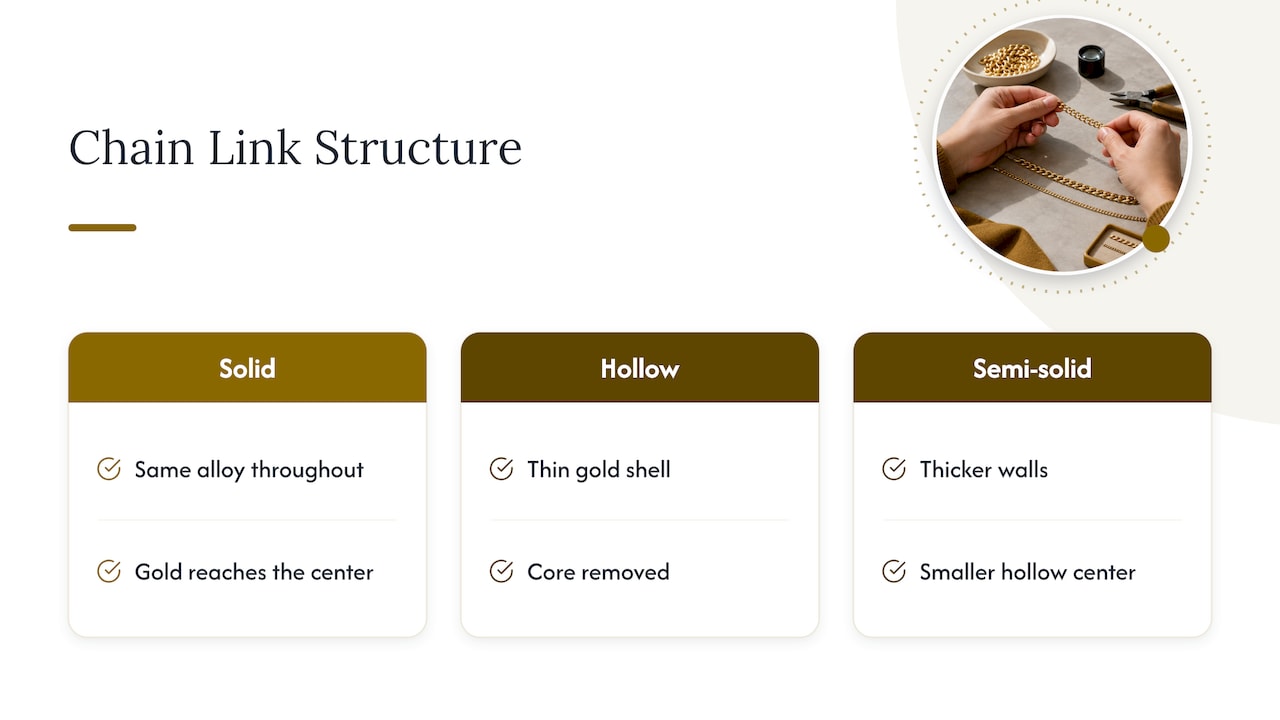
The key point: the karat stamp is the same on all three. What differs is how much gold you are getting for the money.
How hollow and solid chains compare
| Solid | Semi-solid | Hollow | |
|---|---|---|---|
| Construction | Gold throughout | Thick gold walls, small hollow core | Thin gold tube, empty inside |
| Weight for the size | Heaviest | Medium | Lightest |
| Amount of gold | Most | Moderate | Least |
| Price up front | Highest | Middle | Lowest |
| Dents and crushing | Resists well | Resists moderately | Dents easily |
| Repair | Links can be soldered | Limited | Often not worth repairing |
| Good for heavy pendants | Yes | Light to medium | Not recommended |
| Resale value | Follows gold weight | Lower | Lowest |
Why hollow chains cost less
Gold is sold by weight. A chain that contains less gold costs less to make, so a hollow chain can show you a wide, impressive link for a much lower price than a solid chain of the same size. That is the honest appeal of hollow: you get the look of a bigger chain at an entry price.
The tradeoff is that you are paying for the shape, not for the metal. When two chains look the same but one weighs a third as much, the lighter one holds roughly a third of the gold. A slim solid chain can hold more gold than a chunky hollow one.
Wear and durability
The tube walls of a hollow chain are very thin, often a fraction of a millimeter. That has a few practical effects.
- Dents. A bump, a snag on a seat belt or a tight collar can crush a link. A dented hollow link usually stays dented, because there is no solid metal behind it to push back into shape.
- Weak points. Chains rarely snap in the middle. They tend to fail at the clasp and jump ring, where the metal is thinnest and moves the most. A solid chain gives those parts more metal to work with.
- Pendants. A pendant adds steady weight and tension to every link. Solid chains carry that load comfortably year after year.
- Daily wear. Sleeping, showering, working out and pulling a shirt over your head all put stress on a chain. Solid construction is built for that kind of use.
Style matters as well. A rope chain spreads strength across many small twisted wires, and any one of them can catch. A Cuban link carries more metal per inch at the same width. Our guide to the strongest gold chain type goes through what makes a chain last, and our Cuban link chain guide covers sizes and weights.
Hollow vs solid rope chains
Rope chains are the style where this question comes up most. A rope is made of many small links twisted into a spiral, which gives it that sparkle. In a hollow rope, every one of those small links is a thin shell. The spiral can flatten if it is pressed or caught, and a flattened section is hard to correct.
A solid rope keeps its spiral. It is also a good fit for a pendant, because the chain moves smoothly through the bail and holds its shape. If you love the rope look, solid is the version that will still look like new after years of wearing.
Repair and long-term value
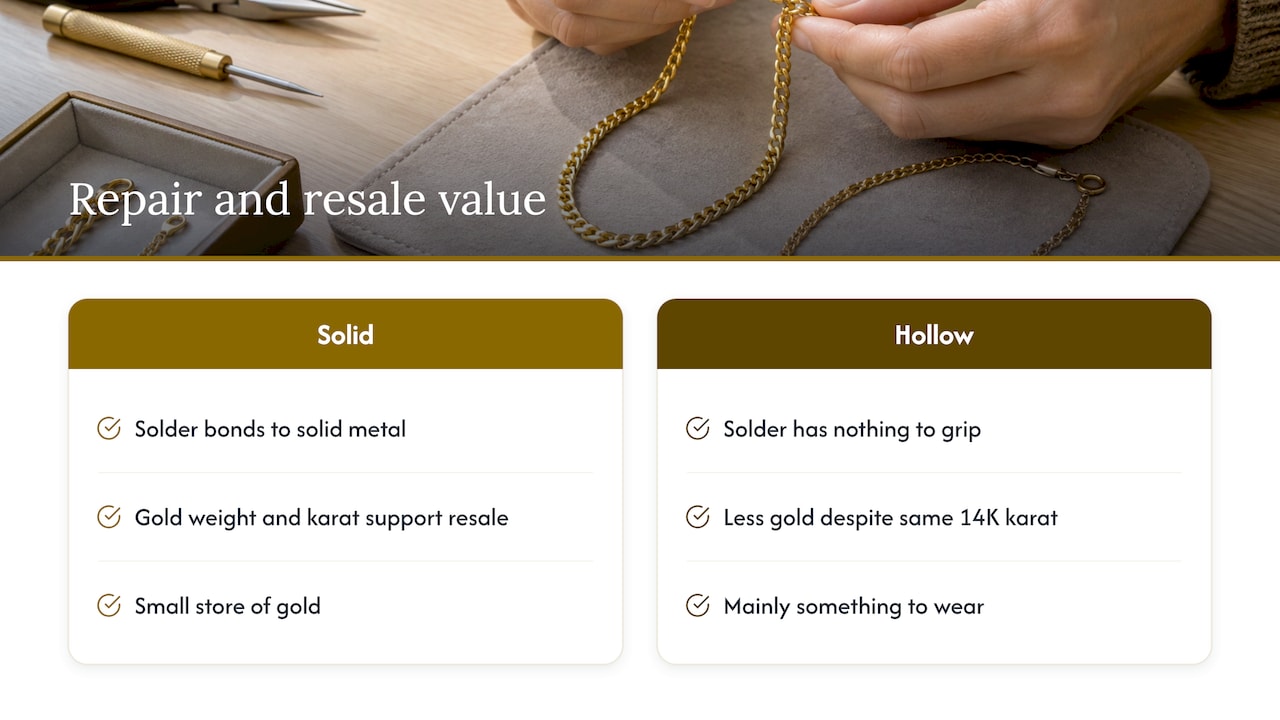
When a solid link breaks, a jeweler can solder it, because there is solid metal for the solder to bond to. A hollow link gives the solder nothing to grip, so many hollow chains cannot be reliably put back together once a link splits. A repair that works on a solid chain may be impractical on a hollow one.
Value follows the same logic. If you ever sell or trade a chain, a buyer values it by the weight of gold and the karat. A hollow 14K chain is still real 14K gold, but there is simply less of it. Over time that gap matters: a solid chain behaves like a small store of gold, while a hollow chain is mainly something to wear.
So the real cost comparison is not the price tag on day one. It is the price divided by how long the chain lasts and what it is worth at the end.
Is a hollow chain ever the right choice?
Hollow chains are real gold, and they are lighter to wear. If you want a bold look for an occasional outfit and you will handle it gently, a hollow chain can fit that purpose. For a chain you will wear most days, give as a meaningful gift, or pair with a pendant, we recommend solid, and that is what we make.
If budget is the main concern, you do not have to go hollow to keep the price down. A solid chain in a slimmer width, a shorter length or a lower karat gives you real, repairable metal at a lower price. Slim and solid usually serves you better than wide and hollow.
How to tell if a chain is hollow or solid
Use this checklist before you buy any chain, from any source.
- Ask directly. Ask whether the chain is solid, semi-solid or hollow, and get the answer in writing on the receipt or product page.
- Look for the weight in grams. A listing that gives width and length but no weight is leaving out the number that matters most. Weight is the best single clue.
- Check the weight against the size. A chain that looks large but feels very light for its size is probably hollow. A heavy, dense feel in the hand points to solid.
- Look for markings. Some hollow chains carry an extra mark near the karat stamp, but not all do, so the absence of a mark proves nothing.
- Examine the cut end of a link. Under magnification, a hollow link shows a seam or a flattened tube.
- Read the description. U.S. rules help here. The Federal Trade Commission’s Jewelry Guides say that a gold alloy product with a hollow center should have that fact disclosed next to the word “gold,” and that it should not be called “solid” gold. A seller who calls a chain solid should mean solid all the way through.
If you shop with us, you do not need to run this test. Our chains are solid, built in-house, and we are happy to answer questions about weight and size.
Choosing by who it is for
A gift for a partner or parent. A chain given on an anniversary or birthday is meant to be worn and kept. Solid gold lasts, and it can be passed on.
A first chain. If this is your first fine jewelry purchase, start with a simple solid chain in 14K. It is the most dependable way to get real value at an approachable price. Our 14K gold jewelry collection is a good place to begin, and 18K is there if you want a richer color.
A chain for a pendant. If the pendant is a diamond or a keepsake, the chain should be as dependable as the pendant. Solid links keep the pendant secure and keep their shape.
A gift for a young person. Children and teens are active, and chains get tugged and caught. A solid chain in a modest width stands up to that far better than a thin hollow one.
Men’s chains. For heavier styles like Cuban and rope, see our men’s gold chains, made in 14K and 18K solid gold.
Perspective
We are a family-owned jewelry maker, and we have been at this since 1999. We make our pieces in-house, and that is the reason we can offer solid gold at direct prices without a middleman adding to the cost.
When someone asks us about hollow or solid, we think about the person who will wear the chain. It might be worn at a wedding, on a daily commute, or by a child who forgets to take it off. A chain should be able to do all of that, and be there years later.
That is why our construction is solid, not hollow or plated. A solid chain is something we can stand behind, and something you can pass on. Our customers can also choose their metal and design the piece the way they like it, so the chain fits both the person and the budget.
Joseph
Design a solid chain of your own
You can choose the metal, style and length of your chain through our design tool. Design Your Own Chain starts at $149, and our Design Your Own Gold Jewelry starts at $149 too. If you would rather browse, our chain collection covers gold, platinum and silver. Shipping is free and insured, and every order is covered by a 30-day money-back guarantee.
To start designing, go to Usajewels.

If you want more detail on choosing a style, width and length, our chain buyers guide walks you through it.
FAQ
Are hollow chains good?
Hollow chains are real gold and they are light and lower in price. They are best for gentle, occasional wear. They dent easily and are hard to repair, so for a chain you will wear daily or use with a pendant, solid is the better fit.
Is a hollow gold chain real gold?
Yes, a hollow chain can be genuine 14K or 18K gold. The difference is quantity: it uses a thin shell of gold around an empty center, so it contains much less gold than a solid chain of the same size. U.S. guidance says such a chain should not be described as solid gold.
Should I get a hollow or solid gold chain?
Choose solid if you want a chain that lasts, carries a pendant, can be repaired and holds its value. If you are watching your budget, a slimmer solid chain usually gives you more lasting value than a wide hollow one.
What is the difference between solid and semi-solid chains?
A semi-solid chain has thick gold walls around a smaller hollow core. It is denser and sturdier than a fully hollow chain, but it still has less gold than a fully solid one. Solid is the most durable and the easiest to repair.
Which chain style is strongest?
Metal per inch matters more than the style name. A solid Cuban link is strong because each link carries a lot of gold, while a rope is made of many fine wires. Whatever the style, solid construction makes it stronger.
Sources
Recommended

Deep Mehta is the Co-Owner of USA Jewels, a family-owned jewelry business she has led since 2013 in Deerfield Beach, Florida. With over 13 years of hands-on experience in fine jewelry retail, manufacturing, and diamond importing, Deep specializes in engagement rings, wedding bands, and custom jewelry design. She also co-manages Kaash Group Talent Acquisition. Deep is a University of Florida graduate and oversees every aspect of USA Jewels’ operations, from product development to marketing.
Fine Jewelry Collection

You May Also Like
59–62.6% Depth: Verify Diamond Table and Depth Before You Buy

Avoid Overpaying: How HPHT vs CVD Diamonds Change What the 4Cs Mean