Pendant Design Ideas: 12 Ways to Make One Personal
The best pendant designs start with one decision: what the pendant should say about the person who wears it. Pick that first, whether it’s a name, a birthstone, a diamond solitaire or a symbol, and the stone, metal and chain follow naturally. At USA Jewels, you can build exactly that online with our Design Your Own Diamond Pendant tool, which starts at $199.
TL;DR
- Choose the message first (a name, a milestone, a birthstone, a single diamond), then the stone, metal and chain.
- A pendant hangs at the neck and is rarely knocked around, so it suits stones that would be too delicate for a ring.
- Match the chain to the pendant’s weight: delicate chains for small pieces, sturdier links for larger ones.
- Our custom pendant tool starts at $199, and sterling silver pieces start at $46, so a meaningful gift fits many budgets.
- Ask where a diamond comes from and whether it is natural or lab-grown before you buy.
Table of Contents
- Why a pendant is such a good canvas for a personal message
- Classic pendant design ideas
- Personalized and sentimental pendant ideas
- Metal, setting and chain: the choices that shape the look
- How to design your own pendant, step by step
- What affects the cost of a custom pendant
- Pendant ideas by recipient
- Buying with confidence: conflict-free diamonds
- Our perspective on pendants
- Start designing your pendant
- FAQ
- Sources
Why a pendant is such a good canvas for a personal message
A ring sits on a hand. A pendant sits at the center of the chest, where everyone can see it. The International Gem Society points out that a pendant’s position lets it communicate a message to others, not only mean something privately to the wearer. That is why names, initials, symbols and meaningful stones all work so well here.
It is also why pendants make such good gifts. They need no ring size, they suit almost any wardrobe, and one well-chosen design can mark an engagement, an anniversary, a graduation or a first birthday.
Classic pendant design ideas
1. The diamond solitaire
One stone, one setting, one chain. A solitaire pendant is the safest and most lasting choice for a first fine-jewelry piece. It pairs with everything and does not date. You choose the diamond shape, the quality and the metal, so the pendant can be as simple or as brilliant as your budget allows.
If you are buying for a partner who already wears a solitaire engagement ring, a matching solitaire pendant is a natural anniversary gift. Our Engagement Ring Settings Explained guide shows the settings that translate well from rings to pendants.
2. The halo pendant
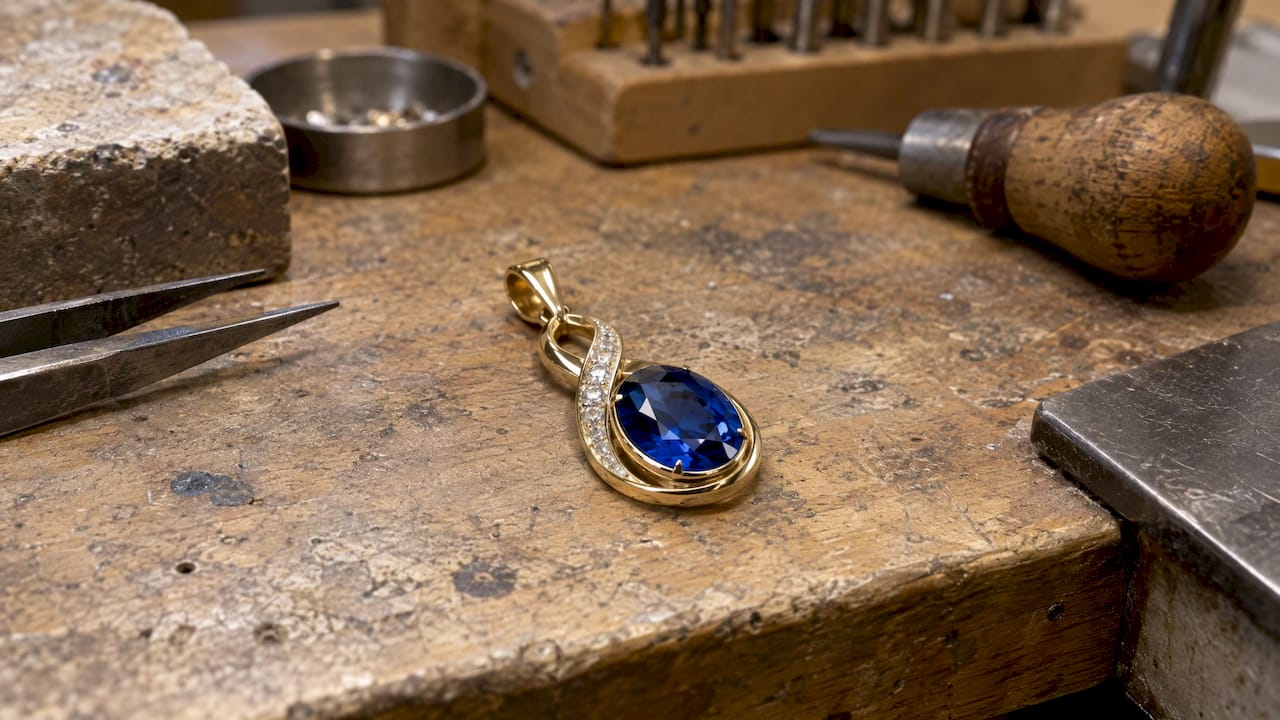
A halo surrounds a center stone with a ring of smaller diamonds. It makes a modest center stone look larger and gives the piece more sparkle from across a room. It is a good pick when you want presence without paying for a much bigger center diamond.
3. The gemstone pendant
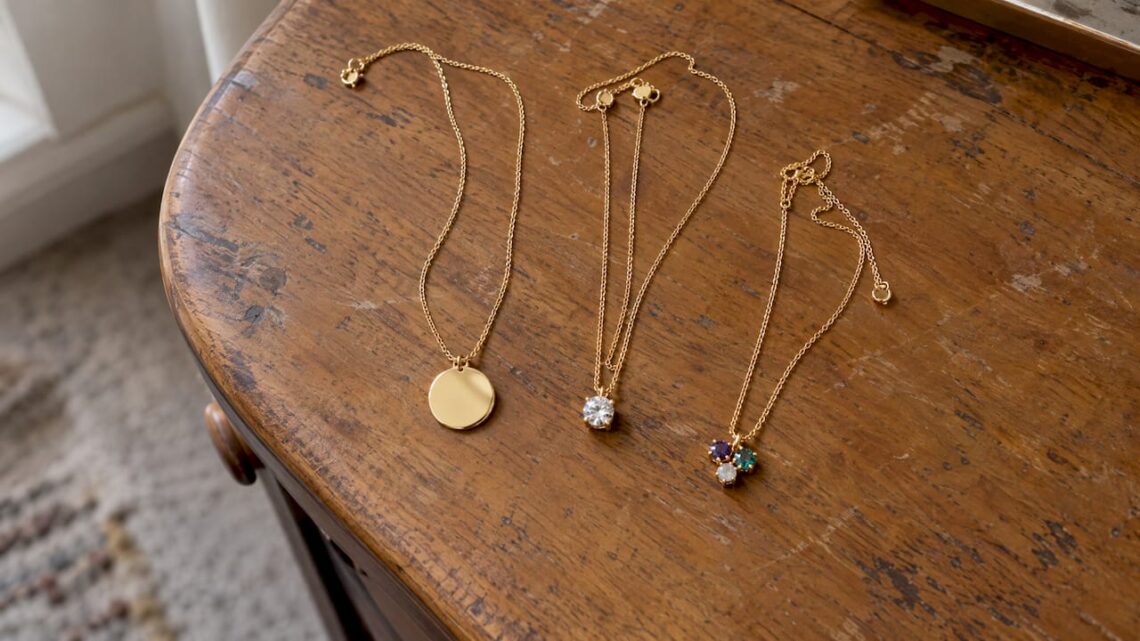
Color is the quickest way to make a pendant feel personal. Birthstones, a favorite color, or the stone from a shared memory all work. Because a pendant is at low risk of impact or abrasion, even softer gemstones can be worn safely in one, which opens up choices that would be risky in a ring. You can browse ready-to-ship options in our gemstone pendants collection, or look at the range of certified loose gemstones if you want to start from the stone.
4. The bar or drop pendant
A slim vertical bar, or a small teardrop shape, gives a clean modern look. Bars are easy to personalize because they have room for a short word, a date or a set of initials. Drops make a diamond or gemstone look elongated and elegant.
Personalized and sentimental pendant ideas
5. Name and initial pendants
A name pendant is the most direct way to personalize a necklace. Initials are subtler: a single letter in gold, or a letter set with small diamonds. For a child’s gift, an initial is a good choice because it stays wearable as they grow. Our guide to name necklace jewelry styles and meaning covers the lettering styles and how they wear.
6. Coordinates, dates and area codes
Some of the most meaningful pendants carry details only the two of you understand: the latitude and longitude of where you met, the date of a proposal, or the area code of a hometown. Jewelry-making resources list coordinates, area codes and flags among common personalization motifs, alongside inside jokes and shared references. Keep the text short, because a pendant is small and a long line becomes hard to read.
7. The birthstone cluster for a family
For a parent or grandparent, a pendant that holds one stone for each child or grandchild is a lasting keepsake. Think about how many stones you need before choosing the pendant, so the layout stays balanced instead of crowded.
8. The milestone pendant
An engagement, a wedding, a new baby or a tenth anniversary can each have a pendant that echoes the occasion. Some couples choose a pendant that uses the same diamond shape as the engagement ring. Others pick the stone color from the wedding. If you are still hunting for the right occasion-based gift, a gift finder like these personalized gift ideas by occasion can help you narrow the recipient and budget before you design.
Metal, setting and chain: the choices that shape the look
9. Choosing the metal
Metal changes the whole mood of a pendant.
| Metal | Look and feel | Where to start |
|---|---|---|
| Yellow gold | Warm, classic, flatters most skin tones | Gold jewelry collection |
| White gold or platinum | Cool, bright, lets a diamond stand out | Platinum jewelry, from $327 |
| Sterling silver | Light, affordable, good for everyday wear | Sterling silver jewelry, from $46 |
A simple rule: warm gold flatters warm-toned gemstones such as citrine or garnet, while white metals make blue and colorless stones look crisp. If you want help with the shortlist, try a couple of metals on the same design in the custom tool and compare.
10. Choosing the setting
The setting decides how the stone is held and how much light it catches. A prong setting lifts the stone and lets light in from all sides. A bezel wraps the stone in a thin rim of metal, which is smooth and secure for daily wear. Our bezel vs prong setting guide walks through the tradeoffs, and the settings guide covers channel settings too. For a child’s pendant or a piece worn every day, a low-profile bezel is a sensible choice.
11. Choosing the chain
A pendant is only as good as the chain it hangs from. The International Gem Society advises pairing small, light pendants with delicate chains, while medium or large pendants need strong links such as cable or rolo that will not bend or kink with regular wear. Length matters as much as style. Shorter chains frame the collarbone, and longer chains let a pendant sit lower on the chest.
Our chain styles page shows the common patterns side by side, and the chain buyers guide explains gold karats and lengths. Our pendant and necklace guide covers how pendant size and chain work together.
12. Choosing the stone type: natural or lab-grown
You can choose either natural or lab-grown diamonds for a pendant, and both are available as certified loose stones. The key is clear labeling. The FTC’s jewelry advertising guidance says sellers should describe lab-grown stones with terms such as “laboratory-grown” placed right before the word diamond, so you always know which one you are buying. A certificate from an independent lab adds detail on the stone itself, and our diamond certification guide compares GIA, AGS and IGI reports.
How to design your own pendant, step by step
Designing a custom pendant is simpler than most people expect. Here is the routine, and where each step tends to go wrong.
- Decide the message. Write down the one thing the pendant should say. Pendants that try to say three things usually say none of them clearly.
- Set a budget. Know your ceiling before you look at stones. Size, quality and metal all move the price, and it is easier to choose when the limit is clear.
- Pick the center stone. Choose a diamond shape and quality, or a gemstone. Round diamonds are brightest, while pear, oval and emerald shapes feel more distinctive. In our design tool you choose the shape, the diamond quality and the metal yourself.
- Pick the metal and setting. Choose yellow gold, white gold, platinum or silver, then a prong or bezel setting that suits how often it will be worn.
- Pick the chain. Match the weight and length to the pendant, as described above.
- Review before you order. Check the stone details, metal and chain length once more. We offer a 30-day money-back guarantee and free insured shipping.
The Design Your Own Pendant tool starts at $199. If you would rather see finished pieces first, our pendant collection starts at $492 and is ready to ship.
What affects the cost of a custom pendant
Four choices drive the price more than any others.
- Metal. Sterling silver is the most affordable. Gold and platinum cost more because of the material and the weight of the piece.
- Stone size and quality. A larger or higher-grade diamond costs more. Choosing a slightly smaller stone, or a lab-grown diamond, can free up budget for a better metal or a finer chain.
- Setting complexity. A simple solitaire costs less than a halo or a cluster with many small stones.
- Chain. A heavier gold chain adds meaningfully to the total.
A practical way to stay on budget: decide which element matters most to the recipient and spend there. For many people it is the center stone. For a child, it is usually durability and a metal that will last.
Pendant ideas by recipient
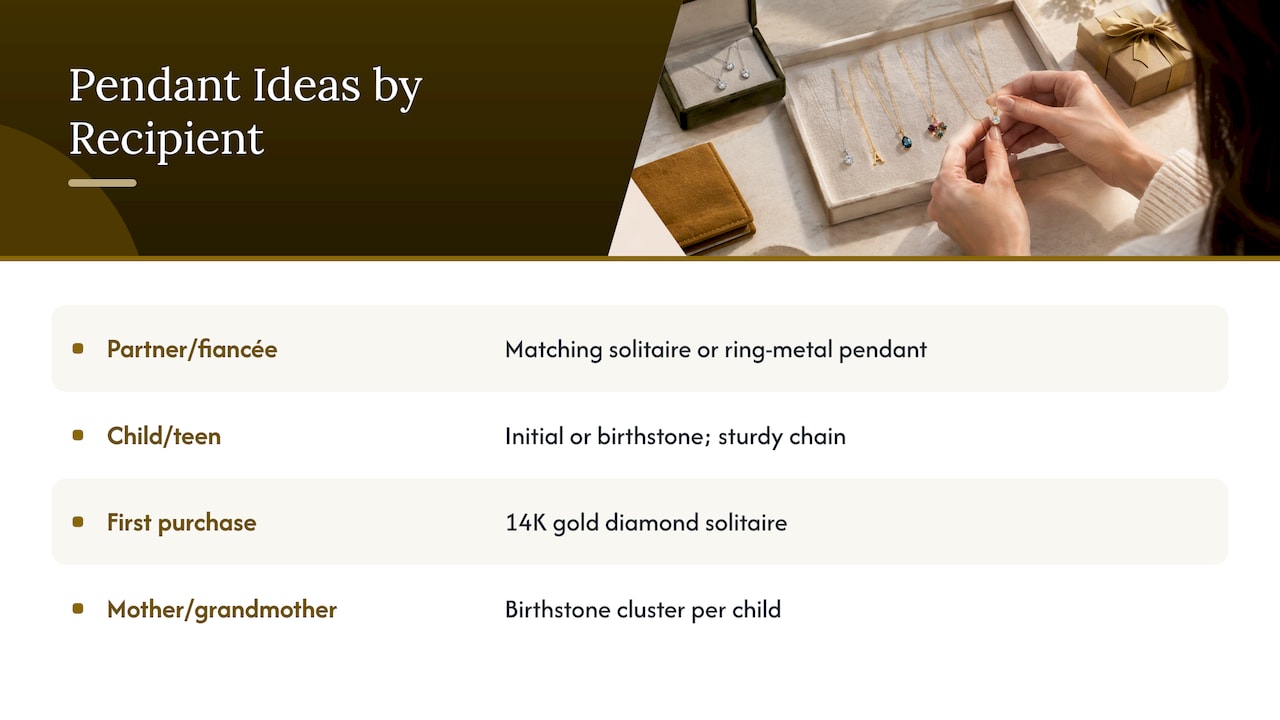
For a partner or fiancée. A diamond solitaire or a gemstone that matches the engagement ring. A pendant in the same metal as her ring ties the two together.
For a child or teen. An initial or a birthstone in a simple bezel setting on a sturdy chain. Solid construction matters because children are rough on jewelry. Our pieces are solid, not hollow or plated. A sterling silver pendant from $46 is a gentle way to start.
For a first fine-jewelry purchase. A small diamond solitaire in 14K gold. It is the piece most likely to be worn every day for years.
For a mother or grandmother. A birthstone cluster for each child or grandchild. Our guide to personalized jewelry gift ideas has more occasion-based suggestions.
Buying with confidence: conflict-free diamonds
If conflict-free stones matter to you, know what the term means. The Kimberley Process is an international initiative to exclude conflict diamonds from the legitimate trade, and it defines them as rough diamonds used by rebel movements to finance conflict. Ask any jeweler how their diamonds are sourced and whether they are natural or lab-grown. At USA Jewels, our diamonds are ethically sourced and certified conflict-free, and we have been a family-owned business since 1999.
Our perspective on pendants
We have been making jewelry as a family since 1999, and pendants are the pieces we see people think about longest. They are rarely bought on impulse. They are bought for a person, a date, a moment.
Because we manufacture in-house and sell direct, we can put the budget where you want it: the stone, the metal, the chain. You choose the diamond shape, the quality and the metal, and you are not paying for middlemen. Every piece is solid, not hollow or plated, so a pendant given to a child or worn every day will hold up.
We also stand behind the diamond itself. Our lifetime diamond upgrade program means a pendant you buy today can grow with the person who wears it. That is the kind of jewelry we want to make: a piece that tells a story and keeps telling it.
Joseph
Start designing your pendant
You can build a pendant from scratch with our Design Your Own Pendant tool, starting at $199, choosing your own diamond shape, quality and metal. If you prefer to see a finished piece, browse our ready-to-ship pendants, or start with a certified loose diamond, which begins at $142. Shipping is free and insured, and every order is covered by our 30-day money-back guarantee.
More than 222 customers have left us Google reviews, and we would be glad to help you with yours. Start on the Design Your Own Diamond Pendant page.
FAQ
What are the most popular custom pendant ideas?
Name and initial pendants, birthstone pendants, diamond solitaires and engraved bars are the most common. Coordinates and meaningful dates are popular for couples. The right pick depends on whether you want the pendant to be subtle or to carry a clear message.
How do I make my own custom pendant?
Choose the message, set a budget, then pick the stone, metal, setting and chain. With our online tool you select each element yourself and see the choices before you order. Custom diamond pendants start at $199.
What chain should I choose for a pendant?
Match the chain to the pendant’s weight. Small, light pendants suit delicate chains, while larger pieces need sturdier links such as cable or rolo. Length changes the look too, so consider where you want the pendant to sit.
Is a pendant a good gift for a child?
Yes. A small initial or birthstone in a low-profile setting on a sturdy chain is practical and meaningful. Sterling silver pieces start at $46, and solid construction helps the piece last through everyday wear.
How do I know a diamond is conflict-free?
Ask the seller about sourcing and whether the stone is natural or lab-grown, and ask for an independent grading report. The Kimberley Process was created to keep conflict diamonds out of legitimate trade. All our diamonds are ethically sourced and certified.
Sources
- Custom Pendants: Buying Guide, International Gem Society
- Personalized Jewelry guide, Fire Mountain Gems
- In the Loupe: Advertising Diamond, Gemstones and Pearls, FTC
- What Is the Kimberley Process?
Recommended
- Design Your Own Custom Jewelry
- Design Your Own Diamond Pendant
- Personalized Jewelry Gift Ideas for Every Occasion
- Design Your Own Engagement Ring: Step-by-Step Guide

Deep Mehta is the Co-Owner of USA Jewels, a family-owned jewelry business she has led since 2013 in Deerfield Beach, Florida. With over 13 years of hands-on experience in fine jewelry retail, manufacturing, and diamond importing, Deep specializes in engagement rings, wedding bands, and custom jewelry design. She also co-manages Kaash Group Talent Acquisition. Deep is a University of Florida graduate and oversees every aspect of USA Jewels’ operations, from product development to marketing.
Fine Jewelry Collection

You May Also Like
Affordable Luxury Jewelry Types: Your 2026 Style Guide
Why Diamond Stud Earrings Are the Best Starter Jewelry