Ring Insurance Cost: What You’ll Pay and How to Lower It
Insuring an engagement ring usually costs about 1% to 2% of its value each year, or roughly $1 to $2 for every $100. NJM’s guide puts a scheduled ring policy in that range. So a $5,000 ring runs about $50 to $100 a year, which is under $9 a month at the top of the range. For most couples that is a small price for covering the ring against loss, theft and damage.
This guide shows the cost at different ring values, what moves the price, how a policy differs from a warranty and what paperwork to gather. If you are designing a ring with us, it also shows how to plan the insurance step so it is easy.
TL;DR
- Expect about 1% to 2% of the ring’s replacement value per year. A $3,000 ring is roughly $30 to $60, and a $10,000 ring is roughly $100 to $200.
- Homeowners and renters policies usually cap jewelry theft at a low limit, often $1,000 to $2,500, so a ring worth more than that needs its own coverage.
- A warranty fixes manufacturing defects. Insurance is what protects against loss, theft and accidental damage.
- You will need a recent appraisal, a photo and your receipt. Gather them when you buy and the policy takes minutes to set up.
Table of Contents
- How much ring insurance costs by ring value
- What changes the price
- Why your homeowners or renters policy probably isn’t enough
- Ring warranty vs. insurance: what each covers
- What you need to get a ring insured
- What insurance usually does not cover
- How to keep the cost down without cutting protection
- Where we fit in: a ring that is easy to insure
- Our view: protect the ring the day you get it
- FAQ
- Sources
How much ring insurance costs by ring value
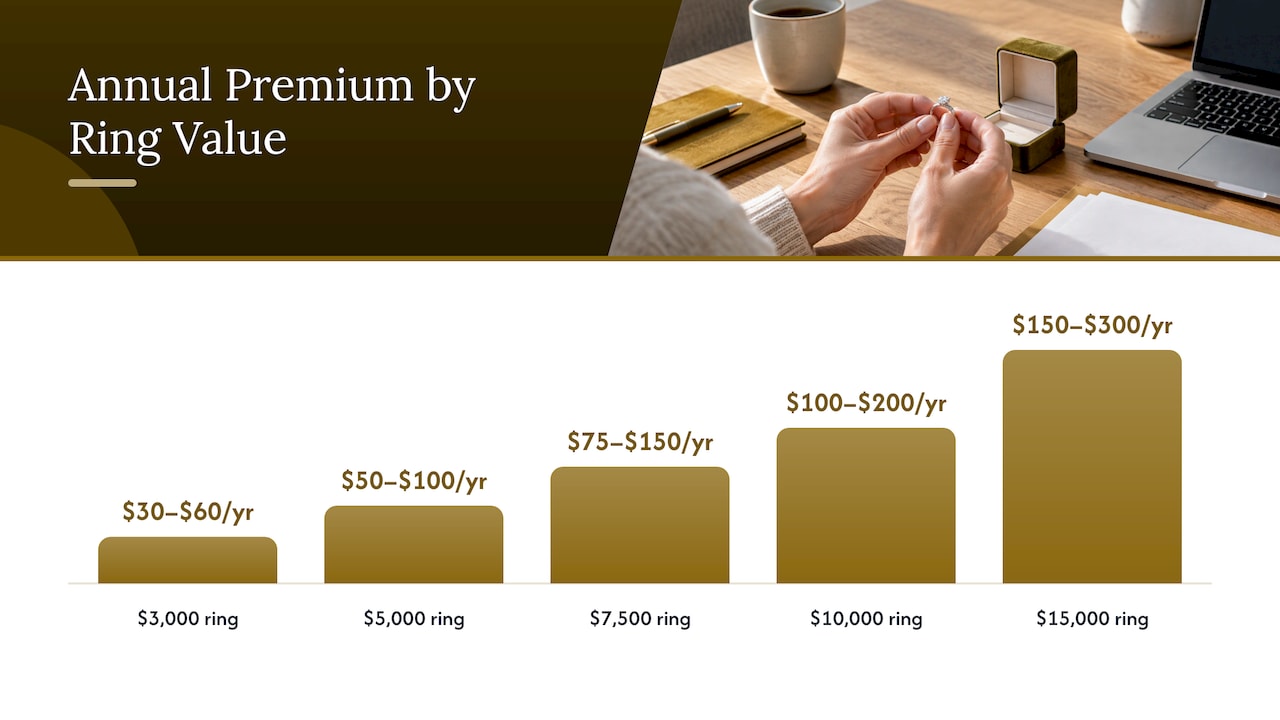
Most insurers price jewelry coverage as a percentage of the amount you insure. That amount is the replacement value, meaning what it would cost to buy a comparable ring today. With a 1% to 2% rate, the math is simple. GEICO’s engagement ring guide lays out the same range, and the table below applies it to common ring values.
| Ring replacement value | Typical annual premium (1% to 2%) | Per month |
|---|---|---|
| $3,000 | $30 to $60 | $2.50 to $5 |
| $5,000 | $50 to $100 | about $4 to $8 |
| $7,500 | $75 to $150 | about $6 to $12.50 |
| $10,000 | $100 to $200 | about $8 to $16.50 |
| $15,000 | $150 to $300 | $12.50 to $25 |
These are typical ranges, not quotes. Your price depends on the insurer, your state, the deductible you choose and the ring itself. Premiums are also reviewed when you renew, so treat the table as a planning tool and get a quote for the exact ring.
One question that comes up often: what about a $50,000 ring? The same math gives roughly $500 to $1,000 a year. The rate stays in a similar band, but at that value insurers may ask for more documentation and security details, so ask for a written quote.
What changes the price
The percentage is a starting point. Five things move your actual premium up or down.
Replacement value
This is the biggest factor, because the rate applies to the value. A ring with a larger or higher-quality center diamond costs more to insure. It also means the amount you insure should match what the ring is really worth today, not what you paid years ago. An outdated appraisal can leave you underinsured.
Type of policy
A scheduled personal property endorsement, sometimes called a rider or floater, adds named items to a homeowners or renters policy. A standalone jewelry policy is a separate contract. Both are priced by value. NJM explains that a scheduled endorsement insures each piece up to the scheduled amount and costs about 1% to 2% of the piece’s value. Standalone policies often advertise low or customizable deductibles and worldwide coverage, which can matter if you travel with the ring.
Deductible
A deductible is the amount you pay before the insurer pays a claim. A higher deductible generally lowers the premium, and a lower one raises it. Some scheduled coverage carries no deductible at all, according to NJM. Ask for quotes at two or three deductible levels and compare the yearly savings with what you could comfortably pay out of pocket.
Where you live
Theft and claim rates vary by area, and insurers price accordingly. Two identical rings can be quoted differently in different ZIP codes. State rules also differ, so always read your own policy rather than relying on a national average.
Ring details and security
The diamond, the metal, the setting and whether the ring is custom all go on the policy. Some insurers also ask whether the ring is kept in a safe at home. Honest, detailed answers prevent surprises at claim time.
Why your homeowners or renters policy probably isn’t enough
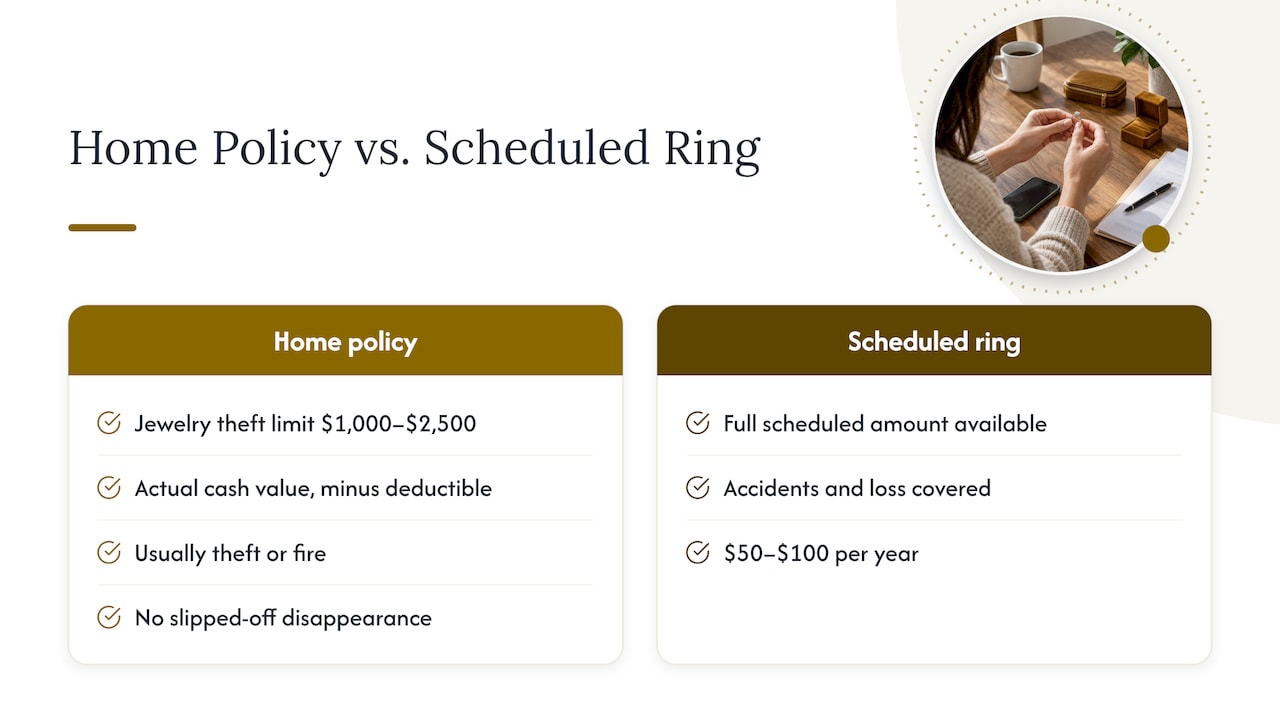
Many people assume a home policy already covers the ring. It does, but only up to a limit. NJM notes that homeowners, condo and renters policies typically include a jewelry theft limit of $1,000 to $2,500. Without a scheduled endorsement, the base policy pays only the actual cash value of the loss, up to that limit, minus your deductible.
Here is what that looks like with a real number. Say your ring is worth $5,000 and it is stolen. If your policy caps jewelry theft at $1,500 and you have a $500 deductible, you could receive about $1,000. Jewelers Mutual describes this same pattern, adding that home policies usually cover theft or a disaster like a fire, but not a ring that slips off your finger and disappears.
Scheduling the ring changes that. Insuring it as a named item means the full scheduled amount is available instead of the low limit, and coverage extends to accidents and loss, not just theft. For a ring that cost more than a month’s rent, spending $50 to $100 a year to close that gap is the practical choice.
Standalone policy or home policy add-on?
Both work. An add-on can be convenient if you already have a home or renters policy you like, and it keeps everything with one company. A standalone jewelry policy can be easier if you move often, rent or want one place to manage several pieces. Get a quote for each, using the same ring value and the same deductible, so you compare like with like.
Ring warranty vs. insurance: what each covers
These two get mixed up, and the difference decides whether you are protected on the day something goes wrong.
A warranty is a promise about workmanship. Jewelers Mutual explains that a ring warranty typically covers repair or replacement for manufacturing defects and may include cleaning, resizing and polishing. It can last anywhere from months to a lifetime. It generally does not cover normal wear and tear, accidents, theft or disappearance.
Insurance covers the events that actually threaten a ring: loss, theft, damage and disappearance. The two are complementary. The warranty keeps the craftsmanship sound, and the policy covers the unexpected.
| Warranty | Insurance | |
|---|---|---|
| Manufacturing defects | Covered | Not the purpose |
| Cleaning, resizing, polishing | May be included | Not covered |
| Accidental damage | Generally not | Covered |
| Theft | Generally not | Covered |
| Loss or disappearance | Generally not | Covered |
| Cost | Often included with purchase or sold as an add-on | Roughly 1% to 2% of value per year |
When you shop, read what the warranty actually includes and for how long, then decide what insurance needs to fill in.
What you need to get a ring insured
Insurers want proof that the ring exists and is worth what you say. NJM lists an up-to-date appraisal, a photograph and the receipt as the usual requirements. Get these together at purchase and you will not be hunting for them later.
- A written appraisal. This is a document from a qualified gemologist describing the carat weight, color, clarity, cut, metal and setting. Our engagement ring appraisal guide explains how the process works and what to look for.
- A clear photograph. Take a few sharp photos from the top and the side. If the diamond has a laser inscription, note the number.
- The receipt or invoice. It documents what you paid and when.
- The diamond’s grading report. A certificate from a recognized lab describes the stone itself. Our diamond certification guide compares GIA, AGS and IGI reports.
Vintage and estate pieces follow the same routine. A ring like this vintage silver ring with a purple stone still needs photos, any paperwork you have and a written valuation before it can be scheduled.
Appraisals go stale. Many insurers prefer one that is recent, and diamond and gold prices change, so a ring appraised years ago may be worth more today than the paper says. Re-appraise every few years and tell your insurer if the value rises. Our jewelry insurance guide covers the ongoing care side.
What insurance usually does not cover
Every policy has exclusions, and knowing them keeps a claim from surprising you. NJM lists these as common for a scheduled endorsement: intentional loss, nuclear hazard, war, insects or vermin, and wear and tear or gradual deterioration. In other words, a policy is for sudden events, not for routine maintenance.
That is why regular care matters. Prongs wear over time, and a loose stone can be lost before any claim could help. Have your ring checked at least once a year, and see our jewelry repair guide for when to fix, resize or restore a piece.
How to keep the cost down without cutting protection
You can trim the premium in sensible ways, and none of them involve covering the ring for less than it is worth.
- Compare deductibles. Raising the deductible lowers the premium. Pick a level you could pay without strain.
- Insure for the right value. Too low and a claim falls short. Too high and you overpay every year. Update after each appraisal.
- Bundle if it saves money. If you already have a home or renters policy, ask for a quote on adding the ring to it and compare it with a standalone policy.
- Keep paperwork organized. Having the appraisal, photos and receipt ready makes quoting and claims faster.
- Set a yearly reminder. Review the value and coverage on your anniversary.
There is also a smarter first step: the ring’s price. Insurance is a percentage of value, and a ring made without retail markup costs less up front and less to insure. Our engagement ring cost guide shows what $3,000 to $7,000 can buy when you skip that markup.
Where we fit in: a ring that is easy to insure
We are a family-owned jewelry company, and we have been making jewelry since 1999. We manufacture in-house and sell direct, which is how we keep prices lower. Our engagement rings start from $346, and you can build your own with a Design Your Own Diamond Ring tool starting from $399, choosing the diamond shape, quality and metal.
Several things about buying from us help when it is time to insure. Our diamonds are certified, so the stone comes with a grading report. Our jewelry is solid, not hollow or plated. Shipping is free and insured, and every order comes with a 30-day money-back guarantee. If you want to see certified stones first, browse our certified loose diamonds, which start from $142.
If you are still choosing, our engagement rings page is the place to start, and our design your own guide walks you through each choice. Planning the whole project? See our engagement ring timeline so the ring, the appraisal and the policy are all in place before the proposal.
Our view: protect the ring the day you get it
We have helped families choose rings for generations, and the same story comes up. People spend weeks picking the stone and the setting, then leave the insurance for later. Later is when something goes wrong.
Our advice is simple. Treat insurance as the last step of buying the ring, not an extra. The cost is small, about 1% to 2% of value a year, and it is the one thing that protects the ring from the events no one plans for.
That is also why we build rings the way we do. Certified diamonds, solid construction and a clear record of what you bought make a ring easy to appraise and easy to schedule. And because we sell direct from our own workshop, the ring costs less to begin with, so the yearly premium is smaller too.
If your ring is ever upgraded, our lifetime diamond upgrade program is something to remember: update your appraisal and your policy at the same time so the coverage always matches the ring on your hand.
Joseph
FAQ
How much does it cost to insure an engagement ring?
Most policies cost about 1% to 2% of the ring’s replacement value per year. A $5,000 ring is typically $50 to $100 a year, and a $10,000 ring is $100 to $200. Your exact price depends on the insurer, your location and the deductible you choose.
Is ring insurance worth it?
For most rings, yes. Home and renters policies usually cap jewelry theft at around $1,000 to $2,500 and may not cover loss or accidental damage. A scheduled policy for a few dollars a month covers the full insured value against those events.
Does my warranty cover the same things as insurance?
No. A warranty typically covers manufacturing defects and may include services like cleaning and resizing. It generally does not cover accidents, theft or disappearance, which is where insurance applies.
Do I need an appraisal to insure a ring?
Usually yes. Insurers commonly ask for an up-to-date appraisal, a photo and the receipt. Keep them together, and refresh the appraisal every few years so the insured value stays accurate.
When should I get the ring insured?
As soon as you own it, and before the proposal if you can. A ring can be lost or stolen at any point, including on the way to the big moment, so have the paperwork ready when the ring arrives.
Sources
- NJM: How To Insure an Engagement or Wedding Ring
- GEICO: Engagement Ring Insurance Guide
- Jewelers Mutual: Engagement Ring Warranty vs. Engagement Ring Insurance
Recommended
- Jewelry Insurance Guide: Protect Your Investment
- $3,000–$7,000 Engagement Rings for U.S. Buyers: Skip Retail Markup, Buy Smarter
- Avoid Deferred Interest on a $5,000 Ring: U.S. Ring Financing
- Engagement Ring Budget Guide

Deep Mehta is the Co-Owner of USA Jewels, a family-owned jewelry business she has led since 2013 in Deerfield Beach, Florida. With over 13 years of hands-on experience in fine jewelry retail, manufacturing, and diamond importing, Deep specializes in engagement rings, wedding bands, and custom jewelry design. She also co-manages Kaash Group Talent Acquisition. Deep is a University of Florida graduate and oversees every aspect of USA Jewels’ operations, from product development to marketing.
Fine Jewelry Collection

You May Also Like
Handcrafted vs. Mass-Produced Children’s Jewelry Guide
Top 5 oradina.com Custom Jewelry Alternatives 2026