AGS vs GIA: What the Difference Means When You Buy a Diamond
For a new diamond purchase, the AGS vs GIA question now has a simple answer: GIA is the lab that grades your stone. AGS Laboratories stopped grading at the end of 2022, and its famous cut research now lives on as an optional add-on to a GIA report called the AGS Ideal Report. So you are not choosing between two labs anymore. You are choosing whether a GIA Excellent cut is enough for you, or whether you also want the extra light performance rating on top.
If you are designing an engagement ring, picking out a first diamond or shopping for a meaningful gift, this guide walks you through what each name means, how the cut grades compare, and what to check on the report before you pay.
TL;DR
- GIA is the independent nonprofit lab that created the 4Cs and the international grading system. It grades the diamond and issues the report.
- AGS Laboratories closed in 2022, and no lab now grades to the AGS standards. Older AGS reports still exist on stones in the resale market.
- AGS Ideal and GIA Excellent are not rival grades. A stone needs a GIA Excellent cut to qualify for the AGS Ideal Report by GIA.
- For most buyers, a GIA report with an Excellent cut grade is the dependable choice. The AGS Ideal rating is a bonus for buyers who want the most scrutiny of light performance.
- Always check that the report number matches the stone, and verify it online with the lab.
Table of Contents
- What AGS and GIA Actually Are
- What Happened to AGS Grading
- AGS Ideal vs GIA Excellent: How the Cut Grades Compare
- Color and Clarity: Is One Lab Stricter?
- What a GIA Report Tells You
- Lab-Grown Diamonds: A Recent Change
- How to Choose: A Simple Decision Path
- How to Verify a Report Before You Pay
- Why We Start From the Stone and the Report
- Design Your Ring With a Diamond You Can Trust
- FAQ
- Sources
What AGS and GIA Actually Are
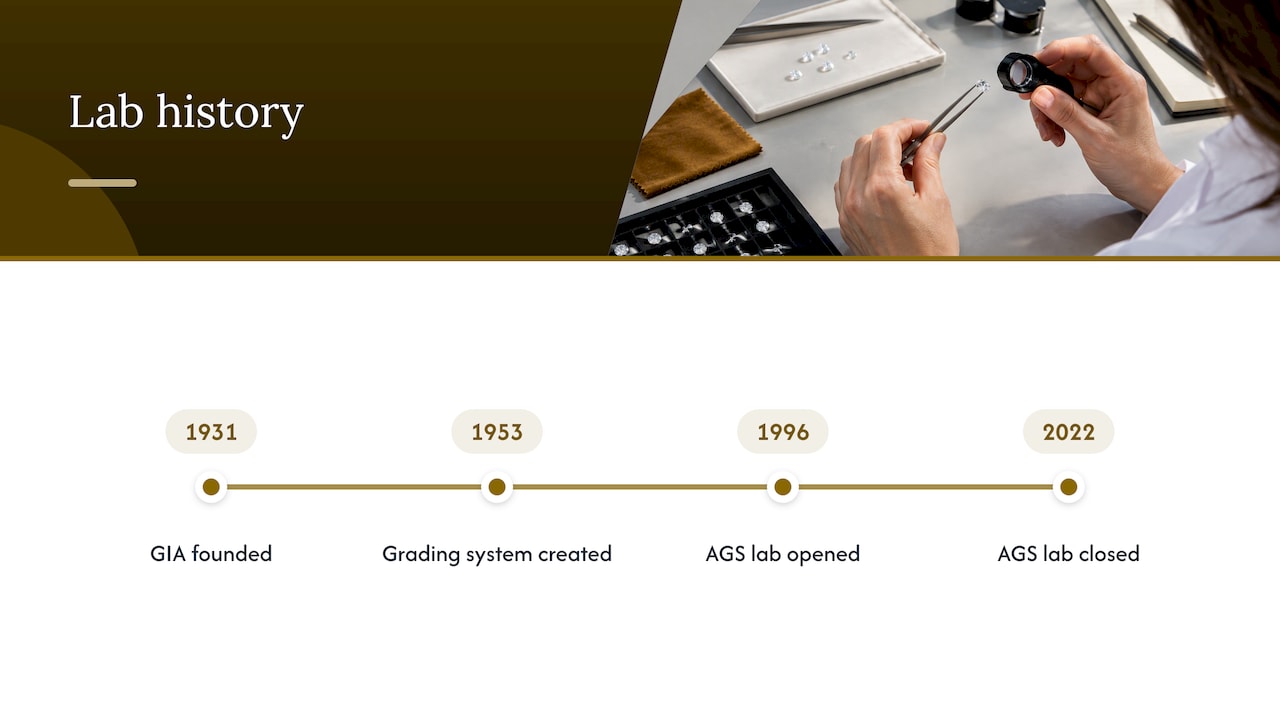
GIA, the Gemological Institute of America, is an independent nonprofit founded in 1931. It invented the 4Cs and created the 1953 International Diamond Grading System, the color, clarity, cut and carat language every jeweler uses today. Because it is a nonprofit that does not sell diamonds, its report works like an independent inspection: someone with no stake in the sale has looked at your stone.
AGS, the American Gem Society, is a sibling organization. Both trace back to the Shipley family in the 1930s. AGS Laboratories, the grading arm, opened in 1996 and became known for one thing in particular: a rigorous cut grading system that rated diamonds from 0 (ideal) to 10.
Here is the part older articles miss. According to the American Gem Society, its laboratory served the industry for 27 years and closed in 2022 so the Society could focus on education and membership. The same page states that no diamond grading laboratory now grades to the AGS Diamond Grading Standards. The AGS Cut Grading System remains the Society’s own.
Why do you still see AGS reports? Diamonds graded before the closure are still sold, resold and insured. If you come across one, it is a legitimate document for that stone, but it is a snapshot from an earlier date, and you cannot get a new one.
What Happened to AGS Grading
In October 2022, GIA announced that AGS Laboratories’ research staff, intellectual property, technology and Las Vegas facility would integrate into GIA. The goal was to carry AGS’s cut research forward under one roof.
The result for shoppers is the AGS Ideal Report by GIA, which launched in January 2023. It is a digital supplement to a GIA report, offered at launch for an additional US$25, with or without an ASET image (a color-coded picture showing how the diamond handles light). GIA’s AGS Ideal Report page has the current details, including whether a printed copy is offered and what it costs. It is not a separate lab or a competing grade. It is an extra layer of information on a GIA-graded stone.
AGS Ideal vs GIA Excellent: How the Cut Grades Compare
Cut is the C that most affects how a diamond sparkles, so this is the comparison people really want.
How GIA grades cut
For standard round brilliant diamonds, GIA gives a cut grade on a five-step scale from Excellent to Poor. Behind that grade are seven components: brightness, fire, scintillation, weight ratio, durability, polish and symmetry. GIA notes that an Excellent grade covers a range of proportion sets and face-up appearances, not one exact formula. So two Excellent diamonds can look slightly different from each other, and both are very well cut.
Want to see how all five levels look in practice? Our guide to GIA’s five cut grades shows what changes at each step.
How AGS Ideal works
The AGS Ideal Report looks at light performance: brightness, fire and contrast from the center of the stone to the edge. American Gem Society’s Director of Gemology, Wade Abel, has explained that the method uses a 3D scan of the diamond and traces virtual rays through its facets to judge how it will look.
A stone earns the top rating, AGS Ideal 0, when it scores zero in brightness, fire and contrast. In plain terms: it stays bright from edge to center, shows lively fire, and spreads its contrast evenly. Only a small percentage of premium stones qualify, per GIA’s page.
The key point: one sits on top of the other
The two grades are not alternatives. To get the AGS Ideal Report, a round brilliant must already have GIA Excellent grades for cut, polish and symmetry. Fancy shapes, such as ovals or pears, need Excellent polish and symmetry. A stone can also hit zero ratings and still not qualify, for example when painting or digging out affects its light performance, GIA says.
So think of it as a ladder. GIA Excellent is a very strong cut. AGS Ideal is a further filter within that group.
| GIA cut grade | AGS Ideal Report by GIA | |
|---|---|---|
| What it is | Part of the main GIA report | Optional digital supplement to a GIA report |
| Scale | Excellent to Poor (five steps) | Light performance ratings; 0 is the top |
| Measures | Seven components, including brightness, fire, scintillation and durability | Brightness, fire and contrast edge to center |
| Who it fits | Every buyer of a GIA-graded round brilliant | Buyers who want the extra assurance of top light performance |
| Shapes | Cut grade for standard round brilliants | Round brilliants and eligible fancy shapes |
Color and Clarity: Is One Lab Stricter?
You will read online that AGS was easier on color or stricter on clarity. Those comparisons came from forum posts and retail blogs, and since AGS no longer grades, they matter mainly if you are looking at an older AGS-graded stone.
What we can say from the lab itself: GIA grades color in a standardized viewing environment and uses independent opinions until enough graders agree. Clarity is graded at 10x magnification, and additional graders or more experienced staff may review the result. That process is a big reason jewelers and insurers treat GIA’s scale as the common yardstick.
The practical lesson: compare diamonds on one lab’s scale at a time. If you are weighing two stones with reports from different labs or different eras, ask for a side-by-side look at the stones themselves rather than trusting letters on paper alone.
What a GIA Report Tells You
A GIA Diamond Grading Report covers shape, color, clarity, cut and carat weight, plus proportions, finish, treatments and a plotted diagram of the stone’s inclusions. For standard round brilliants in D-to-Z color, it adds the cut grade. According to GIA’s guide to reading reports, the report is issued for loose natural diamonds of 0.15 carats or more.
One small wording point: GIA says it does not “certify” diamonds. It grades them and issues reports. “GIA certified” is everyday shorthand, and you will see us and everyone else use it. The report matters because without one, you rely only on the seller’s word.
If you want a walkthrough, our guide on how to read a GIA report takes you through each box. Our GIA certification guide covers what buyers should expect.
What GIA reports cost
You do not pay GIA directly when you buy a stone that is already graded; the cost is built into the diamond. Still, the fee list shows what is involved. GIA’s report comparison page lists approximate costs of $78 for a Diamond Grading Report, $53 for a Diamond Dossier, $48 for an eReport and $20 for a Diamond Focus Report. These are for unmounted stones, and each report type covers a different carat range. Prices change, so check the page for the latest.
Lab-Grown Diamonds: A Recent Change
If you are considering a lab-grown stone, one change matters. Effective October 1, 2025, GIA replaced its D-to-Z lab-grown grading service with the Laboratory-Grown Diamond Quality Assessment, which classifies eligible stones as “Premium” or “Standard.” GIA’s reasoning, announced in June 2025, is that over 95% of lab-grown diamonds fall into a very narrow color and clarity range, so descriptive terms are clearer than natural-diamond letter grades. Existing GIA lab-grown reports remain valid.
So a newer lab-grown stone may show Premium or Standard rather than a G or VS2. That is not a downgrade, just a different vocabulary. For more on the stones themselves, see our lab-grown vs natural diamonds guide, or this lab-grown diamond guide for background on how GIA reports apply to both.
How to Choose: A Simple Decision Path
Here is how we would walk a couple through it.
- Start with a GIA report. It is the recognized standard, it is what many insurers ask for, and every new natural diamond grade comes from it.
- Set your cut floor at Excellent for a round brilliant. This is where most of a diamond’s sparkle comes from, and it is the entry ticket to AGS Ideal.
- Decide if you want the extra rating. If you love the idea of the very top light performance and your budget allows, ask whether the stone carries an AGS Ideal Report. If not, a GIA Excellent stone is still a beautiful, well-made choice.
- Balance the other Cs around cut. Many buyers put budget into cut first, then choose color and clarity levels that look clean to the eye. The cut guide for engagement rings in our diamond cut comparison explains how.
- Match shape to your style. Fancy shapes do not get a GIA cut grade the way rounds do, so look at them in person or in detail photos. Our diamond shapes guide compares each shape.
- Verify the report. See the next section.
How to Verify a Report Before You Pay
Every GIA report has a number, and the stone’s girdle may be laser inscribed with it. Use GIA Report Check to confirm the information against GIA’s database. For reports dated on or after December 19, 2022, it also provides a PDF copy and applicable images and diagrams. Match the carat weight, shape and measurements to the stone in front of you.
Reports are for unmounted stones, and an AGS Ideal Report must be requested while the loose stone is at a GIA lab. That is one more reason many couples choose a diamond first and then set it. You can browse certified loose diamonds that way.
Why We Start From the Stone and the Report
We are a family-owned jeweler with our own in-house manufacturing, and we have been serving customers since 1999. A report is where we begin the conversation because it lets you compare one stone against another on the same terms. When you design a ring with us, you choose the diamond shape, quality and metal, and you can see what each decision does to the price.
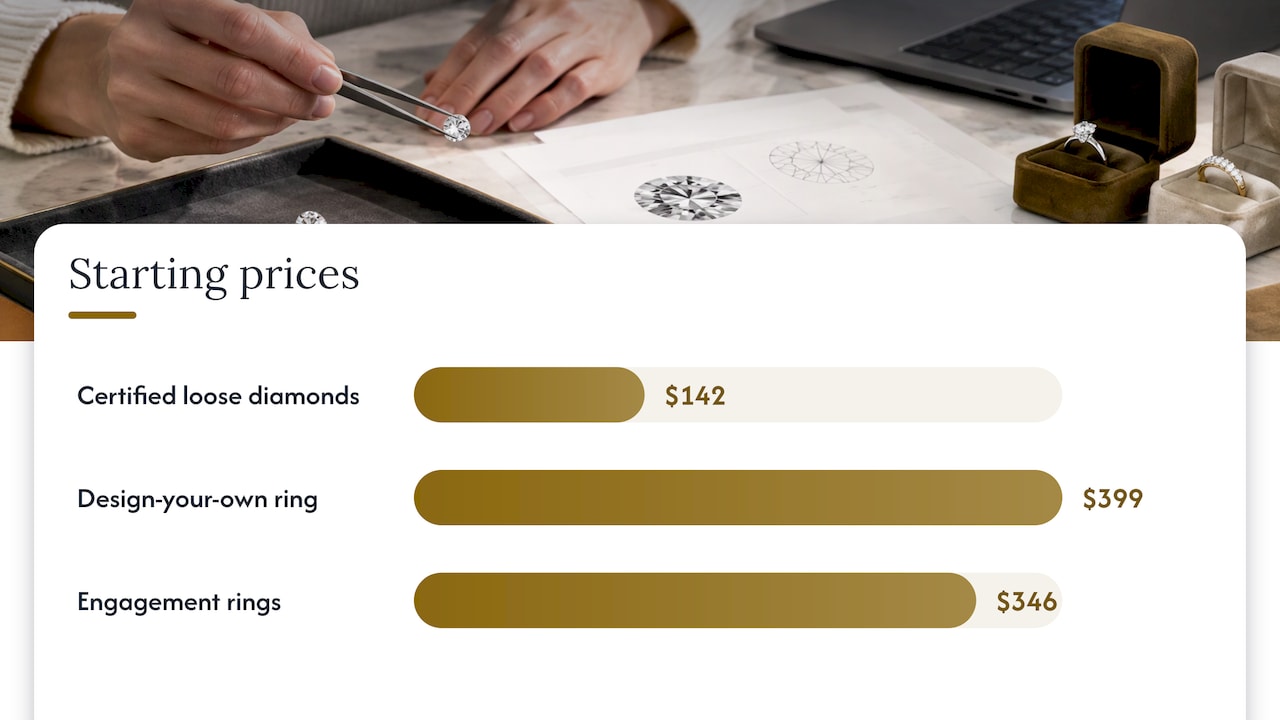
Our certified loose diamonds start from $142, and our Design Your Own Diamond Ring starts from $399. Our engagement rings start from $346. Our step-by-step design guide walks you through the process, and our diamond certification guide compares the major report types.
Our Take on AGS and GIA
When couples sit down with us, the question behind “AGS vs GIA” is almost always the same: “Will this diamond be beautiful, and will I be sure of what I am paying for?” We think a trustworthy report answers the second part, and a good cut answers the first.
That is why we like to keep it simple. Choose a diamond with a strong independent report, aim for an Excellent cut on a round stone, and spend the rest of your budget where your eyes will notice it. The AGS Ideal rating is a lovely extra when a stone has it, and the people at AGS earned their reputation for cut research.
Because we make our jewelry in-house and sell direct, there are no middlemen between you and the stone. Our pieces are solid, not hollow or plated, our diamonds are ethically sourced and conflict-free, and our lifetime diamond upgrade program means your first ring can grow with your story. Shipping is free and insured, and you have 30 days to decide if the piece is right.
That is how we would want our own family to buy a diamond.
Joseph
Design Your Ring With a Diamond You Can Trust
Ready to move from reading to choosing? Our certified loose diamonds, natural and lab-grown, start from $142, and you can pair one with a setting in gold or platinum through our design tool. Every order ships free and insured, with a 30-day money-back guarantee.
Start with our certified loose diamonds, or design your own ring from $399 and choose the shape, quality and metal that fit you.
FAQ
Is AGS better than GIA?
They are no longer competing labs. AGS Laboratories closed in 2022, and GIA took in its cut research. For a new purchase, a GIA report with an Excellent cut is the dependable standard, and the AGS Ideal Report by GIA is an optional extra for eligible stones.
Is AGS Ideal the same as GIA Excellent?
No. GIA Excellent is the top grade on GIA’s five-step cut scale. AGS Ideal is a separate light performance rating that applies only to stones that already have GIA Excellent grades. Think of AGS Ideal as a narrower group within Excellent.
Is an older AGS report still valid?
Yes, for the stone it describes. AGS graded diamonds for 27 years, and those reports remain part of those diamonds’ history. No new AGS laboratory reports are being issued, so compare any older stone against the report details and ask for a close look at the diamond itself.
How can I check that a GIA report is real?
Enter the report number into GIA Report Check. It confirms the information against GIA’s database. Then match the carat weight, shape and measurements to your stone, and look for the report number inscribed on its edge.
Sources
- AGS and GIA Advance Their Common Missions (GIA)
- American Gem Society Laboratories resource page
- GIA 4Cs: Cut
- AGS Ideal Report by GIA
- AGS and GIA Announce Launch of AGS Ideal Report by GIA
- Questions Answered: The AGS Ideal Report
- How GIA Grades Diamonds
- How to Read a GIA Diamond Grading Report
- What is a GIA Diamond? (GIA 4Cs)
- Compare D-to-Z Diamond Grading Reports
- GIA Updated Laboratory-Grown Diamond Services
- GIA New Descriptive Terminology for Laboratory-Grown Diamonds
- GIA Report Check
- Lab-grown diamond guide
Recommended
- GIA Certification Diamonds: What Buyers Need to Know
- Diamond Cut Grades: How GIA’s Five Levels Change What You See
- Diamond Clarity Chart — FL to I3 Grades Explained
- Verify GIA Reports in 2 Minutes: How to Read a GIA Report

Deep Mehta is the Co-Owner of USA Jewels, a family-owned jewelry business she has led since 2013 in Deerfield Beach, Florida. With over 13 years of hands-on experience in fine jewelry retail, manufacturing, and diamond importing, Deep specializes in engagement rings, wedding bands, and custom jewelry design. She also co-manages Kaash Group Talent Acquisition. Deep is a University of Florida graduate and oversees every aspect of USA Jewels’ operations, from product development to marketing.
Fine Jewelry Collection

You May Also Like
10–30 Years or a Lifetime: When to Buy Gold Filled vs Solid Gold
The Average Ring Size for Women (and What to Buy When You’re Not Sure)